


Arabic calligraphy
| Part of a series on |
| Calligraphy |
|---|
 |


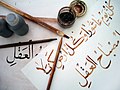
Arabic calligraphy is the artistic practice of handwriting and calligraphy based on the Arabic alphabet. It is known in Arabic as khatt (Arabic: خَطّ), derived from the words 'line', 'design', or 'construction'.[1][2] Kufic is the oldest form of the Arabic script.
From an artistic point of view, Arabic calligraphy has been known and appreciated for its diversity and great potential for development. In fact, it has been linked in Arabic culture to various fields such as religion, art, architecture, education and craftsmanship, which in turn have played an important role in its advancement.[3]
Although most Islamic calligraphy is in Arabic and most Arabic calligraphy is Islamic, the two are not identical. Coptic or other Christian manuscripts in Arabic, for example, have made use of calligraphy. Likewise, there is Islamic calligraphy in Persian and Ottoman Turkish.[4]
Arabic alphabet
[edit]The Arabic alphabet is one of the most widely used scripts in the world. Many scholars believe that the alphabet was created around the 4th century CE.[5] The alphabet consists of 28 letters written from right to left. Each letter can be written in four ways, depending on where the letter is placed in a word. These four locations are also known as initial, medial, final and isolated.
Implements
[edit]The pens used for Arabic calligraphy vary from Latin calligraphy. The tools used for calligraphy are different assortments of pens and calligraphy ink. The most common calligraphy pen used is Qalam.[6]
Khamish pen
[edit]The Khamish pen also known as a reed pen is used by Arab, Turkish, and Iranian calligraphers. The reed of the pen is grown along rivers. Although this pen has been used for over 500 years, preparing the pen is a lengthy process.
Java pen
[edit]The Java pen is known for the tool's hardness and ability to create sharp edges. The pen is good to use for small scripts.
Handam pen
[edit]The Handam pen consists of the same strength that the Java pen has. The pen is good to use for all kinds of scripts.[7]
Celi pen
[edit]The Celi pen is used for large writing in Arabic calligraphy. These pens are made from hardwood and cut and drilled.[8]
Evolution
[edit]Arabic calligraphy evolved from a tool for communication and documentation to an artistic form in the span of 13 centuries, it was also implemented in varius other fields such as mathematics and astronomy. It is a central form of decoration in Islamic art, such as decorative design and architecture. The evolution of Arabic calligraphy lead to the appearance of various scripts, including cursive styles such as Nastaliq and Ruq'ah, and more square, angular styles such as Kufic. The linguistic features of Arabic scripts are shared between all scripts despite differences in styles.[9][better source needed]
Scripts
[edit]Kufic
[edit]
Originally used for inscription on stone and metal, the Kufic style of Arabic calligraphy received its name due to its birth in the city of Kufa, Iraq. This script is one of the oldest scripts used in Arabic and Islamic calligraphy; due to this, the style has undergone many evolutions and changes in its life course, as many attempts were made to perfect it. However, this also led to the development of many different variations of this script, such as the floriated Kufic, square Kufic, knotted Kufic, and many others. This also means there are few distinguishing features of the Kufic script.[10][better source needed]
The Kufic style has been used almost exclusively for Arabic, as opposed to other languages, such as Persian and Urdu, that are written in systems derived from Arabic; a single exception to this is a series of Persian rhymes found on a building in Ghazni from the 11th century.[11]
Naskh
[edit]
Known as the Naskh or Naskhī script, this script is said to have originated from Mecca and Medina.[citation needed] The script is used as a cursive script, for example on papyrus and paper. The origins of the style are debated by scholars, but some believe it initially stemmed from the Thuluth script. One of the main usages for this script was for writing the Holy Quran but it was also used for inscription on metal antiquities, woods and other objects of decorative purpose. The main evolutionary periods for this script were the 3rd and 4th centuries AD, coinciding with the evolution other similar popular styles such as the Rayhani, Thulth, and Muhaqqaq.[10]
Other scripts
[edit]The Thuluth and Nasta'liq and Diwani script are other scripts used for Arabic scripting.
The Thuluth script, used during the medieval times, is known as one of the oldest scripts to exist. The script was used in mosques and for Quranic text due to the appearance of the text.
The Nasta'liq script is used more for Persian than Arabic scripting. Because of the upward slant to the left, the script is seen as different from the other scripts.[12]
The Diwani script was created during the Ottoman era. The lining and lettering of this script creates a sense of closeness when writing. Due to this reason, it is difficult to read since the letters intertwine.[12]

A few other examples:[10]
List of calligraphers
[edit]Some classical calligraphers:
Medieval
[edit]- Ibn Muqla (d. 939/940)
- Ibn al-Bawwab (d. 1022)
- Fakhr-un-Nisa (12th century)
Ottoman era
[edit]- Shaykh Hamdullah (1436–1520)
- Hamid Aytaç (1891-1982)
- Seyyid Kasim Gubari (d. 1624)
- Hâfiz Osman (1642–1698)
- Mustafa Râkim (1757–1826)
- Mehmed Shevki Efendi (1829–1887)
- Al-Kindi(801-873 AD)

Contemporary
[edit]- Hasan Çelebi (b. 1937), Turkey
- Ali Adjalli (b. 1939), Iran
- Wijdan Ali (b. 1939), Jordan
- Hashem Muhammad al-Baghdadi, Iraq
- Everitte Barbee (b. 1988), United States of America
- Mohammad Hosni Syria
- Shakkir Hassan Al Sa'id (1925-2004) in Iraq
- Madiha Omar Iraqi-American
- Hassan Massoudy Iraqi-French (b. 1944)
- Sadequain Naqqash (1930-1987), Pakistan
- Ibrahim el-Salahi (b. 1930), Sudan
- Mouneer Al-Shaarani (b. 1952), Syria
- Mahmoud Taha (b. 1942), Jordan
- Mohamed Zakariya (b. 1942), United States of America
- Uthman Taha (b. 1934), Syria
- Shafiq-Uz-Zaman Khan Pakistan
Legacy
[edit]Type design and type setting
[edit]Arabic calligraphy serves as a major source of inspiration for Arabic type design. For example, the Amiri typeface is inspired by the Naskh script used at the Amiri Press in Cairo.[13]
The shift from Arabic calligraphy to Arabic typefaces presents technical challenges, as Arabic is essentially a cursive script with contextual shapes.[citation needed]
Islamic world and civilization
[edit]Credited to be the one that catalyzed the growth of Arabic calligraphy; with the earliest works of Arabic calligraphy being featured in copies of the Holy Quran dating back to the first century of Islam's revelation such as Birmingham Quran Manuscript,[14] Codex Parisino-Petropolitanus[15] and several others.
Arabic calligraphy can be on occasion be found in places of worship for Muslim's known as Mosques with engravings of Quranic verses / Ayah present on parts of the architecture itself. [16]
The most widely recognized example of Arabic Calligraphy on a place of Islamic worship is the Kaaba present in Mecca, Saudi Arabia.[17]
Arabic calligraphy specializes into the term Islamic calligraphy when it is associated with the Islamic world.
Art
[edit]EL Seed, a French-Tunisian graffiti artist, makes use of Arabic calligraphy in his various art projects, in a style called calligraffiti.[18]
The Hurufiyya (الحروفية letters) movement, since its beginnings in the early 20th century, uses the artistic manipulation of Arabic calligraphy and typography in abstraction.[19]
Taking Shape: Abstraction From the Arab World, 1950s-1980s, a 2020 installation at New York University's Grey Art Gallery, explored how Arabic calligraphy, with its ancient presence in visual art, influenced abstract art in the Arab world.[20] For Madiha Omar, the Arabic alphabet was a means of expressing a secular identity and appropriating Western painting, while Omar El-Nagdi explored the inherent divinity of Arabic calligraphy.[20]
Modern examples
[edit]-
 The Emirates logo is written in traditional Arabic calligraphy
 -
-
 The official logo of the Saudi Tourism website that translates to "Visit Saudi".
 -
 Logo of the Saudi National Center for Archives and Records
 -
 Logo of Al Jazeera Media Network


See also
[edit]References
[edit]- ^ Julia Kaestle (10 July 2010). "Arabic calligraphy as a typographic exercise".
- ^ Stefan Widany (June 2011). The History of Arabic Calligraphy: An Essay on Its Greatest Artists and Its Development. GRIN Verlag. ISBN 978-3-640-93875-9.
- ^ Afā, ʻUmar.; افا، عمر. (2007). al-Khaṭṭ al-Maghribī : tārīkh wa-wāqiʻ wa-āfāq. Maghrāwī, Muḥammad., مغراوي، محمد. (al-Ṭabʻah 1 ed.). al-Dār al-Bayḍāʼ: Wizārat al-Awqāf wa-al-Shuʼūn al-Islāmīyah. ISBN 978-9981-59-129-5. OCLC 191880956.
- ^ "History - Persian Calligraphy- All about Persian Calligraphy". persiancalligraphy.org. Archived from the original on 2015-09-04. Retrieved 2021-03-17.
- ^ "Arabic alphabet | Chart, Letters, & Calligraphy". 22 June 2023.
- ^ "Lettering Pens – Huge overview". 2018-05-15. Retrieved 2019-04-25.
- ^ "The Handam Pen". Arabic Calligraphy Supplies.
- ^ "The Celi Pen". Arabic Calligraphy Supplies.
- ^ "IJISSH". www.ijissh.org. Retrieved 2024-09-21.
- ^ a b c "أنواع الخطوط وأشكالها المختلفة". بيانات (in Arabic). Retrieved 2024-09-21.
- ^ Schimmel & Rivolta 1992, p. 6.
- ^ a b "Arabic Writing and Scripts: A Brief Guide | Shutterstock". 24 July 2014.
- ^ Hosny, Khaled (2012). "The Amiri typeface" (PDF). TUGboat. 33: 12. Archived (PDF) from the original on 2022-10-09.
- ^ "'Oldest' Koran fragments found in Birmingham University". BBC News. 2015-07-21. Retrieved 2024-09-21.
- ^ Coran.
- ^ "The Importance of Calligraphy in Islamic Art- Calligraphy". 2023-04-14. Retrieved 2024-10-04.
- ^ Ankit. "Home - Kabaa Kiswah". Retrieved 2024-10-04.
- ^ PopTech (2011), eL Seed: The Art of Calligraffiti, retrieved 2020-02-24
- ^ "NYU Grey Art Gallery Spotlights Pioneers of Arab Art". 2020-02-07. Archived from the original on 2022-10-06. Retrieved 2020-02-25.
- ^ a b Heinrich, Will (2020-02-20). "How the Arabic Alphabet Inspired Abstract Art". The New York Times. ISSN 0362-4331. Retrieved 2020-02-24.
Bibliography
[edit]- Schimmel, Annemarie; Rivolta, Barbara (1992). Islamic Calligraphy. Brill Archive.
External links
[edit] Media related to Arabic calligraphy at Wikimedia Commons

Arabic language | |||||||||||||||||||||||||||||||||||||
|---|---|---|---|---|---|---|---|---|---|---|---|---|---|---|---|---|---|---|---|---|---|---|---|---|---|---|---|---|---|---|---|---|---|---|---|---|---|
| Overviews | |||||||||||||||||||||||||||||||||||||
| Scripts | |||||||||||||||||||||||||||||||||||||
| Letters | |||||||||||||||||||||||||||||||||||||
| Varieties |
| ||||||||||||||||||||||||||||||||||||
| Academic | |||||||||||||||||||||||||||||||||||||
| Linguistics | |||||||||||||||||||||||||||||||||||||
| Calligraphy · Script | |||||||||||||||||||||||||||||||||||||
| Technical |
| ||||||||||||||||||||||||||||||||||||
| Other |
| ||||||||||||||||||||||||||||||||||||
| |||||||||||||||||||||||||||||||||||||

| Styles |
|  | ||||||||
|---|---|---|---|---|---|---|---|---|---|---|
| Objects | ||||||||||
| Calligraphers | ||||||||||
| ||||||||||
| Organizations | ||||||||||
| Influences | ||||||||||
Part of Islamic arts | ||||||||||
| Architecture |
| .jpeg) | |||||||||||
|---|---|---|---|---|---|---|---|---|---|---|---|---|---|
| Arts |
| ||||||||||||
| Arts of the book |
| ||||||||||||
| Decoration |
| ||||||||||||
| The garden | |||||||||||||
| Museums, collections |
| ||||||||||||
| Exhibitions | |||||||||||||
| Principles, influences | |||||||||||||

.jpg)