


Cashew
| Cashew | |
|---|---|

| |
| Ripe fruit and attached drupe, which contains the edible seed | |
Scientific classification 
| |
| Kingdom: | Plantae |
| Clade: | Tracheophytes |
| Clade: | Angiosperms |
| Clade: | Eudicots |
| Clade: | Rosids |
| Order: | Sapindales |
| Family: | Anacardiaceae |
| Genus: | Anacardium |
| Species: | A. occidentale
|
| Binomial name | |
| Anacardium occidentale | |

Cashew is the common name of a tropical evergreen tree Anacardium occidentale, in the family Anacardiaceae. It is native to South America and is the source of the cashew nut and the cashew apple, an accessory fruit. The tree can grow as tall as 14 metres (46 feet), but the dwarf cultivars, growing up to 6 m (20 ft), prove more profitable, with earlier maturity and greater yields. The cashew nut is edible and is eaten on its own as a snack, used in recipes, or processed into cashew cheese or cashew butter. The nut is often simply called a 'cashew'. Cashew can cause allergies triggered by the proteins found in the nuts.
In 2019, four million tonnes of cashew nuts were produced globally, with Ivory Coast and India the leading producers. As well as the nut and fruit, the plant has several other uses. The shell of the cashew seed yields derivatives that can be used in many applications including lubricants, waterproofing, paints, and, starting in World War II, arms production.[1][full citation needed] The cashew apple is a light reddish to yellow fruit, whose pulp and juice can be processed into a sweet, astringent fruit drink or fermented and distilled into liquor.
Description[edit]
The cashew tree is large and evergreen, growing to 14 metres (46 feet) tall, with a short, often irregularly shaped trunk.[2] The leaves are spirally arranged, leathery textured, elliptic to obovate, 4–22 centimetres (1+1⁄2–8+3⁄4 inches) long and 2–15 cm (3⁄4–6 in) broad, with smooth margins. The flowers are produced in a panicle or corymb up to 26 cm (10 in) long; each flower is small, pale green at first, then turning reddish, with five slender, acute petals 7–15 millimetres (1⁄4–5⁄8 in) long. The largest cashew tree in the world covers an area around 7,500 m2 (81,000 sq ft) and is located in Natal, Brazil.[citation needed]
The fruit of the cashew tree is an accessory fruit (sometimes called a pseudocarp or false fruit).[3][4] What appears to be the fruit is an oval or pear-shaped structure, a hypocarpium, that develops from the pedicel and the receptacle of the cashew flower.[5][6][2] Called the cashew apple, better known in Central America as marañón, it ripens into a yellow or red structure about 5–11 cm (2–4+1⁄4 in) long.[3][6]
The true fruit of the cashew tree is a kidney-shaped or boxing glove-shaped drupe that grows at the end of the cashew apple.[3] The drupe first develops on the tree and then the pedicel expands to become the cashew apple.[3] The drupe becomes the true fruit, a single shell-encased seed, which is often considered a nut in the culinary sense.[3][6][7] The seed is surrounded by a double shell that contains an allergenic phenolic resin,[6] anacardic acid—which is a potent skin irritant[2] chemically related to the better-known and also toxic allergenic oil urushiol, which is found in the related poison ivy and lacquer tree.
-
 Botanical illustration
 -
 Tree in Mozambique, southeastern Africa
 -
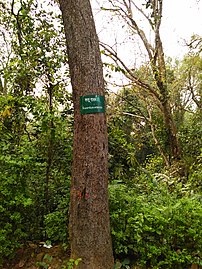 Trunk in Bangladesh
 -
 Flowers
 -
 Pollen grains of Cashew tree
 -
 Young fruits
 -
 Fruits sold as produce


.jpg)


Etymology[edit]
The English name derives from the Portuguese name for the fruit of the cashew tree: caju (Portuguese pronunciation: [kaˈʒu]), also known as acaju, which itself is from the Tupi word acajú, literally meaning "nut that produces itself".[3][4]
The generic name Anacardium is composed of the Greek prefix ana- (ἀνά-, aná, 'up, upward'), the Greek cardia (καρδία, kardía, 'heart'), and the Neo-Latin suffix -ium. It possibly refers to the heart shape of the fruit,[8] to "the top of the fruit stem"[9] or to the seed.[10] The word anacardium was earlier used to refer to Semecarpus anacardium (the marking nut tree) before Carl Linnaeus transferred it to the cashew; both plants are in the same family.[11] The epithet occidentale derives from the Western (or Occidental) world.[12]
The plant has diverse common names in various languages among its wide distribution range,[4] including anacardier (French) with the fruit referred to as pomme de cajou,[13] caju (Portuguese pronunciation: [kaˈʒu]), or acaju (Portuguese).[3][4]
Distribution and habitat[edit]
The species is native to tropical South America[14] and later was distributed around the world in the 1500s by Portuguese explorers.[3][15][6] Portuguese colonists in Brazil began exporting cashew nuts as early as the 1550s.[16] The Portuguese took it to Goa, formerly Estado da Índia Portuguesa in India, between 1560 and 1565. From there, it spread throughout Southeast Asia and eventually Africa.[citation needed]
Cultivation[edit]
| Cashew production (with shell) 2021 | |
|---|---|
| Country | Production (tonnes) |
 Côte d'Ivoire Côte d'Ivoire |
837,850 |
 India India |
738,000 |
 Vietnam Vietnam |
348,504 |
 Philippines Philippines |
255,931 |
 Tanzania Tanzania |
210,786 |
| World | 3,708,153 |
| Source: FAOSTAT of the United Nations[17] | |
The cashew tree is cultivated in the tropics between 25°N and 25°S, and is well-adapted to hot lowland areas with a pronounced dry season, where the mango and tamarind trees also thrive.[18] The traditional cashew tree is tall (up to 14 m) and takes three years from planting before it starts production, and eight years before economic harvests can begin.[citation needed]
More recent breeds, such as the dwarf cashew trees, are up to 6 m (20 ft) tall, and start producing after the first year, with economic yields after three years. The cashew nut yields for the traditional tree are about 0.25 metric tons per hectare, in contrast to over a ton per hectare for the dwarf variety. Grafting and other modern tree management technologies are used to further improve and sustain cashew nut yields in commercial orchards.[citation needed]
Production[edit]
In 2021, global production of cashew nuts (as the kernel) was 3.7 million tonnes, led by Ivory Coast and India with a combined 43% of the world total (table).
Trade[edit]
The top ten exporters of cashew nuts (in-shell; HS Code 080131) in value (USD) in 2021 were Ghana, Tanzania, Guinea-Bissau, Nigeria, Ivory Coast, Burkina Faso, Senegal, Indonesia, United Arab Emirates (UAE), and Guinea.
| 2017 | 2018 | 2019 | 2020 | 2021 | |
|---|---|---|---|---|---|
| World | 2.8B | 2.8B | 1.9B | 2.0B | 1.3B |
| Ghana | 253.2M | 455.7M | 222.6M | 340.7M | 172.7M |
| Tanzania | 530.0M | 426.8M | 221.4M | 362.0M | 159.0M |
| Guinea-Bissau | 318.0M | 129.0M | 122.8M | 128.5M | 143.6M |
| Nigeria | 69.3M | 191.1M | 74.5M | 94.4M | 138.8M |
| Ivory Coast | 1.0B | 1.1B | 730.8M | 612.0M | 129.7M |
| Burkina Faso | 144.8M | 198.9M | 81.0M | 53.3M | 96.0M |
| Senegal | 3.4M | 33.2M | 60.5M | 38.6M | 92.3M |
| Indonesia | 112.7M | 84.4M | 121.0M | 102.4M | 70.7M |
| UAE | 103.1K | 74.5M | 586.3K | 3.4M | 55.2M |
| Guinea | 161.6M | 41.2M | 45.2M | 35.7M | 53.1M |
| Source:[19] | |||||
From 2017 to 2021, the top ten exporters of cashew nuts (shelled; HS Code 080132) were Vietnam, India, the Netherlands, Germany, Brazil, Ivory Coast, Nigeria, Indonesia, Burkina Faso, and the United States.
In 2014, rapid growth of cashew cultivation in Ivory Coast made this country the top African exporter.[20] Fluctuations in world market prices, poor working conditions, and low pay for local harvesting have caused discontent in the cashew nut industry.[21][22][23] Almost all cashews produced in Africa between 2000 and 2019 were exported as raw nuts which are much less profitable than shelled nuts.[24] One of the goals of the African Cashew Alliance is to promote Africa's cashew processing capabilities to improve the profitability of Africa's cashew industry.[25]
| 2017 | 2018 | 2019 | 2020 | 2021 | |
|---|---|---|---|---|---|
| World | 5.5B | 5.1B | 4.7B | 4.5B | 4.2B |
| Vietnam | 3.4B | 3.2B | 3.0B | 2.9B | 2.7B |
| India | 959.9M | 673.6M | 569.6M | 407.9M | 437.8M |
| Netherlands | 302.8M | 304.3M | 248.3M | 266.0M | 281.8M |
| Germany | 168.1M | 179.8M | 174.5M | 202.3M | 183.2M |
| Brazil | 114.2M | 117.0M | 121.3M | 91.0M | 96.8M |
| Ivory Coast | 73.2M | 97.1M | 68.4M | 110.4M | 81.8M |
| Nigeria | 12.0M | 20.2M | 37.3M | 20.1M | 45.0M |
| Indonesia | 60.2M | 55.6M | 57.0M | 45.7M | 40.7M |
| Burkina Faso | 12.1M | 13.8M | 18.9M | 16.3M | 21.6M |
| United States | 33.5M | 26.3M | 22.7M | 21.1M | 19.8M |
| Source:[26] | |||||
Toxicity[edit]
Some people are allergic to cashews, but they are a less frequent allergen than other tree nuts or peanuts.[27] For up to 6% of children and 3% of adults, consuming cashews may cause allergic reactions, ranging from mild discomfort to life-threatening anaphylaxis.[28][29][30][31] These allergies are triggered by the proteins found in tree nuts, and cooking often does not remove or change these proteins.[32] Reactions to cashew and tree nuts can also occur as a consequence of hidden nut ingredients or traces of nuts that may inadvertently be introduced during food processing, handling, or manufacturing.[29][30]
The shell of the cashew nut contains oil compounds that can cause contact dermatitis similar to poison ivy, primarily resulting from the phenolic lipids, anacardic acid, and cardanol.[6][33] Because it can cause dermatitis, cashews are typically not sold in the shell to consumers.[34] Readily and inexpensively extracted from the waste shells, cardanol is under research for its potential applications in nanomaterials and biotechnology.[35]
Uses[edit]
Nutrition[edit]
| Nutritional value per 100 g (3.5 oz) | |
|---|---|
| Energy | 553 kcal (2,310 kJ) |
30.19 g | |
| Starch | 23.49 g |
| Sugars | 5.91 g 0.00 g |
| Dietary fiber | 3.3 g |
43.85 g | |
| Saturated | 7.783 g |
| Monounsaturated | 23.797 g |
| Polyunsaturated | 7.845 g |
18.22 g | |
| Vitamins | Quantity %DV† |
| Vitamin A | 0 IU |
| Thiamine (B1) | 35% 0.423 mg |
| Riboflavin (B2) | 4% 0.058 mg |
| Niacin (B3) | 7% 1.062 mg |
| Pantothenic acid (B5) | 17% 0.86 mg |
| Vitamin B6 | 25% 0.417 mg |
| Folate (B9) | 6% 25 μg |
| Vitamin B12 | 0% 0 μg |
| Vitamin C | 1% 0.5 mg |
| Vitamin D | 0% 0 μg |
| Vitamin E | 6% 0.90 mg |
| Vitamin K | 28% 34.1 μg |
| Minerals | Quantity %DV† |
| Calcium | 3% 37 mg |
| Copper | 244% 2.2 mg |
| Iron | 37% 6.68 mg |
| Magnesium | 70% 292 mg |
| Manganese | 72% 1.66 mg |
| Phosphorus | 47% 593 mg |
| Potassium | 22% 660 mg |
| Selenium | 36% 19.9 μg |
| Zinc | 53% 5.78 mg |
| Other constituents | Quantity |
| Water | 5.20 g |
| †Percentages estimated using US recommendations for adults,[36] except for potassium, which is estimated based on expert recommendation from the National Academies.[37] | |
Raw cashews are 5% water, 30% carbohydrates, 44% fat, and 18% protein (table). In a 100-gram reference amount, raw cashews provide 553 kilocalories, 67% of the Daily Value (DV) in total fats, 36% DV of protein, 13% DV of dietary fiber and 11% DV of carbohydrates.[38] Cashews are rich sources (20% or more of the DV) of dietary minerals, including particularly copper, manganese, phosphorus, and magnesium (79–110% DV), and of thiamin, vitamin B6 and vitamin K (32–37% DV).[38] Iron, potassium, zinc, and selenium are present in significant content (14–61% DV) (table).[38] Cashews (100 g, raw) contain 113 milligrams (1.74 gr) of beta-sitosterol.[38]
Nut and shell[edit]

Culinary uses for cashew seeds in snacking and cooking are similar to those for all tree seeds called nuts.[3][6]
Cashews are commonly used in South Asian cuisine, whole for garnishing sweets or curries, or ground into a paste[6] that forms a base of sauces for curries (e.g., korma), or some sweets (e.g., kaju barfi). It is also used in powdered form in the preparation of several Indian sweets and desserts. In Goan cuisine, both roasted and raw kernels are used whole for making curries and sweets. Cashews are also used in Thai and Chinese cuisines, generally in whole form. In the Philippines, cashew is a known product of Antipolo, and is eaten with suman. The province of Pampanga also has a sweet dessert called turrones de casuy, which is cashew marzipan wrapped in white wafers. In Indonesia, roasted and salted cashews are called kacang mete or kacang mede, while the cashew apple is called jambu monyet (lit. ‘monkey rose apple’).[citation needed]
In the 21st century, cashew cultivation increased in several African countries to meet the demands for manufacturing cashew milk, a plant milk alternative to dairy milk.[39] In Mozambique, bolo polana is a cake prepared using powdered cashews and mashed potatoes as the main ingredients. This dessert is common in South Africa.[40]
-
 Women shelling cashews in Burkina Faso, West Africa
 -
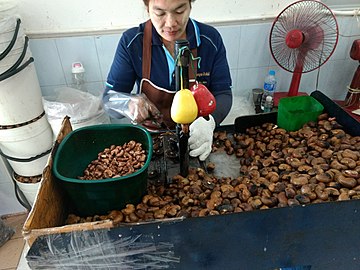 A woman using a machine to shell cashews in Thailand, wearing gloves to protect against contact dermatitis
 -
 Salted, roasted cashew nuts
 -
 Cashew sprouts are eaten raw or cooked


Husk[edit]
The cashew nut kernel has a slight curvature and two cotyledons, each representing around 20–25% of the weight of the nut. It is encased in a reddish-brown membrane called a husk, which accounts for approximately 5% of the total nut. Cashew nut husk is used in emerging industrial applications, such as an adsorbent, composites, biopolymers, dyes and enzyme synthesis.[41]
Apple[edit]
The mature cashew apple can be eaten fresh, cooked in curries, or fermented into vinegar, citric acid[42] or an alcoholic drink.[6] It is also used to make preserves, chutneys and jams in some countries, such as India and Brazil.[6] In many countries, particularly in South America, the cashew apple is used to flavor drinks, both alcoholic and nonalcoholic.[3][2]
In Brazil, cashew fruit juice and the fruit pulp are used in the production of sweets, juice, mixed with alcoholic beverages such as cachaça, and as a flour, milk, or cheese.[43] In Panama, the cashew fruit is cooked with water and sugar for a prolonged time to make a sweet, brown, paste-like dessert called dulce de marañón (marañón being a Spanish name for cashew).[44]
Cashew nuts are more widely traded than cashew apples, because the fruit, unlike the nut, is easily bruised and has a very limited shelf life.[45] Cashew apple juice, however, may be used for manufacturing blended juices.[45]
When the apple is consumed, its astringency is sometimes removed by steaming the fruit for five minutes before washing it in cold water. Steeping the fruit in boiling salt water for five minutes also reduces the astringency.[46]
In Cambodia, where the plant is usually grown as an ornamental rather than an economic tree, the fruit is a delicacy and is eaten with salt.[13]
Alcohol[edit]
In the Indian state of Goa, the ripened cashew apples are mashed, and the juice, called "neero", is extracted and kept for fermentation[6] for a few days. This fermented juice then undergoes a double distillation process. The resulting beverage is called feni or fenny. Feni is about 40–42% alcohol (80–84 proof). The single-distilled version is called urrak, which is about 15% alcohol (30 proof).[47] In Tanzania, the cashew apple (bibo in Swahili) is dried and reconstituted with water and fermented, then distilled to make a strong liquor called gongo.[48]
-
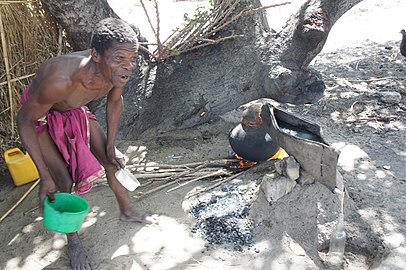 Distilling cashew apple liquor (muchekele) in Mozambique, southeastern Africa
 -
 cashew apples spread for drying and subsequent storage prior to reconstitution in water and later fermentation, Mozambique


Nut oil[edit]
Cashew nut oil is a dark yellow oil derived from pressing the cashew nuts (typically from lower value broken chunks created accidentally during processing), and is used for cooking or as a salad dressing. The highest quality oil is produced from a single cold pressing.[49]
Shell oil[edit]
Cashew nutshell liquid (CNSL) or cashew shell oil (CAS registry number 8007-24-7) is a natural resin with a yellowish sheen found in the honeycomb structure of the cashew nutshell, and is a byproduct of processing cashew nuts. As it is a strong irritant, it should not be confused with the edible cashew nut oil. It is dangerous to handle in small-scale processing of the shells, but is itself a raw material with multiple uses.[35] It is used in tropical folk medicine and for anti-termite treatment of timber.[50] Its composition varies depending on how it is processed.
- Cold, solvent-extracted CNSL is mostly composed of anacardic acids (70%),[51] cardol (18%) and cardanol (5%).[35][52]
- Heating CNSL decarboxylates the anacardic acids, producing a technical grade of CNSL that is rich in cardanol. Distillation of this material gives distilled, technical CNSL containing 78% cardanol and 8% cardol (cardol has one more hydroxyl group than cardanol).[52] This process also reduces the degree of thermal polymerization of the unsaturated alkyl-phenols present in CNSL.
- Anacardic acid is also used in the chemical industry for the production of cardanol, which is used for resins, coatings, and frictional materials.[51][52]
These substances are skin allergens, like lacquer and the oils of poison ivy, and they present a danger during manual cashew processing.[50]
This natural oil phenol has interesting chemical structural features that can be modified to create a wide spectrum of biobased monomers. These capitalize on the chemically versatile construct, which contains three functional groups: the aromatic ring, the hydroxyl group, and the double bonds in the flanking alkyl chain. These include polyols, which have recently seen increased demand for their biobased origin and key chemical attributes such as high reactivity, range of functionalities, reduction in blowing agents, and naturally occurring fire retardant properties in the field of rigid polyurethanes, aided by their inherent phenolic structure and larger number of reactive units per unit mass.[35]
CNSL may be used as a resin for carbon composite products.[53] CNSL-based novolac is another versatile industrial monomer deriving from cardanol typically used as a reticulating agent for epoxy matrices in composite applications providing good thermal and mechanical properties to the final composite material.[citation needed]
Animal feed[edit]
Discarded cashew nuts unfit for human consumption, alongside the residues of oil extraction from cashew kernels, can be fed to livestock. Animals can also eat the leaves of cashew trees.[54]
Other uses[edit]
As well as the nut and fruit, the plant has several other uses. In Cambodia, the bark gives a yellow dye, the timber is used in boat-making, and for house-boards, and the wood makes excellent charcoal.[13] The shells yield a black oil used as a preservative and water-proofing agent in varnishes, cements, and as a lubricant or timber seal.[6] Timber is used to manufacture furniture, boats, packing crates, and charcoal.[6] Its juice turns black on exposure to air, providing an indelible ink.[6]
See also[edit]
- List of culinary nuts
- Semecarpus anacardium (the Oriental Anacardium), a native of India and closely related to the cashew
References[edit]
- ^ Jostock, "Cashew Industry", p. 5.
- ^ a b c d "Cashew". Encyclopedia Britannica. 7 April 2020. Retrieved 8 May 2021.
- ^ a b c d e f g h i j Morton, Julia F. (1987). Cashew apple, Anacardium occidentale L.; In: Fruits of Warm Climates. Center for New Crops and Plant Products, Department of Horticulture and Landscape Architecture, Purdue University, W. Lafayette, Indiana. pp. 239–240. ISBN 978-0-9610184-1-2. Archived from the original on 15 March 2007. Retrieved 18 March 2007.
- ^ a b c d "Anacardium occidentale (cashew nut)". CABI. 20 November 2019. Retrieved 8 May 2021.
- ^ Varghese, T.; Pundir, Y. (1964). "Anatomy of the pseudocarp in Anacardium occidentale L.". Proceedings of the Indian Academy of Sciences, Section B. 59 (5): 252–258. doi:10.1007/BF03052341. S2CID 83230755.
- ^ a b c d e f g h i j k l m n James A Duke (1983). "Anacardium occidentale L." Handbook of Energy Crops. (unpublished); In: NewCROP, New Crop Resource Online Program, Center for New Crops and Plant Products, Purdue University. Retrieved 10 December 2019.
- ^ Kapinga, F. A.; Kasuga, L. J. F.; Kafiriti, E. M. "Growth and production of cashew nut" (PDF). Soils, Plant Growth and Crop Production. Encyclopedia of Life Support Systems. Retrieved 9 April 2021.
- ^ Quattrocchi, Umberto (2016). World Dictionary of Medicinal and Poisonous Plants. CRC. p. 266. ISBN 978-1-4822-5064-0.
referring to the shape of the fruit
- ^ Merriam-Webster: "from the heartlike shape of the top of the fruit stem"
- ^ George Milbry Gould (1898). An Illustrated Dictionary of Medicine, Biology and Allied Sciences: Including the Pronunciation, Accentuation, Derivation, and Definition of the Terms Used in Medicine, Anatomy, Surgery ... P. Blakiston. p. 73.
ἀνά, up; καρδία, the heart, from its heart-shaped seeds
- ^ Hugh F. Glen (2004). What's in a Name. Jacana. p. 3. ISBN 978-1-77009-040-8.
(Greek ana = upwards + kardia = heart); applied by 16th century apothecaries to the fruit of the marking nut, Semecarpus anacardium, and later used by Linnaeus as a generic name for the cashew.
- ^ "Occidental". The Free Dictionary. 2020. Retrieved 6 March 2020.
- ^ a b c Pauline Dy Phon (2000). Plants Utilised In Cambodia/Plantes utilisées au Cambodge. Phnom Penh: Imprimerie Olympic. p. 34.
- ^ "Anacardium occidentale L." Plants of the Word Online. Royal Botanic Gardens Kew. Retrieved 31 March 2024.
- ^ "Cashew". Department of Horticulture, Cornell University. 20 October 2015. Retrieved 16 March 2019.
- ^ Carolyn Joystick, "Cashew Industry" in Encyclopedia of Latin American History and Culture, vol. 2, p. 5. New York: Charles Scribner's Sons 1996.
- ^ "Cashew production in 2021; pick lists from world regions/production quantity". FAOSTAT of the UN. 2023. Retrieved 29 April 2023.
- ^ "Cultivating Cashew Nuts". ARC-Institute for Tropical and Subtropical Crops, South Africa. Archived from the original on 21 February 2015. Retrieved 15 February 2015.
- ^ "2022 Raw Cashew Nut global market overview today". Tridge.
- ^ Bavier, Joe (29 October 2014). "War-scarred Ivory Coast aims to conquer the world of cashews". Reuters. Archived from the original on 23 January 2015. Retrieved 9 February 2015.
- ^ "Tanzania riots over cashew nut payments". BBC. 24 April 2013. Archived from the original on 21 May 2013. Retrieved 14 May 2013.
- ^ Lamble L. (2 November 2013). "Cashew nut workers suffer 'appalling' conditions as global slump dents profits". The Guardian. Retrieved 6 September 2015.
- ^ Wilson B. (4 May 2015). "'Blood cashews': the toxic truth about your favourite nut". The Telegraph. Retrieved 6 September 2015.
- ^ Nelle, Patrick (28 February 2022). "Can Africa cash in on its cashew nut domination?". How we made it in Africa. Retrieved 27 November 2023.
- ^ Nigeria, Guardian (29 September 2023). "ACA seeks creation of cashew development fund to enhance raw nuts processing in Africa". The Guardian Nigeria News - Nigeria and World News. Retrieved 27 November 2023.
- ^ "2022 Cashew Nut Kernel global market overview today". Tridge.
- ^ Rosen, T.; Fordice, D. B. (April 1994). "Cashew Nut Dermatitis". Southern Medical Journal. 87 (4): 543–546. doi:10.1097/00007611-199404000-00026. PMID 8153790.
- ^ Weinberger, Tamar; Sicherer, Scott (2018). "Current perspectives on tree nut allergy: a review". Journal of Asthma and Allergy. 11: 41–51. doi:10.2147/jaa.s141636. ISSN 1178-6965. PMC 5875412. PMID 29618933.
- ^ a b McWilliam V.; Koplin J.; Lodge C.; Tang M.; Dharmage S.; Allen K. (2015). "The prevalence of tree nut allergy: a systematic review". Current Allergy and Asthma Reports. 15 (9): 555. doi:10.1007/s11882-015-0555-8. PMID 26233427. S2CID 36209553.
- ^ a b "Cashew Allergies". Informall Database – funded by European Union. 2010. Archived from the original on 29 October 2010.
- ^ "Food allergies" (PDF). World Health Organization, International Food Safety Authorities Network. 2006.
- ^ "Cashew - allergy information (InformAll: Communicating about Food Allergies - University of Manchester)". research.bmh.manchester.ac.uk. Retrieved 14 September 2022.
- ^ Rosen T.; Fordice, D. B. (1994). "Cashew nut dermatitis". South Med J. 87 (4): 543–46. doi:10.1097/00007611-199404000-00026. PMID 8153790.
- ^ "Why Cashews Aren't Sold In The Shell". Moment of Science, Indiana Public Media. 6 September 2013. Archived from the original on 20 February 2016. Retrieved 22 February 2016.
- ^ a b c d Hamad F. B.; Mubofu E. B. (2015). "Potential biological applications of bio-based anacardic acids and their derivatives". Int J Mol Sci. 16 (4): 8569–90. doi:10.3390/ijms16048569. PMC 4425097. PMID 25894225.
- ^ United States Food and Drug Administration (2024). "Daily Value on the Nutrition and Supplement Facts Labels". Retrieved 28 March 2024.
- ^ National Academies of Sciences, Engineering, and Medicine; Health and Medicine Division; Food and Nutrition Board; Committee to Review the Dietary Reference Intakes for Sodium and Potassium (2019). Oria, Maria; Harrison, Meghan; Stallings, Virginia A. (eds.). Dietary Reference Intakes for Sodium and Potassium. The National Academies Collection: Reports funded by National Institutes of Health. Washington, DC: National Academies Press (US). ISBN 978-0-309-48834-1. PMID 30844154.
- ^ a b c d "Full Report (All Nutrients): 12087, Nuts, cashew nuts, raw, database version SR 27". Agricultural Research Service – United States Department of Agriculture. 2015. Archived from the original on 18 August 2015. Retrieved 6 August 2015.
- ^ Osborn M (26 August 2015). "Access to Market Data and Supply Chain Visibility offer Economic Boost to Ghana Cashew Farmers". Consumer Goods Technology. Archived from the original on 4 June 2016. Retrieved 11 May 2016.
- ^ Phillippa Cheifitz (2009). South Africa Eats. Quivertree Publications. ISBN 9780981428727. OCLC 519442115.
- ^ Khalid Zafeer, Mohd.; Subrahmanya Bhat, K. (1 January 2023). "Valorisation of agro-waste cashew nut husk (Testa) for different value-added products". Sustainable Chemistry for Climate Action. 2: 100014. doi:10.1016/j.scca.2023.100014. ISSN 2772-8269.
- ^ Africa, Nigeria (17 July 2022). "How Nigeria can turn its huge cashew waste into valuable citric acid". Moneyweb. Retrieved 17 July 2022.
- ^ Edi Souza (28 July 2018). "It's cashew time at the fair and on the plate (translated)" (in Portuguese). Folha de Pernambuco. Archived from the original on 21 August 2018. Retrieved 21 August 2018.
- ^ O, Odalys (15 October 2011). "Dulces de mi campiña, Panamá: Dulce de Marañón". Dulces de mi campiña, Panamá. Retrieved 22 September 2021.
- ^ a b Strom, Stephanie (8 August 2014). "Cashew Juice, the Apple of Pepsi's Eye". The New York Times. ISSN 0362-4331. Retrieved 24 November 2015.
- ^ Azam-Ali and Judge (2004). Small-scale cashew nut processing (PDF). FAO, United Nations. Archived (PDF) from the original on 15 February 2017. Retrieved 3 June 2017.
- ^ "Cashew Drink Stages". www.goaonline.in. Retrieved 7 April 2021.
- ^ "Eating in Tanzania". Lonely Planet. Archived from the original on 15 August 2019. Retrieved 8 October 2021.
- ^ "Cashew Oil". Smart Kitchen. Archived from the original on 6 October 2014. Retrieved 15 February 2015.
- ^ a b Clay, Jason (March 2004). World Agriculture and the Environment: A Commodity-By-Commodity Guide To Impacts And Practices. Island Press. p. 268. ISBN 978-1-55963-370-3.
- ^ a b Alexander H. Tullo (8 September 2008). "A Nutty Chemical". Chemical and Engineering News. 86 (36): 26–27. doi:10.1021/cen-v086n033.p026.
- ^ a b c "Exposure and Use Data for Cashew Nut Shell Liquid" (PDF). United States Environmental Protection Agency. Archived from the original (PDF) on 12 May 2013. Retrieved 12 January 2012.
- ^ Ferri, Enrico (22 May 2011). "Bioresins Derived from Cashew Nutshell Oil". MaterialsToday. Archived from the original on 10 September 2015. Retrieved 7 September 2011.
- ^ Heuzé, V.; Tran, G.; Hassoun, P.; Bastianelli, D.; Lebas, F. (2017). "Cashew (Anacardium occidentale) nuts and by-products". Feedipedia. Retrieved 16 January 2023.
External links[edit]
 Media related to Anacardium occidentale at Wikimedia Commons

