


École Polytechnique Fédérale de Lausanne
 EPFL campus | |
| Type | Public research university |
|---|---|
| Established | 1969[1] |
| Budget | 1.142 billion CHF (2022)[2] |
| President | Martin Vetterli[3] |
Academic staff | 372 professors 3,713 (other academic staff) (2023)[4] |
Administrative staff | 2,445 (2023)[3] |
| Students | 13,445 (2023)[5] |
| Undergraduates | 6,940 (2023)[5] |
| Postgraduates | 6,505 (2023)[5] |
| Location | , 46°31′13″N 6°33′56″E / 46.52028°N 6.56556°E |
| Campus | Urban, 136 acres (55.0 ha) |
| Language | English, French |
| Nationalities | 130+ |
| University Press | Dimensions |
| Colours | Swiss red[6] |
| Affiliations | AUF, CESAER, EUA, EuroTech, RESCIF and TIME |
| Website | epfl.ch |
 | |
The École Polytechnique Fédérale de Lausanne (EPFL) is a public research university in Lausanne, Switzerland. Founded in 1969 with the mission to "train talented engineers in Switzerland" and inspired by the École Centrale Paris, EPFL has placed itself as a leading research university specializing in science, technology, engineering and mathematics.
Like its sister institution ETH Zurich, EPFL is part of the Swiss Federal Institutes of Technology Domain[7] which groups several universities and research institutes under the Federal Department of Economic Affairs, Education and Research.[8] As of 2023, EPFL enrolled 13,445 students from over 130 countries.
EPFL has an urban campus that extends alongside Lake Geneva, and includes the EPFL Innovation Park as well as university research centers and affiliated laboratories.
History
[edit]

The roots of modern-day EPFL can be traced back to the foundation of a private school under the name École spéciale de Lausanne in 1853 at the initiative of Lois Rivier, a graduate of the École Centrale Paris and John Gay, the then professor and rector of the Académie de Lausanne. At its inception it had only 11 students and the offices was located at Rue du Valentin in Lausanne.
In 1869, it became the technical department of the Académie de Lausanne. When the Académie was reorganized and acquired the status of a university in 1890, the technical faculty changed its name to École d'ingénieurs de l'Université de Lausanne. In 1946, it was renamed the École polytechnique de l'Université de Lausanne (EPUL). In 1969, the EPUL was separated from the rest of the University of Lausanne and became a federal institute under its current name. EPFL, like ETH Zurich, is thus directly controlled by the Swiss Federal Council.
In contrast, all other universities in Switzerland are controlled by their respective cantonal governments. Following the nomination of Patrick Aebischer as president in 2000, EPFL has started to develop into the field of life sciences. It absorbed the Swiss Institute for Experimental Cancer Research (ISREC) in 2008.[9]
In 1946, there were 360 students at EPFL. In 1969, the university had grown to 1,400 students and 55 faculty members.
In the past two decades, EPFL has grown rapidly in reputation and size. As of 2023, EPFL has more than 13,000 full-time students.
The environment at modern day EPFL is highly international with the school attracting students and researchers from all over the world. More than 125 countries are represented on the campus and the university has two official languages, French and English.
Academics
[edit]Admission
[edit]Holders of a Swiss "maturité gymnasiale" are directly accepted with no other condition in the first year of their Bachelor's program of choice.
Holders of a Swiss Professional "Maturité" or a Swiss specialised "Maturité" are accepted in the Cours de mathématiques spéciales within the places available.
As such, EPFL is not selective in its undergraduate admission procedure for Swiss residents.
However, international students are required to have a final grade average of 80% or above of the maximum grade of the upper secondary school national system.
| Swiss Federal Institutes of Technology (ETH) Domain | ||||||||
|---|---|---|---|---|---|---|---|---|
 | ||||||||
| Ordinary budget 2024 (CHF Mio.) [10] | ||||||||
|
||||||||
| Federal institutes of technology | ||||||||
|
||||||||
| Federal research institutes | ||||||||
|
||||||||
The real selection process happens during the first year of undergraduate studies. This period is called the propaedeutic cycle and the students must pass a block examination of all the courses taken during the first year at the end of the cycle.
If the weighted average is insufficient, a student is required to retake the entire first year of coursework if they wish to continue their studies at EPFL. Roughly 60% of students fail the first year at EPFL all majors combined, and many choose to drop out rather than to repeat the propaedeutic cycle.[11]
The failure rate differs between majors, it is higher for Life Sciences Engineering, Physics, Mathematics and Electrical Engineering where only 30–40% of students pass the first year.
For foreign students, the selection procedure towards the undergraduate program is rather strict, and since most undergraduate courses are taught in French, foreign students must provide documentation of having acquired a level B2 proficiency in French as measured on the CEFR scale, though C1 proficiency is recommended.
The usual time till graduation is six semesters (3 years) for the Bachelor of Science degree and four additional semesters (2 years) for the Master of Science degree with the final semester dedicated to writing a thesis. Though only 58% of the students who manage to graduate are able to graduate within this time-period.[11]
The possibility to study abroad for one or two semesters is offered during the 3rd year of studies as EPFL maintains several long-standing student exchange programs, such as the junior year engineering and science program with Carnegie Mellon University in the United States, as well as a graduate Aeronautics and Aerospace program with the ISAE in France.
Entrepreneurship is actively encouraged at EPFL, as evident by the EPFL Innovation Park being an integral part of the campus. Since 1997, 12 start-ups have been created per year on average by EPFL students and faculty. In the year 2013, a total of 105 million CHF was raised by EPFL start-ups.[12]
Rankings
[edit]| University rankings | |
|---|---|
| Ecole polytechnique fédérale de Lausanne | |
| Global – Overall | |
| ARWU World[13] | 54 (2023) |
| QS World[14] | 26 (2025) |
| Reuters World[15] | 12 (2018) |
| RUR World[16] | 19 (2023) |
| THE World[17] | 33 (2024) |
In 2023, the QS World University Rankings ranks EPFL 16th worldwide across all fields, and among the 10 best universities in several engineering disciplines. Times Higher Education ranks EPFL as the world's 19th best school in the world for Engineering and Technology.[18][19]
EPFL typically scores high on faculty to student ratio, international outlook and scientific impact. The CWTS Leiden Ranking[20] that "aims to provide highly accurate measurements of the scientific impact of universities" ranks EPFL world 13th, and 1st in Europe in the 2013 rankings for all the sciences.
The Times 100 Under 50 Rankings is a ranking of the top 100 universities in the world under 50 years old. Since EPFL in its current form was formed in 1969, it is included in this ranking, and was ranked 1st in the world for three years in a row in 2015,[21] 2016 [22][23] and 2017,[24] and 2nd in the world in 2018 and 2019.[23][24][25][26]
Times Higher Education also ranked EPFL as the most international university in the world two years in a row 2014[27] and 2015.[28]
Campus
[edit]

The École d'ingénieurs de l'Université de Lausanne, from which EPFL in its modern-day form originates, was located in the center of Lausanne. In 1974, five years after EPFL was separated from University of Lausanne and became a federal institute under its current name, the construction of a new campus at Dorigny in Écublens, began. The inauguration of the first EPFL buildings of the new campus took place in 1978.
The EPFL campus has been evolving ever since. The first stage of development, with a total budget of 462 million Swiss francs, was completed in 1984; the second in 1990.
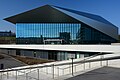
Construction of the northern parts of campus began in 1995 with the Microtechnology building (BM), completed in 1998, and the architecture building (SG), completed in 2000. In 2002, the department of architecture also moved to the campus in Écublens, uniting all departments of EPFL on the same site. The latest addition to the EPFL campus is the Rolex Learning Center completed in February 2010. The Rolex Learning Center is the main campus library and includes areas for work, leisure and services and is located at the center of the campus. The campus has also been expanded with the construction of the SwissTech Convention Center inaugurated in March 2014. As of 2022, RTS began the construction of a regional production center on campus in collaboration with EPFL.[29]
Together with the University of Lausanne, EPFL forms a vast campus complex at the shores of Lake Geneva with about 20,000 students combined.
The campus is served by the Lausanne Metro Line 1 (M1) and is equipped with an electric bicycle sharing system.[30] Since 2012, only electricity from certified hydroelectric generation is being bought by EPFL to power its campus. The university was the first campus to receive the International Sustainable Campus Excellence Award by the International Sustainable Campus Network.[31]
Of the 14,000 people that work and study at the École Polytechnique Fédérale de Lausanne campus, roughly 9.300 are students in either Bachelor, Master or Doctoral programs, the remaining 4,700 being administrative staff, scientists, technical staff, professors and the entrepreneurs located in the Science Park EPFL7. More than 125 nationalities are represented on campus with 48% of the student population being foreign nationals.[32]
Almost all of the structures are on its main campus. However, it also has branches in Neuchâtel ("Microcity"), in Sion ("Pôle EPFL Valais"),[33] in Geneva (Campus Biotech, including the Wyss Center for Bio- and Neuro-engineering) and in Fribourg ("Smart Living Lab"). There was also a research centre in Ras al-Khaimah (United Arab Emirates), EPFL Middle East, between 2009 and 2022.[34]

Buildings
[edit]The campus consists of about 65 buildings on 136 acres (55 ha). Built according to the growth of the school, the campus includes different types of architectures:
- Late 1970s–1980s: modularised building, used today by the Schools of Basic Sciences and Architecture, Civil and Environmental Engineering, Mechanical and Electrical Engineering
- 1990s: buildings with institutes from the Schools of Engineering Sciences and Techniques, Computer and Communication Sciences, and the Scientific Park (PSE)
- Modern: new buildings (2002–2004) with Microengineering, Communications and Architecture institutes, the School of Life Sciences and the College of Management.
- The Rolex Learning Center, a new library (2010)
- 2014: The SwissTech Convention Center and the "Quartier Nord" (convention center, student accommodation, shops...)
- The EPFL-Pavilions building (previously Artlab), designed by Japanese architect Kengo Kuma, was opened in November 2016; it includes three spaces opened to the public. The first one hosts archives from the Montreux Jazz Festival; the second is a space for museum experimentations. The third space, named DataSquare, hosts an exposition on Big data, illustrated by two scientific projects from EPFL: the Human Brain Project and the Venice Time Machine.
- Museums: Musée Bolo, Archizoom (EPFL).
The EPFL and the University of Lausanne also share an active sports centre five minutes away from EPFL, on the shores of Lake Geneva.[35]
Associated campuses
[edit]
Beyond its main campus, EPFL operates a network of associated campuses in Western Switzerland, often sharing these spaces with partner academic institutions and hospitals:
- Fribourg: Smart Living Lab[36]
- Neuchâtel: Microcity[37]
- Geneva: Campus Biotech[38][39]
- Sion: EPFL Valais/Wallis[40]
Language Centre
[edit]The Language Centre offers language and communication modules for French, German, Italian and English (CEFR levels A1 to C2)[41] to enable learners to participate more effectively in academic, professional and social situations in an internationalized multilingual and multicultural context. These modules are reserved for EPFL students, staff members and for their spouses.[42]
Tandems are also organized and set up within the framework of the Tandem Program of the Faculty of Arts/EFLE of the University of Lausanne. This concept includes two people of different first languages meeting regularly to teach each other their respective language.[43]
Students and traditions
[edit]Student body
[edit]The number of students attending studying at EPFL has been rising heavily since EPFL was formed in 1969 under its current name. In 1969 EPFL had roughly 1400 students; that number had grown to 2367 by 1982, 4302 by 1997, 9921 students in 2014, and 10,536 students at the end of 2016.[44] Within the student body, 112 different nationalities are represented. In the period from 1982 to 2014 the female proportion of the student body has increased from 12% to 27%. The proportion of female students is lowest at the School of Computer Science and Communication (15%) and highest at the School of Life Sciences (49%).[45]
Clubs
[edit]
The school encourages the formation of associations and sports activities on campus. As of 2023, there are nearly a hundred clubs and associations on campus for recreational and social purposes.[46] In addition, the school has its own monthly newspaper, Flash. Included in the 79 associations are
- AGEPoly is the Student's Association. Its purpose is to represent the EPFL's students, defend the general interests of the students and inform and consult its members on decisions of the EPFL Direction that concern them.[47]
- The Forum is a student association responsible for organization of the Forum EPFL. The Forum was founded in 1982 as a platform for exchange and meeting between the academic and professional communities. Today, it is one of the largest recruiting events in Europe, and the largest in Switzerland.[48]
- UNIPOLY is the EPFL Association for Ecology, the Association works to create awareness of ecology on campus and in western Switzerland. UNIPOLY is part of the World Student Community for Sustainable Development, an international network of student organizations for sustainable development consisting of EPFL, ETH Zurich, MIT, University of Tokyo, University of Fort Hare, University of Nairobi, Chalmers, and University of Yaounde.[49]
- The Anime and Manga club, PolyJapan, schedules viewings of seasonal anime on a regular basis.
- Polympiads is promoting mathematics and informatics through competitions. They organise the Helvetic Coding Contest, Switzerland's biggest programming competition.[50]
Music festivals
[edit]Several music festivals are held yearly. The largest one is the Balélec Festival, organized in May each year since 1981.[51] The festival welcomes 15,000 visitors to around 30 concerts.[52][53][54]
Archimedean Oath
[edit]EPFL was the birthplace of the Archimedean Oath, proposed by students in 1990.[55] The Archimedean Oath has since spread to a number of European engineering schools. The Archimedean Oath is an ethical code of practice for engineers and technicians, similar to the Hippocratic Oath used in the medical world.
Harassment and sexism
[edit]In 2020, the student association Polyquity published numerous testimonies from students via an Instagram account @payetonepfl denouncing cases of sexual, homophobic and racist harassment as well as cases of rape within the associations present on campus but also within the teaching staff.[56] The student association denounces serious failings of the institution that is supposed to manage harassment.[57]
Scientific partners
[edit]
- EPFL is the official scientific advisor of Alinghi, twice winners of the America's cup 2003 and 2007.
- Solar Impulse is a Swiss long-range solar powered aircraft project developed at EPFL, the project has now achieved the first circumnavigation of the world using only solar power.
- The Hydroptère, is an experimental sailing hydrofoil that in 2009 broke the world speed sailing record, sustaining a speed of 52.86 knots (97.90 km/h; 60.83 mph) for 500m in 30 knots of wind[58]
- EPFL contributed to the construction of SwissCube-1.[59] It is the first satellite entirely built in Switzerland. It was put into orbit on 23 September 2009 by the Indian launcher PSLV.
- To better understand the relationship between nutrition and the brain, EPFL and the Nestlé research center has signed a five-year agreement providing 5 million CHF each year for the creation of two new chairs at the EPFL Brain Mind Institute.
- Logitech and EPFL has announced the creation of the EPFL Logitech Incubator that will provide financial, educational and operational support in entrepreneurship to researchers and students.
- Breitling Orbiter 3 became the first balloon to circumnavigate the Earth non-stop in March 1999. The balloon was piloted by Bertrand Piccard and Brian Jones.
- Solar Impulse 2 completed the first circumnavigation of the Earth by a piloted fixed-wing aircraft using only solar power. The plane was piloted (alternatively) by André Borschberg and Bertrand Piccard.
- The Human Brain Project is the successor of the EPFL Blue Brain Project. The project is directed by EPFL and involves 86 institutions across Europe. The total cost is estimated at 1.190 billion euros.[60]
- EPFL has hosted the UNESCO Chair in Technologies for Development since 2007, where notable papers are presented by experts in the field. In 2014, Mobile Financial Services in Disaster Relief: Modeling Sustainability was presented by technology analyst, David Garrity.[61]
Schools & Colleges
[edit]


EPFL is organised into eight schools and colleges, themselves formed of institutes that group research units (laboratories or chairs) around common themes:
- School of Basic Sciences (SB, Paul Joseph Dyson)
- Institute of Mathematics (MATH, Victor Panaretos)
- Institute of Chemical Sciences and Engineering (ISIC, Emsley Lyndon)
- Institute of Physics (IPHYS, Harald Brune)
- European Centre of Atomic and Molecular Computations (CECAM, Ignacio Pagonabarraga Mora)
- Bernoulli Center (CIB, Nicolas Monod)
- Biomedical Imaging Research Center (CIBM, Rolf Gruetter)
- Interdisciplinary Center for Electron Microscopy (CIME, Cécile Hébert)
- Max Planck-EPFL Centre for Molecular Nanosciences and Technology (CMNT, Thomas Rizzo)
- Swiss Plasma Center (SPC, Ambrogio Fasoli)
- Laboratory of Astrophysics (LASTRO, Jean-Paul Kneib)
- School of Engineering (STI, Ali Sayed)
- Institute of Electrical Engineering (IEL, Giovanni De Micheli[62])
- Institute of Mechanical Engineering (IGM, Thomas Gmür[63])
- Institute of Materials (IMX, Michaud Véronique[64])
- Institute of Microengineering (IMT, Olivier Martin[65])
- Institute of Bioengineering (IBI, Matthias Lütolf[66])
- School of Architecture, Civil and Environmental Engineering (ENAC, Claudia R. Binder)
- Institute of Architecture
- Civil Engineering Institute
- Environmental Engineering Institute
- School of Computer and Communication Sciences (IC, Rüdiger Urbanke)
- Algorithms & Theoretical Computer Science
- Artificial Intelligence & Machine Learning
- Computational Biology
- Computer Architecture & Integrated Systems
- Data Management & Information Retrieval
- Graphics & Vision
- Human-Computer Interaction
- Information & Communication Theory
- Networking
- Programming Languages & Formal Methods
- Security & Cryptography
- Signal & Image Processing
- Systems
- School of Life Sciences (SV, Andrew Oates)
- Bachelor-Master Teaching Section in Life Sciences and Technologies (SSV)
- Brain Mind Institute (BMI, Carmen Sandi)
- Institute of Bioengineering (IBI, Melody Swartz)
- Swiss Institute for Experimental Cancer Research (ISREC, Douglas Hanahan)
- Global Health Institute (GHI, Bruno Lemaitre)
- Ten Technology Platforms & Core Facilities (PTECH)
- Center for Phenogenomics (CPG)
- NCCR Synaptic Bases of Mental Diseases (NCCR-SYNAPSY)
- College of Management of Technology (CDM)
- Swiss Finance Institute at EPFL (CDM-SFI, Damir Filipovic)
- Section of Management of Technology and Entrepreneurship (CDM-PMTE, Daniel Kuhn)
- Institute of Technology and Public Policy (CDM-ITPP, Matthias Finger)
- Institute of Management of Technology and Entrepreneurship (CDM-MTEI, Ralf Seifert)
- Section of Financial Engineering (CDM-IF, Julien Hugonnier)
- College of Humanities (CDH, Thomas David)
- Human and social sciences teaching program (CDH-SHS, Thomas David)
In addition to the eight schools there are seven closely related institutions:
- Swiss Cancer Centre
- Center for Biomedical Imaging (CIBM)
- Centre for Advanced Modelling Science (CADMOS)
- École cantonale d'art de Lausanne (ECAL)
- Campus Biotech
- Wyss Center for Bio- and Neuro-engineering
- Swiss National Supercomputing Centre
Notable people
[edit]Presidents
[edit]The school had directors from 1853 to 1969. In 1969, the school was separated from the rest of the University of Lausanne and became a federal institute. The presidents are:[67]
- Maurice Cosandey (1969–1978)
- Bernard Vittoz (1978–1992)
- Jean-Claude Badoux (1992–2000)
- Patrick Aebischer (2000–2016)
- Martin Vetterli (2017–)
Professors
[edit]- Adrian Mihai Ionescu (Professor, Micro/Nano-electronics, Nanoelectronic Devices Laboratory)
- Álvaro Siza Vieira, Portuguese architect, (Guest Professor, Architecture), Pritzker Prize 1992
- Amin Shokrollahi (Professor, Computer Science and Communication Systems and Mathematics. Best known for the invention of Raptor codes)
- Anastasia Ailamaki (Professor, database systems and applications)
- Anders Meibom (Professor, environmental bio-geochemistry)
- Andrea Ablasser (Assistant Professor, immunology)
- Andrew Oates (Professor, biological timing, patterning, oscillators, synchronisation)
- Arjen Lenstra (Professor, cryptographic algorithms)
- Babak Falsafi (Professor, computer architecture and digital platform design)
- Bart Deplancke (Professor, biology and genetics)
- Bernard Moret (Professor emeritus, computational phylogenetics)
- Boi Faltings (Professor, artificial intelligence)
- Carmela Troncoso (Professor, security and privacy engineering)
- Claude Nicollier (Professor, spatial technology and astronaut)
- Daniel Thalmann (Professor, Computer Science and Communication Systems, Pioneer in Virtual Humans)
- Dario Floreano (Professor, intelligent systems)
- David Chipperfield, British architect, (Visiting Professor, Architecture)
- Denis Duboule (Professor, Life Sciences)
- Roger Boltshauser, Swiss architect, (Visiting Professor, architecture)
- Edouard Bugnion (Swiss software architect and businessman, VMware cofounder)
- Edoardo Charbon (Professor, electrical engineering)
- Eduardo Souto de Moura, Portuguese architect, (Visiting Professor, Architecture), Pritzker Prize 2011
- Francesco Mondada (Professor, mobile robotics)
- Friedhelm Hummel (Professor, neuroengineering)
- Georges Meylan (Professor, astrophysics and cosmology)
- Giovanni De Micheli (Professor, integrated systems)
- Gisou van der Goot (Professor, cell biology)
- Henry Markram (Professor, neurology, director of the Human Brain Project)
- Hubert Girault (Professor, physical and analytical electrochemistry)
- Jean-Daniel Nicoud (Professor, Computer science, inventor of the modern ball mouse)
- Jacques Lévy (Professor, geography and urbanism at the School of Architecture, Civil and Environmental Engineering)
- János Pach (Professor Emeritus, Mathematics, One of the few living Mathematicians with Erdős number 1)
- Jean-François Molinari (Professor, computational solid mechanics)
- Jean-Luc Sandoz (Professor, civil engineer, timber specialist, inventor of Sylvatest and Polux)
- Jean-Pierre Hubaux (Professor, security and privacy)
- Joseph Sifakis (Professor, Computer science, Turing Award laureate)
- Karen Scrivener (Professor of Material Sciences, founder of Nanocem and inventor of LC3[68])
- Luigi Snozzi
- Lyesse Laloui (Professor and director of Laboratory of Soil Mechanics)
- Martin Odersky (Professor, programming methods, inventor of Scala)
- Martin Hairer (Professor of Mathematics, developed the theory of regularity structures, awarded a Fields Medal in 2014)
- Martin Vetterli (Professor in the School of Computer and Communication Sciences EPFL)
- Maryna Viazovska (Professor, Mathematician, solved the Sphere packing problem in dimension 8 and 24, awarded a Fields Medal in 2022)
- Michael Grätzel (Professor, Photonics and Interfaces Sciences, Inventor of the dye-sensitized solar cells)
- Minh Quang Tran (Professor, physics of energy and particles)
- Murat Kunt (Professor Emeritus, former Director of the Signal Processing Laboratory)
- Nicolas Grandjean (Professor, physics)
- Pascal Vitali Fua (Professor, computer vision)
- Patrick Thiran (Professor, network and systems theory)
- Philippe Thalmann
- Raphael Zuber, Swiss architect, (Visiting Professor, architecture)
- Reymond Clavel (Professor, robotics and micro engineering, inventor of the Delta robot)
- Rüdiger Urbanke (Professor, coding, communications, information theory, graphical models, statistical physics for communications and computing)
- Sabine Süsstrunk (Professor, images and visual representation), president of the Swiss Science Council
- Serge Vaudenay (Professor, security and cryptography)
- Victor Panaretos (Professor, mathematical statistics)
Alumni
[edit]
.jpg)
- Guy Berruyer (chief executive of Sage Group)
- Mattia Binotto (former team principal of Scuderia Ferrari)
- Aart de Geus (chairman, founder and CEO of Synopsys)
- George de Mestral (electrical engineer, inventor of Velcro)
- Eric Favre (inventor of Nespresso, the first single-serve coffee container)[69]
- André Gorz (Austrian-French philosopher and economist)
- Daniel Borel (co-founder of Logitech)
- Franck Riboud (CEO of Danone)
- André Kudelski (CEO of Kudelski)
- Jean-Daniel Nicoud (Swiss computer scientist)
- Othman Benjelloun (Moroccan businessman)
- Daniel Brélaz (Swiss Mathematician, Politician and Environmentalist)
- Stefan Kudelski (Industrialist, inventor of the Nagra)
- Luc Recordon (Swiss politician)
- André Borschberg (businessman and pilot, founder of the Solar Impulse project)
- Jacques Dubochet (laureate of the 2017 Nobel Prize in Chemistry)
- Guillaume Pousaz (founder of Checkout.com)
- Alexandra Ros (German analytical chemist)
Gallery
[edit]Buildings and campus
[edit]-
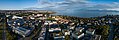 An aerial view of campus
 -
-
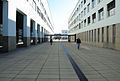 The BM and BP buildings
 -
 The BC building
 -
 The Esplanade
 -
 The CO building
 -
 The Odyssea building
 -
 Artlab
 -
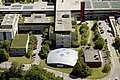


Projects and partnerships
[edit]-
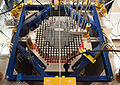 The CROCUS research reactor.
 -

-
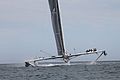 The Hydroptère.
 -
 Boats of Alinghi.
 -
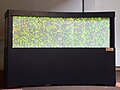 The Biowall.
 -
 The Musée Bolo.
 -
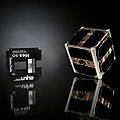 Swiss Cube 1, the first Swiss satellite.
 -
 Solar Impulse achieved the first round-the-world solar flight.


- Human Brain Project: a large 10-year scientific research project, established in 2013, coordinated by Henry Markram (EPFL) and largely funded by the European Union.[70] It aims to provide a collaborative informatics infrastructure and first draft rodent and human whole brain models within its 10-year funding period. It includes 112 research partners in 24 countries in Europe as well as outside Europe.[71]
See also
[edit]- Science and technology in Switzerland
- Swiss Electromagnetics Research and Engineering Centre
- Top Industrial Managers for Europe
- Green building on college campuses
- Technologist, magazine published by EuroTech Universities Alliance
Notes and references
[edit]- ^ "EPFL History". EPFL. Retrieved 18 April 2023.
- ^ "EPFL Annual Report 2022". EPFL.
- ^ a b "Biography".
- ^ "Statistiques Personnel". EPFL. Retrieved 7 March 2024.
- ^ a b c "EPFL in figures". EPFL.
- ^ "Colour" (PDF). Retrieved 31 December 2019.
- ^ "Presentation & Information EPFL". EPFL. Retrieved 31 October 2017.
- ^ "EPFL École polytechnique fédérale de Lausanne". academicpositions.com.
- ^ "Work with members in your community and make a difference! - ON Campus™. Apr 2023". www.suitsoncampus.com.
- ^ "Budgetbericht des ETH-Rats für den ETH-Bereich 2024" [Budget Report 2024] (PDF). ETH Board (in German). Retrieved 26 February 2024.
- ^ a b "Failure statistics - SAE". 26 July 2013. Retrieved 19 July 2015.
- ^ "EPFL in Figures 2013" (PDF). Archived from the original (PDF) on 28 May 2016. Retrieved 6 May 2015.
- ^ "ShanghaiRanking-Univiersities".
- ^ "EPFL – École polytechnique fédérale de Lausanne".
- ^ "Reuters Top 100: The World's Most Innovative Universities - 2018". 11 October 2018. Retrieved 18 April 2023 – via www.reuters.com.
- ^ "Ecole Polytechnique Federale de Lausanne".
- ^ "École Polytechnique Fédérale de Lausanne". 8 June 2023.
- ^ "QS World University Rankings 2023". Top Universities. Retrieved 4 April 2023.
- ^ "World University Rankings 2023 by subject: engineering". Times Higher Education. 4 April 2023. Retrieved 4 April 2023.
- ^ "Leiden ranking". Retrieved 4 October 2013.
- ^ "100 Under 50 Rankings". Times Higher Education. 4 June 2015. Retrieved 29 February 2016.
- ^ "EPFL keeps the lead of "THE Young Universities Ranking"". actu.epfl.ch. Retrieved 7 April 2016.
- ^ a b "150 Under 50 Rankings". Times Higher Education. 17 December 2015. Retrieved 7 April 2016.
- ^ a b "Young University Rankings 2017". Times Higher Education. 4 April 2017. Retrieved 22 June 2017.
- ^ "THE Young University Rankings 2018: results announced". Times Higher Education (THE). 6 June 2018. Retrieved 30 September 2020.
- ^ "Young University Rankings". Times Higher Education (THE). 20 June 2019. Retrieved 30 September 2020.
- ^ "The 100 most international universities in the world 2014". Times Higher Education. 24 January 2014. Retrieved 1 March 2016.
- ^ "The 100 most international universities in the world 2015". Times Higher Education. 23 January 2015. Retrieved 29 February 2016.
- ^ "Bienvenue dans notre futur bâtiment RTS à Lausanne". rts.ch. 29 May 2019.
- ^ Campus roule, www.publibike.ch (page visited on 15 May 2013).
- ^ "Quarante ans de campus durable" [Forty years of sustainable campus]. actualites.epfl.ch (in French). 12 June 2009. Archived from the original on 15 June 2009.
- ^ "présentation epfl". www.epfl.ch.
- ^ EPFL Valais (page visited on 23 August 2013).
- ^ About EPFL Middle East, www.epfl.ae (page visited on March 30, 2024).
- ^ Service des sports UNIL-EPFL, sport.unil.ch (page visited on 10 May 2013).
- ^ "Fribourg - EPFL". 8 July 2015. Retrieved 19 July 2015.
- ^ "Microcity". 30 June 2015. Retrieved 19 July 2015.
- ^ "Geneva". www.epfl.ch. Retrieved 11 March 2021.
- ^ "Campus Biotech sera inauguré cet après-midi". Tribune de Genève (in French). ISSN 1010-2248. Retrieved 11 March 2021.
- ^ "EPFL VALAIS WALLIS". www.epfl.ch. Retrieved 11 March 2021.
- ^ "Grille pour l'auto-évaluation du CECR". Portfolio européen des langues (PEL) (in French). Retrieved 8 December 2020.
- ^ "Language Centre". www.epfl.ch. Retrieved 8 December 2020.
- ^ "Programme Tandem". www.unil.ch (in French). Retrieved 8 December 2020.
- ^ "Facts and Figures EPFL". Retrieved 18 April 2023.
- ^ "EPFL at a glance - EPFL". 28 May 2015. Retrieved 19 July 2015.
- ^ "Student Associations". EPFL.
- ^ "AGEPoly at EPFL".
- ^ "Forum EPFL - Le plus grand salon de recrutement d'Europe". Forum EPFL.
- ^ "Unipoly – Association écologiste EPFL-UNIL". unipoly.ch.
- ^ "Polympiads". polympiads.ch. Retrieved 28 March 2024.
- ^ "Festival Balelec". People Magazine. Sacha Voeffray
- ^ "Balélec repart pour un tour". 24 heures, 27 October 2015
- ^ "Festival Balélec, EPFL Campus, Lausanne, 08.05.2015". Indie Nation, May 13, 2015
- ^ "Festival Balélec, EPFL Campus, Lausanne, 08.05.2015". Indie Nation, May 13, 2015.
- ^ "Serment d'Archimèdes" (PDF). Archived from the original (PDF) on 14 January 2014. Retrieved 10 December 2014.
- ^ "Harcèlement, sexisme, homophobie: Des étudiants sonnent l'alarme à l'EPFL". Le Temps. December 2020.
- ^ "EPFL: Des étudiants dénoncent des agressions et un sexisme latent".
- ^ "EPFL-Hydroptère". Archived from the original on 23 November 2012. Retrieved 5 October 2013.
- ^ "SwissCube Website".
- ^ "Human brain project". Retrieved 5 October 2013.
- ^ "DAY 2 - Thursday 5 June | CODEV". cooperation.epfl.ch. Retrieved 28 February 2017.
- ^ "Welcome from the Director | STI". sti.epfl.ch. Retrieved 29 May 2017.
- ^ "Section SGM | STI". sti.epfl.ch. Retrieved 29 May 2017.
- ^ "Commission d'enseignement - EPFL". Retrieved 18 April 2023.
- ^ "La Structure de la Section | STI". sti.epfl.ch (in French). Retrieved 29 May 2017.
- ^ "Contact | IBI". bioengineering.epfl.ch. Retrieved 29 May 2017.
- ^ President since 1853, official website of the École polytechnique fédérale de Lausanne (page visited on 24 February 2016).
- ^ "Home - LC3 - Limestone Calcined Clay Cement". LC3 - Limestone Calcined Clay Cement.
- ^ "Monodor". Archived from the original on 5 March 2016. Retrieved 20 February 2016.
- ^ "The Human Brain Project - Human Brain Project". www.humanbrainproject.eu. Retrieved 1 March 2016.
- ^ "Home - Partners - Human Brain Project". www.humanbrainproject.eu. Retrieved 1 March 2016.
Bibliography
[edit]- (in French) Histoire de l'École polytechnique de Lausanne : 1953-1978, Presses polytechniques et universitaires romandes, 1999 (ISBN 9782880743956).
- (in French) Michel Pont, Chronique de l'EPFL 1978-2000, Presses polytechniques et universitaires romandes, 2010 (ISBN 9782880748760).
- (in French) Libero Zuppiroli, La bulle universitaire. Faut-il poursuivre le rêve américain ? [The academic bubble. Should we pursue the American dream?], Éditions d'en bas, 2010, 176 pages (ISBN 978-2-8290-0385-1). The first part, entitled "Le parcours exemplaire du Swiss Institute of Technology Lausanne" [The exemplary path of the Swiss Institute of Technology in Lausanne], is about the change of the EPFL after the appointment of Patrick Aebischer as president.

| International | |
|---|---|
| National | |
| Geographic | |
| Academics | |
| Artists | |
| Other | |

- École Polytechnique Fédérale de Lausanne
- ETH Domain
- Technical universities and colleges in Switzerland
- Universities and colleges established in 1853
- Architecture schools in Switzerland
- Buildings and structures in Lausanne
- Engineering universities and colleges in Switzerland
- 1853 establishments in Switzerland
- Schools in Lausanne