


Finger millet
| Finger millet | |
|---|---|

| |
Scientific classification 
| |
| Kingdom: | Plantae |
| Clade: | Tracheophytes |
| Clade: | Angiosperms |
| Clade: | Monocots |
| Clade: | Commelinids |
| Order: | Poales |
| Family: | Poaceae |
| Genus: | Eleusine |
| Species: | E. coracana
|
| Binomial name | |
| Eleusine coracana | |
| Synonyms[1] | |
| |

Finger millet (Eleusine coracana) is an annual herbaceous plant widely grown as a cereal crop in the arid and semiarid areas in Africa and Asia. It is a tetraploid and self-pollinating species probably evolved from its wild relative Eleusine africana.[2]
Finger millet is native to the Ethiopian and Ugandan highlands.[3] Interesting crop characteristics of finger millet are the ability to withstand cultivation at altitudes over 2,000 metres (6,600 ft) above sea level, its high drought tolerance, and the long storage time of the grains.[2]
History[edit]
Finger millet originated in East Africa (Ethiopian and Ugandan highlands). It was claimed to have been found in an Indian archaeological site dated to 1800 BCE (Late Bronze Age);[4] however, this was subsequently demonstrated to be incorrectly identified cleaned grains of hulled millets.[5][6] The oldest record of finger millet comes from an archaeological site in Africa dating to the 8th century AD.[7]
By 1996, cultivation of finger millet in Africa was declining rapidly because of the large amount of labor it required, with farmers preferring to grow nutritionally-inferior but less labor-intensive crops such as maize, sorghum, and cassava.[2]: 39–40 Such a decline was not seen in Asia, however.[2]: 42
Taxonomy and botanical description[edit]
Finger millet is under the genus Eleusine Gaertn.[8][9]
Growing regions[edit]
Main cultivation areas are parts of eastern and southern Africa – particularly Uganda, Kenya, the Democratic Republic of the Congo, Zimbabwe, Zambia, Malawi, and Tanzania – and parts of India and Nepal.[2]: 42, 52 It is also grown in southern Sudan[2]: 39 and "as far south" in Africa as Mozambique.[2]: 56
Climate requirements[edit]
Finger millet is a short-day plant with a growing optimum 12 hours of daylight for most varieties. Its main growing area ranges from 20°N to 20°S, meaning mainly the semiarid to arid tropics. Nevertheless, finger millet is found to be grown at 30°N in the Himalaya region (India and Nepal). It is generally considered as a drought-tolerant crop, but compared with other millets, such as pearl millet and sorghum, it prefers moderate rainfall (500 millimetres (20 in) annually). The majority of worldwide finger millet farmers grow it rainfed, although yields often can be significantly improved when irrigation is applied. In India, finger millet is a typical rabi (dry-winter season) crop. Heat tolerance of finger millet is high. For Ugandan finger millet varieties, for instance, the optimal average growth temperature ranges at about 27 °C, while the minimal temperatures should not be lower than 18 °C. Relative to other species (pearl millet and sorghum), finger millet has a higher tolerance to cool temperatures. It is grown from about 500 to 2,400 metres (1,600 to 7,900 ft) above sea level (e.g. in Himalaya region). Hence, it can be cultivated on higher elevations than most tropical crops. Finger millet can grow on various soils, including highly weathered tropical lateritic soils. It thrives in free-draining soils with steady moisture levels. Furthermore, it can tolerate soil salinity up to a certain extent. Its ability to bear waterlogging is limited, so good drainage of the soils and moderate water-holding capacity are optimal.[2] Finger millet can tolerate moderately acidic soils (pH 5), but also moderately alkaline soils (pH 8.2).[10]
Cropping systems[edit]

Finger millet monocrops grown under rainfed conditions are most common in drier areas of Eastern Africa. In addition, intercropping with legumes, such as cowpea or pigeon pea, are also quite common in East Africa. Tropical Central Africa supports scattered regions of finger millet intercropping mostly with legumes, but also with cassava, plantain, and vegetables.[2]
Most common finger millet intercropping systems in South India are as follows:[citation needed]
- With legumes: Finger millet/dolichos, finger millet/pigeonpea, finger millet/black gram, finger millet/castor
- With cereals: Finger millet/maize, finger millet/foxtail millet, finger millet/jowar, finger millet/little millet
- With other species: Finger millet/brassicas, finger millet/mustard
Weeds[edit]
Weeds are the major biotic stresses for finger millet cultivation. Its seeds are very small, which leads to a relatively slow development in early growing stages. This makes finger millet a weak competitor for light, water, and nutrients compared with weeds.[11] In East and Southern Africa, the closely related species Eleusine indica (common name Indian goose grass) is a severe weed competitor of finger millet. Especially in early growing stages of the crop and the weed and when broadcast seeding instead of row seeding is applied (as often the case in East Africa), the two species are very difficult to distinguish.[2] Besides Eleusine indica, the species Xanthium strumarium, which is animal dispersed and the stolon-owning species Cyperus rotondus and Cynodon dactylon are important finger millet weeds.[11] Measures to control weeds include cultural, physical, and chemical methods. Cultural methods could be sowing in rows instead of broadcast sowing to make distinction between finger millet seedlings and E. indica easier when hand weeding.[2] ICRISAT promotes cover crops and crop rotations to disrupt the growing cycle of the weeds. Physical weed control in financial resource-limited communities growing finger millet are mainly hand weeding or weeding with a hand hoe.[11]
Diseases and pests[edit]
Finger millet is generally seen as not very prone to diseases and pests. Nonetheless, finger millet blast, caused by the fungal pathogen Magnaporthe grisea (anamorph Pyricularia grisea), can locally cause severe damages, especially when untreated.[2] In Uganda, yield losses up to 80% were reported in bad years. The pathogen leads to drying out of leaves, neck rots, and ear rots.[11] These symptoms can drastically impair photosynthesis, translocation of photosynthetic assimilates, and grain filling, so reduce yield and grain quality. Finger millet blast can also infest finger millet weeds such as the closely related E. indica, E. africana, Digitaria spp., Setaria spp., and Doctylocterium spp.[11][12] Finger millet blast can be controlled with cultural measures, chemical treatments, and the use of resistant varieties. Researchers in Kenya have screened wild relatives of finger millet and landraces for resistance to blast.[13] Cultural measures to control finger millet blast suggested by ICRISAT for Eastern Africa include crop rotations with nonhost crops such as legumes, deep ploughing under of finger millet straw on infected fields, washing of field tools after use to prevent dissemination of the pathogen to uninfected fields, weed control to reduce infections by weed hosts, and avoiding of high plant densities to impede the pathogen dispersal from plant to plant.[11] Chemical measures can be direct spraying of systemic fungicides, such as the active ingredients pyroquilon or seed dressings with fungicides, such as trycyclozole.[11][14]
Striga, a parasitic weed which occurs naturally in parts of Africa, Asia, and Australia, can severely affect the crop and yield losses in finger millet and other cereals by 20 to 80%.[15] Striga can be controlled with limited success by hand weeding, herbicide application, crop rotations, improved soil fertility, intercropping and biological control.[16] The most economically feasible and environmentally friendly control measure would be to develop and use Striga-resistant cultivars.[17] Striga resistant genes have not been identified yet in cultivated finger millet but could be found in crop wild relatives of finger millet.[18] Another pathogen in finger millet cultivation is the fungus Helminthosporium nodulosum, causing leaf blight.[10] Finger millet pests are bird predators, such as quelea in East Africa.[2]
Insects[edit]
The pink stem borer (Sesamia inferens) and the finger millet shoot fly (Atherigona miliaceae)[19] are considered as the most relevant insect pests in finger millet cultivation.[10] Measures to control Sesamia inferens are uprooting of infected plants, destroying of stubbles, having a crop rotation, chemical control with insecticides, biological measures such as pheromone traps, or biological pest control with the use of antagonistic organisms (e.g. Sturmiopsis inferens).[20]
Other insect pests include:[21]
- Root feeders
- root aphid Tetraneura nigriabdominalis
- Shoot and stem feeders
- Leaf feeders
- hairy caterpillars, Amsacta albistriga, Amsacta transiens, and Amsacta moorei
- cutworms, Agrotis ipsilon
- armyworm larvae of Spodoptera exempta, Spodoptera mauritia, and Mythimna separata
- leaf-folder Cnaphalocrocis medinalis larvae
- skipper Pelopidas mathias larvae
- grasshoppers, Chrotogonus hemipterus, Nomadacris septemfasciata, and Locusta migratoria
- beetle grubs of Chnootriba similis
- thrip, Heliothrips indicus
- Sucking pests
- aphids, Hysteroneura setariae, Metopolophium dirhodum, Rhopalosiphum maidis, and Sitobion miscanthi
- mealy bug, Brevennia rehi
- leaf hoppers Cicadulina bipunctella and Cicadulina chinai
Propagation and sowing[edit]

Propagation in finger millet farming is done mainly by seeds. In rainfed cropping, four sowing methods are used:[22]
- Broadcasting: Seeds are directly sown in the field. This is the common method because it is the easiest way and no special machinery is required. The organic weed management with this method is a problem, because it is difficult to distinguish between weed and crop.
- Line Sowing: Improved sowing compared to broadcasting. Facilitates organic weed management due to better distinction of weed and crop. In this method, spacing of 22 cm to 30 cm between lines and 8 cm to 10 cm within lines should be maintained. The seeds should be sown about 3 cm deep in the soil.
- Drilling in rows: Seeds are sown directly in the untreated soil by using a direct-seed drill. This method is used in conservation agriculture.
- Transplanting the seedlings: Raising the seedlings in nursery beds and transplant to the main field. Leveling and watering of beds is required during transplanting. Seedlings with 4 weeks age should be transplanted in the field. For early Rabi and Kharif season, seedlings should be transplanted at 25 cm x 10 cm and for late Kharif season at 30 cm x 10 cm. Planting should be done 3 cm depth in the soil
Harvest[edit]
.jpg)
Crop does not mature uniformly and hence the harvest is to be taken up in two stages. When the earhead on the main shoot and 50% of the earheads on the crop turn brown, the crop is ready for the first harvest. At the first harvest, all earheads that have turned brown should be cut. After this drying, threshing and cleaning the grains by winnowing. The second harvest is around seven days after the first. All earheads, including the green ones, should be cut. The grains should then be cured to obtain maturity by heaping the harvested earheads in shade for one day without drying, so that the humidity and temperature increase and the grains get cured. After this drying, threshing and cleaning as after the first harvesting.[2]
Storage[edit]
Once harvested, the seeds keep extremely well and are seldom attacked by insects or moulds. Finger millet can be kept for up to 10 years when it is unthreshed. Some sources report a storage duration up to 50 years under good storage conditions.[2] The long storage capacity makes finger millet an important crop in risk-avoidance strategies as a famine crop for farming communities.[2]
Processing[edit]
Milling[edit]
As a first step of processing finger millet can be milled to produce flour. However, finger millet is difficult to mill due to the small size of the seeds and because the bran is bound very tightly to the endosperm. Furthermore, the delicate seed can get crushed during the milling. The development of commercial mechanical milling systems for finger millet is challenging. Therefore, the main product of finger millet is whole grain flour. This has disadvantages, such as reduced storage time of the flour due to the high oil content. Furthermore, the industrial use of whole grain finger millet flour is limited. Moistening the millet seeds prior to grinding helps to remove the bran mechanically without causing damage to the rest of the seed. The mini millet mill can also be used to process other grains such as wheat and sorghum.[citation needed]
Malting[edit]
Another method to process the finger millet grain is germinating the seed. This process is also called malting and is very common in the production of brewed beverages such as beer. When finger millet is germinated, enzymes are activated, which transfer starches into other carbohydrates such as sugars. Finger millet has a good malting activity. The malted finger millet can be used as a substrate to produce for example gluten-free beer or easily digestible food for infants.[2]

Nutrition[edit]
| Nutritional value per 100 g (3.5 oz) | |
|---|---|
| Energy | 1,283 kJ (307 kcal) |
53.5 g | |
| Dietary fiber | 22.6 g |
1.9 g | |
7.4 g | |
| Minerals | Quantity %DV† |
| Calcium | 26% 344 mg |
| Iron | 63% 11.3 mg |
| Magnesium | 37% 154 mg |
| Phosphorus | 15% 183 mg |
| Potassium | 18% 538 mg |
| Sodium | 0% 2 mg |
| Zinc | 15% 1.7 mg |
| Other constituents | Quantity |
| Water | 11 g |
| †Percentages estimated using US recommendations for adults,[23] except for potassium, which is estimated based on expert recommendation from the National Academies.[24] | |
Finger millet is 11% water, 7% protein, 54% carbohydrates, and 2% fat (table). In a 100 gram (3.5 oz) reference amount, finger millet supplies 305 calories, and is a rich source (20% or more of the Daily Value, DV) of dietary fiber and several dietary minerals, especially iron at 87% DV (table).
Growing finger millet to improve nutrition[edit]
The International Crops Research Institute for the Semi-Arid Tropics (ICRISAT), a member of the CGIAR consortium, partners with farmers, governments, researchers and NGOs to help farmers grow nutritious crops, including finger millet. This helps their communities have more balanced diets and become more resilient to pests and drought. For example, the Harnessing Opportunities for Productivity Enhancement of Sorghum and Millets in Sub-Saharan Africa and South Asia (HOPE) project is increasing yields of finger millet in Tanzania by encouraging farmers to grow improved varieties.[25]
Use[edit]
 | This section needs additional citations for verification. (February 2019) |
Finger millet can be ground into a flour and cooked into cakes, puddings or porridge. The flour is made into a fermented drink (or beer) in Nepal and in many parts of Africa. The straw from finger millet is used as animal fodder.
In India[edit]

Finger millet is a staple grain in many parts of India, especially Karnataka, where it is known as ragi (from Kannada ರಾಗಿ rāgi). It is malted and its grain is ground into flour. The flour is consumed with milk, boiled water, or yogurt. The flour is made into flatbreads, including thin, leavened dosa and thicker, unleavened roti.
There are numerous ways to prepare finger millet, including dosa, idli, and laddu. In southern India, on pediatrician's recommendation, finger millet is used in preparing baby food, because of millet's high nutritional content, especially iron and calcium. Satva, pole (dosa), bhakri, ambil (a sour porridge), and pappad are common dishes made using finger millet. In Karnataka, finger millet is generally consumed in the form of a porridge called ragi mudde in Kannada. It is the staple diet of many residents of South Karnataka. Mudde is prepared by cooking the ragi flour with water to achieve a dough-like consistency. This is then rolled into balls of desired size and consumed with sambar (huli), saaru (ಸಾರು), or curries. Ragi is also used to make roti, idli, dosa and conjee. In the Malnad region of Karnataka, the whole ragi grain is soaked and the milk is extracted to make a dessert known as keelsa. A type of flat bread is prepared using finger millet flour (called ragi rotti in Kannada) in Northern districts of Karnataka.
In Tamil Nadu, ragi is called kezhvaragu (கேழ்வரகு) and also has other names like keppai, ragi, and ariyam.[26] Ragi is dried, powdered, and boiled to form a thick mass that is allowed to cool. This is the famed kali or keppai kali. This is made into large balls to quantify the intake. It is taken with sambar or kuzhambu. For children, ragi is also fed with milk and sugar (malt). It is also made in the form of pancakes with chopped onions and tomatoes. Kezhvaragu is used to make puttu with jaggery or sugar. Ragi is called koozh – a staple diet in farming communities, eaten along with raw onions and green chillies. In Andhra Pradesh, ragi sankati or ragi muddha – ragi balls – are eaten in the morning with chilli, onions, and sambar. In Kerala, puttu, a traditional breakfast dish, can be made with ragi flour and grated coconut, which is then steamed in a cylindrical steamer. In the tribal and western hilly regions of Odisha, ragi or mandiaa is a staple food. In the Garhwal and Kumaon regions of Uttarakhand, koda or maduwa is made into thick rotis (served with ghee), and also made into badi, which is similar to halwa but without sugar. In the Kumaon region, ragi is traditionally fed to women after child birth. In some parts of Kumaon region the ragi flour is used to make various snacks like namkeen sev, mathri and chips.
In South and Far East Asia[edit]
In Nepal, a thick dough (ḍhĩḍo) made of millet flour (kōdō) is cooked and eaten by hand. The dough, on other hand, can be made into thick bread (rotee) spread over flat utensil and heating it. Fermented millet is used to make a beer chhaang and the mash is distilled to make a liquor (rakśiशी). Whole grain millet is fermented to make tongba. Its use in holy Hindu practices is barred especially by upper castes. In Nepal, the National Plant Genetic Resource Centre at Khumaltar maintains 877 accessions (samples) of Nepalese finger millet (kodo).[27][28]
In Sri Lanka, finger millet is called kurakkan and is made into kurakkan roti – an earthy brown thick roti with coconut and thallapa – a thick dough made of ragi by boiling it with water and some salt until like a dough ball. It is then eaten with a spicy meat curry and is usually swallowed in small balls, rather than chewing. It is also eaten as a porridge (kurrakan kenda) and as a sweet called 'Halape'. In northwest Vietnam, finger millet is used as a medicine for women at childbirth. A minority use finger millet flour to make alcohol.
As beverage[edit]
Ragi malt porridge is made from finger millet which is soaked and shadow dried, then roasted and ground. This preparation is boiled in water and used as a substitute for milk powder-based beverages.
Gallery[edit]
-
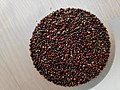 Finger millet
 -
 Multicolored finger millet grains
 -
 Pappad made of finger millet
 -

-
 Roti
Roti -
 Ragi idli
 -
 Idli, a South Indian breakfast dish made from ragi flour
 -
 Chhaang

_BNC_(cropped).png)
.jpg)


.jpg)

References[edit]
- ^ "The Plant List: A Working List of All Plant Species". Retrieved 8 January 2015.
- ^ a b c d e f g h i j k l m n o p q Borlaug, Norman E.; Axtell, John; Burton, Glenn W.; Harlan, Jack R.; Rachie, Kenneth O.; Vietmeyer, Noel D. (1996). Lost Crops of Africa: Volume I: Grains. U.S. National Research Council Consensus Study Report. Washington, D.C.: National Academies Press (NAP). doi:10.17226/2305. ISBN 978-0-309-04990-0. LCCN 93-86876. OCLC 934889803. OL 9872024M.
- ^ A.C. D'Andrea, D.E. Lyons, Mitiku Haile, E.A. Butler, "Ethnoarchaeological Approaches to the Study of Prehistoric Agriculture in the Ethiopian Highlands" in Van der Veen, ed., The Exploitation of Plant Resources in Ancient Africa. Kluwer Academic: Plenum Publishers, New York City, 1999.
- ^ K.T. Achaya (2003). The Story of Our Food. Universities Press. p. 21. ISBN 978-81-7371-293-7.
- ^ Fuller, Dorian Q. (June 2001). "Harappan seeds and agriculture: some considerations". Antiquity. 75 (288): 410–414. doi:10.1017/S0003598X00061068. S2CID 161052214.
- ^ Fuller, Dorian Q. (2003). "African crops in prehistoric South Asia: a critical review". In Neumann, Katharina; Butler, Ann; Kahlheber, Stefanie (eds.). Food, Fuel and Fields: Progress in African Archaeobotany (PDF). Africa Praehistorica 15. Heinrich-Barth-Institut. pp. 239–272. ISBN 3-927688-20-7. Archived (PDF) from the original on 2022-10-09.
- ^ Hilu, K. W.; de Wet, J. M. J.; Harlan, J. R. Harlan (1979). "Archaeobotanical Studies of Eleusine coracana ssp. coracana (Finger Millet)". American Journal of Botany. 66 (3): 330–333. doi:10.1002/j.1537-2197.1979.tb06231.x. JSTOR 2442610.
- ^ Hilu, Khidir W.; Johnson, John L. (1997). "Systematics of Eleusine Gaertn. (Poaceae: Chloridoideae): Chloroplast DNA and Total Evidence". Annals of the Missouri Botanical Garden. 84 (4): 841. doi:10.2307/2992029. JSTOR 2992029.
- ^ Bisht, M. S.; Mukai, Y. (2002-10-01). "Genome organization and polyploid evolution in the genus Eleusine (Poaceae)". Plant Systematics and Evolution. 233 (3): 243–258. doi:10.1007/s00606-002-0201-5. ISSN 1615-6110. S2CID 45763855.
- ^ a b c H.D. Upadhyaya; V. Gopal Reddy & D.V.S.S.R. Sastry (2008). "Regeneration guidelines Fingermillet". Crop Specific Regeneration Guidelines – via ICRISAT+CGIAR.
- ^ a b c d e f g Mgonja A, Ojulong M, Audi P, Manyasa E, Ojulong H (2011). "INTEGRATED BLAST AND WEED MANAGEMENT AND MICRODOSING IN FINGER MILLET: A HOPE PROJECT MANUAL FOR INCREASING FINGER MILLET PRODUCTIVITY IN EASTERN AFRICA". ICRISAT (International Crops Research Institute for Semi Arid Tropics).
- ^ Takan JP, Muthumeenakshi S, Sreenivasaprasad S, Talbot NJ (2004). "Molecular markers and mating type assays to characterise finger millet blast pathogen populations in East Africa". Poster Presented at British Mycological Society (BMS) Meeting, "Fungi in the Environment", Nottingham.
- ^ Dida, Mathews M.; Oduori, Chrispus A.; Manthi, Samuel J.; Avosa, Millicent O.; Mikwa, Erick O.; Ojulong, Henry F.; Odeny, Damaris A. (2021). "Novel sources of resistance to blast disease in finger millet". Crop Science. 61 (1): 250–262. doi:10.1002/csc2.20378. ISSN 1435-0653. S2CID 225135026.
- ^ Sreenivasaprasad S, Takan JP, Mgonja MA, Manyasa EO, Kaloki P, Wanyera N, Okwade AM, Muthumeenakshi S, Brown AE, Lenné JM (2005). "Enhancing finger millet production and utilisation in East Africa through improved blast management and stakeholder connectivity". Aspects of Applied Biology. 75: 11–22.
- ^ Atera, Evans; Itoh, Kazuyuki (May 2011). "Evaluation of ecologies and severity of Striga weed on rice in sub-Saharan Africa". Agriculture and Biology Journal of North America. 2 (5): 752–760. doi:10.5251/abjna.2011.2.5.752.760. ISSN 2151-7517.
- ^ Haussmann, Bettina IG; Hess, Dale E; Welz, H-Günter; Geiger, Hartwig H (2000-06-01). "Improved methodologies for breeding striga-resistant sorghums" (PDF). Field Crops Research. 66 (3): 195–211. doi:10.1016/S0378-4290(00)00076-9. ISSN 0378-4290. Archived (PDF) from the original on 2022-10-09.
- ^ Wilson, J. P.; Hess, D. E.; Hanna, W. W. (October 2000). "Resistance to Striga hermonthica in Wild Accessions of the Primary Gene Pool of Pennisetum glaucum". Phytopathology. 90 (10): 1169–1172. doi:10.1094/PHYTO.2000.90.10.1169. ISSN 0031-949X. PMID 18944482.
- ^ Kuiper, Eric; Groot, Alexia; Noordover, Esther C.M.; Pieterse, Arnold H.; Verkleij, Joe A.C. (1998). "Tropical grasses vary in their resistance to Striga aspera, Striga hermonthica, and their hybrids". Canadian Journal of Botany. 76 (12): 2131–2144. doi:10.1139/cjb-76-12-2131. ISSN 1480-3305.
- ^ Kalaisekar, A.; Padmaja, P.G.; Bhagwat, V.R.; Patil, J.V. (2017). Insect Pests of Millets: Systematics, Bionomics, and Management. Academic Press. ISBN 978-0-12-804243-4.
- ^ Samiksha, S. "Pink Stem Borer (Sesamia inference): Nature, Life Cycle and Control".
- ^ Kalaisekar, A (2017). Insect pests of millets: systematics, bionomics, and management. London: Elsevier. ISBN 978-0-12-804243-4. OCLC 967265246.
- ^ "Finger Millet Farming". Agri Farming India. 2015-05-18.
- ^ United States Food and Drug Administration (2024). "Daily Value on the Nutrition and Supplement Facts Labels". Retrieved 2024-03-28.
- ^ National Academies of Sciences, Engineering, and Medicine; Health and Medicine Division; Food and Nutrition Board; Committee to Review the Dietary Reference Intakes for Sodium and Potassium (2019). Oria, Maria; Harrison, Meghan; Stallings, Virginia A. (eds.). Dietary Reference Intakes for Sodium and Potassium. The National Academies Collection: Reports funded by National Institutes of Health. Washington (DC): National Academies Press (US). ISBN 978-0-309-48834-1. PMID 30844154.
{{cite book}}: CS1 maint: multiple names: authors list (link) - ^ "Harnessing Opportunities for Productivity Enhancement (HOPE) of Sorghum and Millets – ICRISAT". www.icrisat.org. Retrieved 2023-04-13.
- ^ "Live Chennai: Health benefits of millet (Ragi),Health benefits of millet,Health benefits of Ragi,Health benefits,Ragi".
- ^ Bastola, Biswash Raj; Pandey, M. P.; Ojha, B. R.; Ghimire, S. K.; Baral, K. (2015-06-25). "Phenotypic Diversity of Nepalese Finger Millet (Eleusine coracana (L.) Gaertn.) Accessions at IAAS, Rampur, Nepal". International Journal of Applied Sciences and Biotechnology. 3 (2): 285–290. doi:10.3126/ijasbt.v3i2.12413. ISSN 2091-2609.
- ^ LI-BIRD. "Released and promising crop varieties for mountain agriculture in Nepal" (PDF). Archived (PDF) from the original on 2022-10-09.
External links[edit]


- 'Eleusine coracana (L.) Gaertn.' Archived 2015-09-24 at the Wayback Machine
- Dressler, S.; Schmidt, M. & Zizka, G. (2014). "Eleusine coracana". African plants – a Photo Guide. Frankfurt/Main: Forschungsinstitut Senckenberg.
| Authority control databases: National |
|---|
