


Krampus


The Krampus is a horned anthropomorphic figure who, in the Central and Eastern Alpine folkloric tradition, is said to accompany Saint Nicholas on visits to children during the night of 5 December (Krampusnacht; "Krampus Night"), immediately before the Feast of St. Nicholas on 6 December. In this tradition, Saint Nicholas rewards well-behaved children with small gifts, while Krampus punishes badly behaved ones with birch rods.[1][2]
The origin of the figure is unclear; some folklorists and anthropologists have postulated that it may have pre-Christian origins.[3] In traditional parades and in such events as the Krampuslauf ("Krampus run"), young men dressed as Krampus attempt to scare the audience with their antics. Krampus is featured on holiday greeting cards called Krampuskarten.
The figure has been imported into American popular culture, and has appeared in movies, TV and games.
Etymology
[edit]Krampus is thought to come from either Bavarian: krampn, meaning "dead", "rotten", or from the German: kramp/krampen, meaning "claw".[4][5][6] The Krampus is considered to be a half-goat, half-demon monster in some legends.[7] Its role is to punish bad children or scare them into being good.[8][9]
Origins
[edit]
The Krampus is thought to be inspired by other mythical creatures, such as the Perchten or Straggele,[3][6] though there are no written sources before the end of the 16th century.[10]
Discussing his observations in 1975 while in Irdning, a small town in Styria, anthropologist John J. Honigmann wrote that:
The Saint Nicholas festival we are describing incorporates cultural elements widely distributed in Europe. St. Nicholas himself became popular in Germany around the eleventh century. The feast dedicated to this patron of children is only one winter occasion in which children are the objects of special attention, others being Martinmas, the Feast of the Holy Innocents, and New Year's Day. Masked devils acting boisterously and making nuisances of themselves are known in Germany since at least the sixteenth century while animal masked devils combining dreadful-comic (schauriglustig) antics appeared in medieval church plays. A large literature, much of it by European folklorists, bears on these subjects. ... Austrians in the community we studied are quite aware of "heathen" elements being blended with Christian elements in the Saint Nicholas customs and in other traditional winter ceremonies. They believe Krampus derives from a pagan supernatural who was assimilated to the Christian devil.[11]
The Perchten figures persisted but are unrelated to the Krampus. Krampus is a Perchten and Straggele inspired figure; but has very distinct physical traits that make Krampus unique to his cousins. Krampus is usually featured as a man with horns with one grotesque human foot and one foot of a goat, typically covered in black hair, and unique to Krampus; also a very long snake or dragon like tongue.
In the 17th century Krampus had been paired with St. Nicholas as a helper. Because Nicholas is a saint, it wasn’t logical or deemed saintly behavior for Nicholas to deliver punishments. Therefore a helper was assigned to St Nicholas; such as Farmhand Rupert, Smutzli, or Père Fouettard who would go down the chimney or punish the naughty children. Krampus served St Nicholas in the same role.[12]
Modern history
[edit]In the aftermath of the 1932 election in Austria, the Krampus tradition was prohibited by the Dollfuss regime[13] under the clerical fascist Fatherland Front (Vaterländische Front) and the Christian Social Party.
In the 1950s, the government distributed pamphlets titled "Krampus Is an Evil Man" for fear that encounters with Krampus might damage children's mental health.[14] Towards the end of the century, a popular resurgence of Krampus celebrations occurred and continues today.[15]
The Krampus tradition is being revived in Bavaria as well, along with a local artistic tradition of hand-carved wooden masks.[16][17] In 2019 there were reports of drunken or disorderly conduct by masked Krampuses in some Austrian towns.[18]
Appearance
[edit]
Although Krampus appears in many variations, most share some common physical characteristics. He is hairy, usually brown or black, and has one foot that is a cloven hooves and horns of a goat. His long, pointed tongue drops out,[19][20] and he has fangs.[21]
Krampus carries chains, thought to symbolize the binding of the Devil by the Christian Church. He thrashes the chains for dramatic effect. The chains are sometimes accompanied with bells of various sizes.[22] Krampus will carry a bundle of birch branches with which he occasionally swats children.[19] The birch branches are replaced with a whip in some representations. On Christmas Eve, Krampus travels with a sack or a basket strapped to his back; this is to cart off evil children for drowning, eating, or transport to Hell. Some of the older versions make mention of naughty children being put in the bag and taken away.[19] This quality can be found in other companions of Saint Nicholas such as Zwarte Piet.[23]
Jewish physiognomy stereotypes and anti-Semitic undertones
[edit]
Krampus' appearance and features are characterized by horns, hooves, fur, hooked nose, beard, dark hair, fangs, and a long tongue. Scholars have noted that the hooked nose and grotesque features mirror the antisemitic images of Jews in historical central European art.[24][25][26][27][28][29] This similarity raises questions about the implicit messages conveyed through Krampus' portrayal.
Artistic representations of Krampus alongside Saint Nicholas further emphasize this contrast. For instance, early 20th-century Austrian postcards depict Krampus with a devilish appearance, contrasting sharply with the saintly, Aryan features of Saint Nicholas.[25] This juxtaposition reinforces the "otherness" of Krampus but also subtly aligns his characteristics with historical antisemitic depictions of Jews.
Krampusnacht
[edit]The Feast of St. Nicholas is celebrated in parts of Europe on 6 December.[30] On the preceding evening of 5 December, Krampus Night or Krampusnacht, the wicked hairy devil appears on the streets. Sometimes accompanying St. Nicholas and sometimes on his own, Krampus visits homes and businesses.[19] The Saint usually appears in the Eastern Rite vestments of a bishop, and he carries a golden ceremonial staff. Unlike North American versions of Santa Claus, in these celebrations Saint Nicholas concerns himself only with the good children, while Krampus is responsible for the bad. Nicholas dispenses gifts, while Krampus supplies coal and the Rute.[31]
A seasonal play that spread throughout the Alpine regions was known as the Nikolausspiel ("Nicholas play"). Inspired by Paradise plays,[citation needed] which focused on Adam and Eve's encounter with a tempter, the Nicholas plays featured competition for the human souls and played on the question of morality. In these Nicholas plays, Saint Nicholas would reward children for scholarly efforts rather than for good behavior.[32] This is a theme that grew in Alpine regions where the Roman Catholic Church had significant influence.[citation needed]
Perchtenlauf and Krampuslauf
[edit]There were already established pagan traditions in the Alpine regions that became intertwined with Catholicism. People would masquerade as a devilish figure known as Percht, a two-legged humanoid goat with a giraffe-like neck, wearing animal furs.[32] People wore costumes and marched in processions known as Perchtenlaufen, which are regarded as an earlier form of the Krampus runs. Perchtenlaufen were looked at with suspicion by the Catholic Church and banned by some civil authorities. Due to sparse population and rugged environments within the Alpine region, the ban was not effective or easily enforced, rendering the ban useless. Eventually the Perchtenlauf, inspired by the Nicholas plays, introduced Saint Nicholas and his set of good morals. The Percht transformed into what is now known as the Krampus and was made to be subjected to Saint Nicholas' will.[33]
It is customary to offer a Krampus schnapps, a strong distilled fruit brandy.[19] These runs may include Perchten, similarly wild pagan spirits of Germanic folklore and sometimes female in representation, although the Perchten are properly associated with the period between winter solstice and 6 January.
Criticism of the Krampus run
[edit]Every year there are arguments during Krampus runs. Occasionally spectators take revenge for whippings and attack Krampuses. In 2013, after several Krampus runs in East Tyrol, a total of eight injured people (mostly with broken bones) were admitted to the Lienz district hospital and over 60 other patients were treated on an outpatient basis.[34]
Krampuskarten
[edit]Europeans have been exchanging greeting cards featuring Krampus since the 19th century.[35] Sometimes introduced with Gruß vom Krampus (Greetings from Krampus), the cards usually have humorous rhymes and poems. Krampus is often featured looming menacingly over children. He is also shown as having one human foot and one cloven hoof. In some, Krampus has sexual overtones; he is pictured pursuing buxom women.[36] Over time, the representation of Krampus in the cards has changed; older versions have a more frightening Krampus, while modern versions have a cuter, more Cupid-like creature.[citation needed] Krampus has also adorned postcards and candy containers.[37]
Regional variation
[edit]Krampus appears in the folklore of Austria, Bavaria, Bosnia and Herzegovina, Croatia, the Czech Republic, Hungary, Romania, Northern Italy (Autonomous Province of Trento, South Tyrol, and Friuli-Venezia Giulia), Slovakia, and Slovenia.[38]
In Styria, the Rute is presented by Krampus to families. The twigs are painted gold and displayed year-round in the house—a reminder to any child who has temporarily forgotten Krampus. In smaller, more isolated villages, the figure has other beastly companions, such as the antlered "wild man" figures, and St Nicholas is nowhere to be seen. These Styrian companions of Krampus are called Schabmänner or Rauhen.[19]
A toned-down version of Krampus is part of the popular Christmas markets in Austrian urban centres like Salzburg. In these, more tourist-friendly interpretations, Krampus is more humorous than fearsome.[39]

North American Krampus celebrations are a growing phenomenon.[40]
Similar figures are recorded in neighboring areas. Strohbart in Bavaria, Klaubauf(mann) in Austria and Bavaria, while Bartl or Bartel, Niglobartl, and Wubartl are used in the southern part of the country. Other names include Barrel or Bartholomeus (Styria), Schmutzli (German-speaking Switzerland), Pöpel or Hüllepöpel (Würzburg), Zember (Cheb), Belzmärte and Pelzmärtel (Swabia and Franconia). In most parts of Slovenia, whose culture was greatly affected by Austrian culture, Krampus is called parkelj and is one of the companions of Miklavž, the Slovenian form of St. Nicholas.[19][41]
In many parts of Bosnia and Herzegovina and Croatia, Krampus is described as a devil wearing a cloth sack around his waist and chains around his neck, ankles, and wrists. As a part of a tradition, when a child receives a gift from St. Nicholas he is given a golden branch to represent his good deeds throughout the year; however, if the child has misbehaved, Krampus will take the gifts for himself and leave only a silver branch to represent the child's bad acts.[42][43][44][45]
In popular culture
[edit]The character of Krampus has been imported and modified for various North American media,[21][46] including print (e.g. Krampus: The Devil of Christmas, a collection of vintage postcards by Monte Beauchamp in 2004;[47][35] Krampus: The Yule Lord, a 2012 novel by Gerald Brom[48]); Krampus, a comic series from Image Comics in 2013 created by Dean Kotz and Brian Joines, television – both live action ("A Krampus Carol", a 2012 episode of The League[46]) and animation ("A Very Venture Christmas", a 2004 episode of The Venture Bros.,[21] "Minstrel Krampus", a 2013 episode of American Dad![49])–video games (CarnEvil, a 1998 arcade game,[50] The Binding of Isaac: Rebirth, a 2014 video game[51]), and film (Krampus, a 2015 Christmas comedy horror movie from Universal Pictures[52]).
Biology
[edit]Protomelas krampus, the freshwater actinopterygian fish, is named after Krampus.[53]
Gallery
[edit]-
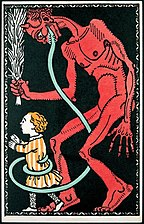 Krampus mit Kind ("Krampus with a child") postcard from around 1911
 -
 Krampus and Saint Nicholas visit a Viennese home in 1896
 -
 Nikolaus and Krampus in Austria in the early 20th century
 -
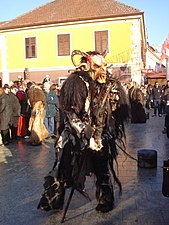 A Straggele costume from Sveti Martin na Muri, northern Croatia, at local carnival in Čakovec (2015)
 -
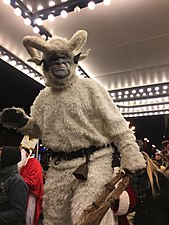 man in a Straggele costume at the Washington DC Krampusnacht walk (2016)


-
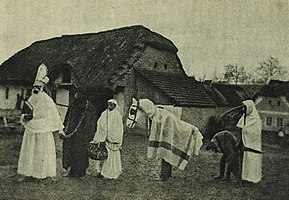 A St. Nicholas procession with Krampus, and other characters, c. 1910
 -
 St. Nikolaus with 12 Straggele in Berchtesgadener Land, Germany (2016)
 -
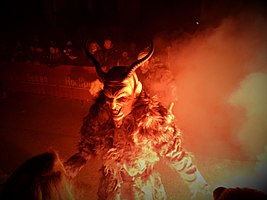 Straggele In Sexten, Italy (2016)


-
 A modern Perchten at the Perchtenlauf in Klagenfurt (2006)
 -
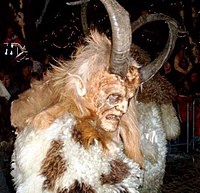 Straggele in Toblach, Italy (2006)


See also
[edit]


Related figures
[edit]- Belsnickel – German Christmas gift-bringer, another West Germanic figure associated with the midwinter period
- Perchta – German Alpine goddess, a female figure in West Germanic folklore whose procession (Perchtenlauf) occurs during the midwinter period
- Pre-Christian Alpine traditions
- Germanic paganism – Traditional religion of Germanic peoples
- Goatman – a malevolent figure in urban folklore originating in Southern United States, like Maryland
- Green Man – Architectural motif
- Holly King and Oak King – Personifications of winter and summer
- Yule goat – Scandinavian decorative Christmas straw goat, a goat associated with the midwinter period among the North Germanic peoples
- Mari Lwyd – South Wales Christmas folk custom
- Namahage – Japanese folklore character associated with new year's ritual
- Nuuttipukki – Scandinavian holiday – Creature in Finnish folklore
- Kallikantzaros – Malevolent goblin in Southeastern European and Anatolian folklore – Creature in Balkan folklore
- Knecht Ruprecht – A companion of Saint Nicholas in Germanic folklore
- Koliada – Ancient pre-Christian Slavic winter festival, an ancient pre-Christian Slavic festival where participants wear masks and costumes and run around.
- Turoń – Creature in Polish folklore
- Ded Moroz – Christmas figure in eastern Slavic cultures
- Sinterklaas – Legendary figure based on Saint Nicholas, celebrated in the Low Countries on 5 or 6 December. He has a companion called Zwarte Piet (Black Pete), who used to punish bad children with a "roe", and kidnap them in bags to Spain. But nowadays they are just as friendly as Sinterklaas ("de Sint"), and give sweets and presents to all children.
- Kurentovanje – 11-day carnival event in Slovenia
- Wild man – Mythical figure
- Silvesterklaus, a Swiss New Year's Eve celebration featuring a musical procession of performers in grotesque costumes.
- Wendigo – Mythical being in Native American folklore.
Other
[edit]- Bogeyman – Mythological Antagonist
- Demon
- Horned deity
References
[edit]- ^ Magazine, Smithsonian; Billock, Jennifer. "The Origin of Krampus, Europe's Evil Twist on Santa". Smithsonian Magazine. Retrieved 4 December 2023.
- ^ "Krampus | Definition, History, & Facts | Britannica". www.britannica.com. 20 October 2023. Retrieved 4 December 2023.
- ^ a b Forcher, Michael; Peterlini, Hans Karl (2010). Südtirol in Geschichte und Gegenwart [South Tyrol past and present] (in German). Haymon Verlag. p. 399.
- ^ Novak, Laura (December 2008). "Arrivano I Krampus: Un Inno Alla Mostruosità" [The Krampus arrive: A Hymn to Monstrosity]. Instoria (in Italian).
- ^ ["I Krampus" [The Krampus]. Friulani.net (in Italian). 28 October 2011.
- ^ a b Muckerman, Anna (8 December 2018). "The man behind the Krampus mask". BBC.
- ^ "Krampus legend". Britannica. 20 October 2023. Retrieved 28 November 2023.
- ^ "St. Nicholas Day in Switzerland & Central Europe". iFolor. 6 October 2018. Retrieved 28 November 2023.
- ^ "Santa Claus Day in Hungary: Have You Been Naughty or Nice?". Hungarian Pod 101. 6 November 2020. Retrieved 28 November 2023.
- ^ Schubladen, Hans (1983–1984). "Zur Geschichte von Perchtenbräuchen im Berchtesgadener Land, in Tirol und Salzburg vom 16. bis zum 19. Jahrhundert. Grundlagen zur Analyse heutigen Traditionsverständnisses" [On the history of Perchten customs in the Berchtesgadener Land, in Tyrol and Salzburg from the 16th to the 19th century. Basics for the analysis of today's understanding of tradition]. Bayerische Hefte für Volkskunde [Bavarian issues for folklore] (in German): 1–29.
- ^ Honigmann, John J. (Autumn 1977). "The Masked Face". Ethos. 5 (3): 263–80. doi:10.1525/eth.1977.5.3.02a00020.
- ^ "Run, Kris Kringle, Krampus is Coming!". Der Spiegel Online. 2 December 2008. Retrieved 17 December 2011.
- ^ "Krampus disliked in Fascist Austria; Genial Black and Red Devil, Symbol of Christmas Fun, Is Frowned Upon". The New York Times. 23 December 1934.
- ^ "Throw Out Krampus". Time. 7 December 1953. p. 41. Archived from the original on 22 December 2008. Retrieved 18 December 2011.
- ^ Silver, Marc (30 November 2009). "Merry Krampus?". NGM Blog Central. National Geographic Society. Archived from the original on 22 September 2010. Retrieved 17 December 2011.
- ^ Olsen, Erik (21 December 2014). "In Bavaria, Krampus Catches the Naughty". The New York Times. Archived from the original on 8 November 2020.
- ^ Alexandra, Zawadil (6 December 2006). "Santa's evil sidekick? Who knew?". Reuters. Archived from the original on 2 November 2017.
- ^ Oltermann, Philip (8 December 2019). "Austria struggles with marauding Krampus demons gone rogue: Police record rising violence and drunkenness in relation to traditional folkloric festivities". The Guardian. Retrieved 8 December 2019.
- ^ a b c d e f g Bruce, Maurice (March 1958). "The Krampus in Styria". Folklore. 69 (1): 44–47. doi:10.1080/0015587X.1958.9717121.
- ^ Zeller, Tom (24 December 2000). "Have a Very Scary Christmas". The New York Times.
- ^ a b c Basu, Tanya (17 December 2013). "Who is Krampus? Explaining the Horrific Christmas Devil". National Geographic Magazine. National Geographic Society. Archived from the original on 20 February 2014. Retrieved 23 April 2014.
- ^ Gatzke, Gretchen (1 December 2009). "Krampus? Who's That?". The Vienna Review. Retrieved 17 December 2011.
- ^ Davis, Robert (2004). Christian Slaves, Muslim Masters: White Slavery in the Mediterranean, the Barbary Coast, and Italy, 1500–1800. Palgrave Macmillan. ISBN 978-1403945518.
- ^ Keller, Heidi (6 July 2023). "THE CHOSEN CREATURES: HOW ANIMAL JUXTAPOSITIONS IN ANTISEMITIC PROPAGANDA CONTRIBUTED TO INSTITUTIONALIZED OTHERNESS". Göteborg University/Department of Philosophy, Linguistics and Theory of Science.
- ^ a b "The Devil's in the Details: The Krampus Conundrum". Retrieved 28 December 2023.
- ^ Strickland, Debra Higgs (31 May 2022), Katz, Steven (ed.), "Antisemitism in Medieval Art", The Cambridge Companion to Antisemitism (1 ed.), Cambridge University Press, pp. 248–270, doi:10.1017/9781108637725.017, ISBN 978-1-108-63772-5, retrieved 28 December 2023
- ^ Bertman, Stephen (2009). "The Antisemitic Origin of Michelangelo's Horned Moses". Shofar. 27 (4): 95–106. ISSN 0882-8539. JSTOR 42944790.
- ^ Enstad, Johannes Due (2023). "Accounting for Contemporary Antisemitism: A Four-Dimensional Framework and a New Dataset". Antisemitism Studies. 7 (1): 4–49. doi:10.2979/ast.2023.a885991. hdl:11250/3062760. ISSN 2474-1817. S2CID 259346037.
- ^ Watson, Andrew (1 February 2022). "Art and propaganda - historical depictions of Jewish people". Chevarim. Februa: 2–10.
- ^ "Horror for the Holidays: Meet the Anti Santa". NPR. National Public Radio. Retrieved 22 December 2011.
- ^ Siefker, Phyllis (1997). Santa Claus, last of the Wild Men: the origins and evolution of Saint Nicholas. Jefferson, North Carolina: McFarland and Co. pp. 155–159. ISBN 978-0-7864-0246-5.
- ^ a b Ridenour 2016, p. 191.
- ^ Ridenour 2016, pp. 97–99.
- ^ Mittermayr, Helmut (8 December 2013). "70 Verletzte bei Krampuslauf" [70 injured in Krampus run]. Tiroler Tageszeitung (in German).
- ^ a b Little, Becky (5 December 2018). "Meet Krampus, the Christmas Devil Who Punishes Naughty Children: The Alpine legend is the original bad Santa". History. Retrieved 17 December 2022.
- ^ Beauchamp, Monte (2004). The Devil in Design: The Krampus Postcards. Seattle, Washington: Fantagraphics. pp. 14–29, 32. ISBN 978-1-56097-542-7.
- ^ Apkarian-Russell, Pamela (2001). Postmarked yesteryear: art of the holiday postcard. Portland, Oregon: Collectors Press. p. 136. ISBN 978-1-888054-54-5.
- ^ Williams, Victoria (2016). Celebrating Life Customs around the World: From Baby Showers to Funerals. Santa Barbara, California: ABC-CLIO. p. 222. ISBN 978-1-4408-3659-6 – via Google Books.
- ^ Haid, Oliver (2006). "Christmas markets in the Tyrolean Alps: Representing regional traditions in a newly created world of Christmas". In Picard, David; Robinson, Mike (eds.). Festivals, tourism and social change: remaking worlds. Buffalo, New York: Channel View Publications. pp. 216–19. ISBN 978-1-84541-048-3.
- ^ Crimmins, Peter (10 December 2011). "Horror for the Holidays: Meet the Anti-Santa". National Public Radio.
- ^ Miles, Clement A. (1912). "VIII". Christmas in ritual and tradition: Christian and Pagan. Toronto: Bell and Cockburn. pp. 227–29. ISBN 978-0-665-81125-8.
- ^ "Dobili ste šibu u čizmici? Evo tko je Krampus koji ju je ostavio" [Got a kick in the boot? This is who the Krampus who left her is]. Index.hr (in Croatian). 6 December 2015. Retrieved 14 December 2015.
- ^ "Sveti Nikola – Mikulaš" [Saint Nicholas - Mikulas]. www.hrvatskarijec.rs (in Croatian). Archived from the original on 22 December 2015. Retrieved 14 December 2015.
- ^ "Krampus nije baš tako loš kao što se čini, on samo opominje" [Krampus isn't as bad as he seems, he just warns]. www.24sata.hr (in Croatian). 6 December 2014.
- ^ "FOTO: Sveti Nikola i Krampus stigli su morem i nagradili dobru djecu" [PHOTO: Saint Nicholas and Krampus arrived by sea and rewarded good children]. Liburnija.net (in Croatian). 26 November 2016. Retrieved 5 December 2016.
- ^ a b "Joines & Kotz's "Krampus!" Terrorizes Christmas at Image". Comic Book Resources. 19 November 2013. Archived from the original on 26 January 2021. Retrieved 21 December 2014.
- ^ Hix, Lisa (11 December 2012). "You'd Better Watch Out: Krampus Is Coming to Town". Collectors Weekly. Retrieved 4 December 2018.
- ^ Hoffert, Barbara (3 May 2012). "Fiction Previews, November 2012, Pt. 1: McCall Smith, Mayle, Munro, and More". Library Journal. Archived from the original on 29 June 2017. Retrieved 21 December 2014.
- ^ McFarland, Kevin (16 December 2013). "American Dad: "Minstrel Krampus"". The A.V. Club. Retrieved 5 September 2020.
- ^ Reed, Ashley; Houghton, David (19 December 2014). "12 games where you beat the everloving cheer out of Santa Claus". GamesRadar. Retrieved 21 December 2014.
- ^ "Krampus – Binding of Isaac: Rebirth Wiki". 18 November 2016. Retrieved 5 December 2016.
- ^ McNary, Dave (4 December 2015). "Box Office: Christmas Horror-Comedy 'Krampus' Jingles its Way to $16 Million". Variety. Retrieved 14 December 2015.
- ^ Dierickx K., Snoeks J. (2020). "Protomelas krampus, a new paedophagous cichlid from Lake Malawi (Teleostei, Cichlidae)". European Journal of Taxonomy (672). doi:10.5852/ejt.2020.672. S2CID 225649985. Archived from the original on 4 August 2022.
Bibliography
[edit]- Ridenour, Al (2016). The Krampus and the Old Dark Christmas: Roots and Rebirth of the Folkloric Devil. Port Townsend, WA: Feral House. ISBN 978-1-62731-034-5.
External links
[edit]


- Krampus
- Alpine folklore
- Austrian folklore
- German folklore
- German legends
- German legendary creatures
- Christmas characters
- Holiday characters
- European demons
- European folklore characters
- Santa's helpers
- Mythological monsters
- Supernatural legends
- Christmas in Germany
- Bavarian folklore
- Masks in Europe
- Ritual masks
- Devils
- Companions of Saint Nicholas
- Paganism in Europe