


Solar eclipse of February 28, 2063
| Solar eclipse of February 28, 2063 | |
|---|---|
 Map | |
| Type of eclipse | |
| Nature | Annular |
| Gamma | −0.336 |
| Magnitude | 0.9293 |
| Maximum eclipse | |
| Duration | 461 s (7 min 41 s) |
| Coordinates | 25°12′S 77°42′E / 25.2°S 77.7°E |
| Max. width of band | 280 km (170 mi) |
| Times (UTC) | |
| Greatest eclipse | 7:43:30 |
| References | |
| Saros | 131 (53 of 70) |
| Catalog # (SE5000) | 9648 |
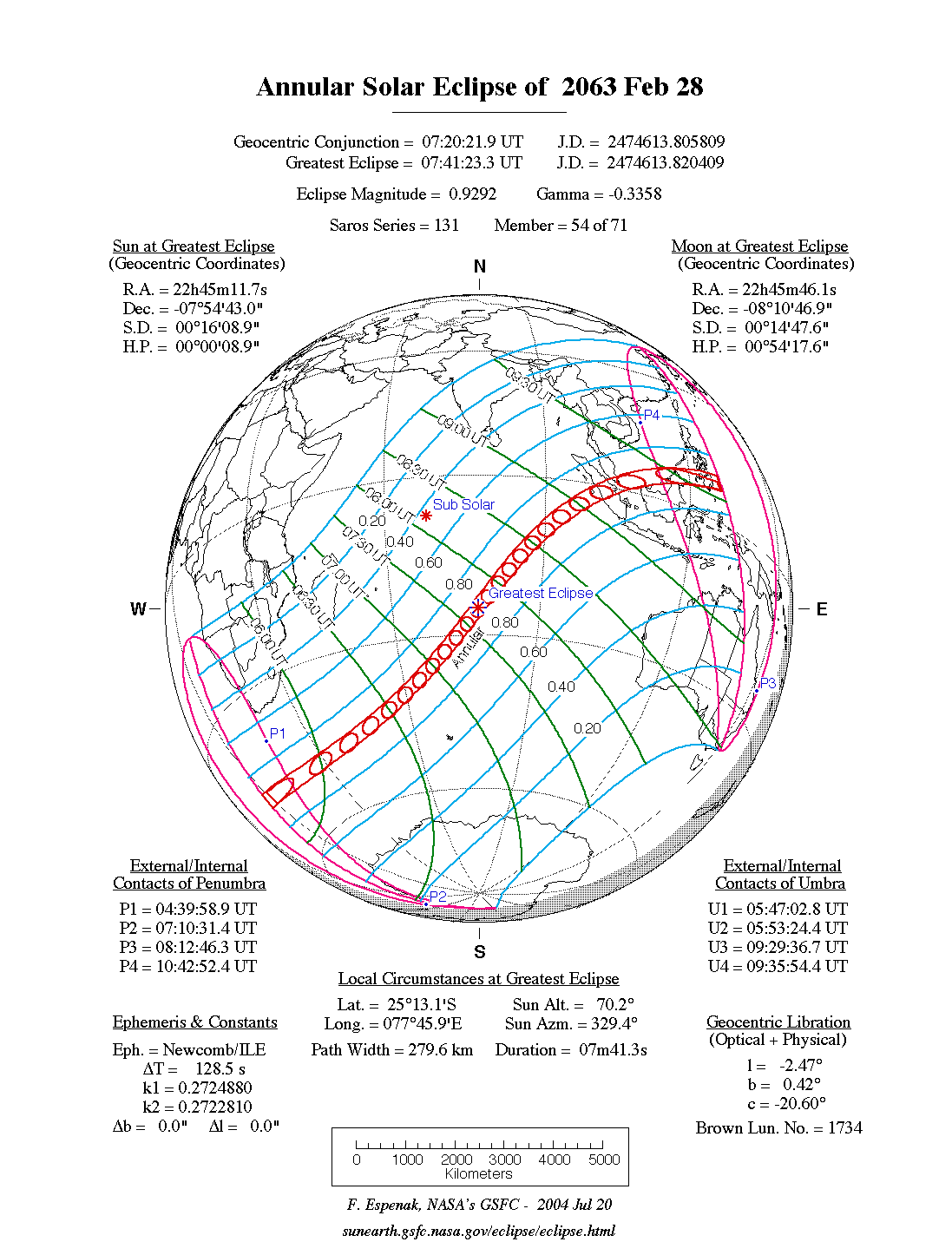
An annular solar eclipse will occur on February 28, 2063. A solar eclipse occurs when the Moon passes between Earth and the Sun, thereby totally or partly obscuring the image of the Sun for a viewer on Earth. An annular solar eclipse occurs when the Moon's apparent diameter is smaller than the Sun's, blocking most of the Sun's light and causing the Sun to look like an annulus (ring). An annular eclipse appears as a partial eclipse over a region of the Earth thousands of kilometres wide.
Related eclipses[edit]
Solar eclipses 2062–2065[edit]
This eclipse is a member of a semester series. An eclipse in a semester series of solar eclipses repeats approximately every 177 days and 4 hours (a semester) at alternating nodes of the Moon's orbit.[1]
| 121 | March 11, 2062 Partial |
126 | September 3, 2062 Partial |
| 131 | February 28, 2063 Annular |
136 | August 24, 2063 Total |
| 141 | February 17, 2064 Annular |
146 | August 12, 2064 Total |
| 151 | February 5, 2065 Partial |
156 | August 2, 2065 Partial |
Saros 131[edit]
It is a part of Saros cycle 131, repeating every 18 years, 11 days, containing 70 events. The series started with partial solar eclipse on August 1, 1125. It contains total eclipses from March 27, 1522 through May 30, 1612 and hybrid eclipses from June 10, 1630 through July 24, 1702, and annular eclipses from August 4, 1720 through June 18, 2243. The series ends at member 70 as a partial eclipse on September 2, 2369. The longest duration of totality was only 58 seconds on May 30, 1612. All eclipses in this series occurs at the Moon’s ascending node.
| Series members 33–70 occur between 1702 and 2369 | ||
|---|---|---|
| 33 | 34 | 35 |
 July 24, 1702 |
 August 4, 1720 |
 August 15, 1738 |
| 36 | 37 | 38 |
 August 25, 1756 |
 September 6, 1774 |
 September 16, 1792 |
| 39 | 40 | 41 |
 September 28, 1810 |
 October 9, 1828 |
 October 20, 1846 |
| 42 | 43 | 44 |
 October 30, 1864 |
 November 10, 1882 |
 November 22, 1900 |
| 45 | 46 | 47 |
 December 3, 1918 |
 December 13, 1936 |
 December 25, 1954 |
| 48 | 49 | 50 |
 January 4, 1973 |
 January 15, 1991 |
 January 26, 2009 |
| 51 | 52 | 53 |
 February 6, 2027 |
 February 16, 2045 |
February 28, 2063 |
| 54 | 55 | 56 |
 March 10, 2081 |
 March 21, 2099 |
 April 2, 2117 |
| 57 | 58 | 59 |
 April 13, 2135 |
 April 23, 2153 |
 May 5, 2171 |
| 60 | 61 | 62 |
 May 15, 2189 |
 May 27, 2207 |
 June 6, 2225 |
| 63 | 64 | 65 |
 June 18, 2243 |
 June 28, 2261 |
 July 9, 2279 |
| 66 | 67 | 68 |
 July 20, 2297 |
 August 1, 2315 |
 August 11, 2333 |
| 69 | 70 | |
 August 22, 2351 |
 September 2, 2369 | |
References[edit]
- ^ van Gent, R.H. "Solar- and Lunar-Eclipse Predictions from Antiquity to the Present". A Catalogue of Eclipse Cycles. Utrecht University. Retrieved 6 October 2018.
External links[edit]
- Graphic, NASA
.jpg)


 | This solar eclipse–related article is a stub. You can help Wikipedia by expanding it. |