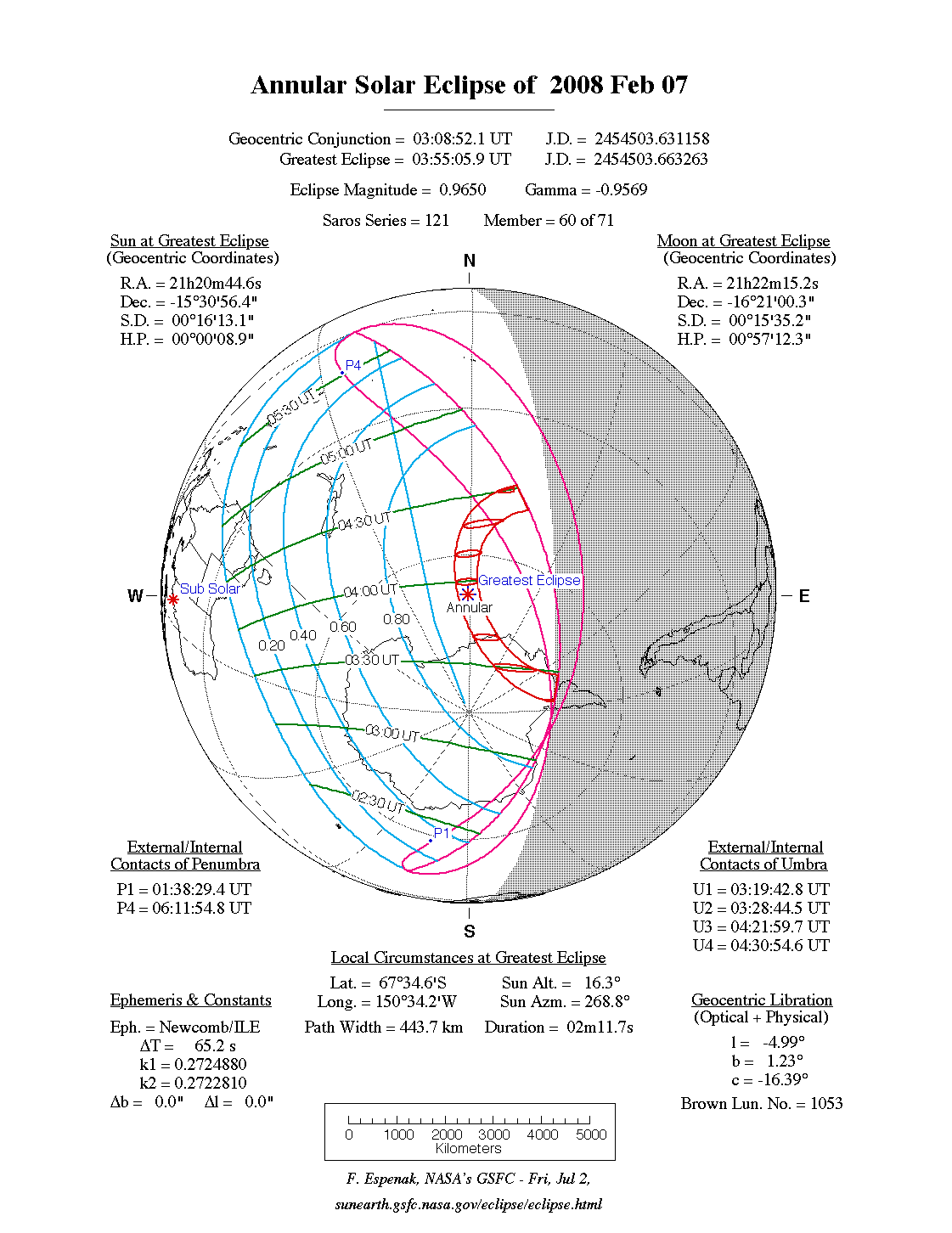
Solar eclipse of February 7, 2008
| Solar eclipse of February 7, 2008 | |
|---|---|
 Partial from Christchurch, New Zealand | |
 Map | |
| Type of eclipse | |
| Nature | Annular |
| Gamma | −0.957 |
| Magnitude | 0.965 |
| Maximum eclipse | |
| Duration | 132 s (2 min 12 s) |
| Coordinates | 67°36′S 150°30′W / 67.6°S 150.5°W |
| Max. width of band | 444 km (276 mi) |
| Times (UTC) | |
| Greatest eclipse | 3:56:10 |
| References | |
| Saros | 121 (60 of 71) |
| Catalog # (SE5000) | 9525 |
An annular solar eclipse occurred at the Moon's ascending node of the orbit on February 7, 2008.[1] A solar eclipse occurs when the Moon passes between Earth and the Sun, thereby totally or partly obscuring the image of the Sun for a viewer on Earth. An annular solar eclipse occurs when the Moon's apparent diameter is smaller than the Sun's, blocking most of the Sun's light and causing the Sun to look like an annulus (ring). An annular eclipse appears as a partial eclipse over a region of the Earth thousands of kilometres wide. Occurring 7 days after apogee (January 31, 2008) and 6.9 days before perigee (February 14, 2008), the Moon's apparent diameter was near the average diameter.
The moon's apparent diameter was 1 arcminute, 17.8 arcseconds (77.8 arcseconds) smaller than the August 1, 2008 total solar eclipse.
This was the first eclipse of the eclipse season, the second being the February 2008 lunar eclipse.
Visibility[edit]
Centrality was visible from parts of Antarctica. A significant partial eclipse was visible over New Zealand and a minor partial eclipse was seen from southeastern Australia.
For most solar eclipses the path of centrality moves eastwards. In this case the path moved west round Antarctica and then north.
Observations[edit]
The best land-based visibility outside of Antarctica was from New Zealand. Professional astronomer and eclipse-chaser Jay Pasachoff observed it from Nelson, New Zealand, 60% coverage, under perfect weather.[2][3]
Images[edit]

Animated path
Gallery[edit]
-
 Partial from McMurdo, Antarctica, 3:23 UTC
 -
 Eclipse projection in Christchurch, New Zealand
.jpg)
.jpg)
Related eclipses[edit]
Eclipses of 2008[edit]
- An annular solar eclipse on February 7.
- A total lunar eclipse on February 21.
- A total solar eclipse on August 1.
- A partial lunar eclipse on August 16.
Solar eclipses 2008–2011[edit]
This eclipse is a member of a semester series. An eclipse in a semester series of solar eclipses repeats approximately every 177 days and 4 hours (a semester) at alternating nodes of the Moon's orbit.[4]
| Ascending node | Descending node | |||||
|---|---|---|---|---|---|---|
| Saros | Map | Gamma | Saros | Map | Gamma | |
| 121 Partial from Christchurch, NZ |
2008 February 07 Annular |
−0.95701 | 126 Novosibirsk, Russia |
2008 August 01 Total |
0.83070 | |
131 Palangka Raya, Indonesia |
2009 January 26 Annular |
−0.28197 | 136 Kurigram, Bangladesh |
2009 July 22 Total |
0.06977 | |
141_Solar_annular_eclipse_of_January_15,_2010_in_Bangui,_Central_African_Republic.JPG) Bangui, Central African Republic |
2010 January 15 Annular |
0.40016 | 146 Hao, French Polynesia |
2010 July 11 Total |
−0.67877 | |
151 Partial from Vienna, Austria |
2011 January 04 Partial (north) |
1.06265 | 156 | 2011 July 01 Partial (south) |
−1.49171 | |
Partial solar eclipses on June 1, 2011, and November 25, 2011, occur on the next lunar year eclipse set.
Saros 121[edit]
Solar saros 121, repeating every about 18 years, 11 days, and 8 hours, contains 71 events. The series started with a partial solar eclipse on April 25, 944. It contains total eclipses from July 10, 1070, to October 9, 1809. It contains hybrid eclipses on October 20, 1827, and October 30, 1845. It contains annular eclipses from November 11, 1863, to February 28, 2044. The series ends at member 71 as a partial eclipse on June 7, 2206. The longest total eclipse occurred on June 21, 1629, with greatest duration of totality at 6 minutes and 20 seconds. The longest annular eclipse will occur on February 28, 2044, with greatest duration of annularity at 2 minutes and 27 seconds.[5]
| Series members 49–65 occur between 1801 and 2100: | ||
|---|---|---|
| 49 | 50 | 51 |
 October 9, 1809 |
 October 20, 1827 |
 October 30, 1845 |
| 52 | 53 | 54 |
 November 11, 1863 |
 November 21, 1881 |
 December 3, 1899 |
| 55 | 56 | 57 |
 December 14, 1917 |
 December 25, 1935 |
 January 5, 1954 |
| 58 | 59 | 60 |
 January 16, 1972 |
 January 26, 1990 |
February 7, 2008 |
| 61 | 62 | 63 |
 February 17, 2026 |
 February 28, 2044 |
 March 11, 2062 |
| 64 | 65 | |
 March 21, 2080 |
 April 1, 2098 | |
Metonic series[edit]
The metonic series repeats eclipses every 19 years (6939.69 days), lasting about 5 cycles. Eclipses occur in nearly the same calendar date. In addition, the octon subseries repeats 1/5 of that or every 3.8 years (1387.94 days). All eclipses in this table occur at the Moon's ascending node.
| 21 eclipse events, progressing from south to north between July 1, 2000 and July 1, 2076 | ||||
|---|---|---|---|---|
| July 1–2 | April 19–20 | February 5–7 | November 24–25 | September 12–13 |
| 117 | 119 | 121 | 123 | 125 |
 July 1, 2000 |
 April 19, 2004 |
February 7, 2008 |
 November 25, 2011 |
 September 13, 2015 |
| 127 | 129 | 131 | 133 | 135 |
 July 2, 2019 |
 April 20, 2023 |
 February 6, 2027 |
 November 25, 2030 |
 September 12, 2034 |
| 137 | 139 | 141 | 143 | 145 |
 July 2, 2038 |
 April 20, 2042 |
 February 5, 2046 |
 November 25, 2049 |
 September 12, 2053 |
| 147 | 149 | 151 | 153 | 155 |
 July 1, 2057 |
 April 20, 2061 |
 February 5, 2065 |
 November 24, 2068 |
 September 12, 2072 |
| 157 | 159 | 161 | 163 | 165 |
 July 1, 2076 |
||||
Notes[edit]
- ^ "Shrinking sun throws off astronomic yardstick: loss of mass deems universal ruler inaccurate". The Ottawa Citizen. 2008-02-08. p. 6. Retrieved 2023-10-25 – via Newspapers.com.
- ^ Solar Eclipse in New Zealand Archived 2011-02-02 at the Wayback Machine, meade4m.com: Advisor/Partner: Jay Pasachoff
- ^ 2008 Annular Eclipse Professor Jay Pasachoff, Williams College--Hopkins Observatory
- ^ van Gent, R.H. "Solar- and Lunar-Eclipse Predictions from Antiquity to the Present". A Catalogue of Eclipse Cycles. Utrecht University. Retrieved 6 October 2018.
- ^ Saros Series Catalog of Solar Eclipses NASA Eclipse Web Site.
References[edit]
- Earth visibility chart and eclipse statistics Eclipse Predictions by Fred Espenak, NASA/GSFC
- shadowandsubstance.com Annular Eclipse of the Sun animated for February 7, 2008
- Photos of solar eclipse around the world
- Animation: Partial solar eclipse from New Zealand [1]
.jpg)