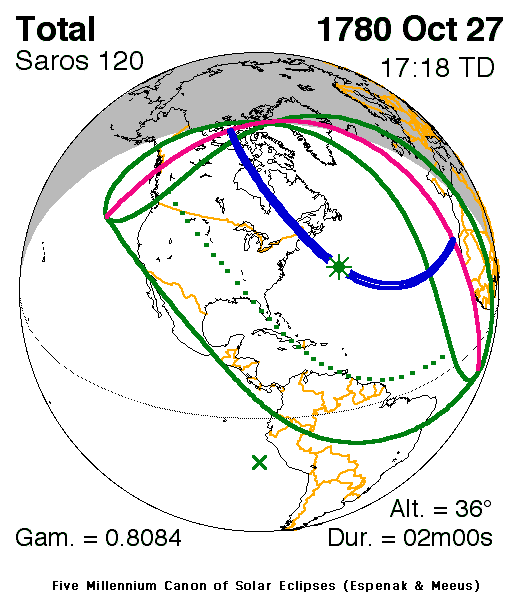
Solar eclipse of October 27, 1780
| Solar eclipse of October 27, 1780 | |
|---|---|
 Map | |
| Type of eclipse | |
| Nature | Total |
| Gamma | 0.8083 |
| Magnitude | 1.0244 |
| Maximum eclipse | |
| Duration | 120 s (2 min 0 s) |
| Coordinates | 35°36′N 58°36′W / 35.6°N 58.6°W |
| Max. width of band | 138 km (86 mi) |
| Times (UTC) | |
| Greatest eclipse | 17:18:27 |
| References | |
| Saros | 120 (48 of 71) |
| Catalog # (SE5000) | 8991 |
A total solar eclipse occurred on October 27, 1780. A solar eclipse occurs when the Moon passes between Earth and the Sun, thereby totally or partly obscuring the image of the Sun for a viewer on Earth. A total solar eclipse occurs when the Moon's apparent diameter is larger than the Sun's, blocking all direct sunlight, turning day into darkness. Totality occurs in a narrow path across Earth's surface, with the partial solar eclipse visible over a surrounding region thousands of kilometres wide.
Observations[edit]
During the American Revolutionary War, the first American solar eclipse expedition was organized and sent out from Harvard College in Massachusetts. A special immunity agreement was negotiated with the British to allow the scientists to work unharmed. The Harvard expedition, after all their efforts, missed the eclipse because they chose a site outside the path of totality. Modern analysis of this embarrassing incident for embryonic American science blames Samuel Williams for miscalculating the path of totality.[1]
Related eclipses[edit]
It is a part of solar Saros 120.
See also[edit]
Notes[edit]
- ^ ECLIPSES IN HISTORY[permanent dead link] by Ken Poshedly
References[edit]
- NASA chart graphics
- Googlemap
- NASA Besselian elements
- Observations of a Solar Eclipse, October 27, 1780, Made at St. John's Island, by Mess'rs. Clarke and Wright, by Joseph Peters 1783 American Academy of Arts & Sciences.
- A Memoir, Containing Observations of a Solar Eclipse of October 27, 1780 by Joseph Willard, 1783
- Where Did the 1780 Eclipse Go? Rothschild, Robert F., Sky and Telescope, 63:558, 1982
.jpg)