


Solar eclipse of November 15, 2096
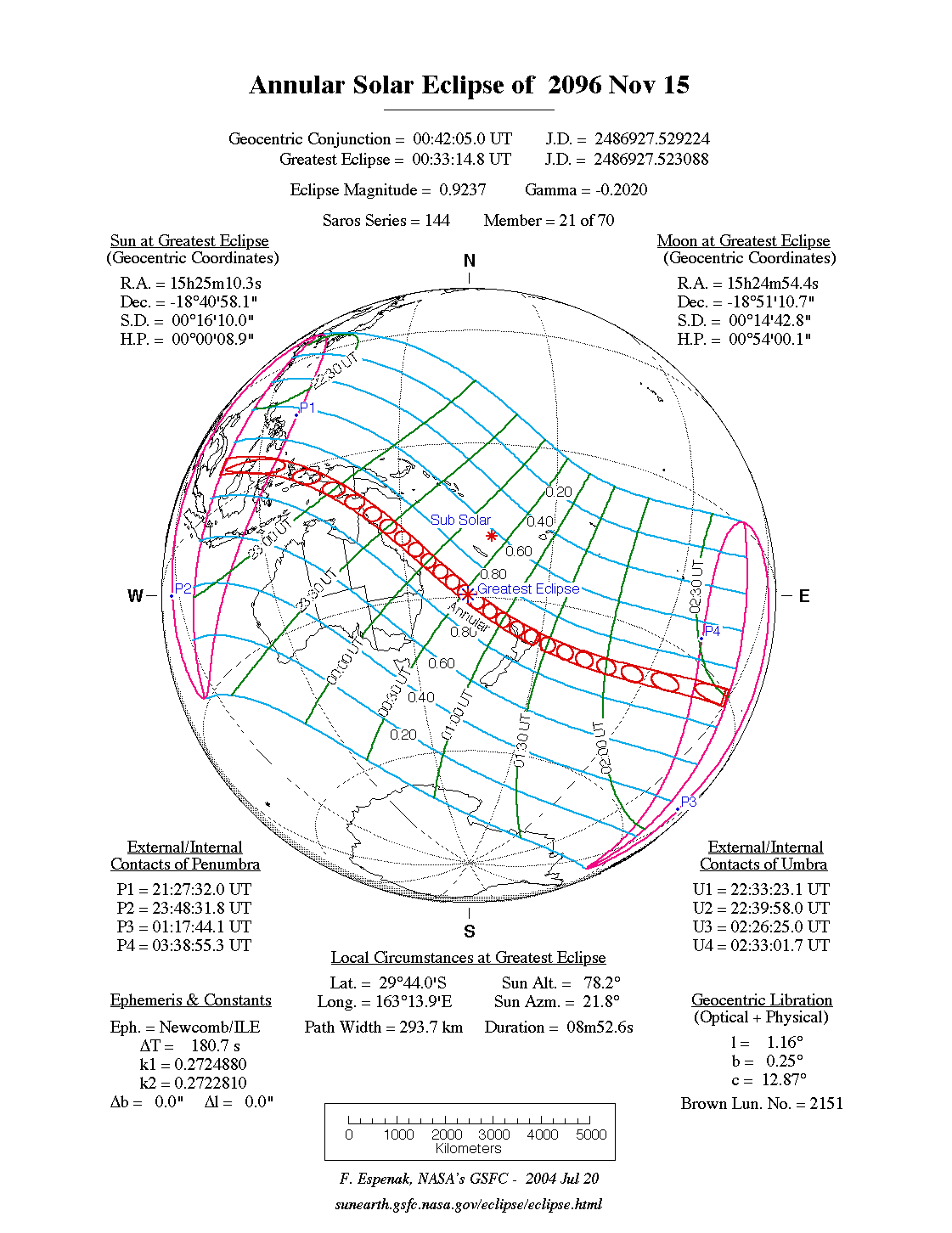
| Solar eclipse of November 15, 2096 | |
|---|---|
 Map | |
| Type of eclipse | |
| Nature | Annular |
| Gamma | −0.20 |
| Magnitude | 0.9237 |
| Maximum eclipse | |
| Duration | 533 s (8 min 53 s) |
| Coordinates | 29°42′S 163°18′E / 29.7°S 163.3°E |
| Max. width of band | 294 km (183 mi) |
| Times (UTC) | |
| Greatest eclipse | 0:36:15 |
| References | |
| Saros | 144 (21 of 70) |
| Catalog # (SE5000) | 9725 |
An annular solar eclipse will occur on Wednesday, November 14 and Thursday, November 15, 2096. A solar eclipse occurs when the Moon passes between Earth and the Sun, thereby totally or partly obscuring the image of the Sun for a viewer on Earth. An annular solar eclipse occurs when the Moon's apparent diameter is smaller than the Sun's, blocking most of the Sun's light and causing the Sun to look like an annulus (ring). An annular eclipse appears as a partial eclipse over a region of the Earth thousands of kilometres wide.
Related eclipses[edit]
Solar eclipses 2094–2098[edit]
This eclipse is a member of a semester series. An eclipse in a semester series of solar eclipses repeats approximately every 177 days and 4 hours (a semester) at alternating nodes of the Moon's orbit.[1]
| 119 | June 13, 2094 Partial |
124 | December 7, 2094 Partial |
| 129 | June 2, 2095 Total |
134 | November 27, 2095 Annular |
| 139 | May 22, 2096 Total |
144 | November 15, 2096 Annular |
| 149 | May 11, 2097 Total |
154 | November 4, 2097 Annular |
| 164 | October 24, 2098 Partial |
Saros 144[edit]
It is a part of Saros cycle 144, repeating every 18 years, 11 days, containing 70 events. The series started with partial solar eclipse on April 11, 1736. It contains annular eclipses from July 7, 1880 through August 27, 2565. There are no total eclipses in the series. The series ends at member 70 as a partial eclipse on May 5, 2980. The longest duration of annularity will be 9 minutes, 52 seconds on December 29, 2168.
| Series members 11–21 occur between 1901 and 2100: | ||
|---|---|---|
| 11 | 12 | 13 |
 Jul 30, 1916 |
 Aug 10, 1934 |
 Aug 20, 1952 |
| 14 | 15 | 16 |
 Aug 31, 1970 |
 Sep 11, 1988 |
 Sep 22, 2006 |
| 17 | 18 | 19 |
 Oct 2, 2024 |
 Oct 14, 2042 |
 Oct 24, 2060 |
| 20 | 21 | |
 Nov 4, 2078 |
Nov 15, 2096 | |
References[edit]
- ^ van Gent, R.H. "Solar- and Lunar-Eclipse Predictions from Antiquity to the Present". A Catalogue of Eclipse Cycles. Utrecht University. Retrieved 6 October 2018.
External links[edit]
- Earth visibility chart and eclipse statistics Eclipse Predictions by Fred Espenak, NASA/GSFC
.jpg)


 | This solar eclipse–related article is a stub. You can help Wikipedia by expanding it. |