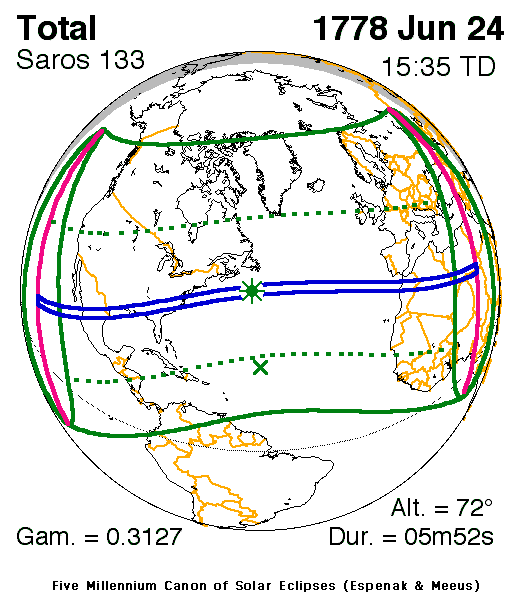
Solar eclipse of June 24, 1778
| Solar eclipse of June 24, 1778 | |
|---|---|
 Map | |
| Type of eclipse | |
| Nature | Total |
| Gamma | 0.3127 |
| Magnitude | 1.0746 |
| Maximum eclipse | |
| Duration | 352 s (5 min 52 s) |
| Coordinates | 41°48′N 55°00′W / 41.8°N 55°W |
| Max. width of band | 255 km (158 mi) |
| Times (UTC) | |
| Greatest eclipse | 15:34:56 |
| References | |
| Saros | 133 (32 of 72) |
| Catalog # (SE5000) | 8985 |
A total solar eclipse occurred on June 24, 1778. A solar eclipse occurs when the Moon passes between Earth and the Sun, thereby totally or partly obscuring the image of the Sun for a viewer on Earth. A total solar eclipse occurs when the Moon's apparent diameter is larger than the Sun's, blocking all direct sunlight, turning day into darkness. Totality occurs in a narrow path across Earth's surface, with the partial solar eclipse visible over a surrounding region thousands of kilometres wide.
The total eclipse was visible in a path across Mexico, southeastern United States, and ended across northern Africa.
Observations[edit]

This was the first total solar eclipse recorded in the United States. The track passed from Lower California to New England. According to Thomas Jefferson, the eclipse was clouded out in Virginia. General George Rogers Clark and his men observed the eclipse as they passed over the Falls of the Ohio on their way to take Kaskaskia during the Illinois Campaign, regarding it as a good omen.[1] U.S. troops marching south through Georgia in an abortive attempt to invade British East Florida also subsequently recorded the event.[2] This solar eclipse lasted four minutes over the middle Atlantic and New England States.[3]
Saros 133[edit]
Solar Saros 133, repeating every 18 years, 11 days, contains 72 events. The series started with a partial solar eclipse on July 13, 1219. It contains annular eclipses from November 20, 1435, through January 13, 1526, with a hybrid eclipse on January 24, 1544. It has total eclipses from February 3, 1562, through June 21, 2373. The series ends at member 72 as a partial eclipse on September 5, 2499. The longest duration of totality was 6 minutes, 49.97 seconds on August 7, 1850.[4] The total eclipses of this saros series are getting shorter and farther south with each iteration. All eclipses in this series occurs at the Moon’s ascending node.
| Series members 30–56 occur between 1742 and 2211 | ||
|---|---|---|
| 30 | 31 | 32 |
| June 3, 1742 | June 13, 1760 | June 24, 1778 |
| 33 | 34 | 35 |
| July 4, 1796 | July 17, 1814 | July 27, 1832 |
| 36 | 37 | 38 |
| August 7, 1850 |  August 18, 1868 |
 August 29, 1886 |
| 39 | 40 | 41 |
 September 9, 1904 |
 September 21, 1922 |
 October 1, 1940 |
| 42 | 43 | 44 |
 October 12, 1958 |
 October 23, 1976 |
 November 3, 1994 |
| 45 | 46 | 47 |
 November 13, 2012 |
 November 25, 2030 |
 December 5, 2048 |
| 48 | 49 | 50 |
 December 17, 2066 |
 December 27, 2084 |
 January 8, 2103 |
| 51 | 52 | 53 |
 January 19, 2121 |
 January 30, 2139 |
 February 9, 2157 |
| 54 | 55 | 56 |
 February 21, 2175 |
 March 3, 2193 |
 March 15, 2211 |
Notes[edit]
- ^ James, George Rogers Clark, 117.
- ^ Revolutionary War Pension Declaration of Sgt Caleb Johnson, Georgia, December 4, 1832, S.7081, U.S. National Archives and Records Administration
- ^ "Solar Eclipse Newsletter, June 2004" (PDF). Retrieved 2013-12-13.
- ^ http://eclipse.gsfc.nasa.gov/SEsaros/SEsaros133.html
References[edit]

- NASA graphic
- Googlemap
- NASA Besselian elements
- Mabel Loomis Todd (1900). Total Eclipses of the Sun. Little, Brown.
- The Solar Corona in the Eclipse of 24 June 1778 Solar Physics: Volume 216, Numbers 1–2 / September, 2003
.jpg)