


Trompe-l'œil

Trompe-l'œil (French for 'deceive the eye'; /trɒmpˈlɔɪ/ tromp-LOY; French: [tʁɔ̃p lœj] ) is an artistic term for the highly realistic optical illusion of three-dimensional space and objects on a two-dimensional surface. Trompe l'œil, which is most often associated with painting, tricks the viewer into perceiving painted objects or spaces as real. Forced perspective is a related illusion in architecture.
History in painting
[edit]
The phrase, which can also be spelled without the hyphen and ligature in English as trompe l'oeil,[1] originates with the artist Louis-Léopold Boilly, who used it as the title of a painting he exhibited in the Paris Salon of 1800.[2] Although the term gained currency only in the early 19th century, the illusionistic technique associated with trompe-l'œil dates much further back.[3] It was (and is) often employed in murals. Instances from Greek and Roman times are known, for instance in Pompeii. A typical trompe l'œil mural might depict a window, door, or hallway, intended to suggest a larger room.
A version of an oft-told ancient Greek story concerns a contest between two renowned painters. Zeuxis (born around 464 BC) produced a still life painting so convincing that birds flew down to peck at the painted grapes. A rival, Parrhasius, asked Zeuxis to judge one of his paintings that was behind a pair of tattered curtains in his study. Parrhasius asked Zeuxis to pull back the curtains, but when Zeuxis tried, he could not, as the curtains were included in Parrhasius's painting—making Parrhasius the winner.[4]

Perspective
[edit]A fascination with perspective drawing arose during the Renaissance. But also Giotto began using perspective at the end of the 13th century with the cycle of Assisi in Saint Francis stories. Many Italian painters of the late Quattrocento, such as Andrea Mantegna (1431–1506) and Melozzo da Forlì (1438–1494), began painting illusionistic ceiling paintings, generally in fresco, that employed perspective and techniques such as foreshortening to create the impression of greater space for the viewer below. This type of trompe l'oeil illusionism as specifically applied to ceiling paintings is known as di sotto in sù, meaning "from below, upward" in Italian. The elements above the viewer are rendered as if viewed from true vanishing point perspective. Well-known examples are the Camera degli Sposi in Mantua and Antonio da Correggio's (1489–1534) Assumption of the Virgin in the Parma Cathedral.
Similarly, Vittorio Carpaccio (1460–1525) and Jacopo de' Barbari (c. 1440 – before 1516) added small trompe l'œil features to their paintings, playfully exploring the boundary between image and reality. For example, a painted fly might appear to be sitting on the painting's frame, or a curtain might appear to partly conceal the painting, a piece of paper might appear to be attached to a board, or a person might appear to be climbing out of the painting altogether—all in reference to the contest of Zeuxis and Parrhasius.
Quadratura
[edit]
Perspective theories in the 17th century allowed a more fully integrated approach to architectural illusion, which when used by painters to "open up" the space of a wall or ceiling is known as quadratura. Examples include Pietro da Cortona's Allegory of Divine Providence in the Palazzo Barberini and Andrea Pozzo's Apotheosis of St Ignatius on the ceiling of the Roman church of Sant'Ignazio in Campo Marzio. The Mannerist and Baroque style interiors of Jesuit churches in the 16th and 17th centuries often included such trompe-l'œil ceiling paintings, which optically "open" the ceiling or dome to the heavens with a depiction of Jesus', Mary's, or a saint's ascension or assumption. An example of a perfect architectural trompe-l'œil is the illusionistic dome in the Jesuit church, Vienna, by Andrea Pozzo, which is only slightly curved, but gives the impression of true architecture.
Trompe-l'œil paintings became very popular in Flemish and later in Dutch painting in the 17th century arising from the development of still life painting. The Flemish painter Cornelis Norbertus Gysbrechts created a chantourné painting showing an easel holding a painting. Chantourné literally means 'cutout' and refers to a trompe l'œil representation designed to stand away from a wall.[5] The Dutch painter Samuel Dirksz van Hoogstraten was a master of the trompe-l'œil and theorized on the role of art as the lifelike imitation of nature in his 1678 book, the Introduction to the Academy of Painting, or the Visible World (Inleyding tot de hooge schoole der schilderkonst: anders de zichtbaere werelt, Rotterdam, 1678).[6][7]
A fanciful form of architectural trompe-l'œil, quodlibet, features realistically rendered paintings of such items as paper knives, playing cards, ribbons, and scissors, apparently accidentally left lying around.[8]
Trompe-l'œil can also be found painted on tables and other items of furniture, on which, for example, a deck of playing cards might appear to be sitting on the table. A particularly impressive example can be seen at Chatsworth House in Derbyshire, where one of the internal doors appears to have a violin and bow suspended from it, in a trompe l'œil painted around 1723 by Jan van der Vaart.[9] Another example can be found in the Painted Hall at the Old Royal Naval College, Greenwich, London. This Wren building was painted by Sir James Thornhill, the first British born painter to be knighted and is a classic example of the Baroque style popular in the early 18th century. The American 19th-century still-life painter William Harnett specialized in trompe-l'œil.
In the 20th century, from the 1960s on, the American Richard Haas and many others painted large trompe-l'œil murals on the sides of city buildings. From the beginning of the 1980s when German artist Rainer Maria Latzke began to combine classical fresco art with contemporary content, trompe-l'œil became increasingly popular for interior murals. The Spanish painter Salvador Dalí utilized the technique for a number of his paintings.[10]
In other art forms
[edit]Trompe-l'œil, in the form of "forced perspective", has long been used in stage-theater set design, so as to create the illusion of a much deeper space than the existing stage. A famous early example is the Teatro Olimpico in Vicenza, with Vincenzo Scamozzi's seven forced-perspective "streets" (1585), which appear to recede into the distance.

Trompe-l'œil is employed in Donald O'Connor's famous "Running up the wall" scene in the film Singin' in the Rain (1952). During the finale of his "Make 'em Laugh" number he first runs up a real wall. Then he runs towards what appears to be a hallway, but when he runs up this as well we realize that it is a large trompe-l'œil mural. More recently, Roy Andersson has made use of similar techniques in his feature films.[11]
Matte painting is a variant of trompe-l'œil, and is used in film production with elements of a scene are painted on glass panels mounted in front of the camera.
Elsa Schiaparelli frequently made use of trompe-l'œil in her designs, most famously perhaps in her Bowknot Sweater, which some consider to be the first use of trompe-l'œil in fashion. The Tears Dress, which she did in collaboration with Salvador Dalí, features both appliqué tears on the veil and tromp-l'œil tears on the dress itself.[12]
Fictional trompe-l'œil appears in many Looney Tunes, such as the Road Runner cartoons, where, for example, Wile E. Coyote paints a tunnel on a rock wall, and Road Runner then races through the fake tunnel. This is usually followed by the coyote's foolishly trying to run through the tunnel after the road runner, only to smash into the hard rock-face. This sight gag was employed in Who Framed Roger Rabbit.
In Chicago's Near North Side, Richard Haas used a 16-story 1929 apartment hotel converted into a 1981 apartment building for trompe-l'œil murals in homage to Chicago school architecture. One of the building's sides features the Chicago Board of Trade Building, intended as a reflection of the building located two miles south.[13][14]
Several contemporary artists use chalk on pavement or sidewalk to create trompe-l'œil works, a technique called street painting or "pavement art". These creations last only until washed away, and therefore must be photographed to be preserved. Practitioners of this form include Julian Beever, Edgar Mueller, Leon Keer, and Kurt Wenner.
The Palazzo Salis of Tirano, Italy, has over centuries and throughout the palace used trompe l'œil in place of more expensive real masonry, doors, staircases, balconies, and draperies to create an illusion of sumptuousness and opulence.[15]
Trompe-l'œil in the form of illusion architecture and Lüftlmalerei is common on façades in the Alpine region.
Trompe l'œil, in the form of "illusion painting", is also used in contemporary interior design, where illusionary wall paintings experienced a renaissance since around 1980. Significant artists in this field are the German muralist Rainer Maria Latzke, who invented, in the 1990s, a new method of producing illusion paintings, frescography, and the English artist Graham Rust.
OK Go's music video for "The Writing's on the Wall" uses a number of trompe-l'œil illusions alongside other optical illusions, captured through a one-shot take.[16] Trompe-l'œil illusions have been used as gameplay mechanics in video games such as The Witness and Superliminal.[17]
Japanese filmmaker and animator Isao Takahata regarded achieving a sense of trompe-l'œil to be important for his work, stating that an animated world should feel as if it "existed right there" so that "people believe in a fantasy world and characters that no one has seen in reality."[18]
Tourists attractions employing large-scale illusory art allowing visitors to photograph themselves in fantastic scenes have opened in several Asian countries, such as the Trickeye Museum and Hong Kong 3D Museum.[19][20] Recently a Trick Art Museum opened in Europe and uses more photographic approaches.[21]
Artists
[edit]

- Cornelis Biltius
- Jacob Biltius
- Donato Bramante
- Petrus Christus
- Antonio da Correggio
- Carlo Crivelli
- Luca Giordano
- Cornelis Norbertus Gysbrechts
- Franciscus Gijsbrechts
- Samuel Dirksz van Hoogstraten
- Andrea Mantegna
- Masaccio
- Jean-Francois de la Motte
- Charles Willson Peale
- Jacobus Plasschaert
- Andrea Pozzo
- Vincenzo Scamozzi
- Giovanni Battista Tiepolo
19th century and modern masters
- Henry Alexander
- Aaron Bohrod
- Louis-Léopold Boilly
- Salvador Dalí
- Walter Goodman
- John Haberle
- William Harnett
- Claude Raguet Hirst
- René Magritte
- John F. Peto
Contemporary
- Ellen Altfest
- Martin Battersby
- Julian Beever
- Daniela Benedini
- Henri Bol
- Henri Cadiou
- Dan Colen
- Piero Fornasetti
- Ronald Francis
- Joanne Gair
- Frederic Gracia
- Richard Haas
- Jonty Hurwitz
- Lorena Kloosterboer
- Rainer Maria Latzke
- Attila Meszlenyi
- István Orosz (Utisz)
- Os Gêmeos, "The Twins"
- Jacques Poirier
- Susan Powers
- John Pugh
- Pierre-Marie Rudelle
- Graham Rust
- Anthony Waichulis
- Kurt Wenner
- Raymond. A. Whyte
- Tavar Zawacki
Paintings
[edit]- Examples of trompe-l'œil paintings
-
 The Annunciation Diptych by Jan van Eyck, detail (c. 1433–1435)
 -
 Portrait of a Carthusian by Petrus Christus (1446). Note the fly near the bottom.
 -
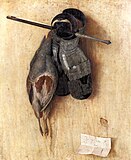 Still-Life with Partridge and Gauntlets by Jacopo de' Barbari, 1504. The first still-life trompe l'œil since antiquity
 -
 Trompe-l'Oeil stem of a Maltese Cross (1561) by Joris Hoefnagel
 -
 Church interior by Gerard Houckgeest (c. 1654)
 -
 Trompe l'oeil Studio Wall with a Vanitas Still Life, Cornelis Norbertus Gijsbrechts, 1664
 -
 The reverse of a framed painting by Cornelis Norbertus Gijsbrechts, 1670
 -
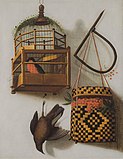 Trompe l'oeil with a bird cage, Cornelis Biltius, 1680s
 -
 Trompe-l'oeil, Jean-François de Le Motte, 1680-1700
 -
 Portrait of François Rivière by Nicola van Houbraken, c. 1700
 -
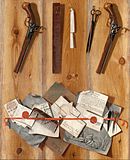 Trompe l´oeil 1737 by Carl Hofverberg
 -
 Trompe l'oeil of a wooden panelling with a painted canvas and print of a landscape capriccio, Jacobus Plasschaert, 1650s
 -
 Printed Pages. Trompe l'œil by Nicolaas de Wit, 1740
 -
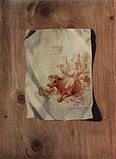 Trompe l'œil by Henry Fuseli, 1750
 -
 Antonio Pérez de Aguilar, Cupboard, c. 1769, National Gallery of Art
 -
 Trompe l'œil dit aux dessins et aux savoyards by Louis-Léopold Boilly, c. 1804–1807
 -
 The Faithful Colt 1890 by William Michael Harnett
 -
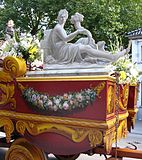 Char de la Ville (photographed 2006) - the "sculpture" is a flat cutout
 -
 Theodor Pištěk, Josef N., (1978), Art Library Project
 -
 Ceiling piece with birds by Abraham Busschop, 1708


.jpg)

Murals
[edit]-
 Complete anamorphosis of the frontage of the Saint-Georges Theatre
 -
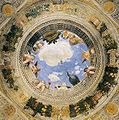 Oculus on the ceiling of the Spouses Chamber, castle of San Giorgio in Mantua, Italy, by Andrea Mantegna
 -
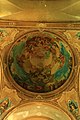 Trompe-l'œil cupola in the church of Brivio, Italy
 -
 Painted windows, Rue de l'Épée/Zwaardstraat, Brussels
 -
 A trompe-l'œil of a pigeon on a window sill, façade mural, rue Emile Lepeu in the 11th arrondissement of Paris, France
 -
 Mural in Schwetzingen, Germany (the view "through" the wall at the end)
 -

-
 Bronze Statues trompe-l'œil in Mt. Pleasant, Utah
 -
 Architectural wall and ceiling trompe-l'œil, Entrance to the library of Chateau Thal, by Rainer Maria Latzke
 -

-
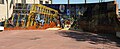 Los Angeles Plaza Historic District: mural off Alameda Street
 -
 Conceptual trompe-l'œil mural at California State University, Chico titled "Academe", featuring Doric columns and crumbling walls, by John Pugh


.jpg)


Sculptures
[edit]-
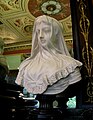 19th-century marble bust with apparently transparent veil, Bankfield Museum, Halifax, West Yorkshire.
 -
 The same bust seen in profile. The effect is consistent from all angles and from close up.
 -
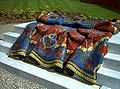 A modern trompe-l'œil mosaic fountain at Brighton, in the form of a carpet thrown over marble steps.
 -
 Tomb of Rudolf Nureyev draped in a mosaic oriental carpet sculpture.


_(8351663480).jpg)
Architecture
[edit]-

-

-
 The interior of Santa Maria presso San Satiro, Milan viewed from the nave
 -
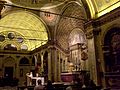 The trompe l'œil choir at Santa Maria presso San Satiro, by Donato Bramante, viewed from the side
 -
 Gallery painted in trompe-l'œil in the Château de Tanlay, France
 -
 Detail of the forced perspective stage scenery of the Teatro Olimpico, as viewed through the porta reggia of the scaenae frons, Vicenza, northern Italy
 -
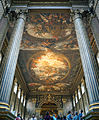 The Painted Hall at the Old Royal Naval College in Greenwich, London, England, designed by Sir Christopher Wren and Nicholas Hawksmoor. The paintings by Sir James Thornhill comprise architectural trompes l'œil; for instance, the Corinthian columns look fluted whilst the far wall depicts pilasters and an entablature. In practice none of these elements exist in the third dimension
 -
 19th-century stained-glass window made for the Henry Gurdon Marquand's mansion in New York


-_Scaenae_frons_close-up_-_La_porta_regia.jpg)


Use in films
[edit]- Singin' in the Rain (1952)
- Willy Wonka & the Chocolate Factory (1971)
- Indiana Jones and the Last Crusade (1989)
- Where the Heart Is (1990)
- Millennium Actress (2001)
- Eternal Sunshine of the Spotless Mind (2004)
- Bewitched (2005)
- Westworld (Season 1, Episode 7) (2016)
See also
[edit]- 2.5D - enhancement of 2-dimensional graphics by limited application of some 3D effects to them
- Bump mapping, normal mapping and parallax mapping - graphical techniques used to add fake details that enhance 2D representations of 3D objects (in the context of that branch of computer graphics that aims to give a realistic 3D view on the screen)
- Camouflage
- Marbling
- Faux painting
- Photorealism
- Anamorphosis
- List of art techniques
Notes
[edit]- ^ For example by the National Gallery of Art, Washington
- ^ Taws, Richard (9 May 2019). "At the National Gallery". London Review of Books 40 (9): 26–27.
- ^ "Illusionism". Grove Art Online. (2003).
- ^ "Parrhasius". Oxford Reference. Retrieved 2022-08-26.
- ^ 'Illusion, Delusion, Collusion, and Perceptual Paradox', in: Michael Kubovy and Christopher Tyler, Psychology of Perspective and Renaissance Art
- ^ Susan Merriam, 'Seventeenth-century Flemish Garland Paintings: Still Life, Vision, and the Devotional Image', Ashgate Publishing, Ltd., 2012
- ^ Thijs Weststeijn, 'The Visible World: Samuel Van Hoogstraten's Art Theory and the Legitimation of Painting in the Dutch Golden Age', Amsterdam University Press, 2008
- ^ Curl, James Stevens (2006). A Dictionary of Architecture and Landscape Architecture (Paperback) (Second ed.). Oxford University Press. pp. 880 pages. ISBN 0-19-860678-8.
- ^ van der Vaardt, Jan. "Violin and bow hanging from door". Devonshire Collection. Chatsworth House UK: Bridgeman Art Library. Archived from the original (Painting) on 21 February 2014. Retrieved 15 April 2012.
- ^ Dali and Postmodernism, p. PA74, at Google Books
- ^ Bateman, Conor (11 June 2015). "A Pigeon Sat on a Branch Reflecting on Existence – An Interview with Cinematographer István Borbás". 4:3. Retrieved 22 July 2015.
- ^ ""The Tears Dress" by Elsa Schiaparelli and Salvador Dalí". 17 April 2018.
- ^ "The City as Artifact". Chicago Historical Society. Retrieved 2007-08-05.
- ^ "Mural, Homage to the Chicago School, by Richard Haas, 1980". Chicago Historical Society. Retrieved 2007-08-05.
- ^ Paull, J. (2015) Tirano's Palace of Trompe L'Oeil: A Photographic Exhibition by John Paull Archived 2015-12-08 at the Wayback Machine SlideShare.
- ^ Plait, Phil (2014-06-17). "The Writing's on the Wall". Slate. Retrieved 2014-06-18.
- ^ Shih, Albert (December 10, 2019). "Perception is Reality: Superliminal Coming to PS4". PlayStation Blog. Retrieved January 6, 2020.
- ^ Kamen, Matt (March 19, 2015). "Studio Ghibli's Isao Takahata on animating his final film". Wired UK. Archived from the original on 2018-04-07. Retrieved April 6, 2018.
- ^ "3-D museums: Next big thing for Asia tourism?". CNBC. 28 August 2014.
- ^ Seow, Bei Yi (13 June 2014). "3-D art wows visitors | the Straits Times". The Straits Times.
- ^ "El museo donde tú eres parte de la obra". ABC. 15 December 2021.
External links
[edit]
- Wade, Nicholas J; Hughes, Patrick (September 1999). "Fooling the Eyes: Trompe L'Oeil and Reverse Perspective". Perception. 28 (9): 1115–1119. doi:10.1068/p281115. PMID 10694961. S2CID 690634.
- Kaufmann, Thomas DaCosta; Kaufmann, Virginia Roehrig (1991). "The Sanctification of Nature: Observations on the Origins of Trompe l'oeil in Netherlandish Book Painting of the Fifteenth and Sixteenth Centuries". The J. Paul Getty Museum Journal. 19: 43–64. JSTOR 4166611.
- Nanay, Bence (March 2015). "Trompe l'oeil and the Dorsal/Ventral Account of Picture Perception". Review of Philosophy and Psychology. 6 (1): 181–197. doi:10.1007/s13164-014-0219-y. hdl:10067/1232140151162165141. S2CID 256075115.
- Deceptions and Illusions, National Gallery of Art exhibition on Trompe-l'œil paintings
- Trompe l'œil Tricks: Borges' Baroque Illusionism, essay by Lois Parkinson Zamora comparing trompe-l'œil to the literature of Borges
- Custom trompe l'œil Paintings, Fresco Blog
- murals.trompe-l-oeil.info Archived 2011-12-12 at the Wayback Machine, More than 10 000 pictures and 1200 Outdoor murals of France and Europe
- Paris: Trompe-l'œil, surréalisme urbain?, Avenue George V. Text and photography by Catherine-Alice Palagret
- "The Mechanics of the Art World," Vistas: Visual Culture in Spanish America, 1520-1820.
- Trick Art Museum: Magic World Museum Barcelona
| Illusions |
|  |
|---|---|---|
| Popular culture |
| |
| Related | ||

| Authority control databases: National |
|---|
