


Dragon's teeth (mythology)

In Greek myth, dragon's teeth (Greek: ὀδόντες (τοῦ) δράκοντος, odontes (tou) drakontos) feature prominently in the legends of the Phoenician prince Cadmus and in Jason's quest for the Golden Fleece. In each case, the dragons are present and breathe fire. Their teeth, once planted, would grow into fully armed warriors.
Myths[edit]
Cadmus and the Spartoi[edit]
Cadmus, the bringer of literacy and civilization, killed the sacred dragon that guarded the spring of Ares. According to the Bibliotheca, Athena gave Cadmus half of the dragon's teeth, advising him to sow them. When he did, fierce armed men, known as Spartoi (Ancient Greek: Σπαρτοί, literal translation: "sown [men]", from σπείρω, speírō, "to sow"), sprang up from the furrows. Cadmus threw a stone among them because he feared them, and they, thinking that the stone had been thrown by one of the others, fought each other until only five of them remained: Echion (future father of Pentheus), Udaeus, Chthonius, Hyperenor and Pelorus. These five helped Cadmus to found the city of Thebes, but Cadmus was forced to be a slave to Ares for eight years to atone for killing the dragon. At the end of the year, he was given Harmonia, the daughter of Aphrodite and Ares, to be his wife.[1]
However, Hellanicus writes that only five Spartoi sprang up, omitting the battle between them. In his version, Zeus had to intervene to save Cadmus from the anger of Ares, who wished to kill him.[2][3] Echion later married Agave, the daughter of Cadmus, and their son Pentheus succeeded Cadmus as king.
Jason[edit]
Similarly, Jason was challenged by King Aeëtes of Colchis to sow dragon's teeth from Athena in order to obtain the Golden Fleece. Medea, Aeëtes' daughter, advised Jason to throw a stone between the warriors that sprang from the earth. The warriors started fighting and killing each other, leaving no survivor but Jason.
Modern references[edit]
The classical legends of Cadmus and Jason have given rise to the phrase "to sow dragon's teeth". This is used as a metaphor to refer to doing something that has the effect of fomenting disputes. In Swedish, the myth is the source of the idiom "draksådd" (dragon-seed) with the meaning of spreading corrupting ideas, or in the broader sense, actions with dire consequences.
Additionally to this phrase, "to the Spartoi, Jason is bad" is another saying that finds its roots from the mythology of the dragon's teeth.[citation needed] Meaning that the creation may see the actions of its creator as detrimental to its own, even though it was begotten by it. This saying stands in contrast to a similar saying about the amphisbaena and Perseus.
John Milton references the myth in his Areopagitica:[4]
"For books are not absolutely dead things, but ...do preserve as in a vial the purest efficacy and extraction of that living intellect that bred them. I know they are as lively, and as vigorously productive, as those fabulous Dragon's teeth; and being sown up and down, may chance to spring up armed men"
Gallery[edit]
-
 Cadmus sowing dragon's teeth; workshop of Peter Paul Rubens, 17th century
 -
 Cadmus Sows the Dragon's Teeth Which Turn into Armed Men, by Hendrik Goltzius, 1615
 -
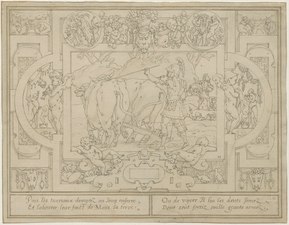 Jason and the Golden Fleece 11: Jason ploughing the earth and sowing the dragon's teeth Thiry, Leonard (ca. 1500–ca. 1550)



References[edit]
- ^ "Apollodorus, Library, book 3, chapter 4". www.perseus.tufts.edu. Retrieved 2023-11-27.
- ^ Gantz, p. 468.
- ^ Scholia on Apollonius of Rhodes, Argonautica 3.1178.
- ^ Milton, John (1644). Areopagitica. Wikisource. p. 12.
- Apollodorus, The Library with an English Translation by Sir James George Frazer, F.B.A., F.R.S. in 2 Volumes, Cambridge, Massachusetts, Harvard University Press; London, England, William Heinemann Ltd. 1921. ISBN 0-674-99135-4. Online version at the Perseus Digital Library. Greek text available from the same website.
- Gantz, Timothy, Early Greek Myth: A Guide to Literary and Artistic Sources, Johns Hopkins University Press, 1996, Two volumes: ISBN 978-0-8018-5360-9 (Vol. 1), ISBN 978-0-8018-5362-3 (Vol. 2).
- Pausanias, Description of Greece with an English Translation by W. H. S. Jones, Litt.D., and H. A. Ormerod, M.A., in 4 Volumes. Cambridge, Massachusetts, Harvard University Press; London, England, William Heinemann Ltd. 1918. ISBN 0-674-99328-4. Online version at the Perseus Digital Library
- Pausanias, Graeciae Descriptio. 3 vols. Leipzig, Teubner. 1903. Greek text available at the Perseus Digital Library.
- Smith, William; Dictionary of Greek and Roman Biography and Mythology, London, England (1873). "Sparti".