


Nymph
_-_Nymphs_and_Satyr_(1873)_HQ.jpg) | |
| Grouping | Mythological |
|---|---|
| Sub grouping | Nature spirit |
| Similar entities | Mermaid, hellois, huldra |
| Country | Greece |
A nymph (Ancient Greek: νύμφη, romanized: nýmphē, Modern Greek: nímfi; Attic Greek: [nýmpʰɛː], Modern Greek: [ˈniɱfi]; sometimes spelled nymphe) is a minor female nature deity in ancient Greek folklore. Distinct from other Greek goddesses, nymphs are generally regarded as personifications of nature, are typically tied to a specific place or landform, and are usually depicted as maidens. They were immortal like other goddesses, except for the Hamadryads, whose lives were bound to a specific tree.[1]
They are often divided into various broad subgroups, such as the Meliae (ash tree nymphs), the Dryads (oak tree nymphs), the Naiads (freshwater nymphs), the Nereids (sea nymphs), and the Oreads (mountain nymphs).[2]
Nymphs are often featured in classic works of art, literature, mythology, and fiction. Since the Middle Ages, nymphs have been sometimes popularly associated or even confused with fairies.
Etymology[edit]
| Greek deities series |
|---|
| Nymphs |
The Greek word nýmphē has the primary meaning of "young woman; bride, young wife" but is not usually associated with deities in particular. Yet the etymology of the noun nýmphē remains uncertain. The Doric and Aeolic (Homeric) form is nýmphā (νύμφα).[3]
Modern usage more often applies to young women, contrasting with parthenos (παρθένος) "a virgin (of any age)", and generically as kore (κόρη < κόρϝα) "maiden, girl". The term is sometimes used by women to address each other and remains the regular Modern Greek term for "bride".
Ancient Greek mythology[edit]

Nymphs were sometimes beloved by many and dwelt in specific areas related to the natural environment: e.g. mountainous regions; forests; springs. Other nymphs were part of the retinue of a god (such as Dionysus, Hermes, or Pan) or of a goddess (generally the huntress Artemis).[4]
The Greek nymphs were also spirits invariably bound to places, not unlike the Latin genius loci, and sometimes this produced complicated myths like the cult of Arethusa to Sicily. In some of the works of the Greek-educated Latin poets, the nymphs gradually absorbed into their ranks the indigenous Italian divinities of springs and streams (Juturna, Egeria, Carmentis, Fontus) while the Lymphae (originally Lumpae), Italian water goddesses, owing to the accidental similarity of their names, could be identified with the Greek Nymphae. The classical mythologies of the Roman poets were unlikely to have affected the rites and cults of individual nymphs venerated by country people in the springs and clefts of Latium. Among the Roman literate class, their sphere of influence was restricted and they appear almost exclusively as divinities of the watery element.[citation needed]
Greek folk religion[edit]
The ancient Greek belief in nymphs survived in many parts of the country into the early years of the twentieth century when they were usually known as "nereids".[5] Nymphs often tended to frequent areas distant from humans but could be encountered by lone travelers outside the village, where their music might be heard, and the traveler could spy on their dancing or bathing in a stream or pool, either during the noon heat or in the middle of the night.[6] They might appear in a whirlwind. Such encounters could be dangerous, bringing dumbness, besotted infatuation, madness or stroke to the unfortunate man. When parents believed their child to be nereid-struck, they would pray to Saint Artemidos.[7][8]
Nymphs and fairies[edit]
Nymphs are often depicted in classic works across art, literature, mythology, and fiction. They are often associated with the medieval romances or Renaissance literature of the elusive fairies or elves.[9][10]
Sleeping nymph[edit]

A motif that entered European art during the Renaissance was the idea of a statue of a nymph sleeping in a grotto or spring.[11][12][13] This motif supposedly came from an Italian report of a Roman sculpture of a nymph at a fountain above the River Danube.[14] The report, and an accompanying poem supposedly on the fountain describing the sleeping nymph, are now generally concluded to be a fifteenth-century forgery, but the motif proved influential among artists and landscape gardeners for several centuries after, with copies seen at neoclassical gardens such as the grotto at Stourhead.[15][16][17]
List[edit]
All the names for various classes of nymphs have plural feminine adjectives, most agreeing with the substantive numbers and groups of nymphai. There is no single adopted classification that could be seen as canonical and exhaustive.[18] Some classes of nymphs tend to overlap, which complicates the task of precise classification. e.g. dryads and hamadryads as nymphs of trees generally, meliai as nymphs of ash trees.[18]
By dwelling or affinity[edit]
The following is not the authentic Greek classification, but is intended as a guide:
| Type / Group / Individuals | Location | Relations and Notes |
|---|---|---|
| Celestial nymphs | ||
| Aurae (breezes) | also called Aetae or Pnoae,[citation needed] daughters of Boreas[19] | |
| Asteriae (stars) | mainly comprising the Atlantides (daughters of Atlas) | |
| 1. Hesperides (evening) | Far West | nymphs of the sunset, the West, and the evening; daughters of Atlas; also had attributes of the Hamadryads[20] |
| • Aegle | ||
| • Arethusa | ||
| • Erytheia (or Eratheis) | mother of Eurytion by Ares[21] | |
| 2. Hyades (star cluster; sent rain) | Boeotia (probably) | daughters of Atlas by either Pleione or Aethra[22] |
| 3. Pleiades | daughters of Atlas and Pleione;[23] constellation; also were classed as Oreads | |
| • Maia | Mt. Cyllene, Arcadia | partner of Zeus and mother of Hermes[24] |
| • Electra | Mt. Saon, Samothrace | mother of Dardanus and Iasion by Zeus[25] |
| • Taygete | Taygetos Mts., Laconia | mother of Lacedaemon by Zeus[26] |
| • Alcyone | Mt. Cithaeron, Boeotia | mother of Hyperes and Anthas by Poseidon[27] |
| • Celaeno | Mt. Cithaeron, Boeotia or Euboea | mother of Lycus and Nycteus by Poseidon[28] |
| • Asterope | Pisa, Elis | mother of Oenomaus by Ares[29] |
| • Merope | Corinth | wife of Sisyphus and mother of Glaucus[30] |
| Nephele (clouds) | daughters of Oceanus[31] and/or Tethys[32] or of Aither[33] | |
| Land nymphs | ||
| Alseides (groves) | [34] | |
| Auloniades (valley pastures, glens) | ||
| Leimakides or Leimonides (meadows) | ||
| Napaeae (dells) | [35] | |
| Oreads (mountains, grottoes), also Orodemniades | ||
| Wood and plant nymphs | ||
| Anthousai (flowers) | ||
| Dryades (trees) | ||
| Hamadryades or Hadryades | ||
| 1. Daphnaeae (laurel tree) | ||
| 2. Epimeliades or Epimelides (apple tree; also protected flocks) | other name variants include Meliades, Maliades and Hamameliades; same as these are also the Boucolai (Pastoral Nymphs) | |
| 3. Kissiae (ivy) | ||
| 4. Meliae (manna-ash tree) | born from the drops of blood that fell on Gaia when Cronus castrated Uranus[36] | |
| Hyleoroi (watchers of woods) | ||
| Water nymphs (Hydriades or Ephydriades) | ||
| Haliae (sea and seashores) | ||
| 1. Nereids | Mediterranean Sea | 50 daughters of Nereus and Doris[37] |
| Naiads, Naides (fresh water) | ||
| 1. Crinaeae (fountains) | ||
| 2. Eleionomae (wetlands) | ||
| 3. Limnades, Limnatides (lakes) | ||
| 4. Pegaeae (springs) | ||
| 5. Potameides (rivers) | ||
| Oceanids | daughters of Oceanus and Tethys,[38] any freshwater, typically clouds and rain. see List of Oceanids | |
| Underworld nymphs | ||
| Lampades | Hades | torch bearers in the retinue of Hecate |
| • Orphne | is a representation of the darkness of the river Styx, the river of hatred, but is not to be confused with the goddess Styx herself nor with Nyx, goddess of night, despite being associated with both. She is the consort of Acheron, (the god of the river in Hades), and the mother of Ascalaphus, (the orchardist of Hades).[39] | |
| • Leuce (white poplar tree) | daughter of Oceanus and lover of Hades[40] | |
| • Melinoe | Orphic nymph, daughter of Persephone and "Zeus disguised as Pluto".[41] Her name is a possible epithet of Hecate. | |
| • Minthe (mint) | Cocytus River | probably a daughter of Cocytus, lover of Hades and rival of Persephone[42][43] |
| Other nymphs | ||
| Hecaterides (rustic dance) | daughters of Hecaterus by a daughter of Phoroneus; sisters of the Dactyls and mothers of the Oreads and the Satyrs[44] | |
| Kabeirides | daughters of Cadmilus and sisters of the Kabeiroi[45] or of Hephaestus and Cabeiro[46] | |
| Maenads or Bacchai or Bacchantes | frenzied nymphs in the retinue of Dionysus | |
| 1. Lenai (wine-press) | ||
| 2. Mimallones (music) | ||
| 4. Thyiai or Thyiades (thyrsus bearers) | ||
| Melissae (honey) | likely a subgroup of Oreades or Epimelides | |
By location[edit]
The following is a list of individual nymphs or groups thereof associated with this or that particular location. Nymphs in such groups could belong to any of the classes mentioned above (Naiades, Oreades, and so on).
| Groups and Individuals | Location | Relations and Notes |
|---|---|---|
| Aeaean Nymphs | Aeaea Island | handmaidens of Circe |
| Aegaeides | Aegaeus River on the island of Scheria | |
| Aesepides | Aesepus River in Anatolia | |
| • Abarbarea | ||
| Acheloides | Achelous River in Acarnania | |
| • Callirhoe, second wife of Alcmaeon | ||
| Acmenes | Stadium in Olympia, Elis | |
| Amnisiades | Amnisos River on the island of Crete | entered the retinue of Artemis |
| Anigrides | Anigros River in Elis | believed to cure skin diseases |
| Asopides | Asopus River in Sicyonia and Boeotia | |
| • Aegina | Island of Aegina | mother of Menoetius by Actor, and Aeacus by Zeus |
| • Asopis | ||
| • Chalcis | Chalcis, Euboea | regarded as the mother of the Curetes and Corybantes; perhaps the same as Combe and Euboea |
| • Cleone | Cleonae, Argos | one of the daughters of Asopus |
| • Combe | Island of Euboea | consort of Socus and mother by him of the seven Corybantes |
| • Corcyra | Island of Corcyra | mother of Phaiax by Poseidon |
| • Euboea | Island of Euboea | abducted by Poseidon; perhaps the same as Chalcis and Combe above |
| • Harpina | Pisa, Elis | mother of Oenomaus by Ares |
| • Ismene | Ismenian spring of Thebes, Boeotia | wife of Argus, eponymous king of Argus and thus, mother of Argus Panoptes and Iasus. |
| • Nemea | Nemea, Argolis | others called her the daughter of Zeus and Selene |
| • Oeroe or Plataia | Plataea, Boeotia | carried off by Zeus |
| • Ornea | Ornia, Sicyon | |
| • Peirene | Corinth | others called her father to be Oebalus or Achelous by Poseidon she became the mother of Lecheas and Cenchrias |
| • Salamis | Island of Salamis | mother of Cychreus by Poseidon |
| • Sinope | Sinope, Anatolia | mother of Syrus by Apollo |
| • Tanagra | Tanagra, Boeotia | mother of Leucippus and Ephippus by Poemander |
| • Thebe | Thebes, Boeotia | wife of Zethus and also said to have consorted with Zeus |
| • Thespeia | Thespia, Boeotia | abducted by Apollo |
| Astakides | Lake Astacus, Bithynia | appeared in the myth of Nicaea |
| • Nicaea | Nicaea, Bithynia | |
| Asterionides | Asterion River, Argos | daughters of the river god Asterion; nurses of the infant goddess Hera |
| • Acraea | ||
| • Euboea | ||
| • Prosymna | ||
| Carian Naiades (Caria) | Caria | |
| • Salmacis | Halicarnassus, Caria | |
| Nymphs of Ceos | Island of Ceos | |
| Corycian Nymphs (Corycian Cave) | Corycian cave, Delphi, Phocis | daughters of the river god Pleistos |
| • Kleodora (or Cleodora) | Mt. Parnassus, Phocis | mother of Parnassus by Poseidon |
| • Corycia | Corycian cave, Delphi, Phocis | mother of Lycoreus by Apollo |
| • Daphnis | Mt. Parnassus, Phocis | |
| • Melaina | Dephi, Phocis | mother of Delphos by Apollo |
| Cydnides | River Cydnus in Cilicia | |
| Cyrenaean Nymphs | City of Cyrene, Libya | |
| Cypriae Nymphs | Island of Cyprus | |
| Cyrtonian Nymphs | Town of Cyrtone, Boeotia | Κυρτωνιαι |
| Deliades | Island of Delos | daughters of Inopus, god of the river Inopus |
| Dodonides | Oracle at Dodona | |
| Erasinides | Erasinos River, Argos | daughters of the river god Erasinos; attendants of the goddess Britomartis. |
| • Anchiroe | ||
| • Byze | ||
| • Maera | ||
| • Melite | ||
| Nymphs of the river Granicus | River Granicus | daughters of the river-god Granicus |
| • Alexirhoe | mother of Aesacus by Priam | |
| • Pegasis | mother of Atymnios by Emathion | |
| Heliades | River Eridanos | daughters of Helios who were changed into trees |
| Himeriai Naiades | Local springs at the town of Himera, Sicily | |
| Hydaspides | Hydaspers River, India | nurses of infant Zagreus |
| Idaean Nymphs | Mount Ida, Crete | nurses of infant Zeus |
| • Ida | ||
| • Adrasteia | ||
| Inachides | Inachos River, Argos | daughters of the river god Inachus |
| • Io | mother of Epaphus by Zeus | |
| • Amymone | ||
| • Philodice | wife of Leucippus of Messenia by whom she became the mother of Hilaeira, Phoebe and possibly Arsinoe | |
| • Messeis | ||
| • Hyperia | ||
| • Mycene | wife of Arestor and by him probably the mother of Argus Panoptes; eponym of Mycenae | |
| Ionides | Kytheros River in Elis | daughters of the river god Cytherus |
| • Calliphaea | ||
| • Iasis | ||
| • Pegaea | ||
| • Synallaxis | ||
| Ithacian Nymphs | Local springs and caves on the island of Ithaca | |
| Ladonides | Ladon River | |
| Lamides or Lamusides | Lamos River in Cilicia | possible nurses of infant Dionysus |
| Leibethrides | Mounts Helicon and Leibethrios in Boeotia; or Mount Leibethros in Thrace) | |
| • Libethrias | ||
| • Petra | ||
| Lelegeides | Lycia, Anatolia | |
| Lycaean Nymphs | Mount Lycaeus | nurses of infant Zeus, perhaps a subgroup of the Oceanides |
| Melian Nymphs | Island of Melos | transformed into frogs by Zeus; not to be confused with the Meliae (ash tree nymphs |
| Mycalessides | Mount Mycale in Caria, Anatolia | |
| Mysian Nymphs | Spring of Pegai near Lake Askanios in Bithynia | who abducted Hylas |
| • Euneica | ||
| • Malis | ||
| • Nycheia | ||
| Naxian Nymphs | Mount Drios on the island of Naxos | nurses of infant Dionysus; were syncretized with the Hyades |
| • Cleide | ||
| • Coronis | ||
| • Philia | ||
| Neaerides | Thrinacia Island | daughters of Helios and Neaera, watched over Helios' cattle |
| Nymphaeides | Nymphaeus River in Paphlagonia | |
| Nysiads | Mount Nysa | nurses of infant Dionysos, identified with Hyades |
| Ogygian Nymphs | Island of Ogygia | four handmaidens of Calypso |
| Ortygian Nymphs | Local springs of Syracuse, Sicily | named for the island of Ortygia |
| Othreides | Mount Othrys | a local group of Hamadryads |
| Pactolides | Pactolus River | |
| • Euryanassa | wife of Tantalus | |
| Pelionides | Mount Pelion | nurses of the Centaurs |
| Phaethonides | a synonym for the Heliades | |
| Phaseides | Phasis River | |
| Rhyndacides | Rhyndacus River in Mysia | daughters of the river god Rhyndacus |
| Sithnides | Fountain at the town of Megara | |
| Spercheides | River Spercheios | one of them, Diopatra, was loved by Poseidon and the others were changed by him into trees |
| Sphragitides, or Cithaeronides | Mount Cithaeron | |
| Tagids, Tajids, Thaejids or Thaegids | River Tagus in Portugal and Spain | |
| Thessalides | Peneus River in Thessaly | |
| Thriae | Mount Parnassos | prophets and nurses of Apollo |
| Trojan Nymphs | Local springs of Troy |
Others[edit]
The following is a selection of names of the nymphs whose class was not specified in the source texts. For lists of Naiads, Oceanids, Dryades etc., see respective articles.
| Names | Location | Relations and Notes |
|---|---|---|
| Alphesiboea | India | loved by Dionysus[47] |
| Aora | Crete | eponym of the town Aoros in Crete[48] |
| Areia | daughter of Cleochus and mother of Miletus by Apollo[49] | |
| Astyoche | one of the Danaïdes, and the mother of Chrysippus by Pelops[50] | |
| Axioche or Danais | Elis | mother of Chrysippus by Pelops[51][52] |
| Brettia | Mysia | eponym of Abrettene, Mysia[53] |
| Brisa | brought up the god Dionysus[54] | |
| Calybe | Troy | mother of Bucolion, Laomedon[55] |
| Carmentis or Carmenta | Arcadia | She had a son with Hermes, called Evander. Her son was the founder of Pallantium, one of the cities that was merged later into ancient Rome.[56] |
| Chalcea | mother of Olympus by Zeus[57] | |
| Chania | a lover of Heracles | |
| Chariclo | Thebes | mother of Tiresias by Everes[58] |
| Charidia | mother of Alchanus by Zeus[57] | |
| Chryse | Lemnos | fell in love with Philoctetes[59] |
| Cirrha | Phocis | eponym of Cirrha in Phocis[60] |
| Clymene | mother of Tlesimenes by Parthenopaeus[61] | |
| Cretheis | briefly mentioned in Suda[62] | |
| Crimisa | Italy | eponym of a city in Italy[63] |
| Deiopea | one of Hera's nymphs who was promised to Aeolus[64] | |
| Dodone | Dodona | eponym of Dodona[65] |
| Echemeia | Cos | spelled "Ethemea" by Hyginus, consort of Merops[66] |
| Eidothea | Mt. Othrys | mother by Eusiros of Cerambus[67] |
| Eunoë | Phrygia | possible mother of Hecuba by Dymas[68] |
| Eunoste | Boeotia (possibly) | nurse of Eunostus[69] |
| Euryte | Athens | mother of Halirrhothius by Poseidon[70] |
| Harmonia | Akmonian Wood, near Themiscyra | mother of the Amazons by Ares[71][72] |
| Hegetoria | Rhodes | consort of Ochimus[73] |
| Hemera | mother of Iasion by Zeus | |
| Himalia | Rhodes | mother of Cronius, Spartaios, and Cytos by Zeus[74] |
| Hyale | belongs to the train of Artemis[75] | |
| Hyllis | Argos | possible eponym of the tribe Hylleis and the city Hylle[76] |
| Idaea | Crete | mother of Cres[77] and Asterion[57] by Zeus |
| Idaea | Mt. Ida, Troad | mother of Teucer by Scamander[78] |
| Ithome | Messenia | one of the nurses of Zeus[79] |
| Laodice | Argolis (possibly) | mother of Apis by Phoroneus[citation needed] |
| Leucophryne | Magnesia (possibly) | priestess of Artemis Leucophryne |
| Ligeia | ||
| Linos | mother of Pelops by Atlas in some accounts[80] | |
| Lotis | pursued by Priapus and was changed into a tree that bears her name[81] | |
| Ma | nymph in the suite of Rhea who nursed Zeus | |
| Melanippe | Attica (possibly) | married Itonus, son of Amphictyon[82] |
| Melissa | Crete | nurse of Zeus[83] |
| Mendeis | Thrace | consort of Sithon[84] |
| Menodice | daughter of Orion and mother of Hylas by Theiodamas[85] | |
| Methone | Pieria | mother of Oeagrus by King Pierus of Emathia[86] |
| Myrmex | Attica | beloved companion of Athena whom she turned into an ant[87] |
| Nacole | Phrygia | eponym of Nacoleia in Phrygia[88] |
| Neaera | Thrinacia | mother of Lampetia and Phaethusa by Helios[89] |
| Neaera | mother of Aegle by Zeus[citation needed] | |
| Neaera | Lydia | mother of Dresaeus by Theiodamas[90] |
| Nymphe | Samothrace | mother of Saon by Zeus[91] |
| Oeneis | mother of Pan by Hermes[92] | |
| Oinoie | Sicinus | mother of Sicinus by Thoas[93] |
| Olbia | Bithynia | mother of Astacus by Poseidon[94] |
| Paphia | possibly the mother of Cinyras by Eurymedon[95] | |
| Pareia | Paros | mother of four sons by Minos[96] |
| Polydora | one of the Danaïdes[97] | |
| Pyronia | mother of Iasion by Minos | |
| Psalacantha | Icaria | changed into a plant by Dionysus[98] |
| Rhene | Mt. Cyllene, Arcadia | consorted with Oileus[99] |
| Semestra | Thrace | nurse of Keroessa[100] |
| Teledice | Argolis (possibly) | a consort of Phoroneus[101] |
| Thalia | Sicily | mother of the Palici by Zeus[102] |
| Thisbe | Boeotia | eponym of the town of Thisbe[103] |
| Tithorea | Mt. Parnassus, Phocis | eponym of the town of Tithorea (previously called Neon)[104] |
In non-Greek tales influenced by Greek mythology[edit]
- Sabrina (the river Severn)
- Tágides (Tagus River)
Gallery[edit]
-
-
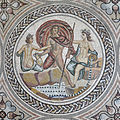
 Fight between Nymph and Satyr, Naples National Archaeological Museum
 -

-
-
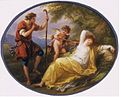 A Sleeping Nymph Watched by a Shepherd by Angelica Kauffman (about 1780, V&A Museum no. 23-1886)
 -
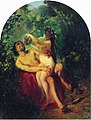 Satyr and nymph by Konstantin Makovsky (1864)
 -
 Nymphs and Satyr by William-Adolphe Bouguereau (1873)
 -
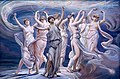 The Pleiades by Elihu Vedder (1885)
 -
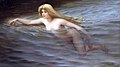 A naiad by Luis Ricardo Falero (1892)
 -
 The Souls of Acheron by Adolf Hirémy-Hirschl (1898)
 -
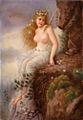 Young oread, on German porcelain plate (late 19th century)
 -

-
 Echo, an Oread (mountain nymph) watches Narcissus in this 1903 painting of Echo and Narcissus by John William Waterhouse
 -
 Nymph with morning glory flowers by Jules Joseph Lefebvre
 -
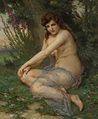 La Nymphe de la Foret by Guillaume Seignac
 -
 Statue of a Nymph with Cornucopia by Đorđe Jovanović in Dunavski park, Novi Sad (1912)
 -
 Nymphe by Gaston Bussière (1929)


.jpg)


See also[edit]
Notes[edit]
- ^ Parad, Carlos; Förlag, Maicar (1997). "Genealogical Guide to Greek Mythology: Nymphs". Astrom Editions. Retrieved 25 May 2019.
- ^ Grimal, p. 313, s.v. Nymphs.
- ^ "Online Etymology Dictionary". etymonline.com.
- ^ Larson, Jennifer (1997). "Handmaidens of Artemis?". The Classical Journal. 92 (3): 249–257. JSTOR 3298110.
- ^ Lawson, John Cuthbert (1910). Modern Greek Folklore and Ancient Greek Religion (1st ed.). Cambridge: Cambridge University Press. p. 131.
- ^ Lee, D. Demetracopoulou (1936). "Folklore of the Greeks in America". Folklore. 47 (3): 294–310. doi:10.1080/0015587X.1936.9718647. JSTOR 1256865 – via JSTOR.
- ^ "Heathen Artemis yielded her functions to her own genitive case transformed into Saint Artemidos", as Terrot Reaveley Glover phrased it in discussing the "practical polytheism in the worship of the saints", in Progress in Religion to the Christian Era 1922:107.
- ^ Tomkinson, John L. (2004). Haunted Greece: Nymphs, Vampires and Other Exotika (1st ed.). Athens: Anagnosis. chapter 3. ISBN 978-960-88087-0-6.
- ^ Kready, Laura (1916). A Study of Fairy Tales. Boston: Houghton Mifflin Company.
- ^ Briggs, Katharine Mary (1976). "Euphemistic names for fairies". An Encyclopedia of Fairies. New York: Pantheon Books. ISBN 0-394-73467-X.
- ^ "The Nymph of the Spring". National Gallery of Art. Retrieved 23 September 2016.
- ^ Stephen John Campbell (2004). The Cabinet of Eros: Renaissance Mythological Painting and the Studiolo of Isabella D'Este. Yale University Press. pp. 95–6. ISBN 978-0-300-11753-0.
- ^ Maryan Wynn Ainsworth; Joshua P. Waterman; Dorothy Mahon (2013). German Paintings in the Metropolitan Museum of Art, 1350-1600. Metropolitan Museum of Art. pp. 95–6. ISBN 978-1-58839-487-3.
- ^ Jay A. Levenson; National Gallery of Art (U.S.) (1991). Circa 1492: Art in the Age of Exploration. Yale University Press. p. 260. ISBN 978-0-300-05167-4.
- ^ Leonard Barkan (1999). Unearthing the Past: Archaeology and Aesthetics in the Making of Renaissance Culture. Yale University Press. pp. 237–8. ISBN 978-0-300-08911-0.
- ^ Elisabeth B. MacDougall (January 1994). Fountains, Statues, and Flowers: Studies in Italian Gardens of the Sixteenth and Seventeenth Centuries. Dumbarton Oaks. pp. 37–56. ISBN 978-0-88402-216-9.
- ^ Kenneth Gross (1992). The Dream of the Moving Statue. Cornell University Press. pp. 170–175. ISBN 978-0-8014-2702-2.
- ^ a b Rose, Herbert Jennings (1959). A Handbook of Greek Mythology (1st ed.). New York: E. P. Dutton. p. 173. ISBN 978-0-525-47041-0.
- ^ Quintus Smyrnaeus, 1.683 ff.
- ^ Diodorus Siculus, 4.26.2
- ^ Stesichorus, Geryoneis Frag S8
- ^ Hyginus, Fabulae 192
- ^ Apollodorus, 3.10.1
- ^ Hesiod, Theogony 938
- ^ Apollodorus, 3.12.1
- ^ Hyginus, Fabulae 155
- ^ Pausanias, 2.30.8
- ^ Apollodorus, 3.10.1
- ^ Hyginus, Fabulae 84
- ^ Hyginus, Astronomica 2.21
- ^ Aristophanes, Clouds 264
- ^ Orphic Hymn 22
- ^ Aristophanes, Clouds 563
- ^ Homer, Iliad 20.4
- ^ Statius, Thebaid 9.385
- ^ Hesiod, Theogony 182–187
- ^ Hesiod, Theogony 240-262
- ^ Hesiod, Theogony 365–366
- ^ Ovid, Metamorphoses 5.539 ff
- ^ Servius, Commentary on Virgil's Aeneid 7.61
- ^ Orphic Hymn 71
- ^ Oppian, Halieutica 3.485 ff
- ^ Strabo, 8.3.14
- ^ Strabo, 10.3.19
- ^ Acusilaus Frag as cited in Strabo, 10.3.21
- ^ Strabo, 10.3.21 citing Pherecydes
- ^ Pseudo-Plutarch, De fluviis 24
- ^ Stephanus of Byzantium, Ethnica s.v. Aōros
- ^ Apollodorus, 3.1.2
- ^ Robert Graves. The Greek Myths, section 110 s.v. The Children of Pelops
- ^ Scholia on Euripides, Orestes, 4; on Pindar, Olympian Ode 1.144
- ^ Plutarch, Parallela minora 33
- ^ Stephanus of Byzantium, s.v. Abrettēnē
- ^ Schol. ad Pers. Sat. i. 76.
- ^ Apollodorus, 3.12.3
- ^ "Dionysius of Halicarnassus, Roman Antiquities, 2.1".
- ^ a b c Pseudo-Clement, Recognitions 10.21–23
- ^ Apollodorus, 3.6.7
- ^ Sophocles, Philoctetes 1327
- ^ Pausanias, 10.37.5
- ^ Hyginus, Fabulae 71
- ^ Suida, s.v. Kretheus
- ^ Stephanus of Byzantium, s.v. Krimisa
- ^ Virgil, Aeneid 1.71-75
- ^ Stephanus of Byzantium, s.v. Dodone
- ^ Hyginus, Astronomica 2.16.2
- ^ Antoninus Liberalis, 22 vs Cerambus
- ^ Scholia on Homer's Iliad 16. 718 with Pherecydes as the authority
- ^ Plutarch, Quaestiones Graecae 40
- ^ Apollodorus, 3.14.2
- ^ "Apollonius Rhodius, Argonautica, Book 2".
- ^ "ARGONAUTICA BOOK 2".
- ^ Diodorus Siculus, 5.57.7
- ^ Diodorus Siculus, 5.55.5
- ^ Ovid, Metamorphoses 3.155
- ^ Stephanus of Byzantium, s.v. Hylleis
- ^ Stephanus of Byzantium, s.v. Krētē
- ^ Apollodorus, 3.12.1
- ^ Pausanias, 4.33.1
- ^ Robert Graves. The Greek Myths, section 108 s.v. Tantalus
- ^ Ovid, Fasti 1.416 & 1.423; Metamorphoses, 9.347
- ^ Pausanias, 9.1.1
- ^ Lactantius, Divine Institutes 1.22.3
- ^ Conon, Narrations 10
- ^ Hyginus, Fabulae 14
- ^ Of the Origin of Homer and Hesiod and their Contest, Fragment 1. Translated by Evelyn-White.
- ^ William Smith. A Dictionary of Greek and Roman biography and mythology s.v. Myrmex
- ^ Suida, s.v. Nakoleia
- ^ Homer, Odyssey 12.133 ff
- ^ Quintus Smyrnaeus, 1.290–291
- ^ Dionysius of Halicarnassus, Antiquitates Romanae 1.61.3
- ^ Scholiast ad Theocritus, 1.3
- ^ Apollonius Rhodius, Argonautica 1.620 ff with scholia on 1.623
- ^ Stephanus of Byzantium, s.v. Astakos
- ^ Scholia on Pindar, Pythian Ode 2.28
- ^ Apollodorus, 3.1.2
- ^ Antoninus Liberalis, 32
- ^ Ptolemy Hephaestion, New History 5 in Photius, Myrobiblion 190
- ^ Homer, Iliad 2.728
- ^ "Dionysius of Byzantium, Anaplous of the Bosporos, §24".
- ^ Apollodorus, 2.1.1
- ^ Macrobius, Saturnalia 5.19.15
- ^ Pausanias, 9.32.3
- ^ Pausanias, 10.32.9
References[edit]
- Burkert, Walter (1985). Greek Religion (1st ed.). Cambridge, MA: Harvard University Press. ISBN 978-0-674-36281-9.
- Grimal, Pierre, The Dictionary of Classical Mythology, Wiley-Blackwell, 1996. ISBN 978-0-631-20102-1.
- Larson, Jennifer Lynn (2001). Greek Nymphs: Myth, Cult, Lore. New York: Oxford University Press. ISBN 978-0-19-514465-9.
- Lawson, John Cuthbert, Modern Greek Folklore and Ancient Greek Religion, Cambridge University Press, Cambridge, 1910, p. 131
- paleothea.com homepage
- Tomkinson, John L. (2004). Haunted Greece: Nymphs, Vampires and Other Exotika (1st ed.). Athens: Anagnosis. ISBN 978-960-88087-0-6.
External links[edit]
- The Warburg Institute Iconographic Database (images of Nymphs)
 The dictionary definition of nymph at Wiktionary
 Media related to Nymphs at Wikimedia Commons


| Subgenres |
| ||||||||||
|---|---|---|---|---|---|---|---|---|---|---|---|
| Media |
| ||||||||||
| Awards | |||||||||||
| Fandom | |||||||||||
| Tropes |
| ||||||||||
| Related | |||||||||||

