


Spanish cuisine
 | This article may require copy editing for grammar, style, cohesion, tone, or spelling. (August 2023) |
_4.3.jpg)
_4.3.JPG)


| Part of a series on the |
| Culture of Spain |
|---|
 |
| History |
| People |
| Languages |
| Mythology and folklore |
| Cuisine |
| Festivals |
| Art |
| Music |
| Sport |


Spanish cuisine (Spanish: Cocina española) consists of the traditions and practices of Spanish cooking. It features considerable regional diversity, with important differences between the traditions of each of Spain's regional cuisines.
Olive oil (of which Spain is the world's largest producer) is extensively used in Spanish cuisine.[1][2] It forms the base of many vegetable sauces (known in Spanish as sofritos).[3] Herbs most commonly used include parsley, oregano, rosemary and thyme.[4] The use of garlic has been noted as common in Spanish cooking.[5] The most used meats in Spanish cuisine include chicken, pork, lamb and veal.[6] Fish and seafood are also consumed on a regular basis.[6] Tapas and pinchos are snacks and appetizers commonly served in bars and cafes.
History[edit]
Antiquity[edit]

Authors such as Strabo wrote about the aboriginal people of Spain using nuts and acorns as staple foods.[7] The extension of vineyards along the Mediterranean seemed to be due to the colonization of Greeks and Phoenicians, who also introduced the production of olive oil. Spain became the largest producer of olive oil in the world. The growing of crops of the so-called tríada mediterránea (the "Mediterranean triad": wheat, the grapevine, and olives) underpinned the staple meal products for the inhabitants of the south of the Iberian Peninsula during the Roman Era (bread, wine and oil).[8]
Middle Ages[edit]
The Visigoths' limited but lasting contributions to Spanish cuisine included the spread of consumption of fermented milk and the preference for avoiding the mix of water and wine.[9]
Rice was possibly introduced for the first time by Byzantines in the Iberian Peninsula by the 6th century. After the Muslim conquest of the Iberian peninsula in the 8th century, Arabs expanded rice cultivation,[10] bringing new irrigation techniques originally from the Indian subcontinent that also allowed for the cultivation of crops such as sugar cane, watermelon, lemon and oranges.[11] Other ingredients possibly introduced in the Iberian Peninsula during the Hispano-Muslim period include sorghum, spinach, eggplant, peach, apricot and saffron.[12] The most famous Spanish dish, paella, used two ingredients that were probably popularized during the Al-Andalus period: rice and saffron.[13]
_Sopar_de_Tarragona.jpg)
Moors also developed the basis for the art of pastry-making and introduced escabeche,[14] a food preservation technique relying on vinegar. Dishes like ajo blanco, alboronía,[15] alajú,[16] hallulla,[17] albóndigas,[18] mojama,[19] arrope,[20] were some of the many legacies of Moorish cuisine.[21][13][22] Although Muslim religion did not allow alcoholic drinks, the consumption of wine was widespread as the Qur'anic precepts never got to overrule the preexisting traditions.[23] There are many accounts of the "drinking chats" of Abd al-Rahman II, Abd al-Rahman III and Almanzor.[24] Almodrote (a formerly popular sauce preparation out of vogue since the late 17th century) was a Sephardic recipe in origin.[25] Observing the kashrut regulations, Jews and judaizantes opted for blood-drained meat without fat, outright rejecting bacon.[26] Potajes were an important part of the Jewish cuisine in the Middle Ages, most notably adafina, a local name for a ḥamin dish,[27] along with other Jewish culinary legacies in Spain.[28][29][30] The cookbook history in the country could be traced back to works such as the Llibre de Sent Soví (1324) and Ruperto de Nola's Llibre de Coch (1520),[31] both written in the Catalan language.
Modern era[edit]


.jpg)
The arrival of Europeans to the Americas in 1492 initiated the advent of new culinary elements, such as tomatoes, potatoes, maize, bell peppers, spicy peppers, paprika, vanilla and cocoa, or chocolate. Spain was where chocolate was first mixed with sugar to temper its natural bitterness. Other ingredients traveled to the Americas, such as rice, grapes, olives and many types of cereals.[32]
Influenced by Arabic harisa, grain-based soups such as farinetes (along the Mediterranean coast) and, similarly, gachas (in the Central Plateau) were customary in Early Modern Spain.[33]
Foreign visitors noted with disdain the Spaniards' use of olive oil and (pig's) lard for cooking rather than their preferred (cow's) butter. The latter was barely available and, according to the 17th-century account of Madame d'Aulnoy, on the rare occasions that it was, would come "from afar, preserved in pig's tripes and full of worms". Butter was only produced locally in places such as Galicia, Asturias and Soria, or was imported, preserved in potassium nitrate, (the so-called "Flanders' butter").[34]
By the 18th century, many American ingredients, such as peppers and tomatoes, had been fully incorporated to the Spanish cuisine. Contemporary foreign visitors such as French ambassador Jean-François de Bourgoing, judged negatively this change happening in Spain by the late part of the century: "Spanish cooking, which they have inherited, is not generally pleasing to foreigners. Spaniards like strong condiments such as pepper, tomato sauce, hot peppers and saffron, which color or infect nearly all their dishes".[35]
Spain was the bridge for the Columbian exchange between the rest of Europe and the New World.[36] Many traditional Spanish dishes such as tortilla de patata (an omelette made with potatoes), would not be possible without the Columbian exchange. Gazpacho, salmorejo, and pan con tomate are made with tomatoes, which traveled from the New World to the Old World.[citation needed]
For most of the 19th century, the aristocracy consumed a set of dishes that was largely an imitation of French cuisine. That was the available cuisine at the time, together with the degeneration of regional cuisines.[37] A positive foreign take on the Spanish dishes opposing the largely negative views from foreign commentators was that of Richard Ford, who was fond of Spanish specialties such as Sherry and ham.[37]
Modern Spanish cuisine was gestated in the late 19th to early 20th century, with gastronomes and writers such as Mariano Pardo de Figueroa (Dr. Thebussem), José Castro y Serrano, Ángel Muro, Emilia Pardo Bazán and Dionisio Pérez, some of whom put effort into developing the idea of a "national cuisine" recognisable by Spaniards as their own.[38]
Keen on participating in the Spanish nation-building process, Dr. Thebussem, in an autochthonous example of culinary nationalism, proposed to the King's Chef that the olla podrida (a rustic stew typically made of meat, legumes and other vegetables) should be served at official banquets as a national dish.[39] This could be considered an important step in the process of straying away from the French cooking paradigm,[40] which was dominant in the 19th century in Europe. Olla podrida had been previously ridiculed in foreign (most notably French) satires.[41]
Although the new foodscape built in opposition to the French centralist culinary model accounted for the awareness of the distinctive regional singularities, subsequent food writers in the country would continue to cope with the tension between the Spanish peripheral and centralist foodscapes.[42]
The influential cooking book 1080 recetas de cocina by Simone Ortega (first published in 1972) became a hit in Spain, remaining as of 2019 the third best-selling book ever in the history of the country after Don Quixote and the Bible.[43] This was not a book exclusively of Spanish traditional recipes, but also included French recipes, bringing an exotic penchant to Spanish homes.[43]
Televised cooking shows started in the country in 1984 with Con las manos en la masa.[44]
Meal routines[edit]
 | This section needs additional citations for verification. (July 2021) |

A continental-style breakfast (desayuno) may be taken just after waking up, or before entering the workplace. Common products taken during breakfast include coffee, milk, chocolate drink, biscuits (most notably Marie biscuits), magdalenas, toasts (featuring ingredients such as oil, tomato and butter) or churros.[45]
Due to the large time span between breakfast and lunch, it is not uncommon to halt the working schedule to take a mid-morning snack.
Lunch (el almuerzo or la comida, meaning "the food"), the large midday meal in Spain, contains several courses, especially in restaurants. In some regions of Spain, the word almuerzo refers to the mid-morning snack, instead of lunch. Lunch usually starts between 2:00 p.m. or 2:30 p.m. finishing around 3:00 p.m. to 3:30 p.m., and is usually followed by sobremesa, which refers to the table talk that Spanish people undertake. Menus are organized according to these courses and include five or six choices in each course. At home, Spanish meals contain one to two courses and a dessert. The content of this meal is usually a soup dish, salad, a meat or a fish dish and a dessert such as fruit, yoghurt or something sweet. Tapas may also be typically served before or during lunch.
In recent years,[clarification needed] the Spanish government took action to shorten the lunch break, in order to end the working day earlier. Most businesses shut down for two or three hours for lunch, then resume the working day until dinner time in the evening.[46][47]
La cena, meaning both dinner or supper, is taken between 8:30 p.m. and 11:00 p.m. It typically consists of one course and dessert. Due to the large time span between lunch and dinner, an afternoon snack, la merienda, equivalent to afternoon tea, may take place at about 6:00 p.m. At merienda, people typically drink coffee, eat something sweet, or eat a sandwich or a piece of fruit.
Some country-wide staple dishes common throughout Spain include croquetas (croquettes), paella (a rice dish from the Valencian Community), ensaladilla rusa (the local name for the Olivier salad), gazpacho (a vegetable cold soup), and tortilla de patatas (Spanish omelette).[48] There is a disagreement in Spanish society when it comes to preferring onion as an ingredient in the Spanish omelette, often accompanied by exclusionary and vehement takes by either side.[49]
-
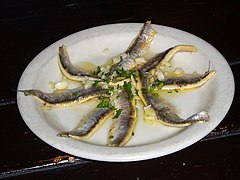 Boquerones en vinagre
 -
 Croquetas
 -
 Processed gazpacho carton packages
 -
 Pincho de tortilla
 -
 Mejillones en escabeche


_4.3.jpg)

Tapas (appetizers), taken before lunch or dinner, or during them, are common. It is also common for tapas to be provided as a complimentary appetizer in bars and cafes when ordering a drink.[50] Aside from some of the aforementioned specialties, other signature tapas include: mejillones en escabeche (marinated mussels), gildas, albóndigas (meatballs), callos, torreznos or raxo de cerdo.[51]
Regional cuisines[edit]
| This section needs additional citations for verification. (July 2021) |
Andalusia[edit]
.jpg)

Andalusian cuisine is twofold: rural and coastal. Of all the Spanish regions, this region uses the most olive oil in its cuisine. The Andalusian dish that has possibly achieved the most international fame is gazpacho, a cold soup made with chopped vegetables, such as tomatoes and green peppers, vinegar, water, salt, olive oil, and bread (crumbs). Other cold soups include poleá, zoque and salmorejo.
Eating olives as a snack is common. Meat dishes include flamenquín, pringá, oxtail stew, and menudo gitano (also called Andalusian tripe). Hot soups include sopa de gato (made with bread), caldillo de perro (fish soup with orange juice) and migas canas. Fish dishes include pescaíto frito, soldaditos de Pavía, and parpandúa. The traditional Andalusian breakfast[clarification needed] is typically eaten by laborers throughout Spain.
Cured meats include Serrano ham and Iberico ham. Typical drinks in the area include anise, wine (such as Malaga, Jerez, and Pedro Ximénez), and sherry brandy.
Aragon[edit]
Aragonese cuisine has a rural origin. One of its most famous dishes is roast lamb, or asado de ternasco. The lamb is cooked with garlic, salt, olive oil, laurel leaves, thyme and parsley.[52] Pork dishes are also very popular, among them, magras con tomate. Popular Aragonese recipes made with bread are migas de Pastor, migas con chocolate, regañaos, and goguera.
Legumes are very important to Aragonese dishes, but the most popular vegetables are borage and thistle, as well as the famed tomate rosa de Barbastro. In terms of cured meats, jamón de Teruel and ham from Huesca are used often. Among the cheeses, queso de Tronchón is notable. Fruit-based cuisine includes the very popular frutas de Aragón (English: fruits of Aragon, which are candied fruits covered in chocolate) and maraschino cherries. Also to note is the Melocotón con vino, consisting on melocotón de Calanda, a regional peach variant, infused in red wine with sugar and cinnamon.[53]
Another sweet Aragonese specialities are the trenza de Almudevar, the tortas de alma, guirlache (a type of nougat), adoquín del Pilar and Españoletas (a kind of local cookie).[54]
The presence of peaches in Aragonese cuisine can be seen in its drinks. Sopeta is a traditional beverage emerging from sliced peach, white wine and sugar. The best-known wines of Aragon are those from Cariñena, Somontano (Huesca), Calatayud and Campo de Borja.
Asturias[edit]
.jpg)

Asturian cuisine has a long and rich history, deeply rooted in Celtic traditions of Atlantic Europe.[citation needed] One of its most famous dishes is fabada asturiana. Fabada is the traditional stew of the region, made with white beans, sausages (such as chorizo and morcilla), and pork. A well-known recipe is fabes con almejas (beans with clams). Asturian beans (fabes) can also be cooked with hare, partridge, prawns, or octopus. Another known recipe is pote asturiano (made with white beans, kale, potatoes and a variety of sausages and bacon) and potaje de vigilia.
Pork-based foods, such as chosco, callos a l'asturiana and bollu preñáu (chorizo-stuffed bread rolls), are popular. Common meat dishes include carne gobernada (roasted veal), cachopo (a crunchy, crumb-coated veal steak stuffed with ham and cheese), and caldereta. Fish and seafood play an important role in Asturian cuisine. The Cantabrian Sea provides a rich variety of species, including tuna, hake and sardines.
Asturian cheeses are very popular in the rest of Spain. Among them, the most representative is Cabrales cheese, a pungent, blue cheese developed in the regions near the Picos de Europa. Other popular cheese types are gamonéu afuega'l pitu, and queso de Pría. These are usually enjoyed with the local cider, a low-alcohol drink made of Asturian apples with a distinctive sourness.
Asturian cider, Sidra de Asturias, made of a special type of apple, is traditionally poured escanciada from a certain height, usually over the head of the waiter/server. When the cider falls into the glass from above, the drink "breaks", becoming aerated and bubbly. It is consumed immediately after being served, in consecutive, tiny shots.
Notable desserts are frisuelos (similar to crêpes, usually filled with cream or apple jam), rice pudding (white rice cooked with milk, lemon zest and sugar), and carbayón (dulce) (puff pastry cakes filled with almond mash and covered with sugar glaze).
Balearic Islands[edit]
Balearic cuisine has purely Mediterranean characteristics due to its location. The islands have been conquered several times throughout their history by the French and the English, which left some culinary influences. Some well-known food items are the sobrassada, arroz brut, mahón cheese, gin de Menorca (pelota), and mayonnaise. Among the dishes are tumbet, frito mallorquín, and roasted suckling pig. Popular desserts include ensaïmada, tambor d'ametlla, and suspiros de Manacor.
Basque Country[edit]
.jpg)
The cuisine of the Basque Country has a wide and varied range of ingredients and preparations. The culture of eating is strong among the inhabitants of this region.[clarification needed] Highlights include meat and fish dishes. Among fish, cod (bacalao) is produced in various preparations: bacalao al pil pil, bacalao a la vizcaína, etc. Also popular are anchovies, bream, and bonito. Among the most famous dishes is changurro. Common meat dishes include beef steaks, pork loin with milk, fig leaf quail, and marinated goose.
Txakoli or chacolí (a white wine characterised by its high acidity and a lesser-than-average alcohol content) is a staple drink from the Basque Country, produced in Álava and Biscay.[55] Basque cider is popular to drink following the apple harvest and is served in cider houses and bars.[56]
Canary Islands[edit]


The Canary Islands have a unique cuisine due to its geographical location in the Atlantic ocean. The Canary Islands were part of the trading routes to the Americas, hence creating a melting pot of different culinary traditions. Fish (fresh or salted) and potatoes are among the most common staple foods in the islands. The consumption of cheese, fruits, and pork meat also characterizes Canarian cuisine. The close proximity to Africa[dubious ] influences the climate and creates a range of warm temperatures that in modern times have fostered the agriculture of tropical and semitropical crops: bananas, yams, mangoes, avocados, and persimmons. There crops are heavily used in Canarian cuisine.
The aboriginal people, Guanches, based their diet on gofio (a type of flour made of different toasted grains), shellfish, and goat and pork products. Gofio is still consumed in the islands and has become part of the traditional cuisine.
A sauce called mojo is very common throughout the islands. It has been adapted and developed in many ways, so that it may complement various main dishes. Fish dishes usually require a "green mojo" made from coriander or parsley, while roasted meats require a red variety made from chilli peppers that are commonly known as mojo picón.
Some classic dishes in the Canary Islands include papas arrugadas, almogrote, frangollo, rabbit in salmorejo sauce, and stewed goat.
Some popular desserts are truchas (pastries filled with sweet potato or pumpkin), roasted gofio (a gofio-based dough with nuts and honey), príncipe Alberto (a mousse-like preparation with almonds, coffee, and chocolate), and quesillo (a variety of flan made with condensed milk).
Wineries are common in the islands. However, only Malvasia wine from Lanzarote has gained international recognition.
Cantabria[edit]

A popular Cantabrian dish is cocido montañés (highlander stew), a rich stew made with beans, cabbage, and pork. Seafood is widely used and bonito is present in the typical sorropotún or marmita de bonitu (tuna pot). Recognized quality meats are Tudanca veal and game meat.
Cantabrian pastries include sobaos and quesadas pasiegas. Dairy products include Cantabrian cream cheese, smoked cheeses, picón Bejes-Tresviso, and quesucos de Liébana.
As for alcohol, orujo is the Cantabrian pomace brandy. Cider (sidra) and chacoli wine are also favorites.[57][58] Cantabria has two wines labelled denominación de origen calificada (denomination of qualified origin): Costa de Cantabria and Liébana.
Castile-La Mancha[edit]

In Castilla-La Mancha, the culinary habits reflect the origin of foods eaten by shepherds and peasants. Wheat and grains are a dominant product and ingredient. They are used in bread, soups, gazpacho manchego, crumbs,[clarification needed] porridge, etc. One of the most abundant ingredients in Manchego cuisine is garlic, leading to dishes such as ajoarriero, ajo puerco, and garlic marinade[clarification needed].
Some traditional recipes are gazpacho manchego, pisto manchego, and migas ruleras. Also popular in this region is morteruelo, a kind of foie gras manchego. Manchego cheese is also renowned.
Given the fact that its lands are dry, and thus unable to sustain large amounts of cattle living on grass, an abundance of small animals, such as rabbit, and especially birds (pheasant, quail, partridge, squab), can be found. This has led to game meat being incorporated into traditional dishes, such as conejo al Ajillo (rabbit in garlic sauce), perdiz escabechada (marinated partridge) or huevos de codorniz (quail eggs).
Castile and León[edit]

In Castile and León, characteristic dishes include morcilla, (a black pudding made with special spices), judión de la Granja, sopa de ajo (garlic soup), Cochinillo asado (roast piglet), lechazo (roast lamb), Chuletón de Ávila (Ávila rib steak), botillo del Bierzo, hornazo from Salamanca, jamón de Guijuelo (a cured ham from Guijuelo, Salamanca), salchicha de Zaratán, other sausages, Serrada cheese,[clarification needed] queso de Burgos, and Ribera del Duero wines.
Major wines in Castilian-Leonese cuisine include the robust wine of Toro, reds from Ribera del Duero, whites from Rueda, and clarets from Cigales.
Catalonia[edit]

The cuisine of Catalonia is based in a rural culture; it is extensive and has great culinary wealth. It features cuisine from three climates: coastal (seafood), mountains, and the interiors. Some famous dishes include escudella, pa amb tomàquet, bean omelette[clarification needed], coca de recapte, samfaina, thyme soup, caragols a la llauna and the bomba de Barceloneta.[59] Notable sauces are romesco sauce, aioli, bouillabaisse of Catalan origin and picada.
Cured pork cuisine includes botifarra (white and black) and the fuet of Vic. Fish dishes include suquet (fish stew), cod stew, and arròs negre. Among the vegetable dishes, the most famous are calçots and escalivada (roasted vegetables). As for desserts, these include Catalan cream, carquinyolis, panellets, tortell, and neules.
Extremadura[edit]

The cuisine of Extremadura is strict, with dishes prepared by shepherds. It is very similar to the cuisine of Castilla. Extremaduran cuisine is abundant in pork; it is said that the region is one of the best for breeding pigs in Spain thanks to the acorns that grow in their fields. Iberian pig herds raised in the fields of Montánchez are characterized by dark skin and thin legs. This breed of pig is found exclusively in Southwestern Iberia, both in Spain and Portugal. Iberian pork products such as sausages are common and often added to stews (cocido extremeño), as well as cachuela (pork liver pâté seasoned with paprika, garlic and other spices).
Other meat dishes are lamb stew or goat stew (caldereta de cordero and caldereta de cabrito). Additionally, meat dishes can include game meats, such as wild boar, partridge, pheasant, or venison.
Distinctive cheeses from the region include the so-called quesos de torta (sheep milk cheeses typically curdled with the infusion of thistle).[60] Both the torta of La Serena and the torta of El Casar enjoy a protected designation of origin.[60] Among the desserts are leche frita, perrunilla, and pestiños (fritters), as well as many sweets that have their origins in convents.
Cod preparations are well known, and tench is among the most traditional freshwater fish with fish and vegetable dishes such as moje de peces or escarapuche.

Soups are often bread-based and are served in both hot and cold forms. Pennyroyal mint is sometimes used to season gazpachos or soups such as sopa de poleo. Extremaduran ajoblanco (ajoblanco extremeño) is a cold soup, which is different from Andalusian ajoblanco since it contains egg yolk in the emulsion and vegetables but no almonds.
The Northeastern comarca of La Vera produces pimentón de la Vera, which is smoked paprika highly valued all over Spain and extensively used in Extremaduran cuisine.
The region is also known for its vino de pitarra tradition (homemade wine made in small earthenware vessels).[61]
Galicia[edit]

.jpg)
Galician cuisine is known in Spanish territory because of the emigration of its inhabitants. Similarly to neighbouring Asturias, Galicia shares some culinary traditions in stews and soups with the Celtic nations of Atlantic Europe.[62] One of the most noted Galician dishes is soup. Also notable in this region is pork with turnip tops, a popular component of the Galician carnival meal laconadas. Another remarkable recipe is caldo de castañas (a chestnut broth), which is commonly consumed during winter. Pork products are also popular.[63] Cattle breeding is very common in Galicia, meaning red meat is consumed often, typically with potatoes.
The simplicity and authenticity of the Galician cooking methods were praised in the early 20th century by popular gastronome Manuel Puga e Parga (aka Picadillo), who praised dishes such as lacón con grelos or caldeiradas (fish stew), opposed to the perceived sophistication of the French cuisine.[64]
The seafood dishes are famous and rich in variety. Among these are the Galician empanadas, octopus, scallops, crab, and barnacles. In the city of Santiago de Compostela, located along an ancient pilgrim trail from the Pyrenees, it was customary for travellers to first eat scallops upon arriving in the city.[65]
Among the many dairy products is queso de tetilla.
The queimadas (a folkloric preparation of orujo) consists of mixing of the alcoholic beverage with peels of orange or lemon, sugar or coffee beans, prepared in a nearly ritual ceremony involving the flambé of the beverage.[66] Sweets that are famous throughout the Iberian Peninsula are the tarta de Santiago and filloas (crêpes).
La Rioja[edit]
La Rioja is recognized by the use of meats such as pork and cold cuts, which are produced after the traditional slaughter. Lamb is perhaps the second most popular meat product in this region (chuletillas al sarmiento). Veal is common in mountainous areas. Another well-known dish is caparrones, Rioja stew. The most famous dish is Rioja style potatoes and fritada. Lesser-known dishes are Holy lunch and ajo huevo (garlic eggs)[clarification needed]. Pimientos asados (roasted peppers) is a notable vegetable dish.
La Rioja is famously known in Spain for its red wine, so most of these dishes are served with wine. Rioja wine has designated origin status.
Madrid[edit]
.jpg)
Madrid did not gain its own identity in the Court until 1561[clarification needed] when Philip II moved the capital to Madrid. Since then, due to immigration, many of Madrid's culinary dishes have been made from modifications to dishes from other Spanish regions. Madrid, due to the influx of visitors from the nineteenth century onwards, was one of the first cities to introduce the concept of the restaurant, hosting some of the earliest examples.[citation needed]
Murcia[edit]

The cuisine of the region of Murcia has two sides with the influence of Manchego cuisine. The region of Murcia is famous for its varied fruit production. Among the most outstanding dishes are: tortilla murciana, zarangollo, mojete, aubergine a la crème, pipirrana, etc. A typical sauce of this area is ajo cabañil, used to accompany meat dishes.
Regional dishes include michirones (beans cooked with bay leaves, hot peppers and garlic), olla gitana, cocido murciano con pelotas, sopa de mondongo, and others.
Some meat products from Murcia are morcilla (black pudding), which is flavored with oregano, and pastel murciano, made with ground beef. Among fish and seafood are the golden salt,[clarification needed] Mar Menor prawns, and baked octopus. Rice dishes are common and include caldero, arroz empedrado, paella Valenciana (rice with rabbit and snails), arroz de escribano, and arroz viudo.
Confectionery products include exploradores and pastel de Cierva, typical in Murcia gastronomy and found in almost every pastry shop in Murcia. They are both sweet and savoury at the same time. Desserts are abundant; among them are paparajotes, Orchard[clarification needed], stuffed pastries, and others.
This region also has wine appellations of origin, such as the wines from Jumilla, Bullas and Yecla.
[edit]

The gastronomy of Navarra has many similarities with Basque cuisine. Some of its flag dishes are trucha a la navarra (Navarra-style trout), ajoarriero, cordero en chilindrón, and relleno. There are also recipes such as the Carlists eggs that are commonly used.
Salted products are common and include chorizo de Pamplona, stuffing and sausage. The lamb and beef have, at present, designations of origin. Some dairy products are Roncal cheese, curd, and Idiazabal cheese. Typical alcoholic drinks include claret and pacharán.
Valencia[edit]
The cuisine of Valencia has two components: the rural and the coastal. A popular Valencia creation is paella, a rice dish cooked in a circular pan and topped with vegetables and meats (originally rabbit and chicken).[68] Dishes such as arroz con costra, arròs negre, fideuá, arròz al horn, and rice with beans and turnips are also common in the city.
Coastal towns supply the region with fish, leading to popular dishes like all i pebre (fish stew), typical of the Albufera.
The desserts in this region include coffee liqueur, chocolate Alicante, arnadí[69] and horchata, the last two being of Muslim origin.[70] Notably, during Christmas, nougat is made in Alicante and Jijona. Another well-known dessert are peladillas (almonds wrapped in a thick layer of caramel).
Notable Spanish chefs[edit]

- Ferran Adrià.[71]
- Juan Mari Arzak.[72]
- Santi Santamaría.[73]
- Martín Berasategui.[74]
- Carme Ruscalleda.[75]
- José Andrés - (Minibar by José Andrés, Washington D.C.) Andrés hosts Made in Spain on PBS.[76]
- Karlos Arguiñano - celebrity television chef.[77]
- Sergi Arola - (La Broché, Arola and Sergi Arola Gastro).[78]
- Penelope Casas - New York-born cookbook author.[79][80][81]
- Carlos Dominguez Cidon - recipient of the "Premio Alimentos" award in 1999 and Michelin Guiding Star award in 2004; author of eight books.[82][83]
- María Mestayer de Echagüe - also known as "Marquesa de Parabere", the author of a two-volume cooking encyclopaedia entitled La Cocina Completa.[84][self-published source]
- Ángel Muro - a 19th-century food expert and author of the book Practicón.[85]
- Simone and Ines Ortega - authors of 1080 recetas (1080 Recipes).[86]
- Manuel María Puga y Parga - an early 20th century food expert and author of La cocina práctica.[87]
- Ilan Hall - Casa Mono, Manhattan, NY, winner of Top Chef Season 2.[88]
- Joan Roca, Jordi Roca i Fontané and Josep Roca i Fontané - (El Celler de Can Roca, "Rocambolesc", "Can Roca", "Mas Marroch" and "Cap Roig", in the province of Girona, and the restaurant "Roca Barcelona" in the province of Barcelona). Three Michelin stars in 2009. In 2013, El Celler de Can Roca was selected as the best restaurant in the world by Restaurant magazine.[citation needed]
See also[edit]


- Early impact of Mesoamerican goods in Iberian society
- List of Spanish desserts
- List of Spanish dishes
- List of Spanish soups and stews
- Agriculture in Spain
- List of Spanish cheeses
- Bread culture in Spain
- List of cuisines
- Mediterranean cuisine
- European cuisine
- Filipino cuisine
References[edit]
- ^ "World's olive oil production has tripled". International Olive Council (in Italian). 4 January 2021. Retrieved 29 September 2022.
- ^ Akyürek, Suat (2018). "Investigation of similarities and differences of Turkish and Spanish cuisine cultures". Turkish Studies. 13 (3). Ankara: 49–64. doi:10.7827/TurkishStudies.12900. ISSN 1308-2140.
- ^ Martínez-Galiano, Juan Miguel; Olmedo-Requena, Rocío (2018). "Effect of Adherence to a Mediterranean Diet and Olive Oil Intake during Pregnancy on Risk of Small for Gestational Age Infants". Nutrients. 10 (9): 1234. doi:10.3390/nu10091234. PMC 6164545. PMID 30189597.
- ^ Hoffman, Richard; Gerber MD, Mariette (2011). The Mediterranean Diet: Health and Science. doi:10.1002/9781118785027. ISBN 9781444330021.
- ^ Wild 2015, p. 99.
- ^ a b Weichselbaum, Elisabeth; Benelam, Bridget; Costa, Helena Soares (2005). "Synthesis report No 6: Traditional Foods in Europe" (PDF). European Food Information Resource Network. pp. 51–52.
- ^ Medievalists.net (8 October 2020). "Acorns in the Middle Ages". Medievalists.net. Retrieved 1 February 2021.
- ^ Ruiz López, Ildefonso David; Ramírez Ruiz, Carmen (2012). "La tríada mediterránea en las acuñaciones monetarias del sur peninsular" (PDF). Iberian (4): 57. ISSN 2174-5633.
- ^ Díaz Yubero, Ismael (1999). "Gastronomía española". Real Academia de Ciencias Veterinarias de España.
- ^ Pons Biescas, Antoni; Tur Marí, Josep A. (2005). "La alimentación en Bizancio". In Salas-Salvadó, Jordi; García-Lorda, Pilar; Sánchez Ripollés, José M.ª (eds.). La alimentación y la nutrición a través de la historia. Barcelona: Editorial Glosa. p. 180. ISBN 84-7429-257-3.
- ^ Gil Cuadrado, Luis Teófilo (2002). "La influencia musulmana en la cultura hispano-cristiana medieval". Anaquel de Estudios Árabes. 13: 58. ISSN 1130-3964.
- ^ Nadeau, Carolyn A. (1 January 2016). Food Matters: Alonso Quijano's Diet and the Discourse of Food in Early Modern Spain. University of Toronto Press. ISBN 978-1-4426-3730-6.
- ^ a b "Can I have Some Moor? A Look at Moorish Influence on Spanish Cuisine - Global Foodways". Adhc.lib.ua.edu. Retrieved 10 March 2022.
- ^ Díaz Yubero, Ismael. "La evolución de la alimentación y la gastronomía en España" (PDF). Biblioteca Nacional de España. pp. 121–154.
- ^ "alboronía | Diccionario de la lengua española – Edición del Tricentenario". Real Academia Española.
- ^ "alajú | Diccionario de la lengua española – Edición del Tricentenario". Real Academia Española.
- ^ "hallulla | Diccionario de la lengua española – Edición del Tricentenario". Real Academia Española.
- ^ "albóndiga | Diccionario de la lengua española – Edición del Tricentenario". Real Academia Española.
- ^ "almojama | Diccionario de la lengua española – Edición del Tricentenario". Real Academia Española.
- ^ "arrope | Diccionario de la lengua española – Edición del Tricentenario". Real Academia Española.
- ^ "Cocinas" (PDF). www.bne.es. Retrieved 17 August 2020.
- ^ "Influencia árabe | Cocina española". www.spanish-food.org.
- ^ Marín, Manuela (2003). "En los márgenes de la ley: el consumo de alcohol en al Andalus" (PDF). In Puente, Cristina de la (ed.). Estudios onomástico-biográficos de al Andalus (Identidades marginales) XIII. pp. 273–274.
- ^ Marín 2003, p. 286.
- ^ Quesada, Fernando (13 March 2017). Las cosas claras y el chocolate espeso: Historias, curiosidades y anécdotas gastronómicas. Editorial Cultiva Libros S.L. ISBN 9781635037104 – via Google Books.
- ^ Cantera Montenegro, Enrique (2003). "La carne y el pescado en el sistema alimentario judío en la España medieval". Espacio, Tiempo y Forma, Serie III, Historia Medieval. 16 (16). Madrid: Universidad Nacional de Educación a Distancia: 24. doi:10.5944/etfiii.16.2003.3689.
- ^ Cantera Montenegro 2003, p. 32.
- ^ Debora Chomski. "La Cocina Judia (para celebrar la vida)" (PDF). Academiaaragonesadegastronomia.com. Retrieved 10 March 2022.
- ^ "Gastronomía sefardí en la Red de Juderías de España - Diario de Gastronomía: Cocina, vino, gastronomía y recetas gourmet". Diariodegastronomia.com. 17 July 2020. Retrieved 9 March 2022.
- ^ "Bibliografia Sefardi" (PDF). Cervantes.es. Retrieved 10 March 2022.
- ^ Wild, Matthew J. (2015). "Eating Spain: National Cuisine Since 1900". Theses and Dissertations-Hispanic Studies. Vol. 24. p. 30.
- ^ Medina, Xavier (2005). Food Culture in Spain (Food Culture around the World). Greenwood. ISBN 978-0313328190.
- ^ Campbell, Jodi (2017). At the First Table. Food and Social Identity in Early Modern Spain. Lincoln and London: University of Nebraska Press. p. 15. ISBN 9780803296619.
- ^ Vega de Arlucea, Ana (30 May 2019). "¿Por qué hace años los extranjeros odiaban la cocina española?". La Voz de Galicia.
- ^ Pérez Samper, María de los Ángeles (2014). "The Early Modern Food Revolution: A Perspective from the Iberian Atlantic". In Aram, Bethany; Yun-Casalilla, Bartolomé (eds.). Global Goods and the Spanish Empire, 1492-1824: Circulation, Resistance and Diversity. Palgrave Macmillan. p. 33. doi:10.1057/9781137324054. ISBN 978-1-349-45891-2.
- ^ Pérez Samper 2014, p. 33.
- ^ a b Bueno, Pilar; Ortega, Raimundo (1 August 1998). "De la fonda nueva a la nueva cocina. La evolución del gusto culinario en España durante los siglos XIX y XX". Revista de Libros.
- ^ Aguirregoitia-Martínez, Ainhoa; Fernández-Poyatos, Mª Dolores (2017). "The Gestation of Modern Gastronomy in Spain (1900-1936)". Culture & History Digital Journal. 6 (2): 019. doi:10.3989/chdj.2017.019. hdl:10045/71778. ISSN 2253-797X.
- ^ Anderson, Lara (2013). "The unity and diversity of La olla podrida: an autochthonous model of Spanish culinary nationalism". Journal of Spanish Cultural Studies. 14 (4). Routledge: 400–414. doi:10.1080/14636204.2013.916027. S2CID 143940504.
- ^ Anderson 2013, pp. 402–403.
- ^ Anderson 2013, p. 404.
- ^ Anderson, Lara (2019). "Writing from and for the Periphery. Carving Out a Place for Spanish Food Studies" (PDF). Repensar los estudios ibéricos desde la periferia. Vol. 13. Edizioni Ca' Foscari. p. 104. doi:10.30687/978-88-6969-302-1/006. ISBN 978-88-6969-302-1. ISSN 2610-8844. S2CID 166399222.
- ^ a b Serna, Víctor de la (31 May 2019). "Así consiguió Simone Ortega que sus '1080 recetas' se vendan tanto como el 'Quijote'". El Mundo.
- ^ Massanés, Toni; Guitiá, Jorge (2010). "Libertad en los fogones. La cocina española y sus libros, de la transición a nuestros días" (PDF). La cocina en su tinta. Biblioteca Nacional de España. pp. 191–193. ISBN 978-84-92462-15-5.
- ^ "¿Qué desayunan los españoles?". Korespa. 2 January 2020.
- ^ Jones, Sam (2016). "Working 9 to 8: Spain seeks to shorten 11-hour working day". The Guardian. Retrieved 2016-12-20.
- ^ "Spain, Land of 10 P.M. Dinners, Asks if It’s Time to Reset Clock". The New York Times. Retrieved 2016-12-20.
- ^ Castillo, Toni (13 May 2015). "Los cinco clásicos de la gastronomía española". Bonvieur.
- ^ Taboada, Lucía (27 August 2014). "Abordamos una cuestión de estado: La tortilla, ¿con o sin cebolla?". Revista GQ.
- ^ Jessop, Tara (27 April 2016). "A Brief History of the World Famous Spanish Tapas". Culture Trip. Retrieved 10 July 2020.
- ^ Bonilla, Mer (20 June 2019). "Las tapas más famosas de la cocina española y las recetas para que te salgan de lujo". El Español.
- ^ "La receta del asado perfecto". ternascodearagon.es. Retrieved 30 January 2024.
- ^ "Melocotón al vino con canela". ¡HOLA!. Retrieved 30 January 2024.
- ^ Cocina Aragonesa | El fogón ilustrado
- ^ "El Ministerio de Agricultura incluye en su web la ruta del 'txakoli'". El País. 26 January 2015.
- ^ Zimmerman, Lindsey (10 April 2019). "Basque Cider: A Deep Dive into Northern Spain's Most Iconic Drink". Devour Tours. Retrieved 11 January 2024.
- ^ Barreda, F. The chacoli Santander in the 13th to 19th centuries. Maxtor Editorial Library. 1943. 2001 edition, first reprint. ISBN 84-95636-84-0.
- ^ "'Vignobles et vins du Nord-Ouest de l'Espagne, Alain Lemps." "The txakoli of Burgos Valle de Mena wants OJ" 2005. Accessed 19 January 2008.
- ^ Pérez, Mónica (2 November 2019). "Catalan classics: the bomba de Barceloneta". In English.
- ^ a b Iborra, Elisabeth G. (15 December 2019). "Quesos de torta extremeños: ocho preguntas para convertirnos en unos expertos". eldiario.es.
- ^ "Pitarra Wines: Spanish Wines Made with Flor". Food and Wine Tours in Portugal and Spain. 3 October 2012.
- ^ "Visualizar obra". bvg.udc.es.
- ^ "El tercer Cocido do Porco Celta registra un lleno total en Sarria". www.elprogreso.es. 21 February 2011.
- ^ Narváez, Ana (11 September 2019). "Picadillo, el alcalde que dio nombre al concurso de tapas de A Coruña". Quincemil. El Español.
- ^ Fieldhouse, Paul. The World Religions Cookbook. Greenwood Press. p. 90.
- ^ "Santiago de Compostela, epicentro gastronómico de Galicia". Asociación Nacional de Gastronomía y Turismo de Galicia.
- ^ Vega, Ana [Biscayenne] (21 September 2017). "Bocadillo de Calamares". El País.
- ^ "The Art of Paella". 27 June 2013. Retrieved 27 September 2016.
- ^ "Arnadí | Diccionario de la lengua española".
- ^ Goldstein, Darra (2015). The Oxford Companion to Sugar and Sweets. Oxford University Press. ISBN 9780199313396.
- ^ "A laboratory of taste." The New York Times Sunday supplement. 10 August 2003.
- ^ Hughes, H. (2009). Frommer's 500 places for food and wine lovers, p. 110. John Wiley & Sons. ISBN 0470480645, 9780470480649. Google Books. Retrieved 18 January 2014.
- ^ Keown, D. (2011). A companion to Catalan culture, p. 247. Tamesis Books. ISBN 1855662272, 9781855662278.
- ^ Facaros, D. and Pauls, M. (2008). Bilbao and the Basque Lands, p. 190. New Holland Publishers. ISBN 1860114008, 9781860114007.
- ^ Ruscadella, C. (2007). Carme Ruscadella's Mediterranean Cuisine. Salsa Books. ISBN 8496599159, 9788496599154.
- ^ "Biography." Archived 10 February 2009 at the Wayback Machine Jose Made In Spain website. Accessed 18 January 2014.
- ^ Barlow, J. (2014). Everything but the squeal, p. 83. Clic-books.com. Google Books. Retrieved 18 January 2014.
- ^ Stone, P. (2011). Frommer's Barcelona. John Wiley & Sons. ISBN 1119994497, 781119994497.
- ^ Casas, P. (1982). The foods and wines of Spain.
- ^ Parsons R. "Penelope Casas, pioneer of English-language Spanish cookbooks, dies." LA Times 19 August 2013.
- ^ "Penelope Casas, Spanish food author, dies at 70." 18 August 2013. The New York Times Retrieved 9 September 2013.
- ^ Staff (11 January 2009). "Carlos D. Cidón propone un ambicioso programa de cursos para profesionales de la cocina". Diaro de León (in Spanish). Archived from the original on 16 July 2011. Retrieved 15 August 2010.
- ^ Staff (12 May 2009). "Fallece Carlos Domínguez Cidón, uno de los "pilares importantes" de la gastronomía de Castilla y León". Europa Press (in Spanish). Agencia Europa Press. Retrieved 15 August 2010.
- ^ The Immigrants' Universe. Xlibris[self-published source] Corporation 2010 p128. ISBN 1456811940, 9781456811945.[self-published source]
- ^ Richardson, P. (2008). A Late Dinner: Discovering the Food of Spain, p. 68. Bloomsbury Publishing. ISBN 0747593809, 9780747593805.
- ^ Anderson, L. (2013). Cooking Up the Nation: Spanish Culinary Texts and Culinary Nationalization in the Late Nineteenth and Early Twentieth Century, p. 2. Boydell & Brewer Ltd. ISBN 1855662469, 9781855662469.
- ^ Puga y Parga, M. (2001). La cocina práctica. Everest Galicia. ISBN 8440305109, 9788440305107.
- ^ Food and Wine Magazine. "Bravo's New Top Chef Tells All". Retrieved 25 December 2014.
External links[edit]


| National | |
|---|---|
| Other | |
