


Peugeot 1007
| Peugeot 1007 | |
|---|---|
 | |
| Overview | |
| Manufacturer | Peugeot (PSA Group) |
| Production | 2004–2009 |
| Assembly | France: Poissy (Poissy Plant) |
| Designer | Pininfarina[1] |
| Body and chassis | |
| Class | Supermini/City car |
| Body style | 3-door hatchback[2][3] |
| Layout | Front-engine, front-wheel-drive |
| Related | Citroën C2 Citroën C3 Peugeot 206 |
| Powertrain | |
| Engine | Petrol: 1.4 L TU3 I4 8V 1.4 L ET3 I4 16V 1.6 L TU5 I4 16V Diesel: 1.4 L PSA DV4 HDi I4 8V 1.6 L PSA DV6 HDi I4 16V |
| Dimensions | |
| Wheelbase | 2,315 mm (91.1 in) |
| Length | 3,731 mm (146.9 in) |
| Width | 1,826 mm (71.9 in) |
| Height | 1,620 mm (63.8 in) |
| Curb weight | 1,291 kg (2,846 lb) |
| Chronology | |
| Successor | Peugeot 107 |
The Peugeot 1007 is a small three-door car manufactured by Peugeot from 2004 to 2009, noted for its user-swappable interior trim pieces and its four pillar design incorporating two power sliding doors. It shares its platform with the Peugeot 206, Citroën C2 and Citroën C3. Sales commenced in April 2005 in Europe.
Background
[edit]The 1007 is the production version of the Sésame concept, which was presented at the 2002 Paris Motor Show.[4][5]
The car featured the optional "2-Tronic" automated manual transmission, also used (under the name "Sensodrive") on the Citroën's C2, C3 and C3 Pluriel which shares the 206's 1.4 L and 1.6 L petrol engines and 1.4 L and 1.6 L diesel engines.
For its size, the 1007 was expensive, with prices around €14,000 / £10,000. Euro NCAP awarded the vehicle its second best ever rating for adult occupant safety.[6] It has been described as a supermini,[3][6][7] an urban hatchback,[8] a city car,[2][9][10] and a small car,[3][11][12] while some of the 1007's features have been compared to those of multi-purpose vehicles (MPVs).[2][3][11] The vehicle was generally described as a petit monospace, minispace (small MPV) or microspace (smaller small MPV) by French press.[13][14][15][16][17][18][19] Pininfarina, the studio that designed the 1007, described it as an MPV.[20] Peugeot referred to the 1007 as a berline monocorps (one-box car).[21][22]
-
 Rear view
 -
 Interior


Features
[edit]The 1007 is the first mainstream car from Peugeot to feature a "double zero" number. In English speaking countries, the name was marketed with the pronunciation "ten oh seven".
Originally launched with the pronunciation, "one double oh seven", and James Bond style promotion, Peugeot revised their strategy, under pressure from the Bond franchise owners.[8][23] It is also commonly called the "one thousand and seven". In France, it was marketed as the "mille sept".
Discontinuation in Europe
[edit]The 1007 was dropped from Peugeot's model line up in the United Kingdom in 2008, although the car was still in production in mainland Europe until the end of 2009.
Reception
[edit]Although the concept car received good reception from the public, once in production, the 1007 was regarded as one of Peugeot's largest sales failures.[24][25][26] Overall, due to poor sales, Peugeot lost an estimated €15,380 per vehicle produced.[27]
Engines
[edit]| Petrol engines[28][29] | ||||||||
| Model | Engine | Displacement cc (ci) |
Power | Torque | 0–100 km/h,s | Top speed km/h (mph) |
Transmission | CO2 emission (g/km) |
| 1.4 L | TU3 I4 | 1,360 (83) | 55 kW; 74 bhp (75 PS) | 89 N⋅m (66 lb⋅ft) | 14.4 | 165 km/h (103 mph) | TBA | 153 |
| 1.4 L | ET3 I4 16V | 1,360 (83) | 65 kW; 87 bhp (88 PS) | 133 N⋅m (98 lb⋅ft) | 13.6 | 173 km/h (107 mph) | TBA | 153 |
| 1.6 L | TU5 I4 16V | 1,587 (97) | 81 kW; 108 bhp (110 PS) | 110 N⋅m (81 lb⋅ft) | 12.0 | 190 km/h (120 mph) | TBA | 163 |
| Diesel engines | ||||||||
| 1.4 L | DV4 HDi diesel I4 | 1,398 (85) | 50 kW; 67 bhp (68 PS) | 160 N⋅m (120 lb⋅ft) | 15.4 | 160 km/h (99 mph) | TBA | 115 |
| 1.6 L | DV6 HDi diesel I4 | 1,560 (95) | 82 kW; 109 bhp (111 PS) | 194 N⋅m (143 lb⋅ft) | 10.6 | 185 km/h (115 mph) | TBA | 125 |
Sales
[edit]| Year | Worldwide sales | Worldwide Production | Notes |
| 2004 | 1,100[30] | TBA | TBA |
| 2005 | 53,800[30] | TBA | TBA |
| 2006 | 34,100[30] | TBA | TBA |
| 2007 | 18,600[30] | TBA | TBA |
| 2008 | 11,000[30] | TBA | TBA |
| 2009 | 5,200[30] | 4,800[28] | TBA |
| 2010 | 100[28] | 0[28] | TBA |
Gallery
[edit]-
 Side view
 -
 Door opened
 -
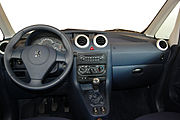 Interior


See also
[edit]- Toyota Porte, similar class car with sliding side door
References
[edit]- ^ "The Peugeot 1007: the city car with sliding doors by Pininfarina". carrozzieri-italiani.com. Retrieved 18 February 2024.
- ^ a b c Enright, Andy (6 October 2008). "Peugeot 1007 (2005 - 2009) used car review". rac.co.uk. Retrieved 20 June 2022.
- ^ a b c d "Used Peugeot 1007 Hatchback 2005 - 2008 review". What Car?. Retrieved 20 June 2022.
- ^ The Car Design Yearbook. Merrell Publishers. 2005. ISBN 978-1-85894-285-8.
- ^ Hemmes, Henny. "Peugeot Sésame concept car". Autoweek.nl.
- ^ a b "Peugeot 1007". euroncap.com. Retrieved 2007-06-17.
- ^ Hardy, Sam (3 April 2007). "Peugeot 1007". Auto Express. Retrieved 20 June 2022.
- ^ a b English, Andrew (2005-04-02). "Mind the doors". Telegraph. Archived from the original on 2005-08-05. Retrieved 2010-03-15.
- ^ Pegden, Eileen; Gibson, Dean (6 June 2006). "Peugeot 1007". Auto Express. Retrieved 20 June 2022.
- ^ "Fail of the century #2: Peugeot 1007". Top Gear magazine. Retrieved 20 June 2022.
- ^ a b "Peugeot 1007 (2005-2010) review". Auto Express. 29 December 2006. Retrieved 20 June 2022.
- ^ Ross, David (6 June 2019). "Peugeot 1007 Hatchback (2005 - 2009) review". Parker's Car Guides. Retrieved 20 June 2022.
- ^ "Peugeot 107 et Citroën C1, les jumelles françaises". Le Monde.fr (in French). 2005-04-16. Retrieved 2022-06-20.
- ^ "Essai/ Peugeot 1007 : la boite à malice". Autonews (in French). 2005-03-25. Retrieved 2022-06-20.
- ^ "Modus et 1007, deux modèles de campagne". Les Echos (in French). 2005-05-17. Retrieved 2022-06-20.
- ^ "Peugeot 1007 1.6 2-Tronic Sporty Pack - Mini cube". Challenges (in French). 2005-05-30. Retrieved 2022-06-20.
- ^ "Peugeot 1007". www.largus.fr. Retrieved 2022-06-20.
- ^ Caradisiac.com (6 July 2004). "Peugeot 1007 : un minispace bourré d'astuces". Caradisiac.com (in French). Retrieved 2022-06-20.
- ^ "Peugeot 1007 : le microspace". Autonews (in French). 2004-07-01. Retrieved 2022-06-20.
- ^ "Peugeot" (PDF). pininfarina.it. Retrieved 20 June 2022.
- ^ "Peugeot 1007". 2007-06-23. Archived from the original on 2007-06-23. Retrieved 2022-06-20.
- ^ "Brochure Peugeot 1007" (PDF). forum-peugeot.com. March 2008.
- ^ Top Gear; Season 4 episode 10
- ^ "1007 grootste flop van Peugeot". De Standaard (in Flemish). October 2009. Retrieved 2021-08-06.
- ^ Diez, Willi (2015-08-25). Automobil-Marketing: Erfolgreiche Strategien, praxisorientierte Konzepte, effektive Instrumente (in German). Vahlen. ISBN 978-3-8006-4641-8.
- ^ John, Honest; Fowler, George (2016-10-15). Car-tastrophes: 80 Automotive Atrocities from the past 20 years. Veloce Publishing Ltd. ISBN 978-1-84584-933-7.
- ^ "Zoom, sputter, aagghhh!!". The Economist. 2013-09-25. ISSN 0013-0613. Retrieved 2021-11-29.
- ^ a b c d "Engine specs from PSA Peugeot Citroën" (PDF). Creator and designer. PSA Peugeot Citroën. Archived from the original (PDF) on 5 June 2017. Retrieved 22 November 2012.
- ^ https://www.autoweek.nl/carbase/peugeot/1007/.
{{cite web}}: Missing or empty|title=(help) - ^ a b c d e f "PSA". Psa-peugeot-citroen.com. 2010-06-30. Archived from the original on 2010-12-06. Retrieved 2010-12-04.
External links
[edit]A brand of Stellantis | ||||||||||
| Current vehicles |
|  | ||||||||
| Historic vehicles |
| |||||||||
| Motorsport | ||||||||||
| Concept cars | ||||||||||
| Related topics | ||||||||||

