


Peugeot 308
| Peugeot 308 | |
|---|---|
_-_121.jpg) | |
| Overview | |
| Manufacturer | Peugeot[a] |
| Production | 2007–present |
| Body and chassis | |
| Class | Compact car/small family car (C) |
| Chronology | |
| Predecessor | Peugeot 307 |
The Peugeot 308 is a small family car (C-segment car; compact car in North America) produced by French automobile manufacturer Peugeot. It was unveiled in June 2007, and launched in September 2007 in hatchback form, which was followed by station wagon (the 308 SW) in March 2008, coupé cabriolet (the 308 CC) in February 2009, and a sedan version (the 408) in February 2010.[1] The 308 replaced the 307, and positioned below the 508 and above the smallest 208.
The first generation was largely based on its predecessor, the 307, and utilized modified versions of that car's drivetrain and chassis. The second-generation model was unveiled in 2013, and it was awarded as the 2014 European Car of the Year. The third-generation model was unveiled in 2021 and introduced a hybrid powertrain.[2]
First generation (T7; 2007)
[edit]| Peugeot 308 I | |
|---|---|
_XS_HDi_5-door_hatchback_(2015-07-03)_01.jpg) | |
| Overview | |
| Model code | T7 |
| Production | October 2007–2013 2011–2016 (China) 2011–2021 (Argentina) |
| Assembly | France: Mulhouse (Mulhouse Plant); Sochaux (Sochaux Plant) Argentina: El Palomar (PSA Argentina) China: Wuhan (DPCA) Malaysia: Gurun (NAM) Russia: Kaluga (PCMA Rus)[3] |
| Designer | Stéphan Peureux |
| Body and chassis | |
| Body style | 3-door hatchback 5-door hatchback 5-door station wagon/estate 2-door coupé cabriolet 4-door sedan |
| Layout | Front-engine, front-wheel-drive or four-wheel-drive |
| Platform | PSA PF2 platform |
| Related | Peugeot 307 Peugeot 408 Peugeot 3008 Peugeot 5008 Peugeot RCZ Peugeot Partner Citroën C4 Citroën C4 Picasso Citroën DS4 Citroën Berlingo |
| Powertrain | |
| Engine | |
| Electric motor | 2x BSG e-Boosters |
| Transmission | 5-speed manual 6-speed manual 4-speed automatic 6-speed automatic 6-speed automated manual |
| Hybrid drivetrain | μHEV (308 e-HDi) |
| Dimensions | |
| Wheelbase | 2,608 mm (102.7 in) 2,708 mm (106.6 in) (SW)[4] 2,605 mm (102.6 in) (CC)[5] |
| Length | 4,276 mm (168.3 in) 4,500 mm (177.2 in) (SW) 4,440 mm (174.8 in) (CC)[5] ? (Saloon/Sedan) |
| Width | 1,815 mm (71.5 in) |
| Height | 1,498 mm (59.0 in) 1,566 mm (61.7 in) (SW) 1,426 mm (56.1 in) (CC)[5] |
Design
[edit]Launched as the replacement for the Peugeot 307 in most international markets, the new vehicle was based upon the old 307's chassis, but has new bodywork and is slightly longer and wider. Developed under the project code "Project T7",[6] ts coefficient of drag is 0.29, and it has a five-star rating on Euro NCAP. Following the facelift of March 2011, the drag factor was reduced to 0.28.[7]
The 308 HDi holds the Guinness world record of the most fuel efficient mainstream car currently in production, having averaged 3.13 litres per 100 kilometres (90 mpg‑imp; 75 mpg‑US) over a distance of 14,580 km (9,060 mi), but Peugeot ran foul of British advertising rules by referencing a fuel consumption of 126 mpg‑imp (2.24 L/100 km; 105 mpg‑US) in an advert for the car.[8]
The 308 is manufactured in France at the Mulhouse and Sochaux factories.[9] It is also manufactured in Kaluga, Russia, for the local market, since 2010, and El Palomar, Argentina, for the South American market since 2011.[10]
The car attracted minor criticism in right-hand drive markets as the windscreen wiper mechanism was unchanged from the design for left-hand drive vehicles, meaning a large unwiped area was present at the top of the windscreen on the driver's side, but was absent on the passenger side, as the driver's side wiper was shorter, and the passenger wiper "went up" first.
-
 Peugeot 308 (three-door)
 -
 Peugeot 308 (five-door)
 -
 Peugeot 308 SW (308 Touring in Australia)
 -
 Peugeot 308 CC
 -
 Interior (2010 Peugeot 308 XSE)


_XSE_HDi_Touring_station_wagon_(2016-01-04)_02.jpg)
_CC_HDi_convertible_(2015-07-15)_02.jpg)
_XSE_Touring_station_wagon_(2010-10-16).jpg)
Body styles
[edit].jpg)
.jpg)
Hatchback
[edit]The 308 was available as a five-door hatchback, with a three-door limited to a few markets. In May 2010, Peugeot announced the return of a GTi model (known as the GT in the United Kingdom), featuring a turbocharged 1.6 L engine with 200 bhp (149 kW; 203 PS).[11]
Estate
[edit]A station wagon concept version of the 308, the Peugeot 308 SW Prologue, was also unveiled at the 2007 Frankfurt Motor Show. The production version was shown at the 78th International Geneva Motor Show in March 2008 and went on sale that summer. The 308 SW (or 308 Touring in Australia) was available in a five or seven-seat versions.
A further variation of the X08 chassis used by the 308 is an SUV or an MPV, named 3008.[12]
Cabriolet
[edit]A cabriolet with a retractable hardtop known as the 308 CC replaced the Peugeot 307 CC in February 2009.[13] The roof folds into the boot in twenty seconds, and at up to speeds of 7.5 mph (12.1 km/h). With the roof up the boot space capacity is 465 litres but this reduces to 266 litres with the roof down.
Saloon
[edit]In September 2011, Peugeot presented, for the market in China, a four-door saloon (sedan) version of the 308.[14] This version produced for the market in China by Dongfeng is based on 308 facelift, but differs from the model in Europe, with large front grille, more chrome on the hips and different shape of the LED tail lights. The interior is identical to the European model.
The engine range includes a petrol 1.6 16V 110 hp and 143 hp 2.0 16V. The trunk has a volume of 502 litres. The Peugeot 308 sedan, sold at 160.000 units in three years, joins the Peugeot 408 in China, a C segment car with a slightly higher price.
Facelift
[edit]_Allure_5-door_hatchback_(2015-07-09)_01.jpg)
_Sportium_HDi_5-door_hatchback_(2015-07-06)_02.jpg)

A facelifted 308 was released in May 2011, following the public launch at the 2011 Geneva Motor Show, with a new front end and minor changes to the rear of the vehicle. Peugeot also launched the 308 e-HDI micro-hybrid model with stop-start technology, a system to recover energy during deceleration and a hybrid battery that delivers additional energy on startup.
A full hybrid 3008 was also announced at the same time. The version produced in South America is assembled with this facelift. The facelift was also given to the 308 SW and 308 CC.
Second facelift
[edit].jpg)
As the EMP2 platform was not industrialized in South America, the first generation 308 continued to be marketed there and received a second facelift in 2015. The front bumper is inspired by the 308 II (reduced front lights, Peugeot logo, and text, anti-fog lights, less contoured hood ...).
The interior undergoes some modifications to accommodate some elements of the 308 II. There is a touch screen perfectly integrated with the centre console, instead of the traditional CD / MP3 and empty pockets.
For some years, the 308 I was sold in Argentina alongside the European-built 308 II, locally named 308 S.[10]
As it counterpart the first generation 408, the first generation 308 stayed manufactured in Argentina until 2021, when it was discontinued without any local or imported direct replacement.[15]
Concepts
[edit]308 Hybrid
[edit]Bosch announced in June 2007 that it was supplying hybrid diesel-electric technology to Peugeot for the 308.[16] A prototype 308 equipped with this technology was displayed in the Frankfurt Motor Show of 2007, and a further 'Prologue' concept car was shown at the 2008 Paris Motor Show, featuring a 1.6 litre HDi engine to turn the front wheels, and an electric motor to turn the rears.[17]
308 RCZ Coupé
[edit]Peugeot presented a 2+2 coupé concept car development of the 308, the 308 RCZ,[18] at the 2007 Frankfurt Motor Show. This coupé concept is 18 mm lower than the standard car. It has similar proportions to the Audi TT. The final production model was unveiled at the 2009 Frankfurt Motor Show as the RCZ without the 308 name, and went on sale in the spring of 2010.
Awards
[edit]In November 2007, the 308 was awarded the Goldene Lenkrad (Golden Steering Wheel) in Germany. A panel of automotive professionals chose the 308 as the best compact family car after it finished first in nine of the 15 criteria.[19]
Safety
[edit]| Test | Score | Rating |
|---|---|---|
| Adult occupant: | 35 | 
|
| Child occupant: | 39 | 
|
| Pedestrian: | 19 |
|
Second generation (T9; 2013)
[edit]| Peugeot 308 II | |
|---|---|
_%E2%80%93_Frontansicht,_4._Januar_2014,_D%C3%BCsseldorf.jpg) Peugeot 308 Hatchback (pre-facelift) front | |
| Overview | |
| Model code | T9 |
| Also called | Peugeot 308 S (Argentina) |
| Production | June 2013–May 2021 |
| Assembly | France: Mulhouse (Mulhouse Plant); Sochaux (Sochaux Plant) China: Wuhan (DPCA) Malaysia: Gurun (NAM) |
| Designer | Thomas Röhm |
| Body and chassis | |
| Body style | 5-door hatchback 5-door estate 4-door saloon |
| Layout | Front-engine, front-wheel-drive or four-wheel-drive |
| Platform | PSA EMP2 V1 |
| Related | Peugeot 408 Peugeot 3008 Peugeot 508 Peugeot 5008 Peugeot RCZ Citroën C4 Picasso |
| Powertrain | |
| Engine |
|
| Transmission | 5-speed manual 6-speed manual 6-speed EAT6 Aisin 8-speed EAT8 Aisin AWF8F35 automatic |
| Dimensions | |
| Wheelbase | 2,620 mm (103.1 in) 2,730 mm (107.5 in) (SW) |
| Length | 4,253 mm (167.4 in) 4,585 mm (180.5 in) (SW) |
| Width | 1,815 mm (71.5 in) |
| Height | 1,460 mm (57.5 in) 1,471 mm (57.9 in) (SW) |
| Curb weight | 1,060–1,320 kg (2,340–2,910 lb) |
| Chronology | |
| Successor | Peugeot 408 saloon (China) |
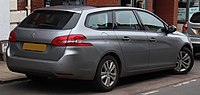
The second generation 308 was unveiled on 13 May 2013, with updated style along with the 508 and the 208, and was displayed at the 2013 Frankfurt Motor Show. Peugeot changed its numbering system where the final digit is fixed: 8 for the mainstream range, and 1 for the models aimed at emerging countries, such as the Peugeot 301.[21] It is built on the PSA EMP2 platform, shared with Citroën C4 Picasso, resulting in 140 kg (310 lb) weight loss compared to previous generation.[22]
The changes included daytime running lights/DRL at the bottom and the blinker (turn signal indicator) is on the daytime light, advising the pedestrian or other road user to which direction it is moving.
GTi by Peugeot Sport
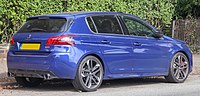
[edit]The Peugeot 308 GTi by Peugeot Sport featured engines producing 250 hp (186 kW) and 270 hp (201 kW). The 250 hp version had full LED headlights, an electronic limited slip differential, 18" alloys, keyless entry, stop/start technology, 11 mm lowered ride height, a coloured reversing camera and twin exhausts.
Additionally, the 270 hp version gets 380 mm Alcon front brakes, massaging leather/Alcantara bucket seats, a Torsen limited-slip differential and 19" lightweight alloy wheels.
2017 update
[edit]The features include a new bonnet and front bumper design and indicators that scroll, and a newly designed grille that features the famous Peugeot Lion. All models, except Active and GTi, feature the Panoramic roof. New DRLs are matched at the back with the LED Claws lit permanently when the vehicle is running.
A new more powerful 1.5HDi engine with 130 bhp joined the line up from September 2017. All models have TomTom satellite navigation as standard in addition to the central touchscreen update.
2020 update
[edit]In July 2020, a revised 308 was announced featuring a number of trim and colour changes, but most significantly, the introduction of the digital i-Cockpit which was first introduced on the Peugeot 3008.
Production of the 308 II ended in May 2021.[23]
Gallery
[edit]-
 Hatchback (pre-facelift) rear
 -
 SW (pre-facelift)
 -
 Interior
 -
 Hatchback (facelift) front
 -
 Hatchback (facelift) rear
 -
 Sedan
Sedan -
 SW (facelift)
 -
 Peugeot 308 GTi (pre-facelift) front
 -
 Peugeot 308 GTi (pre-facelift) rear
 -
 Peugeot 308 GTi (facelift) front
 -
 Peugeot 308 GTi (facelift) rear
 -
 Peugeot 308 TCR
_%E2%80%93_Heckansicht,_4._Januar_2014,_D%C3%BCsseldorf.jpg)


_Allure_hatchback_(2018-07-19)_01.jpg)
_Allure_hatchback_(2018-07-19)_03.jpg)


Safety
[edit]| Test | Points | % |
|---|---|---|
| Overall: |
| |
| Adult occupant: | 33 | 92% |
| Child occupant: | 39 | 79% |
| Pedestrian: | 23 | 64% |
| Safety assist: | 7 | 81% |
Third generation (P5; 2021)
[edit]| Peugeot 308 III | |
|---|---|
_-_081.jpg) | |
| Overview | |
| Model code | P5 |
| Production | September 2021–present |
| Assembly | France: Mulhouse (Mulhouse Plant)[25] |
| Designer | Sébastien Criquet |
| Body and chassis | |
| Body style | |
| Layout | Front-engine, front-wheel-drive |
| Platform | EMP2 V3[26] |
| Related | |
| Powertrain | |
| Engine |
|
| Electric motor | Synchronous Electric Motor, 81 kW (110 PS; 109 hp) (308 PHEV) Permanent Magnet Synchronous Motor, 115 kW (156 PS; 154 hp) (e-308) |
| Transmission | 6-speed manual 8-speed automatic 1-speed direct-drive fixed gear ratio (e-308) |
| Hybrid drivetrain | Plug-in hybrid (PHEV) |
| Battery | 12.4 kWh (PHEV)[27] 54/50 kWh (e-308 gross/net) |
| Electric range | 58–60 km (36–37 mi) (PHEV, WLTP) 349–400 km (217–249 mi) (e-308, WLTP |
| Dimensions | |
| Wheelbase | 2,675 mm (105.3 in) 2,732 mm (107.6 in) (SW) |
| Length | 4,367 mm (171.9 in) 4,636 mm (182.5 in) (SW) |
| Width | 1,852 mm (72.9 in) |
| Height | 1,440 mm (56.7 in) |
The third-generation 308 was unveiled on March 18, 2021, and launched in May 2021.[23] The vehicle is based on the third-generation of the EMP2 platform which made its wheelbase grow by 55 mm (2.2 in) and is shared with the second generation DS 4 as well as the sixth generation Opel Astra. Peugeot has also reduced its height by 20 mm (0.8 in) to create a sleeker silhouette and to achieve a lower drag coefficient of 0.28. It is also the first vehicle to bear the new Peugeot logo.[28] It went to production on 29 September 2021 and went on sale on the same day.[29]
All variants of the third-generation 308 is equipped with LED headlights complemented by vertical LED daytime running lights. These headlights feature the Peugeot Matrix LED Technology on GT and GT Premium variants. It is also equipped with the Drive Assist pack that adds adaptive cruise control with Stop and Go function, lane keeping assistance, semi-automatic lane change, anticipated speed recommendation, and curve speed adaptation. Other features offered as standard or optional include long-range blind-spot monitoring, 360-degree surround-view parking assistance with four cameras, rear cross-traffic alert, heating for the windscreen and steering wheel, and an E-call+ emergency call function.[30]
It is also offered as a plug-in hybrid producing 180 PS (178 hp; 132 kW). The 225 PS (222 hp; 165 kW) version will also be available on the GT version.[31]
The station wagon version was released in June 2021.[32][33] A crossover derivative was unveiled in June 2022 as the 408.[34]
A battery electric version called the e-308 was introduced in September 2022. It is equipped by a new generation 54 kWh battery pack, with a chemical composition of 80 per cent nickel, 10 per cent manganese and 10 per cent cobalt.[35]
-
 Hatchback (rear view)
 -
 SW (rear view)
 -
 Peugeot 308 Hybrid
 -
 Peugeot e-308
 -
 Interior
_-_082.jpg)


_-_002.jpg)
Safety
[edit]| Test | Points | % |
|---|---|---|
| Overall: |
| |
| Adult occupant: | 29.1 | 76% |
| Child occupant: | 41.3 | 84% |
| Pedestrian: | 37.0 | 68% |
| Safety assist: | 10.5 | 65% |
Sales and production
[edit]| Year | Europe | Worldwide Production | Worldwide sales | Notes |
| 2007 | 43,256 | 106,056 | 82,500[37] | |
| 2008 | 231,804 | 304,131 | 290,100[37] | |
| 2009 | 225,949 | 233,700[38] | 252,100[37] | |
| 2010 | 180,575 | 226,600[38] | 226,200[38] | |
| 2011 | 155,272 | 201,929[1] | 203,998[1] | Total production reaches 1,072,551 units.[1] |
| 2012 | 119,143 | 179,200[39] | 184,300[39] | Total production reaches 1,251,700 units.[39] |
| 2013 | 99,697 | |||
| 2014 | 161,515 | |||
| 2015 | 213,764 | |||
| 2016 | 194,650 | |||
| 2017 | 157,422 | |||
| 2018 | 153,651 | |||
| 2019 | 141,060 | |||
| 2020 | 90,324 | |||
| 2021 | 53,356 | |||
| 2022 | 90,160 |
Awards
[edit]In March 2014, the Peugeot 308 was awarded European Car of the Year, in competition with the BMW i3 and Tesla Model S.[40][41] The Peugeot 308 was also voted Car of the Year by Auto Europa in Italy, by the Italian automotive journalists association, Car of the Year in Switzerland by Schweizer Illustrierte, and four other magazines.[42][43]
In 2022, the new Peugeot 308 SW was selected as the 'Company Vehicle of the Year' at the Automobile Awards.[44]
Notes
[edit]- ^
- PSA Group (2007–2021)
- Stellantis (2021–present)
References
[edit]- ^ a b c d "PSA Annual Report 2012" (PDF). Car manufacturers. PSA. Retrieved 4 April 2013.[permanent dead link]
- ^ Mann, Richard. "New Peugeot 308 announced". Retrieved 18 March 2021.
- ^ "Peugeot-Citroën-Mitsubishi: parte la produzione nella nuova fabbrica in Russia". autoblog.it (in Italian). 24 April 2010. Retrieved 11 November 2010.
- ^ "Peugeot 308". autocar.co.uk. Retrieved 17 November 2007.
- ^ a b c "Peugeot 308 CC 2.0 HDi (163bhp) Active 2d specs & dimensions | Parkers". www.parkers.co.uk. Retrieved 13 June 2023.
- ^ "308: dynamic, stylish contours and materials". Peugeot. Retrieved 5 May 2011.
- ^ "Peugeot press release March 2011" (PDF). Archived from the original (PDF) on 15 July 2011. Retrieved 13 March 2011.
- ^ Sweney, Mark (7 October 2009). "The Guardian 7 October 2009". Guardian. London. Retrieved 13 March 2011.
- ^ "PSA Press Release". Psa-peugeot-citroen.com. Archived from the original on 28 June 2011. Retrieved 13 March 2011.
- ^ a b "Stellantis dejará de fabricar tres modelos de Peugeot y Citroën en Argentina". Motor1.com (in Spanish). Retrieved 20 December 2022.
- ^ "Top Gear 24 May 2010". Topgear.com. 24 May 2010. Archived from the original on 8 March 2014. Retrieved 13 March 2011.
- ^ "Independent Online (South Africa) 11 March 2011". Iol.co.za. 11 June 2010. Retrieved 13 March 2011.
- ^ "Auto Express February 2009". Autoexpress.co.uk. 18 February 2009. Retrieved 13 March 2011.
- ^ por Enrique GarcĂa de 16 de Sep del 2011 (16 September 2011). "Peugeot 308 sedan". Es.autoblog.com. Archived from the original on 27 March 2012. Retrieved 8 November 2011.
{{cite web}}: CS1 maint: numeric names: authors list (link) - ^ "Stellantis dejará de fabricar tres modelos de Peugeot y Citroën en Argentina". Motor1.com (in Spanish). Retrieved 20 December 2022.
- ^ "Bosch says it has contract for diesel-hybrid parts". autonews.com. 12 June 2007. Retrieved 11 November 2010.
- ^ "Auto Express February 2009". Autoexpress.co.uk. 20 April 2009. Retrieved 13 March 2011.
- ^ The Times 27 January 2008[dead link]
- ^ "The 308 awarded the Golden Steering Wheel". Car news and reviews. Vcars.co.uk. 26 March 2008. Retrieved 4 April 2013.
- ^ https://cdn.euroncap.com/media/8798/euroncap_peugeot_308_2007_5stars.pdf
- ^ Holder, Jim (24 May 2012). "Peugeot revamps naming structure". Autocar. Retrieved 10 February 2018.
- ^ "The new Peugeot 308:A refined design and an innovative cockpit for unique driving sensations". Peugeot Media Center. 13 May 2013. Retrieved 10 February 2018.
- ^ a b Chopin, Florian (29 May 2021). "Peugeot 308 II. Elle sort définitivement du catalogue". www.largus.fr. Retrieved 29 May 2021.
- ^ https://cdn.euroncap.com/media/5994/euroncap_peugeot_308_2013_5stars.pdf
- ^ "La nouvelle Peugeot 308 sera produite à l'usine de Mulhouse". www.largus.fr.
- ^ "Photo 30 - schéma technique plateforme EMP2 V3 nouvelle Peugeot 308 2021 - Peugeot 308 2021. A bord de la nouvelle compacte française en vidéo". www.largus.fr. Retrieved 13 September 2022.
- ^ https://www.auto-motor-und-sport.de/news/9081237/preisliste-peugeot-308-29.06.2021.pdf Archived 30 November 2022 at the Wayback Machine [bare URL PDF]
- ^ "New Peugeot 308 Revealed As The Volkswagen Golf's Worst Nightmare". Motor1.com. Retrieved 19 March 2021.
- ^ "Peugeot 308 : une entrée en production pour les 211 ans du Lion - autojournal.fr". 28 September 2021.
- ^ Anderson, Brand (18 March 2021). "2021 Peugeot 308 Unveiled With New Looks, Advanced Tech, And Two Plug-In Hybrids". Carscoops. Retrieved 19 March 2021.
- ^ Chopin, Florian (20 January 2020). "Peugeot 308 2021. 1ères photos et infos sur la nouvelle compacte" [2021 Peugeot 308: First photos and info on the new compact car]. L'argus (in French). Archived from the original on 27 May 2020.
- ^ "Peugeot 308 wagon adds plug-in hybrid versions". Automotive News Europe. 23 June 2021. Retrieved 20 October 2021.
- ^ Sergeev, Angel (24 February 2021). "Next-Gen Peugeot 308 Wagon Spied For The First Time". Motor1.com. Retrieved 24 June 2021.
- ^ "Peugeot: une 308 spéciale pour les Etats-Unis?". autoplus (in French). 15 July 2019.
- ^ "2023 Peugeot E-308 And E-308 SW Silently Debut In Europe". InsideEVs. Retrieved 5 October 2022.
- ^ https://cdn.euroncap.com/media/69655/euroncap-2022-peugeot-308-datasheet.pdf
- ^ a b c "PSA". Psa-peugeot-citroen.com. 30 June 2010. Archived from the original on 6 December 2010. Retrieved 11 November 2010.
- ^ a b c "Engine specs from PSA Peugeot Citroën" (PDF). Creator and designer. PSA Peugeot Citroën. Archived from the original (PDF) on 5 June 2017. Retrieved 22 November 2012.
- ^ a b c Memento Mars 2013 (in French), PSA Peugeot Citroën, 21 February 2013, p. 50, archived from the original on 11 March 2013
- ^ Mann, Richard. "New Peugeot 308 wins European Car of the Year 2014". Charters. Archived from the original on 4 March 2014. Retrieved 3 March 2014.
- ^ "Peugeot 308 is Euro Car of the Year". TopGear. Retrieved 14 December 2023.
- ^ "Peugeot 308, Car of the year 2015 in Italy". Union Italiana Giornalisti Automobile dell'Automotive. Archived from the original on 9 November 2014. Retrieved 20 December 2014.
- ^ "Peugeot 308 : Das "Schweizer Auto des Jahres"". Charters. 6 December 2013. Retrieved 20 December 2014.
- ^ "La nouvelle Peugeot 308 SW élue « Véhicule d'entreprise » de 2022". Autojournal. 12 December 2022. Retrieved 14 December 2023.
External links
[edit]
A brand of Stellantis | ||||||||||
| Current vehicles |
|  | ||||||||
| Historic vehicles |
| |||||||||
| Motorsport | ||||||||||
| Concept cars | ||||||||||
| Related topics | ||||||||||

