


Thurgau
Thurgau | |
|---|---|
| Canton of Thurgau Kanton Thurgau (German) | |
 Flag | |
 Location in Switzerland
Map of Thurgau  | |
| Coordinates: 47°35′N 9°4′E / 47.583°N 9.067°E | |
| Country | Switzerland |
| Capital | Frauenfeld |
| Subdivisions | 80 municipalities, 5 districts |
| Government | |
| • Executive | Regierungsrat (5) |
| • Legislative | Grosser Rat (130) |
| Area | |
| • Total | 991.77 km2 (382.92 sq mi) |
| Population (December 2020)[2] | |
| • Total | 282,909 |
| • Density | 290/km2 (740/sq mi) |
| GDP | |
| • Total | CHF 17.208 billion (2020) |
| • Per capita | CHF 61,190 (2020) |
| ISO 3166 code | CH-TG |
| Highest point | 991 m (3,251 ft): Hohgrat |
| Lowest point | 370 m (1,214 ft): Thur at the cantonal border in Neunforn |
| Joined | 1803 |
| Languages | German |
| Website | www |

Thurgau (German: [ˈtuːrɡaʊ] ⓘ; French: Thurgovie; Italian: Turgovia; Romansh: Turgovia), anglicized as Thurgovia, and formally[4] as the Canton of Thurgau, is one of the 26 cantons forming the Swiss Confederation. It is composed of five districts. Its capital is Frauenfeld.
Thurgau is part of Eastern Switzerland. It is named after the river Thur, and the name Thurgovia was historically used for a larger area, including part of this river's basin upstream of the modern canton. The area of what is now Thurgau was acquired as subject territories by the cantons of the Old Swiss Confederacy from the mid 15th century. Thurgau was first declared a canton in its own right at the formation of the Helvetic Republic in 1798.
The population, as of December 2020[update], is 282,909.[2] In 2007, there were a total of 47,390 resident foreigners, constituting 19.9% of the population.[5]
History[edit]
In prehistoric times the lands of the canton were inhabited by people of the Pfyn culture along Lake Constance. During Roman times the canton was part of the province Raetia until 450, when Alemanni settled on the lands.
In the sixth century, Thurgovia became a Gau of Francia as part of Alamannia, passing to the Duchy of Swabia in the early 10th century. At this time, Thurgovia included not just what is now the canton of Thurgau, but also much of the territory of the modern canton of St. Gallen, the Appenzell and the eastern parts of the canton of Zürich.
The most important cities of Thurgovia in the early medieval period were Konstanz as the seat of the bishop and St. Gallen for the Abbey of Saint Gall.
The dukes of the House of Zähringen and the counts of the Kyburg family took over much of the land in the High Middle Ages. The town of Zürich was part of the Thurgau until it became reichsunmittelbar in 1218.[dubious ] When the Kyburg dynasty became extinct in 1264 the House of Habsburg took over that land.
The Old Swiss Confederacy allied with ten freed bailiwicks of the former Toggenburg seized the lands of the Thurgau from the Habsburgs in 1460, and it became a subject territory of seven Swiss cantons (Zurich, Lucerne, Uri, Schwyz, Unterwalden, Zug and Glarus).
During the Protestant Reformation in Switzerland, both the Catholic and emerging Reformed parties sought to swing the subject territories, such as the Thurgau, to their side. In 1524, in an incident that resonated across Switzerland, local peasants occupied the cloister of Ittingen in the Thurgau, driving out monks, destroying documents, and devastating the wine-cellar. Between 1526 and 1531, most of the Thurgau's population adopted the new Reformed faith spreading from Zurich; Zurich's defeat in the 1531 Second War of Kappel ended Reformed predominance. Instead, the First Peace of Kappel protected both Catholic and Reformed worship, though the provisions of the treaty generally favored the Catholics, who also made up a majority among the seven ruling cantons. Religious tensions over the Thurgau were an important background to the First War of Villmergen (1656), during which Zurich briefly occupied the Thurgau.
In 1798 the land became a canton for the first time as part of the Helvetic Republic. In 1803, as part of the Act of Mediation, the canton of Thurgau became a member of the Swiss confederation. The cantonal coat of arms was designed in 1803, based on the coat of arms of the Kyburg family, which ruled the Thurgau in the 13th century, changing the background to green-and-white, at the time considered "revolutionary" colours (c.f. tricolour); as the placement of a yellow (or) charge on white (argent) is a violation of heraldic principles, there have been suggestions to modify the design, including a 1938 suggestion to use a solid green field divided by a diagonal white line, but they were unsuccessful.
The current cantonal constitution of Thurgau dates from 1987.
Geography[edit]

To the north the canton is bound by the Lake Constance across which lies Germany (Baden-Württemberg and Bavaria) and Austria (Vorarlberg). The Rhine creates the border in the northwest. To the south lies the canton of St. Gallen; to the west lie the cantons of Zürich and Schaffhausen.
The area of the canton is 991 km2 (383 sq mi) and commonly divided into three hill masses. One of these stretches along Lake Constance in the north. Another is further inland between the Thur and the river Murg. The third one forms the southern border of the canton and merges with the Hörnli mountain in the pre-Alps.
Demographics[edit]
The population of the canton (as of 31 December 2020) is 282,909.[2] The canton is mostly German speaking. The population (as of 2000[update]) is split between Protestants (45%) and Roman Catholics (36%).[6]
Historical population[edit]
The historical population is given in the following table:
| Historic Population Data[7] | ||||
|---|---|---|---|---|
| Year | Total Population | Swiss | Non-Swiss | Population share of total country |
| 1850 | 88 908 | 87 006 | 1 902 | 3.7% |
| 1880 | 99 231 | 92 120 | 7 111 | 3.5% |
| 1900 | 113 221 | 98 183 | 15 038 | 3.4% |
| 1950 | 149 738 | 139 990 | 9 748 | 3.2% |
| 1970 | 182 835 | 148 792 | 34 043 | 2.9% |
| 2000 | 228 875 | 183 942 | 44 933 | 3.1% |
| 2020 | 282,909 | 3.3% | ||
Political subdivisions[edit]
Districts[edit]


Since January 2011, Thurgau has been divided into five districts which are named after their capitals. Before this date, there were eight districts - (Steckborn District, Bischofszell District and Diessenhofen District formed their own districts with their surrounding municipalities).[8]
- Frauenfeld District with capital Frauenfeld
- Kreuzlingen District with capital Kreuzlingen
- Weinfelden District with capital Weinfelden
- Münchwilen District with capital Münchwilen
- Arbon District with capital Arbon
Municipalities[edit]
As of 2009[update], there are 80 municipalities in the canton.[9] The ten largest municipalities by population are:
-
 1. Frauenfeld - population 25,974
 -
 2. Kreuzlingen - population 22,390
 -
 3. Arbon - population 14,950
 -
 4. Amriswil - population 14,211
 -
 5. Weinfelden - population 11,629
 -
 6. Romanshorn - population 11,327
 -
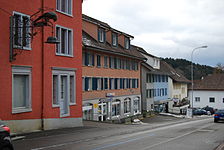 7. Aadorf - population 9,216
 -
 8. Sirnach - population 7,901
 -
 9. Bischofszell - population 5,907
 -
 10. Münchwilen - population 5,830


Politics[edit]
Federal election results[edit]
| Percentage of the total vote per party in the canton in the National Council Elections 1971–2019[10] | |||||||||||||||
|---|---|---|---|---|---|---|---|---|---|---|---|---|---|---|---|
| Party | Ideology | 1971 | 1975 | 1979 | 1983 | 1987 | 1991 | 1995 | 1999 | 2003 | 2007 | 2011 | 2015 | 2019 | |
| FDP.The Liberalsa | Classical liberalism | 16.9 | 14.4 | 16.9 | 18.3 | 18.5 | 16.5 | 15.3 | 14.7 | 11.9 | 12.1 | 11.2 | 13.0 | 11.5 | |
| CVP/PDC/PPD/PCD | Christian democracy | 23.4 | 22.3 | 24.6 | 21.6 | 20.4 | 16.5 | 13.0 | 15.7 | 16.5 | 15.2 | 14.4 | 13.1 | 12.7 | |
| SP/PS | Social democracy | 20.7 | 21.6 | 22.4 | 19.5 | 13.4 | 15.1 | 18.1 | 16.1 | 14.1 | 11.7 | 12.1 | 12.7 | 12.6 | |
| SVP/UDC | Swiss nationalism | 26.0 | 25.1 | 26.4 | 22.8 | 21.7 | 23.7 | 27.0 | 33.2 | 41.0 | 42.3 | 38.7 | 39.9 | 36.7 | |
| Ring of Independents | Social liberalism | * b | 6.6 | 5.3 | 3.9 | 2.6 | 3.3 | * | * | * | * | * | * | * | |
| EVP/PEV | Christian democracy | * | * | * | 5.3 | * | 3.2 | 2.7 | 2.8 | 2.7 | 2.8 | 2.9 | 2.3 | 2.7 | |
| GLP/PVL | Green liberalism | * | * | * | * | * | * | * | * | * | * | 5.2 | 6.2 | 8.1 | |
| BDP/PBD | Conservatism | * | * | * | * | * | * | * | * | * | * | 5.0 | 3.8 | 2.3 | |
| POCH | Progressivism | * | * | * | * | 0.2 | * | * | * | * | * | * | * | * | |
| GPS/PES | Green politics | * | * | * | 5.9 | 10.8 | 9.0 | 9.3 | 6.2 | 7.9 | 10.2 | 7.0 | 5.4 | 10.6 | |
| SD/DS | National conservatism | 4.2 | 2.5 | 1.9 | 2.7 | * | 3.5 | 4.8 | 2.5 | 2.9 | 1.9 | * | * | * | |
| Rep. | Right-wing populism | 8.8 | 7.6 | 2.0 | * | * | * | * | * | * | * | * | * | * | |
| EDU/UDF | Christian right | * | * | * | * | * | * | * | 1.9 | 1.9 | 2.6 | 3.5 | 3.4 | 2.8 | |
| FPS/PSL | Right-wing populism | * | * | * | * | 6.4 | 8.7 | 8.0 | 2.7 | 0.3 | * | * | * | * | |
| Other | * | * | 0.4 | * | 6.0 | 0.5 | 1.9 | 4.3 | 0.7 | 1.1 | * | 0.2 | |||
| Voter participation % | 62.0 | 56.6 | 48.3 | 52.7 | 48.5 | 47.1 | 44.1 | 44.6 | 42.9 | 46.9 | 46.7 | 46.6 | 42.4 | ||
- ^a FDP before 2009, FDP.The Liberals after 2009
- ^b "*" indicates that the party was not on the ballot in this canton.
Economy[edit]
The canton of Thurgau is known for its agricultural produce. Particularly, apples, pears. The many orchards in the canton are mainly used for the production of cider. Wine is produced in the Thur valley.
There is also industry in the canton of Thurgau. The main industries are printing, textiles and handicrafts. Small and middle-sized businesses are important for the cantonal economy. Many of these are concentrated around the capital.
Notes and references[edit]
- ^ Arealstatistik Land Cover - Kantone und Grossregionen nach 6 Hauptbereichen accessed 27 October 2017
- ^ a b c "Ständige und nichtständige Wohnbevölkerung nach institutionellen Gliederungen, Geburtsort und Staatsangehörigkeit". bfs.admin.ch (in German). Swiss Federal Statistical Office - STAT-TAB. 31 December 2020. Retrieved 21 September 2021.
- ^ Statistik, Bundesamt für (2021-01-21). "Bruttoinlandsprodukt (BIP) nach Grossregion und Kanton - 2008-2018 | Tabelle". Bundesamt für Statistik (in German). Retrieved 2023-07-01.
- ^ Welcome to the Canton of Thurgau![permanent dead link], Migration Office Department of Integration, tg.ch. Retrieved 2021-01-30
- ^ Federal Department of Statistics (2008). "Ständige Wohnbevölkerung nach Staatsangehörigkeit, Geschlecht und Kantonen". Archived from the original (Microsoft Excel) on 15 December 2008. Retrieved 5 November 2008.
- ^ Federal Department of Statistics (2004). "Wohnbevölkerung nach Religion". Archived from the original (Interactive Map) on 2016-09-24. Retrieved 2009-01-15.
- ^ "Thurgau". Historisches Lexikon der Schweiz (in German). Retrieved 2022-01-25.
- ^ "Kanton Thurgau > Bezirke und Gemeinden". Archived from the original on 2012-02-18. Retrieved 2012-01-29.
- ^ "Liste officielle des communes de la Suisse - 01.01.2008". Office fédéral de la statistique. Archived from the original on 12 June 2009. Retrieved 15 December 2008.
- ^ Nationalratswahlen: Stärke der Parteien nach Kantonen (Schweiz = 100%) (Report). Swiss Federal Statistical Office. 2015. Archived from the original on 2016-08-02. Retrieved 2016-08-08.
External links[edit]

- Official website
 (in German)
 - Official statistics
- Coolidge, William Augustus Brevoort (1911). . Encyclopædia Britannica. Vol. 26 (11th ed.). pp. 899–900.


Major topics | |||||||||
| History | .svg) | ||||||||
| Geography |
| ||||||||
| Politics | |||||||||
| Economy | |||||||||
| Society |
| ||||||||

| International | |
|---|---|
| National | |
| Geographic | |
| Other | |
- Thurgau
- Cantons of Switzerland
- Cantons of the Helvetic Republic
- Former condominiums of Switzerland
- States and territories established in 1803
- 15th-century establishments in the Old Swiss Confederacy
- 1460s establishments in the Holy Roman Empire
- 1460 establishments in Europe
- 1803 establishments in Switzerland