Tourism in Saudi Arabia
_architecture_3_Feb_2022.jpg)


Saudi Arabia is the second biggest tourist destination in the Middle East with over 16 million visiting in 2017.[1] Although most tourism in Saudi Arabia still largely involves religious pilgrimages, there is growth in the leisure tourism sector. As the tourism sector has been largely boosted lately, the sector is expected to a significant industry for Saudi Arabia, reducing its dependence on oil revenues. This is proved as tourism sector is expected to generate $25 billion in 2019.[2] Potential tourist areas include the Hijaz and Sarawat Mountains, Red Sea diving and a number of ancient ruins.
According to the World Travel and Tourism Council (WTTC), in 2018, Travel and tourism in Saudi Arabia added 9% to the Kingdom’s total economy which is worth $65.2 billion.[3]
In December 2013, Saudi Arabia announced its intention to begin issuing tourist visas for the first time in its history. Council of Ministers entrusted the Ministry of Tourism with visa issuing on the basis of certain regulations approved by the Ministries of Interior and Foreign Affairs.[4] On 27 September 2019, Saudi Arabia formally announced the issuance of the tourist visa to visitors from 49 countries for a fee of $80. The visa can be either obtained online (eVisa) or on arrival.[5] Ten days after the implementation of instant tourist visas, 24,000 foreign visitors entered Saudi Arabia. China visitors topped the list, with the UK and the US in second and third.[6]
Popular places to visit in Saudi Arabia are Makkah, Medina, Mada'in Salih, Yanbu, Tabuk, Jeddah and Riyadh.
Arriving in Saudi Arabia can be through 13 international airports served by various global airlines. There are also 15 domestic airports connecting the country regions and cites. For moving within the country, there are budget airlines like Flynas, Fyadeal, Nesma Airlines, in addition to Saudi Airlines and SaudiGulf Airlines.
Museums
[edit]Saudi Arabia has a variety of museums ranging from historical museums, archeological museums, and cultural and scientific museums. These museums exhibit the art life, old handicrafts, and antiquities of the Kingdom and including:
.jpg)
- National Museum of Saudi Arabia: This is the most famous museum in Saudi Arabia. It was established in 1999 and is located in Riyadh as a part of the King Abdulaziz Historical Centre.[7] The museum highlights the prominent history of the Arabian Peninsula and its historical role in Islam expanding as well as the history of Saudi Arabia.[7] The museum also holds many ancient manuscripts that are traced back to many ancient civilizations. Indeed Saudi Arabia is considered one of the richest countries in regards of the number of ancient manuscripts.[8]
- Al-Zaher Palace Museum: It is a historical museum established in 1944 and exhibits the history of Makkah and various archaeological collections for different periods of Islamic history in the region.[9]
- Al-Madinah Museum: It exhibits Al-Madina's heritage and history featuring different archaeological collections, visual galleries and rare images that relate to Al-Medina.[10] It also includes the Hejaz Railway Museum.
- Jeddah Regional Museum of Archaeology and Ethnography in Jeddah: it exhibits various collections including artifacts of the stone age back to the Acheulean period, elements illustrating the rise of Islam, and a collection of ethnographic items portraying the modern culture of the region.
_(50703484406).jpg)
- Nasseef House in Jeddah: a historical building in Al-Balad, founded in 1872. later, In 2009, it was transformed into a museum and cultural center.
- Royal Saudi Air Force Museum in Riyadh: This museum displays the history of the Royal Saudi Air Force.
- Masmak fort: is a clay and mud-brick fort, it was built around 1865.
- Makkah Antiquities and Heritage Museum: The museum was originally a royal guest house and went by the name of Zaher Palace. It was later converted into a school, and then into a museum.[11]
.jpg)
- Tabuk Castle: is an ancient castle in Tabuk, the capital city of the Tabuk Region in northwestern Saudi Arabia which dates back to 1559.[12] The castle has been rehabilitated and transformed into a museum open to all visitors.
- Dammam National Museum is located on the 4th floor of the Dammam Public Library, opposite the Muhammad bin Fahd Stadium on the cross lane from the Dammam-Khobar Highway in Al Toubaishi district. The museum focuses on the country's history, culture, and inhabitants through displays of relics and remnants of handicrafts.
- Al Ula Museum: one of the most crucial tourist destinations within the Kingdom, is described as a vibrant living museum in the open air, where the rich tapestry of Saudi Arabian history unfolds against the backdrop of breathtaking landscapes, ancient ruins, and architectural marvels.[citation needed]
- Museum of Buraidah
- Al Ahsa Museum
- The Two Holy Mosques Architecture Exhibition
World Heritage Sites
[edit]There are seven UNESCO World Heritage Sites in Saudi Arabia inscribed from 2008 to 2023;[13] they are as follows:

- Al-Ahsa Oasis: The Al-Ahsa Oasis is a serial property comprising gardens, canals, springs, wells and a drainage lake, as well as historical buildings, urban fabric and archaeological sites.[14]

- Mada'in Salih is a pre-Islamic archaeological site located in the AlUla sector, within the Al Madinah Region of Saudi Arabia.[15] A majority of the vestiges date from the Nabatean kingdom (1st century AD).[16] The site constitutes the kingdom's southernmost and largest settlement after Petra, its capital.[17][18] Traces of Lihyanite and Roman occupation before and after the Nabatean rule, respectively, can also be found in situ,[18] while accounts from the Qur’an tell of an earlier settlement of the area by the tribe of Thamud in the 3rd millennium BC.[19]

- At-Turaif District in ad-Dir'iyah, a town in Saudi Arabia located on the northwestern outskirts of Riyadh. Diriyah was the original home of the Saudi royal family and served as the capital of the first Saudi dynasty from 1744 to 1818. Today, the town is the seat of the Diriyah Governorate, which also includes the villages of Uyayna, Jubayla, and Al-Ammariyyah, among others, and is part of Ar Riyad Province.[20]

- Historic Jeddah: Historic Jeddah was as a major port for Indian Ocean trade routes, channelling goods to Mecca. It was also the gateway for Muslim pilgrims to Mecca who arrived by sea.[21]
- Rock Art in the Hail Region: This property shows numerous representations of human and animal figures covering 10,000 years of history.[22]
- Ḥimā Cultural Area: Ḥimā Cultural Area contains a collection of rock art images illustrating hunting, fauna, flora and lifestyles of 7,000 years.[23]
- 'Uruq Bani Ma'arid: The property encompasses the western part of the greatest expanse of windblown sand on Earth, known as Ar Rub' al-KhaIi, and conserves one of the Earth’s most spectacular desert landscapes.[24]
- Qaryat al-Faw: Lying at a strategic point of the ancient trade routes of the Arabian Peninsula, the property was abruptly abandoned around the 5th century CE.[25]
Main festivals and events
[edit]
- Riyadh Season: is a six-month long entertainment festival that includes a wide range of entertainment events from international concerts, sport events, Michelin star restaurants and family-oriented activities such as Winter Wonderland.[26]
- Jenadriyah: It is an annual cultural and heritage festival held in Jenadriyah near Riyadh. The festival hosts various cultural and heritage events such as Al Janadriya Operetta, Saudi ardah, and camel racing.
- Souk Okaz: It is an annual cultural event held in Ta'if. It was known as an open market in the ancient past. Nowadays, Souk Okaz combines more than 150 attractions of heritage and cultural events, theatre performances, and arts and crafts.[27][28]
- Historic Jeddah Festival: is a celebration that takes place in the historical Al Balad district of Jeddah. The festival exhibits the culture and heritage of Jeddah.[29]
- “Winter at Tantora” festival : an annual festival held in the old town of AlUla, in northwestern Saudi Arabia.
- Ha'il International Rally
- Al Qassim Date Festival: is the largest date festival in the world held in the central Qassim region of Saudi Arabia.
- King Abdulaziz Falconry Festival[30] is an international festival organized by the Saudi Falcons Club and witnesses the participation of a group of falcon owners in the Kingdom and the Gulf Cooperation Council.[31]
- Riyadh Fashion Week: a spectacular showcase of Saudi Arabia's flourishing fashion identity, featuring a curated lineup of 16 mesmerizing runway shows that invite attendees to embark on an extraordinary and evocative journey into the heart of style, cultural richness, and innovation. [32]
Religious tourism
[edit]
Tourism in Saudi Arabia still largely involves religious pilgrimages. Mecca and Medina receive over three million pilgrims a year during the month of Dhu al-Hijjah in Hajj,[33] and around two million during the month of Ramadan to perform Umrah.[34] During the rest of the year, Mecca and Medina receive around four million for Umrah. The Hajj, or pilgrimage to the city, is one of the five pillars of Islam. Only Muslims are permitted in Mecca, while non-Muslims can enter Medina.
Saudi Seasons
[edit]
In 2019, in support of Saudi Vision 2030, the country launched an initiative known as Saudi Seasons to help promote domestic and international tourism. Backed via public and private sector investments, Saudi Seasons consists of "seasons" in specific areas of the country throughout the year, which serve as a collective brand for cultural and entertainment events (including festivals, concerts, theatrical performances, exhibitions, sports, and other attractions) held during the periods:[35][36] Riyadh Season, the largest of the events in the Saudi capital of Riyadh, runs from October through March annually. The inaugural edition of Riyadh Season generated six billion riyals in revenue and over eleven million visitors.[37][38]
Other sites
[edit]
The Red Sea Project is being developed as a beach resort where women can wear bikinis.[39] The construction began in 2019. The Red Sea is one of the seven wonders of the underwater world. Known for its beautiful coral reefs and abundant marine life, it is listed as one of the best diving locations in the world.[40]
Tourists in Saudi
[edit]
The Travel & Tourism sector in Saudi Arabia is set for impressive growth, with an anticipated annual average increase of 11% over the next decade, positioning itself as the fastest-growing industry in the Middle East. This positive trajectory is highlighted by a projection that the Kingdom is expected to attract a substantial 22.1 million international arrivals by 2025. Such a promising outlook not only emphasizes the increasing allure of Saudi Arabia as a travel destination but also signifies the country's strategic efforts to establish itself as a key player in the global tourism landscape.[citation needed]
Most visitors arriving in Saudi Arabia on a short term basis were from the following countries:
| Country | 2022 | 2021 | 2020 | 2019 | 2018 | 2017 | 2016 |
|---|---|---|---|---|---|---|---|
 Bahrain Bahrain
|
2,177,662 | 239,947 | 99,854 | 510,900 | 574,350 | 568,564 | 918,432 |
 Kuwait Kuwait
|
1,948,429 | 623,462 | 629,240 | 2,132,114 | 1,992,838 | 2,092,824 | 2,064,087 |
 Egypt Egypt
|
1,462,922 | 308,253 | 431,790 | 1,099,854 | 799,950 | 958,777 | 1,621,644 |
 Pakistan Pakistan
|
1,407,164 | 257,640 | 483,290 | 2,210,877 | 2,177,306 | 2,537,201 | 2,181,985 |
 Indonesia Indonesia
|
1,228,186 | 11,467 | 293,291 | 1,428,935 | 1,375,004 | 1,427,056 | 1,144,554 |
 India India
|
1,108,678 | 316,488 | 338,965 | 1,571,070 | 1,440,170 | 1,581,233 | 1,656,245 |
 Qatar Qatar
|
764,485 | 254,013 | 10,372 | 46,152 | 119,287 | 274,935 | 623,917 |
 Jordan Jordan
|
597,165 | 196,898 | 242,834 | 836,678 | 615,993 | 715,493 | 920,449 |
 United Arab Emirates United Arab Emirates
|
595,813 | 94,927 | 165,716 | 784,305 | 739,404 | 649,902 | 947,628 |
 Iraq Iraq
|
491,510 | 87,843 | 65,582 | 316,519 | 239,790 | 325,022 | 213,735 |
 Bangladesh Bangladesh
|
465,845 | 69,203 | 81,748 | 472,388 | 360,447 | 339,876 | 289,858 |
 Malaysia Malaysia
|
327,229 | 19,654 | 80,514 | 411,971 | 320,109 | 342,971 | 361,120 |
 Oman Oman
|
318,991 | 70,146 | 100,789 | 260,550 | 184,657 | 195,156 | 167,863 |
 United Kingdom United Kingdom
|
252,515 | 54,125 | 78,655 | 355,266 | 265,128 | 229,672 | 261,070 |
 United States United States
|
226,500 | 61,084 | 121,347 | 893,981 | 824,768 | 442,376 | 618,946 |
 Syria Syria
|
184,511 | 160,372 | 70,698 | 26,573 | 27,532 | 30,595 | 25,660 |
 Morocco Morocco
|
133,375 | 8,988 | 22,654 | 220,543 | 216,518 | 252,204 | 217,981 |
 Nigeria Nigeria
|
119,876 | 20,038 | 20,913 | 173,120 | 134,495 | 139,674 | 151,585 |
 France France
|
103,548 | 21,148 | 28,142 | 115,294 | 77,422 | 62,934 | 77,132 |
 Philippines Philippines
|
71,142 | 18,097 | 10,689 | 71,195 | 59,171 | 82,718 | 171,562 |
 Lebanon Lebanon
|
66,737 | 21,214 | 45,282 | 107,765 | 62,927 | 68,451 | 75,003 |
 Canada Canada
|
66,115 | 13,195 | 16,215 | 108,716 | 69,753 | 43,558 | 69,835 |
 Russia Russia
|
64,354 | 8,465 | 6,204 | 25,115 | 19,397 | 16,013 | 22,491 |
 Kazakhstan Kazakhstan
|
61,673 | 7,915 | 12,302 | 24,014 | 14,377 | 8,934 | 9,073 |
 Kyrgyzstan Kyrgyzstan
|
59,334 | 9,721 | 5,243 | 17,124 | 8,500 | 5,892 | 6,537 |
 Germany Germany
|
58,318 | 13,224 | 13,327 | 146,675 | 59,804 | 46,930 | 84,664 |
 China China
|
44,074 | 13,183 | 16,184 | 135,835 | 62,834 | 61,315 | 55,766 |
 Italy Italy
|
35,443 | 13,840 | 11,890 | 40,053 | 30,252 | 29,992 | 61,037 |
 Spain Spain
|
19,651 | 9,738 | 4,838 | 40,173 | 20,913 | 16,727 | 14,025 |
 Nepal Nepal
|
16,911 | 9,639 | 6,717 | 18,530 | 7,270 | 12,839 | 55,591 |
Future prospects
[edit]Saudi Arabia’s overall number of tourist trips is on course to be 93.8 million by 2023, up from 64.7 million in 2018.[2] Riyadh and Jeddah hosted Color Runs in late 2019. Hotels are no longer required to ask Saudi couples for proof of marriage for a check-in. The government is spending billions[clarification needed] on bringing forms of entertainment such as wrestling, tennis, car racing, expensive restaurants and concerts to expand tourism.[41] Saudi Arabia is the sole bidder to host the 2034 FIFA World Cup. The country announced its bid in October 2023, and was the only nation to submit a bid by the deadline, presenting a significant and promising opportunity for the future development and global recognition of Saudi Arabia.[42]
Saudi Arabia's tourism strategy is closely aligned with the 2030 vision, seeking to significantly enhance the sector's role in the domestic economy. The plan targets a contribution of over 10% to the growth of domestic product (GDP), the creation of one million new job opportunities, and the attraction of 100 million annual visits by 2030. This ambitious agenda reflects a comprehensive effort to position the Kingdom as a prominent player in the global tourism landscape.[43]
Embarking on a transformative journey to diversify its economic, social, and cultural dimensions, Saudi Arabia's Crown Prince has unveiled four pivotal projects under the ambitious 2030 vision. Qiddiyah Entertainment City, a colossal recreational and entertainment hub, promises a world of theme parks, sports facilities, desert tracks for motorsports, and a diverse array of historical and cultural events. NEOM, a $500 billion endeavor, envisions a futuristic city near the Red Sea, incorporating multiple cities, airports, seaports, and innovation centers. Meanwhile, the Red Sea Project focuses on luxury tourism, highlighting the natural wonders of the Red Sea through sustainable practices. Amaala Resort, an ultra-luxurious project, centers on wellness, healthy tourism, and cultural experiences, all aimed at not only elevating the nation's income but also transforming the quality of life for its citizens through world class tourism and entertainment experiences. With these visionary projects under the 2030 vision, the future prospects for the nation's economic, social, and cultural landscape appear promising and transformative.[44]
Tourism Projects Under Construction
[edit]The following list contains major Saudi Vision 2030 tourism projects under construction:
| Project | Location | Total Area (km2) | Announcement Date | Expected Completion | Cost | Website |
|---|---|---|---|---|---|---|
| NEOM,[45] including The Line, Trojena, and Sindalah | Tabuk | 26,500 | 2017-10-24 | 2030 | $500 billion | [1] |
| Qiddiya[citation needed] | South-west of Riyadh | 360 | 2017-04-08 | 2030 | $9.8 billion[46] | [2] |
| Red Sea Global[47] including The Red Sea Project and Amaala | Tabuk | 28,000 | 2017-07-31 | 2030 (fist phase) 2035 (final phase) |
$23.6 billion[46] | [3] |
| Diriyah Gate project[48] | Diriyah | 7.1 | 2017-07-20 | 2027 | $63.2 billion[49] | [4] |
| New Murabba, including Mukaab[50] | Riyadh | 19 | 2023-02-16[51] | 2030[52] | $50 billion[53] | [5] |
| Sports Boulevard[54] | Riyadh | 135 | 2019-05-19 | 2027 | $23 billion[55] | [6] |
| King Salman Park[56][57] | Riyadh | 16 | 2019-03-19 | 2027 | $23 billion | [7] |
| Expo 2030 Site[58] | Riyadh | 6.6[59] | 2023-11-28 | 2030 | $7.8 billion | [8] |
| King Abdullah International Gardens[60] | Riyadh | 2.5 | 2014-02-28[61] | 2025 | $200 million[62] | [9] |
| Jeddah Central[63] | Jeddah | 5.7 | 2021-12-17 | 2027 (first phase) 2030 (final phase) |
$19.9 billion[64] | [10] |
| Jeddah Economic City[65] | Jeddah | 5.3 | 2011-08-01 | $30 billion[46] | [11] | |
| Masar Destination[66] | Mecca | 1.2[67] | 2020-06-28[68] | 2030 | $26.66 billion[46] | [12] |
| Rua Al Madinah,[69] including Islamic Civilization Village[70] | Medina | 1.5 | 2022-08-24 | 2026 (first phase 2030 (final phase)[71] |
$37 billion[46] | [13] |
| The Rig[72] | Persian Gulf | 0.3 | 2021-10-16 | $5 billion[73] | [14] | |
| Al-Ula Vision[74][75] | Al-Ula | 22,500 | 2019-02-11 | 2027 | $15 billion[76] | [15] |
| Soudah Peaks[77] | Asir | 627 | 2023-09-25 | 2029[78] | $7.7 billion[79] | [16] |
Promotion
[edit]Lionel Messi as ambassador
[edit]The Kingdom of Saudi Arabia signed Argentine professional footballer and Inter Miami forward, Lionel Messi, as its tourism ambassador in May 2022.[80] Messi was signed by Saudi Arabia as its ambassador during a trip he made to the country’s port city of Jeddah, along the Red Sea. Saudi’s Minister of Tourism, Ahmed Al Khateeb officially announced the signing in a tweet by writing, “This is not his first visit to the kingdom and it will not be the last”, indicating the footballer’s future visits to Saudi for promoting its tourism.[81][82] The news received critical reactions from media and human rights groups calling it Saudi Arabia’s use of sports to improve its reputation.[83]
Gallery
[edit]-
 Al-Rifai House in Farasan Islands
 -
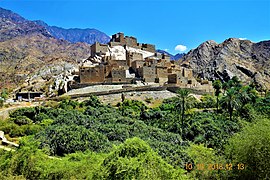 Thee Ain village located in Al Bahah Province
 -
 Rijal Alma'a Heritage Village in 'Asir Province
 -
 The desert of Al-Rub' Al-Khali (The Empty Quarter)
 -
 King Abdulaziz Center for World Culture (Ithra) in Dhahran
 -
 The 3000-year-old ancient historical city of Dumat al-Jandal in Al Jawf Province
 -

-
 The historic district of Jeddah
 -
 Rock pool at Banyan Tree AlUla
 -
 Imarah Palace which is built using traditional Najrani architecture
 -
 Boulevard World Zone of Riyadh Season
 -
 Art Street in Abha


_(cropped).png)


,_Saudi_Arabia_in_November_2022.jpg)


See also
[edit]
- Saudi Tourism Authority
- Economy of Saudi Arabia
- Museums in Saudi Arabia
- Visa policy of Saudi Arabia
- Public Decency Law in Saudi Arabia
References
[edit]- ^ UNWTO Tourism Highlights 2018 Edition: page 19. World Tourism Organization (UNWTO). 2018. doi:10.18111/9789284419876. ISBN 9789284419876. S2CID 240334031. Archived from the original on 26 September 2019. Retrieved 30 April 2019.
{{cite book}}:|website=ignored (help) - ^ a b Bridge, Sam (30 April 2019). "Why $25bn tourism sector can become Saudi Arabia's 'white oil'". ArabianBusiness.com. Archived from the original on 2019-05-07. Retrieved 2019-05-07.
- ^ "Travel and Tourism crucial to Saudi Arabias economy". WTTC. Archived from the original on 2019-04-30. Retrieved 2019-04-30.
- ^ "Tourist visas to be introduced". 6 December 2013. Archived from the original on 21 March 2019. Retrieved 11 June 2015.
- ^ "Saudi Arabia to offer tourist visas for the first time". Arab News. 2019-09-27. Archived from the original on 2019-10-17. Retrieved 2019-09-28.
- ^ "24,000 visitors to Saudi Arabia within 10 days of new tourist visa system". Arab News. 2019-10-07. Retrieved 2019-10-12.
- ^ a b "The National Museum". www.nationalmuseum.org.sa. Archived from the original on 2015-05-25. Retrieved 2019-05-01.
- ^ "Saudi Arabia among world's richest countries with ancient manuscripts". Arab News. 2019-04-08. Retrieved 2019-04-08.
- ^ "The Saudi Commission for Tourism and National Heritage to Submit the Rehabilitation and Development Project of Al-Zaher Palace of Makkah". scth.gov.sa. Archived from the original on 2019-05-01. Retrieved 2019-05-01.
- ^ "Al Madinah Museum". sauditourism.sa. Archived from the original on 2019-05-01. Retrieved 2019-05-01.
- ^ Mirza, Mohammed (7 May 2016). "10 Must-See Sights In Makkah That You Are Probably Missing Out On". Archived from the original on 2020-08-09. Retrieved 2020-05-09.
- ^ "Tabuk Castle". sauditourism.sa. Archived from the original on 2019-05-01. Retrieved 2019-05-01.
- ^ "Saudi Arabia". UNESCO World Heritage Centre. Archived from the original on 2019-04-30. Retrieved 2019-04-30.
- ^ "Al-Ahsa Oasis, an Evolving Cultural Landscape". UNESCO World Heritage Centre. Archived from the original on 2019-04-24. Retrieved 2019-04-30.
- ^ Abu-Nasr, Donna (2009-08-30). "Digging up the Saudi past: Some would rather not". Associated Press. Archived from the original on 2009-09-12. Retrieved 2009-09-17.
- ^ The New Encyclopædia Britannica: Macropædia Volume 13. USA: Encyclopædia Britannica, Inc. 1995. p. 818. ISBN 0-85229-605-3.
- ^ "Expansion of the Nabataeans". Archived from the original on 2011-07-23. Retrieved 2009-09-17.
- ^ a b "ICOMOS Evaluation of Al-Hijr Archaeological Site (Madâin Sâlih) World Heritage Nomination" (PDF). World Heritage Center. Archived from the original on 2021-11-15. Retrieved 2009-09-16.
- ^ "Creation of Al-Hijr". Archived from the original on 2011-02-04. Retrieved 2009-09-17.
- ^ "At-Turaif District in ad-Dir'iyah". UNESCO World Heritage Centre. Archived from the original on 2019-04-30. Retrieved 2019-04-30.
- ^ "Historic Jeddah, the Gate to Makkah". UNESCO World Heritage Centre. Archived from the original on 2019-04-30. Retrieved 2019-04-30.
- ^ "Rock Art in the Hail Region of Saudi Arabia". UNESCO World Heritage Centre. Archived from the original on 2019-03-01. Retrieved 2019-04-30.
- ^ "Ḥimā Cultural Area". whc.unesco.org. UNESCO World Heritage Centre. Retrieved 2024-02-15.
- ^ "'Uruq Bani Ma'arid". whc.unesco.org. UNESCO World Heritage Centre. Retrieved 2024-02-15.
- ^ "The Cultural Landscape of Al-Faw Archaeological Area". whc.unesco.org. UNESCO World Heritage Centre. Retrieved 2024-10-12.
- ^ "Riyadh Season 2021 kicks off in Saudi Arabia's capital". Al Arabiya English. 2021-10-20. Archived from the original on 2022-01-08. Retrieved 2022-01-16.
- ^ "Saudi Souq Okaz festival set to become major tourist attraction". Arab News. 2018-06-17. Archived from the original on 2019-05-03. Retrieved 2019-05-13.
- ^ "Souk Okaz". scth.gov.sa. Archived from the original on 2019-05-01. Retrieved 2019-05-13.
- ^ "Historic Jeddah Festival". www.sauditourism.sa. Archived from the original on 2019-04-24. Retrieved 2019-05-26.
- ^ "Most beautiful falcons to compete at King Abdulaziz Falconry Festival". Arab News. 2019-12-07. Archived from the original on 2019-12-08. Retrieved 2019-12-07.
- ^ "King Abdulaziz Falconry Festival". Archived from the original on 4 August 2021. Retrieved 15 July 2020.
- ^ Çakmak, Burak (2023). "ABOUT RFW 2023". Riyadh Fashion Week.
- ^ "Hajj Requirements: Visas for 1430 Hajj". Royal Embassy of Saudi Arabia. Archived from the original on 2009-08-11. Retrieved 2009-07-30.
- ^ "1430H Umrah Visas". Royal Embassy of Saudi Arabia. Archived from the original on 2009-07-26. Retrieved 2009-07-30.
- ^ "Saudi festival seasons for Taif and Al-Soudah launched at the double". Arab News. 2019-07-07. Archived from the original on 2019-08-10. Retrieved 2019-07-30.
- ^ "Everything you need to know about the Saudi Seasons". Time Out Riyadh. 2024-06-02. Retrieved 2024-07-24.
- ^ "Revealed: the impact of Riyadh Season on Saudi tourism". Arabian Business. 2020-01-29. Retrieved 2024-07-23.
- ^ "Saudi Arabia's Entertainment Blowout is Twice as Big This Year". Bloomberg.com. 21 October 2021.
- ^ Sanchez, Raf (2 August 2017). "Saudi Arabia to open luxury beach resort where women can wear bikinis". The Telegraph. Archived from the original on 11 October 2019. Retrieved 25 February 2019.
- ^ "Blue Water Travel". 6 July 2019. Archived from the original on 12 July 2020. Retrieved 15 July 2020.
- ^ "Saudi Arabia is Changing Fast - WSJ". www.wsj.com. Archived from the original on 9 November 2019. Retrieved 12 January 2022.
- ^ Al Misehal, Yasser (2023). "Saudi Arabian Football Federation submits official letter of intent to bid for 2034 FIFA World Cup". Saudi Arabia Football Federation.
- ^ Times (Ed), Saudi Arabia (2023). "Tourism Strategy in Saudi Arabia". GOV.SA.
- ^ Aldakhil, F. (2020). FIU Digital Commons: Florida International University Research. FIU Digital Commons. https://digitalcommons.fiu.edu/cgi/viewcontent.cgi?article=5914&context=etd
- ^ "Saudi Arabia Just Announced Plans to Build a Mega City That Will Cost $500 Billion". Bloomberg.com. 24 October 2017. Archived from the original on 3 December 2017. Retrieved 13 December 2017.
- ^ a b c d e Halligan, Neil (2023-02-03). "Saudi Arabia megaprojects 2024: From Neom to AlUla, 17 developments shaping its future". The National News. Retrieved 2024-02-15.
- ^ "Home | The Red Sea Development Company". www.theredsea.sa. Retrieved 13 September 2021.
- ^ "Ad Diriyah a 'jewel' of Saudi Arabia, its revival key to Kingdom's future, says project chief". Arab News. 16 December 2018. Archived from the original on 24 April 2019. Retrieved 25 April 2019.
- ^ Chilton, Nicola (2023-02-22). "Diriyah: The latest 'giga project' aiming to transform Saudi Arabia". CNN. Retrieved 2024-02-06.
- ^ "New Murabba project to give Saudi capital Riyadh 'a unique icon instantly recognizable' — the Mukaab". 21 February 2023.
- ^ "HRH Crown Prince Announces New Murabba Development Company to Develop the World's Largest Modern Downtown in Riyadh".
- ^ "Saudi Crown Prince launches New Murabba project to be ready by 2030". Construction Week. 2023-02-17. Retrieved 2024-02-06.
- ^ Iqbal, Yasir (2023-07-27). "Top 10 plans for Saudi Arabia's $1 trillion capital". MEED. Retrieved 2024-02-06.
- ^ El Akkad, Farah (2023-10-18). "Sports Boulevard Riyadh Plays Vital Part in Saudi Vision 2030". Leaders MENA. Retrieved 2024-02-06.
- ^ Palanisamy, Senthil (2021-02-10). "PROJECTS: Saudi likely to award Riyadh sports boulevard contracts in Q1". Zawya. Retrieved 2024-02-06.
- ^ "King Salman Launches $23 Bln Wellbeing Projects in Riyadh". Asharq Al-Awsat. 6 December 2018. Archived from the original on 11 December 2018. Retrieved 24 April 2019.
- ^ "King Salman Announces $23 Billion for Four Entertainment Projects Including the 'World's Biggest Park' in Riyadh". Saudi-US Trade Group. 6 December 2018. Archived from the original on 11 December 2018. Retrieved 24 April 2019.
- ^ "Saudi Arabia's Riyadh selected to host World Expo in 2030". Al Jazeera. 2023-11-28. Retrieved 2024-02-16.
- ^ Corder, Josh (2024-02-05). "Saudi Arabia Plans Dedicated Visa To Boost World Expo Event". Skift. Retrieved 2024-02-16.
- ^ "Over 40% of King Abdullah International Gardens' operations completed". Saudi Gazette. 2023-04-01. Retrieved 2024-03-10.
- ^ "King Abdullah gardens project starts in Riyadh". Arab News. Retrieved 2024-03-10.
- ^ "King Abdullah International Gardens, Riyadh". World Construction Network. 2007-11-12. Retrieved 2024-03-10.
- ^ "Saudi Fund to Develop Jeddah Downtown With $4.8 Billion Project". Bloomberg.com. Archived from the original on 5 October 2017. Retrieved 13 December 2017.
{{cite news}}: CS1 maint: bot: original URL status unknown (link) - ^ "Introducing the Jeddah Central Project - an ambitious development designed to make Jeddah a world-class destination and strengthen the city's economy". vision2030.gov.sa. Retrieved 2024-02-06.
- ^ Foreman, Colin (2023-09-13). "Jeddah developer restarts world's tallest tower". MEED. Retrieved 2024-02-16.
- ^ "Infrastructure work at Masar Destination nears 92% completion". Arab News. 2023-01-01. Retrieved 2024-01-29.
- ^ "The Destination Masterplan". masardestination.com. Masar Destination. Retrieved 2024-02-06.
- ^ "x.com".
- ^ "Saudi crown prince launches Rua Al-Madinah project near Prophet's Mosque". Arab News. 2022-08-24. Retrieved 2024-01-29.
- ^ "Islamic Civilization Village project to boost visitor experience in Madinah". Arab News. 2024-01-08. Retrieved 2024-01-29.
- ^ Levesque, Eva (2023-10-16). "Construction to start on Rua Al Madinah giga-project". AGBI. Retrieved 2024-02-06.
- ^ "PIF announces 'THE RIG.' project". Saudi Gazette. 16 October 2021. Retrieved 21 August 2023.
- ^ Diaz, One Carlo (2024-01-17). "The Rig: Saudi Arabia reveals location of oil rig-themed resort and park". The National News. Retrieved 2024-01-29.
- ^ "Royal Commission for AlUla hosts 'Launching the Vision for AlUla'". The Saudi Center for International Communication. 11 February 2019. Archived from the original on 26 April 2019. Retrieved 24 April 2019.
- ^ "Al Ula Vision... Saudi Arabia gift to world". Saudigazette. 11 February 2019. Archived from the original on 26 April 2019. Retrieved 11 February 2019.
- ^ "MEGA-PROJECT". mrgglobal.com. Retrieved 2024-02-01.
- ^ "Saudi crown prince launches 'Soudah Peaks' masterplan". 25 September 2023.
- ^ Iqbal, Yasir (2024-01-31). "Saudi Arabia set to tender Soudah Peaks in Q3". MEED. Retrieved 2024-02-06.
- ^ "Saudi Arabia announces $7.7bn Soudah Peaks masterplan for luxury mountain resort". Arabian Business. 2023-09-25. Retrieved 2024-02-06.
- ^ "Lionel Messi unveiled as Saudi Arabia tourism ambassador". SportsPro. 10 May 2022. Archived from the original on 11 May 2022. Retrieved 10 May 2022.
- ^ "Lionel Messi earned $122m last year. He still felt the need to take Saudi money". The Guardian. 12 May 2022. Archived from the original on 12 May 2022. Retrieved 12 May 2022.
- ^ "Ahmed Al Khateeb's Tweet on Messi". Twitter. Archived from the original on 9 May 2022. Retrieved 9 May 2022.
- ^ "Messi Is Accused of Being the Face of a Blood-Soaked Regime". VICE. 20 June 2022. Archived from the original on 20 June 2022. Retrieved 20 June 2022.
External links
[edit]
- Visit Saudi Website
- Saudi Tourism Authority Website
- Saudi Ministry of Tourism Website
- Nusuk Website for Performing Umrah
- Riyadh Season Website
- Visit Al-Balad Website
- Experience Al-Ula Website
- Diriyah Website
|