


Octahedron
| Regular octahedron | |
|---|---|
 (Click here for rotating model) | |
| Type | Platonic solid |
| Elements | F = 8, E = 12 V = 6 (χ = 2) |
| Faces by sides | 8{3} |
| Conway notation | O aT |
| Schläfli symbols | {3,4} |
| r{3,3} or {}+{}+{}=3{} | |
| Face configuration | V4.4.4 |
| Wythoff symbol | 4 | 2 3 |
| Coxeter diagram |    
|
| Symmetry | Oh, BC3, [4,3], (*432) |
| Rotation group | O, [4,3]+, (432) |
| References | U05, C17, W2 |
| Properties | regular, convexdeltahedron, Hanner polytope |
| Dihedral angle | 109.47122° = arccos(−1⁄3) |
 3.3.3.3 (Vertex figure) |
 Cube (dual polyhedron) |
 Net | |

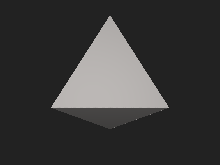
In geometry, an octahedron (pl.: octahedra or octahedrons) is a polyhedron with eight faces. The term is most commonly used to refer to the regular octahedron, a Platonic solid composed of eight equilateral triangles, four of which meet at each vertex.
A regular octahedron is the dual polyhedron of a cube. It is also a rectified tetrahedron, a square bipyramid in any of three orthogonal orientations, and a triangular antiprism in any of four orientations.
An octahedron is the three-dimensional case of the more general concept of a cross polytope.
A regular octahedron is a 3-ball in the Manhattan (ℓ1) metric.
Regular octahedron[edit]
Dimensions[edit]
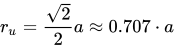
If the edge length of a regular octahedron is a, the radius of a circumscribed sphere (one that touches the octahedron at all vertices) is
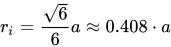
and the radius of an inscribed sphere (tangent to each of the octahedron's faces) is
while the midradius, which touches the middle of each edge, is

Orthogonal projections[edit]
The octahedron has four special orthogonal projections, centered, on an edge, vertex, face, and normal to a face. The second and third correspond to the B2 and A2 Coxeter planes.
| Centered by | Edge | Face Normal |
Vertex | Face |
|---|---|---|---|---|
| Image | 
|

|

|

|
| Projective symmetry |
[2] | [2] | [4] | [6] |
Spherical tiling[edit]
The octahedron can also be represented as a spherical tiling, and projected onto the plane via a stereographic projection. This projection is conformal, preserving angles but not areas or lengths. Straight lines on the sphere are projected as circular arcs on the plane.

|

|
| Orthographic projection | Stereographic projection |
|---|
Cartesian coordinates[edit]
An octahedron with edge length √2 can be placed with its center at the origin and its vertices on the coordinate axes; the Cartesian coordinates of the vertices are then
- ( ±1, 0, 0 );
- ( 0, ±1, 0 );
- ( 0, 0, ±1 ).
In an x–y–z Cartesian coordinate system, the octahedron with center coordinates (a, b, c) and radius r is the set of all points (x, y, z) such that

Area and volume[edit]
The surface area A and the volume V of a regular octahedron of edge length a are:

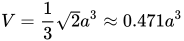
Thus the volume is four times that of a regular tetrahedron with the same edge length, while the surface area is twice (because we have 8 rather than 4 triangles).
If an octahedron has been stretched so that it obeys the equation
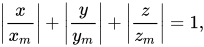
the formulas for the surface area and volume expand to become

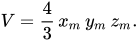
Additionally the inertia tensor of the stretched octahedron is
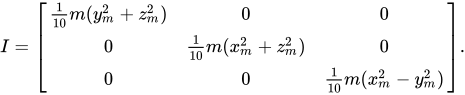
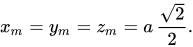
These reduce to the equations for the regular octahedron when
Geometric relations[edit]
Using the standard nomenclature for Johnson solids, an octahedron would be called a square bipyramid.
Dual[edit]
The octahedron is the dual polyhedron of the cube.

If an octahedron of edge length is inscribed in a cube, then the length of an edge of the cube .


Stellation[edit]

The interior of the compound of two dual tetrahedra is an octahedron, and this compound, called the stella octangula, is its first and only stellation. Correspondingly, a regular octahedron is the result of cutting off from a regular tetrahedron, four regular tetrahedra of half the linear size (i.e. rectifying the tetrahedron). The vertices of the octahedron lie at the midpoints of the edges of the tetrahedron, and in this sense it relates to the tetrahedron in the same way that the cuboctahedron and icosidodecahedron relate to the other Platonic solids.
Snub octahedron[edit]
One can also divide the edges of an octahedron in the ratio of the golden mean to define the vertices of an icosahedron. This is done by first placing vectors along the octahedron's edges such that each face is bounded by a cycle, then similarly partitioning each edge into the golden mean along the direction of its vector. There are five octahedra that define any given icosahedron in this fashion, and together they define a regular compound. An icosahedron produced this way is called a snub octahedron.
Tessellations[edit]
Octahedra and tetrahedra can be alternated to form a vertex, edge, and face-uniform tessellation of space. This and the regular tessellation of cubes are the only such uniform honeycombs in 3-dimensional space.
Characteristic orthoscheme[edit]
Like all regular convex polytopes, the octahedron can be dissected into an integral number of disjoint orthoschemes, all of the same shape characteristic of the polytope. A polytope's characteristic orthoscheme is a fundamental property because the polytope is generated by reflections in the facets of its orthoscheme. The orthoscheme occurs in two chiral forms which are mirror images of each other. The characteristic orthoscheme of a regular polyhedron is a quadrirectangular irregular tetrahedron.
The faces of the octahedron's characteristic tetrahedron lie in the octahedron's mirror planes of symmetry. The octahedron is unique among the Platonic solids in having an even number of faces meeting at each vertex. Consequently, it is the only member of that group to possess, among its mirror planes, some that do not pass through any of its faces. The octahedron's symmetry group is denoted B3. The octahedron and its dual polytope, the cube, have the same symmetry group but different characteristic tetrahedra.
The characteristic tetrahedron of the regular octahedron can be found by a canonical dissection[1] of the regular octahedron which subdivides it into 48 of these characteristic orthoschemes surrounding the octahedron's center. Three left-handed orthoschemes and three right-handed orthoschemes meet in each of the octahedron's eight faces, the six orthoschemes collectively forming a trirectangular tetrahedron: a triangular pyramid with the octahedron face as its equilateral base, and its cube-cornered apex at the center of the octahedron.[2]
| Characteristics of the regular octahedron[3] | |||||
|---|---|---|---|---|---|
| edge | arc | dihedral | |||
| 𝒍 | 90° | 109°28′ | |||
| 𝟀 | 54°44′8″ | 90° | |||
| 𝝉[a] | 45° | 60° | |||
| 𝟁 | 35°15′52″ | 45° | |||
| 35°15′52″ | |||||


If the octahedron has edge length 𝒍 = 2, its characteristic tetrahedron's six edges have lengths , , around its exterior right-triangle face (the edges opposite the characteristic angles 𝟀, 𝝉, 𝟁),[a] plus , , (edges that are the characteristic radii of the octahedron). The 3-edge path along orthogonal edges of the orthoscheme is , , , first from an octahedron vertex to an octahedron edge center, then turning 90° to an octahedron face center, then turning 90° to the octahedron center. The orthoscheme has four dissimilar right triangle faces. The exterior face is a 90-60-30 triangle which is one-sixth of an octahedron face. The three faces interior to the octahedron are: a 45-90-45 triangle with edges , , , a right triangle with edges , , , and a right triangle with edges , , .


Topology[edit]
The octahedron is 4-connected, meaning that it takes the removal of four vertices to disconnect the remaining vertices. It is one of only four 4-connected simplicial well-covered polyhedra, meaning that all of the maximal independent sets of its vertices have the same size. The other three polyhedra with this property are the pentagonal dipyramid, the snub disphenoid, and an irregular polyhedron with 12 vertices and 20 triangular faces.[4]
Nets[edit]
The regular octahedron has eleven arrangements of nets.
Faceting[edit]
The uniform tetrahemihexahedron is a tetrahedral symmetry faceting of the regular octahedron, sharing edge and vertex arrangement. It has four of the triangular faces, and 3 central squares.
 Octahedron |
 Tetrahemihexahedron |
Uniform colorings and symmetry[edit]
There are 3 uniform colorings of the octahedron, named by the triangular face colors going around each vertex: 1212, 1112, 1111.
The octahedron's symmetry group is Oh, of order 48, the three dimensional hyperoctahedral group. This group's subgroups include D3d (order 12), the symmetry group of a triangular antiprism; D4h (order 16), the symmetry group of a square bipyramid; and Td (order 24), the symmetry group of a rectified tetrahedron. These symmetries can be emphasized by different colorings of the faces.
| Name | Octahedron | Rectified tetrahedron (Tetratetrahedron) |
Triangular antiprism | Square bipyramid | Rhombic fusil |
|---|---|---|---|---|---|
| Image (Face coloring) |
 (1111) |
(1212) |
 (1112) |
 (1111) |
 (1111) |
| Coxeter diagram |
|
 = =  
|
  
|

|
|
| Schläfli symbol | {3,4} | r{3,3} | s{2,6} sr{2,3} |
ft{2,4} { } + {4} |
ftr{2,2} { } + { } + { } |
| Wythoff symbol | 4 | 3 2 | 2 | 4 3 | 2 | 6 2 | 2 3 2 |
||
| Symmetry | Oh, [4,3], (*432) | Td, [3,3], (*332) | D3d, [2+,6], (2*3) D3, [2,3]+, (322) |
D4h, [2,4], (*422) | D2h, [2,2], (*222) |
| Order | 48 | 24 | 12 6 |
16 | 8 |
Irregular octahedra[edit]
The following polyhedra are combinatorially equivalent to the regular polyhedron. They all have six vertices, eight triangular faces, and twelve edges that correspond one-for-one with the features of a regular octahedron.
- Triangular antiprisms: Two faces are equilateral, lie on parallel planes, and have a common axis of symmetry. The other six triangles are isosceles.
- Tetragonal bipyramids, in which at least one of the equatorial quadrilaterals lies on a plane. The regular octahedron is a special case in which all three quadrilaterals are planar squares.
- Schönhardt polyhedron, a non-convex polyhedron that cannot be partitioned into tetrahedra without introducing new vertices.
- Bricard octahedron, a non-convex self-crossing flexible polyhedron
More generally, an octahedron can be any polyhedron with eight faces. The regular octahedron has 6 vertices and 12 edges, the minimum for an octahedron; irregular octahedra may have as many as 12 vertices and 18 edges.[5] There are 257 topologically distinct convex octahedra, excluding mirror images. More specifically there are 2, 11, 42, 74, 76, 38, 14 for octahedra with 6 to 12 vertices respectively.[6][7] (Two polyhedra are "topologically distinct" if they have intrinsically different arrangements of faces and vertices, such that it is impossible to distort one into the other simply by changing the lengths of edges or the angles between edges or faces.)
Some better known irregular octahedra include the following:
- Hexagonal prism: Two faces are parallel regular hexagons; six squares link corresponding pairs of hexagon edges.
- Heptagonal pyramid: One face is a heptagon (usually regular), and the remaining seven faces are triangles (usually isosceles). It is not possible for all triangular faces to be equilateral.
- Truncated tetrahedron: The four faces from the tetrahedron are truncated to become regular hexagons, and there are four more equilateral triangle faces where each tetrahedron vertex was truncated.
- Tetragonal trapezohedron: The eight faces are congruent kites.
- Gyrobifastigium: Two uniform triangular prisms glued over one of their square sides so that no triangle shares an edge with another triangle (Johnson solid 26).
- Octagonal hosohedron: degenerate in Euclidean space, but can be realized spherically.
Octahedra in the physical world[edit]
Octahedra in nature[edit]

- Natural crystals of diamond, alum or fluorite are commonly octahedral, as the space-filling tetrahedral-octahedral honeycomb.
- The plates of kamacite alloy in octahedrite meteorites are arranged paralleling the eight faces of an octahedron.
- Many metal ions coordinate six ligands in an octahedral or distorted octahedral configuration.
- Widmanstätten patterns in nickel-iron crystals
Octahedra in art and culture[edit]

- Especially in roleplaying games, this solid is known as a "d8", one of the more common polyhedral dice.
- If each edge of an octahedron is replaced by a one-ohm resistor, the resistance between opposite vertices is 1/2 ohm, and that between adjacent vertices 5/12 ohm.[8]
- Six musical notes can be arranged on the vertices of an octahedron in such a way that each edge represents a consonant dyad and each face represents a consonant triad; see hexany.
Tetrahedral octet truss[edit]
A space frame of alternating tetrahedra and half-octahedra derived from the Tetrahedral-octahedral honeycomb was invented by Buckminster Fuller in the 1950s. It is commonly regarded as the strongest building structure for resisting cantilever stresses.
Related polyhedra[edit]
A regular octahedron can be augmented into a tetrahedron by adding 4 tetrahedra on alternated faces. Adding tetrahedra to all 8 faces creates the stellated octahedron.

|
|
| tetrahedron | stellated octahedron |
|---|
The octahedron is one of a family of uniform polyhedra related to the cube.
| Uniform octahedral polyhedra | ||||||||||
|---|---|---|---|---|---|---|---|---|---|---|
| Symmetry: [4,3], (*432) | [4,3]+ (432) |
[1+,4,3] = [3,3] (*332) |
[3+,4] (3*2) | |||||||
| {4,3} | t{4,3} | r{4,3} r{31,1} |
t{3,4} t{31,1} |
{3,4} {31,1} |
rr{4,3} s2{3,4} |
tr{4,3} | sr{4,3} | h{4,3} {3,3} |
h2{4,3} t{3,3} |
s{3,4} s{31,1} |
|
|
|
|
|
|
|
|
|
| ||
=  
|
=
|
=
|
|
 = = or or 
|
= or
|
=
| ||||

|

|
 
|
 
|

|
 
|

|

|
 
|
 
|
 
|
| Duals to uniform polyhedra | ||||||||||
| V43 | V3.82 | V(3.4)2 | V4.62 | V34 | V3.43 | V4.6.8 | V34.4 | V33 | V3.62 | V35 |
|
|
|
|
|
|
|
|

|
|
|
|
|
|
|
|
|
|
|
| ||||

|

|

|

|

|

|

|

|

|

|

|
It is also one of the simplest examples of a hypersimplex, a polytope formed by certain intersections of a hypercube with a hyperplane.
The octahedron is topologically related as a part of sequence of regular polyhedra with Schläfli symbols {3,n}, continuing into the hyperbolic plane.
| *n32 symmetry mutation of regular tilings: {3,n} | |||||||||||
|---|---|---|---|---|---|---|---|---|---|---|---|
| Spherical | Euclid. | Compact hyper. | Paraco. | Noncompact hyperbolic | |||||||

|

|
|

|

|

|

|

|

|

|

|

|
| 3.3 | 33 | 34 | 35 | 36 | 37 | 38 | 3∞ | 312i | 39i | 36i | 33i |
Tetratetrahedron[edit]
The regular octahedron can also be considered a rectified tetrahedron – and can be called a tetratetrahedron. This can be shown by a 2-color face model. With this coloring, the octahedron has tetrahedral symmetry.
Compare this truncation sequence between a tetrahedron and its dual:
| Family of uniform tetrahedral polyhedra | |||||||
|---|---|---|---|---|---|---|---|
| Symmetry: [3,3], (*332) | [3,3]+, (332) | ||||||
|
|
|
|
|
|
|
|
|
|
|
|
|
|
|
|
|
|
| {3,3} | t{3,3} | r{3,3} | t{3,3} | {3,3} | rr{3,3} | tr{3,3} | sr{3,3} |
| Duals to uniform polyhedra | |||||||
|
|
|
|
|
|
|
|
|
| V3.3.3 | V3.6.6 | V3.3.3.3 | V3.6.6 | V3.3.3 | V3.4.3.4 | V4.6.6 | V3.3.3.3.3 |
The above shapes may also be realized as slices orthogonal to the long diagonal of a tesseract. If this diagonal is oriented vertically with a height of 1, then the first five slices above occur at heights r, 3/8, 1/2, 5/8, and s, where r is any number in the range 0 < r ≤ 1/4, and s is any number in the range 3/4 ≤ s < 1.
The octahedron as a tetratetrahedron exists in a sequence of symmetries of quasiregular polyhedra and tilings with vertex configurations (3.n)2, progressing from tilings of the sphere to the Euclidean plane and into the hyperbolic plane. With orbifold notation symmetry of *n32 all of these tilings are Wythoff constructions within a fundamental domain of symmetry, with generator points at the right angle corner of the domain.[9][10]
| *n32 orbifold symmetries of quasiregular tilings: (3.n)2 | |||||||
|---|---|---|---|---|---|---|---|
 Construction |
Spherical | Euclidean | Hyperbolic | ||||
| *332 | *432 | *532 | *632 | *732 | *832... | *∞32 | |
| Quasiregular figures |

|

|

|

|

|

|

|
| Vertex | (3.3)2 | (3.4)2 | (3.5)2 | (3.6)2 | (3.7)2 | (3.8)2 | (3.∞)2 |
Trigonal antiprism[edit]
As a trigonal antiprism, the octahedron is related to the hexagonal dihedral symmetry family.
| Uniform hexagonal dihedral spherical polyhedra | ||||||||||||||
|---|---|---|---|---|---|---|---|---|---|---|---|---|---|---|
| Symmetry: [6,2], (*622) | [6,2]+, (622) | [6,2+], (2*3) | ||||||||||||

|

|
|

|

|

|

|

|

| ||||||

|
|
|
|
|
|
|
|
| ||||||
| {6,2} | t{6,2} | r{6,2} | t{2,6} | {2,6} | rr{6,2} | tr{6,2} | sr{6,2} | s{2,6} | ||||||
| Duals to uniforms | ||||||||||||||
|
|

|
|

|
|
|

|

|

| ||||||
| V62 | V122 | V62 | V4.4.6 | V26 | V4.4.6 | V4.4.12 | V3.3.3.6 | V3.3.3.3 | ||||||
| Antiprism name | Digonal antiprism | (Trigonal) Triangular antiprism |
(Tetragonal) Square antiprism |
Pentagonal antiprism | Hexagonal antiprism | Heptagonal antiprism | ... | Apeirogonal antiprism |
|---|---|---|---|---|---|---|---|---|
| Polyhedron image | 
|
|

|

|

|

|
... | |
| Spherical tiling image | 
|
|

|

|
|

|
Plane tiling image | 
|
| Vertex config. | 2.3.3.3 | 3.3.3.3 | 4.3.3.3 | 5.3.3.3 | 6.3.3.3 | 7.3.3.3 | ... | ∞.3.3.3 |
Square bipyramid[edit]
| Bipyramid name |
Digonal bipyramid |
Triangular bipyramid |
Square bipyramid |
Pentagonal bipyramid |
Hexagonal bipyramid |
... | Apeirogonal bipyramid |
|---|---|---|---|---|---|---|---|
| Polyhedron image |

|
|

|

|
... | ||
| Spherical tiling image |

|

|

|

|

|
Plane tiling image |

|
| Face config. | V2.4.4 | V3.4.4 | V4.4.4 | V5.4.4 | V6.4.4 | ... | V∞.4.4 |
| Coxeter diagram |
|
|
|

|
|
... | 
|
[edit]
Truncation of two opposite vertices results in a square bifrustum.
The octahedron can be generated as the case of a 3D superellipsoid with all exponent values set to 1.
See also[edit]
- Octahedral number
- Centered octahedral number
- Spinning octahedron
- Stella octangula
- Triakis octahedron
- Hexakis octahedron
- Truncated octahedron
- Octahedral molecular geometry
- Octahedral symmetry
- Octahedral graph
- Octahedral sphere
Notes[edit]
- ^ a b (Coxeter 1973) uses the greek letter 𝝓 (phi) to represent one of the three characteristic angles 𝟀, 𝝓, 𝟁 of a regular polytope. Because 𝝓 is commonly used to represent the golden ratio constant ≈ 1.618, for which Coxeter uses 𝝉 (tau), we reverse Coxeter's conventions, and use 𝝉 to represent the characteristic angle.
References[edit]
- ^ Coxeter 1973, p. 130, §7.6 The symmetry group of the general regular polytope; "simplicial subdivision".
- ^ Coxeter 1973, pp. 70–71, Characteristic tetrahedra; Fig. 4.7A.
- ^ Coxeter 1973, pp. 292–293, Table I(i); "Octahedron, 𝛽3".
- ^ Finbow, Arthur S.; Hartnell, Bert L.; Nowakowski, Richard J.; Plummer, Michael D. (2010). "On well-covered triangulations. III". Discrete Applied Mathematics. 158 (8): 894–912. doi:10.1016/j.dam.2009.08.002. MR 2602814.
- ^ "Enumeration of Polyhedra". Archived from the original on 10 October 2011. Retrieved 2 May 2006.
- ^ "Counting polyhedra".
- ^ "Polyhedra with 8 Faces and 6-8 Vertices". Archived from the original on 17 November 2014. Retrieved 14 August 2016.
- ^ Klein, Douglas J. (2002). "Resistance-Distance Sum Rules" (PDF). Croatica Chemica Acta. 75 (2): 633–649. Archived from the original (PDF) on 10 June 2007. Retrieved 30 September 2006.
- ^ Coxeter, H.S.M. (1973). Regular Polytopes (Third ed.). Dover. Chapter V: The Kaleidoscope, Section: 5.7 Wythoff's construction. ISBN 0-486-61480-8.
- ^ Huson, Daniel H. (September 1998), Two Dimensional Symmetry Mutation
External links[edit]
- . Encyclopædia Britannica. Vol. 19 (11th ed.). 1911.
- Weisstein, Eric W. "Octahedron". MathWorld.
- Klitzing, Richard. "3D convex uniform polyhedra x3o4o – oct".
- Editable printable net of an octahedron with interactive 3D view
- Paper model of the octahedron
- K.J.M. MacLean, A Geometric Analysis of the Five Platonic Solids and Other Semi-Regular Polyhedra
- The Uniform Polyhedra
- Virtual Reality Polyhedra – The Encyclopedia of Polyhedra
- Conway Notation for Polyhedra – Try: dP4