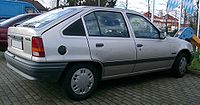
Opel Kadett
|
|
It has been suggested that Chevrolet Kadett be merged into this article. (Discuss) Proposed since August 2012. |
| Manufacturer | Opel |
|---|---|
| Production | 1937–1940, 1962-1991 |
| Predecessor | Opel 1.3 litre |
| Successor | Opel Astra |
| Class | Small family car |
The Opel Kadett is a small family car produced by the German automobile manufacturer Opel between 1937 and 1940, and then again from 1962 until 1991 (Cabrio 1993), when it was replaced by the Opel Astra.
Kadett (1937–1940) [edit]
Opel Kadett Spezial (K38) "Cabrio-Limousine" (1939) |
|
| Production | 1937–1940 |
|---|---|
| Assembly | Rüsselsheim, Germany |
| Layout | FR layout |
| Engine | 1,074 cc sv I4 |
| Transmission | 3-speed manual |
| Wheelbase | 2,337 mm (92.0 in) |
| Width | 1,375 mm (54.1 in) |
| Related | Moskvitch 400/420 |
The first Opel car to carry the Kadett name was presented to the public in December 1936 by Opel's Commercial-Technical director, Heinrich Nordhoff, who would in later decades become known for his leadership role in building up the Volkswagen company.
The new Kadett followed the innovative Opel Olympia in adopting a chassis-less monocoque construction, suggesting that like the Vauxhall 10 introduced in 1937 by Opel's English sister-company, the Opel Kadett was designed for high volume low cost production.
Kadett series 11 234 (1937) [edit]
For 1937 the Kadett was offered as a small and unpretentious[1] two door "Limousine" (sedan/saloon) or, at the same list price of 2,100 Marks, as a soft top "Cabrio-Limousine". The body resembled that of the existing larger Opel Olympia and its silhouette reflected the "streamlining" tendencies of the time. The 1,074cc side-valve engine came from the 1935 Opel P4 and came with the same listed maximum power output of 23 PS (17 kW; 23 hp) at 3,400 rpm.[2]
The brakes were now controlled using a hydraulic mechanism. The suspension featured synchromous springing, a suspension configuration already seen on the manufacturer's larger models and based on the Dubonnet system for which General Motors in France had purchased the license. The General Motors version, which had been further developed by Opel’s North American parent, was intended to provide a soft ride, but there was some criticism that handling and road-holding were compromised, especially when the system was applied to small light-weight cars such as the Kadett.[3] By the end of 1937 33,402 of these first generation Kadetts had been produced.[4]
Kadett "KJ38" and "K38 Spezial" (1938 - 1940) [edit]
From December 1937 a modified front grill signalled an upgrade. Nevertheless, the 1,074cc Opel 23 PS (17 kW; 23 hp) engine and the 2,337 mm (92.0 in) wheelbase were unchanged, and it would have taken a keen eyed observer to spot the difference between the cars for 1937 and those for 1938.[5]
The manufacturer now offered two versions of the Kadett, designated the "Kadett KJ38 and the "Kadett K38" the latter also being sold as the "Kadett Spezial". Mechanically and in terms of published performance there was little to differentiate the two, but the "Spezial" had a chrome stripe below the window line, and extra external body trim in other areas such as on the front grill. The interior of the "Spezial" was also better equipped. To the extent that the 300 Mark saving for buyers of the car reflected reduced production costs, the major difference was that the more basic "KJ38" lost the synchromous springing with which the car had been launched, and which continued to be fitted on the "Spezial". The base car instead reverted to traditional rigid axle based suspension similar to that fitted on the old Opel P4.
The base car was available only as a two door "Limousine" (sedan/saloon). Customers looking for a soft-top "Cabrio-limousine would need to specify a "Kadett Spezial". For the first time Kadett buyers, provided they were prepared to choose a "Kadett Spezial" could also specify a four-door "Limousine" (sedan/saloon) bodied car, priced at 2,350 Marks as against 2,150 Marks for a "Spezial Cabrio-Limousine" and 2,100 Marks for a two-door "Spezial Limousine"
In marketing terms the "Kadett KJ38" was intended to fill the niche that Opel had recently vacated with the departure of the Opel P4, but the KJ38, priced at 1,800 Marks, was more expensive than the P4 and its reduced specification left it with the image of a car for poor people[6] at a time when economic growth in Germany was finally fostering a less minimalist approach to car buying. The "Kadett K38 Spezial" fared better in the market place: in 1938 and again in 1939 it was Germany's the top selling small car. By May 1941 the company had produced 17,871 "Kadett KJ38"s and 56,335 "Kadett K38 Spezial"s.[7]
Commercial [edit]
Competitive pricing led to commercial success, and Kadetts continued to be produced during the early months of the war: by the time production ended in May 1940, following intensification of World War II, 106,608 of these Opel Kadetts[8] had come off the assembly line at Opel's Rüsselsheim plant, which had been the first major car plant in Germany to apply the assembly-line production techniques pioneered by Henry Ford.
Soviet afterlife [edit]
After the war, Opel production facilities from Brandenburg an der Havel (trucks) were crated up together with the production line plant and tooling from the Ruesslesheim (cars) plant and transported to the Soviet Union, along with the drawings and plans for the Kadett, as part of a larger reparations package agreed upon by the victorious powers. From 1948, the prewar Kadett was manufactured as the Moskvitch 400/420 and continued to be produced, very little changed, on the edge of Moscow until 1956.
Kadett A (1962–1965) [edit]
| Production | 1962–1965 |
|---|---|
| Assembly | Bochum, Germany |
| Body style | 2-door saloon 3-door Car-A-Van (estate) Coupé |
| Layout | FR layout |
| Engine | 993 cc Opel OHV OHV I4 |
| Transmission | 4-speed manual all-synchromesh |
| Wheelbase | 2,325 mm (91.5 in) |
| Length | 3,923 mm (154.4 in) or 3,990 mm (157 in) ("L" models featuring bumper overriders) |
| Width | 1,470 mm (58 in) 1,483 mm (58.4 in) (Car-A-Van) |
| Height | 1,410 mm (56 in) (saloon) 1,397 mm (55.0 in) (coupé) 1,800 mm (71 in) (Car-A-Van) |
The Kadett was re-introduced in 1962, with deliveries beginning on 2 October, a little more than 22 years after the original model was discontinued in May 1940.[9]
Origins [edit]
In 1957 Opel Product Director Karl Stief was mandated by General Motors headquarters in Detroit to develop "the perfect Anti-Volkswagen" ("einen perfekten Anti-VW"). The development team was headed up by Stief, supported by Hans Mersheimer (car-body) and Werner K. Strobel (engine and running gear), under conditions of such secrecy that even now very little is known of the development history of the 1962 Kadett. GM was trying to conceal a new technique of platform and design sharing between Opel and its British equivalent Vauxhall, which released the strikingly similar Viva HA in 1963, a year after Opel introduced the Kadett. Over the subsequent two decades Vauxhall's role in the design of its own cars rapidly diminished and by 1985 its car range entirely consisted of rebadged Opel models.
Opel had been Germany's largest auto-producer in the 1930s, and in Wolfsburg the producers of the Kadett's principal target did not disguise their concern at the prospect of Opel's return to small car production. At the Volkswagen annual general meeting a few months before the launch of the Kadett, Volkswagen chairman Heinrich Nordhoff (who himself had been a senior manager with Opel in the 1930s and 1940s) went on record with a warning to shareholders that Opel (along with Ford Germany) were backed by a level of financial muscle on a scale unimaginable to any German company, and that it seemed that the two American transplants were now determined to use their financial strength to make aggressive inroads into the German auto-market at any price.[10]
New Factory [edit]
A mark of General Motors' confidence in their plans for the small car sector, and something that the Opel Kadett and the Vauxhall Viva had in common, was that the manufacturer built for each new model a completely new car plant in a region characterized by relatively high unemployment and the availability of a skilled workforce, but with no strong tradition of volume auto-making. The Vauxhall Viva was the first car built at Vauxhall's Ellesmere Port plant while the Kadett A was the first product of Opel's new purpose built Bochum plant.[9] Fifty years later, in 2012, Opel announced the closure of the Bochum plant (now known as Plant Bochum II), effective 2016, with the loss of approximately 3,000 jobs, in response to the manufacturer's longstanding over capacity and loss of market share in key western European markets.[11][12]
Bodies [edit]
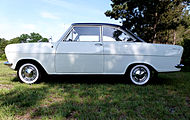
The car later became known as the Kadett A. In addition to the standard saloon, from March 1963, the manufacturer offered an L (luxury model) and an estate (branded as the "Opel Kadett Car-A-Van").[13] In October 1963 Opel introduced a coupé version of the Kadett with which buyers could enjoy enhanced style at the expense of rear seat headroom.[13][14]
Engines [edit]
The Opel OHV four cylinder "over-square" 1-litre water cooled engine weighed only 96 kg and was the first all-new engine developed by Opel since before the war. The side-mounted camshaft was driven not through gear-cogs but using a single chain with a hydraulic tensioner, the valve train employing rocker-arms and light-weight hollow rods. The arrangement was low on weight and on friction, permitting engine speeds above 6,000 rpm. The pistons were formed from an aluminium-alloy and incorporated a bimetal expansion strip to ensure uniform thermal expansion. The three-bearing forged crankshaft was of more traditional construction. The carefully designed aluminium inlet manifold provided for efficient feed of the fuel-mixture to the cylinders and helped provide the engine with good fuel economy characteristics.
The engine came with a choice from two power levels. For the standard 1.0 litre engine maximum output was listed as 40 PS (29 kW) at 5,000 rpm, and in October 1963 the high compression "1.0 S-Motor" was added, sharing the 993 cc capacity of the original power unit, but offering a maximum 48 PS (35 kW) of power at 5,400 rpm.[15] The more powerful "S-Motor" engine featured modifications to the inlet manifold, cylinders and camshaft along with a carburetor employing larger (36 mm (1.4 in) diameter than the 30 mm (1.2 in) used on the standard engine. This came with an 8.8: 1 compression ratio whereas the 40 PS (29 kW; 39 hp) engine used a compression ratio of only 7.8 : 1.[16] Higher compression ratios for performance versions of standard engines were a growing trend in West Germany in the 1960s, led by Opel and Ford, and made possible by the growing availability of higher octane "Super" grade fuel at filling stations.
The care taken over the detailed design of the new engine was rewarded with a power unit which earned widespread respect in the industry and, at least with the Kadett A, tended to outlive the rest of the car in which it was fitted. In later incarnations both the 1.0 litre unit and an enlarged 1.2 litre version were still used in small Opels, including the first Opel Corsa (and Vauxhall Nova) well into the 1990s.
Transmission and brakes [edit]
Power was transmitted to the rear wheels via a single dry-plate clutch and a four-speed all-synchromesh gear box, controlled using a conventional floor mount gear lever. There were 200 mm (7.9 in) brake drums on all four wheels: braking operated via a single circuit hydraulic system.[15]
Market reaction [edit]
The Kadett featured a more modern design than the Volkswagen Beetle that then dominated the market for small family cars in West Germany and various surrounding countries. The Kadett offered more passenger space, more luggage capacity, and better visibility for the driver. Its water-cooled engine provided effective heating for the passenger compartment. However, by the mid-1970s the Kadett's weakness was already apparent as the car's bodywork was not well protected from corrosion.
International sales [edit]
In addition to its West German home market, the Kadett A sold strongly in what were becoming the manufacturer's traditional export strongholds (notably in Benelux, Scandinavia, Austria and Switzerland). Between February 1964 and the Autumn/Fall of 1965 the cars were also exported to the USA where they were sold through approximately 500 Buick dealers. The same 993 cc engine was fitted and it is not clear whether it was differently tuned for North America: horsepower ratings were differently computed in the USA, following locally devised "SAE" rules: for American market purposes the maximum outputs for the engines were quoted as 46 hp (34 kW; 47 PS) and 54 hp (40 kW; 55 PS).
Production volumes [edit]
A total of 649,512 Kadett "A"s were built at the company's new Bochum factory by the time it was replaced by the Kadett "B" in July 1965. 126,616 of the cars produced were Car-A-Van bodied estate models, while the remaining 522,896 comprised a small number of coupés and approximately half a million sedans/saloons.[9]
Included in these figures are CKD kits shipped from Bochum to relatively small-scale GM plants for local assembly in South Africa, Denmark, Belgium, Portugal, Uruguay, Peru, and Venezuela.
Trivia [edit]
On the British motoring show Top Gear, Richard Hammond drove a 1963 Kadett A through the middle of Botswana during a 2007 challenge. During the challenge, Richard Hammond successfully drove the Opel Kadett across the Makgadikgadi Salt Pan, making the Kadett A one of the first ever cars to cross the whole pan. He loved the car so much that he named it Oliver and later had the car shipped to the United Kingdom and restored, and it remains in his possession. It appeared on Richard Hammond's Blast Lab with the personalised number plate 'OLIV3R'. It also appeared in the Top Gear lorry challenge as one of the used obstacles.
Kadett B (1965–1973) [edit]
Opel Kadett B 2-door Limousine |
|
| Production | 1965–1973 |
|---|---|
| Assembly | Bochum, Germany |
| Body style | Sedan/Saloon (2/4-door notchback / fastback) "Car-A-Van" (3/5-door estate / Kombi / stn wgn) Coupés |
| Engine | 1972-73: 993cc 40/48 PS ohv I4 (export) 1965-73: 1,078cc 45/50/55/60 PS ohv I4 1971-73: 1,196cc 60 PS ohv I4 1967-70: 1,492cc 65 PS CIH I4 (export) 1967-70: 1,698cc 75 PS CIH I4 1967-73: 1,897cc 90/106 PS CIH I4 (petrol/gasoline engines) |
| Wheelbase | 2,416 mm (95.1 in) |
| Length | 4,105 mm (161.6 in) to 4,182 mm (164.6 in) (according to bumpers and body type) |
| Width | 1,573 mm (61.9 in) |
| Height | 1,274 mm (50.2 in) to 1,405 mm (55.3 in) (according to wheel size and body type) |
| Related | Opel Olympia A |
The Kadett B was launched at the Frankfurt Motor Show in late summer 1965,[14][17] The Kadett B was larger all-round than the Kadett A: 5% longer both overall and in terms of the wheelbase, 7% wider and 9% heavier (unladen weight), albeit 10 mm (0.39 in) lower in basic standard "Limousine" (sedan/saloon) form.[18] Production ended in July 1973, with the successor model introduced a month later following the summer shut-down, in August.
Bodies: more choice [edit]
Opel had built a reputation for providing stylish cars, and the simple well balanced proportions of the recently introduced Opel Rekord Series A had continued the tradition. The unapologetic slab-sided functionalism of the Kadett B disappointed some commentators.[19] However, customers were not deterred, possibly because the simple car body enabled the car to provide an aggressively priced practical and modern car with far more interior space than the Volkswagen which hitherto had dominated the German small car market without serious challenge for more than a decade.
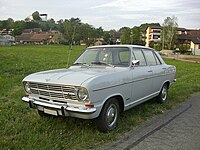
The range of bodies was widened with the Kadett B. The entry level model, priced in September 1965 at 5,175 Marks, was the 2-door "Limousine" (sedan/saloon). In addition, for the first time since 1940, it was again possible to buy a 4-door Kadett "Limousine". In September 1967 a fast back "Limousine" model, designated as the "Kadett LS" and offered with two or four doors, joined the range.[20]
A three-door "Car-A-Van" (kombi/estate/station wagon) was offered from the 1965 launch, with a five-door "Car-A-Van" added to the range in 1967.[21]
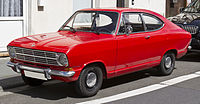
Opel also offered a two-door Kadett coupé with reduced headroom for the passengers in the rear. The coupé body introduced in 1965 included a thick C-pillar with reduced side-windows between the C-pillar and the B-pillar. The thick C-pillar incorporated three prominent air extractor slots reminiscent of the gills on a fish, as a result of which this coupé acquired the soubriquet "Kiemencoupé" (gills coupé). A coupé body with larger side windows for the passengers in the back appeared in 1967 identified as the "Coupé F", initially only on the more lavishly equipped cars, but from 1971 all Kadett B coupés used the newer body. The newer Coupé, with an increased quantity of glass, was slightly heavier than the "gills-coupé" as well as being less aerodynamically efficient, leading to a small reduction in claimed top speed.
Body types and equipment levels by chassis number [edit]
The first two digits of the chassis number identified the body type and equipment level as follows:
Chassis number . . . . . . .Years . . . Body type . . . . . . . . . . . . . . . . . . . Equipment level . . . [edit]
- Chassis number 31........: 1965-73: two door "Limousine" (saloon/sedan): Standard equipment level
- Chassis number 32........: 1965-70: Coupé („Kiemen-Coupé" / "Gills coupé"), "L" equipment level
- Chassis number 32........: 1966-70: code "32.." also used for "Rallye-Coupé"
- Chassis number 33........: 1967-70: five door "Caravan" (estate/station wagon): Standard equipment level
- Chassis number 34........: 1965-73: three door "Caravan" (estate/station wagon): Standard equipment level
- Chassis number 35........: 1967-70: five door "Caravan" (estate/station wagon): "L" equipment level
- Chassis number 36........: 1965-73: four door "Limousine" (saloon/sedan): Standard equipment level special "Ascona" branded Kadett for Swiss assembly
- Chassis number 37........: 1965-73: four door "Limousine" (saloon/sedan): "L" equipment level
- Chassis number 38........: 1965-73: two door "Limousine" (saloon/sedan): "L" equipment level
- Chassis number 38........: 1973: code "38.." also used for limited edition "specials" "Kadett Festival" and "Kadett Holiday"
- Chassis number 39........: 1965-73: three door "Caravan" (estate/station wagon): "L" equipment level
- Chassis number 91.........: 1967-70: two door "LS" fastback "Limousine" (saloon/sedan) with forced air ventilation
- Chassis number 92.........: 1967-73: two door fastback "Coupé F"
- Chassis number 92.........: 1967-73: code also used for "Coupé F" bodied "Kadett-Rallye""
- Chassis number 95.........: 1965-72: two door "Coupé F" USA export version
- Chassis number 96.........: 1967-70: four door "LS" fastback "Limousine" (saloon/sedan) with forced air ventilation
- Chassis number 97.........: 1967-70: Opel Olympia: four door "LS" fastback "Limousine" (saloon/sedan). Similar to Chassis nbr "96.." cars but with modified front and "Olympia" level (better) equipment
- Chassis number 98.........: 1967-70: Opel Olympia: two door "LS" fastback "Limousine" (saloon/sedan). Similar to Chassis nbr "97.." cars but with only two doors
- Chassis number 98.........: 1967-70: Opel Olympia: two door "Coupé F". Similar to Chassis nbr "92.." cars but with modified front and "Olympia" level (better) equipment
Engines [edit]
Smaller Opel OHV 4-cylinder engines [edit]
1.1 litre (1965 - 1973) [edit]
At launch, and for the next two years till September 1967, all Kadett Bs were fitted with an OHV four cylinder "over-square" water cooled engine. The unit followed the architecture of the 993 cc engine first seen in the 1962 Kadett A, from which it was a development. Both engines featured a 61 mm (2.4 in) cylinder stroke, but for the engine in the Kadett B, generally referred to as a 1.1-litre or 1,100 cc unit, the bore was increased by 3 mm (0.12 in) to 75 mm (3.0 in), which made it even more over-square and resulted in a capacity increase to 1,078 cc. There were as before two levels of power: stated output for the standard engine was 45 PS (33 kW) at 5,000 rpm, while the "High compression" engine, listed as the "1100 S" motor, produced 55 PS (40 kW) at 5,400 rpm. Both engine versions were fitted with a Solex 35 PDSI carburetor, but the higher compression ratio on the 55 PS (40 kW; 54 hp) unit necessitated the use of higher octane "super grade" fuel.[22] There was also a "low compression" 40 PS (29 kW) version of this engine used for certain export markets outside western Europe where available fuel came with a significantly lower octane rating than was normal for "regular" grade fuel in Germany.
In September 1967, as part of a larger proliferation of engine and trim options, a more powerful version of the 1,078cc engine became available, listed as the "1100 SR" motor, fitted with two Solex 35 PDSI carburetors and providing a maximum output of 60 PS (44 kW; 59 hp) at 5,200 rpm. The compression ratio was further raised, now to 9.2 : 1 and fitting the 60 PS (44 kW; 59 hp) unit raised the claimed top speed to 140 km/h (87 mph) as against 125 km/h (78 mph) and 135 km/h (84 mph) for the 45 PS (33 kW; 44 hp) and 55 PS (40 kW; 54 hp) powered Kadetts.[23]
However, the early 1970s saw increasing awareness of the dangers to health arising from lead being added to road fuel, and the oil companies responded to the resulting political and regulatory pressures by reducing both the levels of lead in fuel and the availability at filling stations of higher octane petrol/gasoline. High compression versions of the Opel 1,078cc engine were therefore withdrawn from August 1971, leaving just a 50 PS (37 kW; 49 hp) unit which used the 7.8 : 1 compression ratio that had been used in the base version back in 1965, delivering a reduced torque (presumably as art of a trade off against higher power output). Between August 1971 and July 1973 the niche hitherto occupied by the higher compression 1,078cc units was filled by a newly bored out 1,196cc version of what was, in other respects, the engine much as before.[24]
By the time the Kadett B was replaced in 1973 there had been no fewer than six differently sized engines available for it from Opel: by far the most popular was the 1,078cc motor that powered 89% (2.3 million of 2.6 million) of the Kadett Bs produced.[25]
1.2 litre (1971 - 1973) [edit]
The 1.2 litre unit that, in the Kadett B, replaced in August 1971 the higher compression versions of the 1.1 litre motor was listed as the "1200 S" motor. It retained the 61 mm (2.4 in) cylinder stroke of the original version of this engine, but the cylinder bore was further increased, giving an overall engine capacity of 1,196 cc and maximum output of 60 PS (44 kW; 59 hp) at 5,400 rpm.[26]
Only 95,000 Kadett Bs were fitted with the 1.2 litre engine which nevertheless went on to power successor Kadett and Corsa models until 1993. In the shorter term, in March 1972 this became the entry level power unit for base level versions of the recently introduced Opel Ascona and Manta models.[27]
1.0 litre (export only: 1972 - 1973) [edit]
In 1972 and 1973 Opel produced 10,000 Kadett Bs powered by the 993cc original version of the engine that ten years earlier had powered the Kadett A. Maximum output, as previously, was 40 PS (29 kW; 39 hp)} or 48 PS (35 kW; 47 hp) according to the compression ratio selected. This engine was not fitted in cars destined for the domestic market, but was used for cars sold in export markets, primarily Italy, where annual car tax rates increased very considerably for cars fitted with engines of above 1.0 Litre.[28]
Larger Opel OHV "CIH" 4-cylinder engines [edit]
1.7 litre (1967 - 1970) [edit]
In 1967 Ford added a 1.7 litre version to their Ford 12M/15M range. Both the Kadett and the Ford by now took up more road space than a typical European 1.1 litre small family sedan, and in September 1967 Opel added a 1,698cc engine to the Kadett's range of available power units. A suitable unit already existed, having been fitted in the Opel Rekord since 1965. The engine in question had been the manufacturer's second all-new engine design since the war, although much of its underlying philosophy came from General Motors developments in Detroit and from experience with the new engine developed for the Kadett A earlier in the 1960s. Opel's so-called Camshaft in Head (CIH) engine followed the trends of the time in replacing side-valves with an overhead valvegear configuration, which was no doubt facilitated by the over-square architecture of the cylinder block: the engine also carried its camshaft directly above the cylinders. However, instead of operating directly on the cylinder valves, the camshaft still operated the valves using rods and rocker arms because, unusually (except within general Motors) the camshaft itself was positioned too low above the cylinders to permit direct action from the camshaft on the valves. One reason for this may have been cosmetic. Opel's Camshaft in Head (CIH) engine configuration enabled a succession of Opels to feature the low bonnet/hood lines that style-conscious product development departments favoured. As on the smaller Kadett engines with their side mounted camshafts, the "in head" camshaft on the Opel CIH engine was chain driven, a weight-saving option which reduced lumpiness and friction at higher engine speeds when compared with the gear-cogs which had been used to drive camshafts in the previous generation of Opel engines.
The engine, known as the 1.7S or 1700S, was listed for the Kadett only for three years, between September 1967 and August 1970. The lower compression 60 PS (44 kW; 59 hp) version fitted in many Rekords was not offered to Kadett buyers. In the Kadett B the engine provided a maximum output of 75 PS (55 kW; 74 hp) employing a relatively high 9.5 : 1 compression ratio. That translated, in manual transmission cars, into a top speed of 153 km/h (95 mph) or 155 km/h (96 mph) according to body type. Despite its being listed for three year, only 6,000 Kadetts with the 1,698cc engine were produced, suggesting that the manufacturer preferred to fit engines of this size in their larger Rekord model (which between 1966 and 1971 took more than half a million of the 1,698cc units), while persuading Kadett customers looking for more power to switch their preference to the (in most respects similar) 1,897cc version of the (CIH) engine.[29]
1.9 litre (1967 - 1973) [edit]
Also listed from 1967, and fitted in 143,000 Kadett Bs was the 1,897cc version of the Camshaft in Head (CIH) engine. Again, only the high compression version of the engine was listed for the Kadett, providing maximum output of 90 PS (66 kW; 89 hp) at 5,100 rpm, using a 9.5 : 1 compression ratio. After August 1971 the compression ratio was reduced to 9.0 : 1 due to the reduction in octane levels available at filling stations. In practice, though the engine was listed for the Kadett B until 1973, very few of the Kadetts produced in 1972 and 1973 were fitted with it, as the focus of dealers' and customers' attention switched to the manufacturer's newer Ascona and Manta models.[30]
The 1.9 litre engine was fitted in the top of the range "Opel Rallye Kadett" as an alternative to the smaller high compression 1.2 litre engine also offered for this sportingly attired variant, readily identifiable from the thick black side stripe and the lavish application of black paint on the lid of the bonnet/hood.[31]
In Germany the "1900 S" engine was offered only in the coupé bodied "Opel Rallye Kadett" although for certain export markets, notably the USA, this engine was available in all body versions offered.
Between April 1970 and the end of the Kadett B's model life a more highy tuned "HL" („Hochleistung“/"High powered") version of the 1.9 litre engine could be fitted to a Rallye Sprint version of the car, power further increased to 106 PS (78 kW; 105 hp). "Hochleistung" cars could be purchased from Opel dealers and from at least one specialist engine tuning business, but they never appeared on Opel price lists in Germany where the cars were always rare. The 106 PS (78 kW; 105 hp) powered Kadett B Rallye Sprint was less of a rarity in Sweden where a high proportion of the cars produced were sold.
1.5 litre (export only: 1967 - 1970) [edit]
The smallest of Opel's (CIH) engines never found its way into Kadetts for the domestic market, but the 1,492cc unit was installed in 44,000 Kadett saloons/sedans and estates/station wagons destined for export between 1967 and 1970, primarily for Austria, Sweden and the USA. The version fitted in the Kadetts was a 65 PS (48 kW; 64 hp) high compression unit.
Running gear [edit]
Transmission [edit]
The car came with a four speed all-synchromesh manual transmission as standard, gear selection being performed using a centrally positioned floor-mounted lever. From November 1968 on the larger engined cars, and from February 1969 also on the smaller engined Kadetts, it became possible to specify the alternative of a "GM Strasbourg" Turbo-Hydramatic 180 three-speed automatic transmission, available at the extra cost (initially) of 800 Marks.[32]
Brakes [edit]
The Kadett B was the first Kadett to offer disc brakes on the front wheels. 238 mm (9.4 in) diameter disc brakes at the front came included as standard fittings on all but the cheapest versions, complemented by 200 mm (7.9 in) diameter drum brakes at the back. The brakes were controlled hydraulically. From February 1967 the single hydraulic braking circuit was replaced by a dual circuit braking system: this built in reserve of redundancy in the braking control system reflected a growing interest in primary and secondary safety which was becoming a feature of German auto-design in the 1960s. Whether as an option on the base model or as a standard feature across the rest of the range, where disc brakes were fitted Opel also included servo-assistance in the braking system from February 1967.[33]
Steering and suspension [edit]
The Kadett B inherited its suspension from the Kadett A. Two years after launch, however, in August 1967, the simple longitudinally mounted leaf springs with a centrally connected rigid axle which till then had suspended the rear wheels were replaced with a more sophisticated set-up incorporating coil springs, trailing arms and a Panhard rod. Road holding was usefully improved.[34] At the same time, reflecting growing preoccupation with secondary safety in the marketplace, the old steering wheel was replaced with a padded "Safety" steering wheel, now mounted on a telescopic steering column which was designed to collapse in the event of a serious collision.
Versions and trim levels [edit]
standard "Kadett", "Kadett L" and "Kadett LS" [edit]
The basic car was known simply as the Opel Kadett or the “standard” Opel Kadett, but for a few hundred Marks more customers could choose an Opel Kadett “L” with a less Spartan interior and a little more chrome on the outside, along with over-riders on the bumpers. When the fastback saloon was offered, between 1967 and 1970, it was identified as the Kadett “LS”.
“Rallye Kadett” [edit]
The “Rallye Kadett” was offered only with the coupé body, which it combined with the twin carburettor “SR” version of the 1.1 litre engine (between 1965 and 1971) or the high compression 1.9 litre engine (between 1967 and 1973). The Rallye Kadett came with twin halogen driving lights and, on the inside, a black panel of rocker switches as part of the dash-board along with black synthetic leather seat coverings. It also came with matt black panels on the bonnet/hood (“to reduce reflection”) and black stripes along the side. Customers worried by the flamboyant look of all the black paint could order a Rallye Kadett without it, but very few Rallye Kadett buyers opted for the “understated” paintwork option.
Opel Olympia [edit]
In August 1967 Opel revived an old name, introducing the Opel Olympia A. The Olympia name had last been used, till 1959, for a reduced specification version of the Opel Rekord, but now it was applied to a luxury derivative of the Opel Kadett B, readily distinguishable from the outside (at least in respect of the saloon/sedan version) by reason of its "black vinyl" roof-skin, together with the word "Olympia" appearing on the body sides behind the front wheels.[35]
Giving the Olympia its own name may have distanced it from the Kadett in the Opel showrooms and enabled the manufacturer to charge a premium price, but in other respects the new Olympia did not convincingly fill the gap in the range that had opened up between small family cars and big family cars, the Rekords having grown ever larger with each new generation.[36]
The Olympia was available in saloon/sedan and coupé bodied versions. The saloon/sedan, available with 2 or 4 doors, shared the fast-back "Limousine" body of the "Kadett LS", while the Olympia coupe used the same body as the "Kadett coupé F". The Olympia was fitted with the "1100 SR" twin carburettor 60 PS (44 kW; 59 hp) engine, and could also be ordered with any one of the three high compression Camshaft in Head (CIH) engines also fitted in the Kadett and providing 75 PS (55 kW; 74 hp), 90 PS (66 kW; 89 hp) or, in those export markets where the 1.5 litre version was available, 65 PS (48 kW; 64 hp).[37]
The Olympia A was withdrawn in August 1970, by when 80,637 had been produced.[38] The Olympia's demise cleared the way for the Opel Ascona, produced from August 1970 and introduced to the market in November 1970. The Ascona filled the gap between the smaller Kadett and the larger Rekord more obviously and, in terms of the sales figures, more persuasively than the Kadett based Olympia, defining in the German auto-market a new mid-weight family car class where it would be joined by the Ford Taunus TC and, a couple of years later, by the Audi 80 and the Volkswagen Passat.[39]
Limited edition "run-out" specials [edit]
The Kadett B was in production for 8 years, which represented a longer production run than was achieved by any other Kadett before or subsequently. This freed up the manufacturer to focus new model development on the important Ascona and Manta models which appeared in 1970. The Kadett B's strong marketplace performance was helped by the lukewarm reception German buyers gave to the Ford Escort which in its original incarnation German buyers perceived as cramped, crude and uncomfortable.[40] At the end of 1972, with rumours of a replacement appearing in the trade press, Opel nevertheless felt it necessary to prepare a series of special edition Opel Kadetts with a number of "options" included as standard features, but with little chance for customers to vary the specifications. By building large batches of identically equipped cars the manufacturer was able to provide attractively low prices to customers prepared to forego the chance to specify their Kadett "à la carte" from the colour, trim and options lists. Forty years on, some of the options listed have become standard on cars of this class, while others have fallen completely out of favour.
The limited edition cars were built and sold for the 1973 model year, which was the Kadett B's run-out (or final) year.
Opel Kadett Sport (1973) [edit]
The special edition Kadett Sport came with matt black exterior decor reminiscent of the Kadett Rallye, but whereas the Kadett Rallye came with a coupe body the Kadett-Sport used only the two door "Limousine" sedan/saloon body. Also the recommended price was 1,171 Marks (12%) lower than for the similarly powered 1.2 litre 60 PS (44 kW; 59 hp) Kadett Rallye.
The Kadett-Sport buyer could specify any one of three eye-cathing body colours: "roof-tile red", "yellow ochre" and "lemon yellow" (Ziegelrot, Ocker und Citrusgelb). Appropriate features included in the "customer-friendly" price were a sports exhaust/muffler, extra dials on the dash-board, a sports steering wheel, servo assisted brakes with discs at the front, anti-roll bars, high-backed front seats, sports wheels and tires, a heated rear window, seat belts and, under the bonnet, an enhanced alternator to cope with the anticipated demands of additional electrical equipment.
Opel Kadett Holiday (1973) [edit]
The special edition Kadett Holiday came with a standard package of extras, chief among which were a steel sliding sun roof, sports wheels, large fog lights at the front and a rear fog light, and high-backed front seats incorporating stylish wrap-around head restraints.
Opel Kadett Festival (1973) [edit]
The most luxuriously equipped of the special edition Kadetts of 1973, the Festival could be purchased as a Limousine (sedan/saloon) or as a Coupé. The cars were powered by the 60 PS (44 kW; 59 hp) 1.2S engine, and for approximately an extra 500 Marks the 3-speed automatic "Strasbourg" transmission could be specified.
The Kadett-Festival buyer could choose from three fashionably metallic body colours: "sahara gold", "monza blue" and "lime green". "Extras" included as standard features in the "friendly" price were velour covered seats exclusive to the Kadett Festival, a sports steering wheel, front disc brakes packaged with servo-assistance for the brakes, anti-roll bars front and rear, a more powerful alternator than on most Kadetts, halogen spot lamps, a heated back window, sports wheels with radial tires and the external decoration of thin twin side-stripes.
Opel Kadett Grand Prix (1973) [edit]
The Kadett Grand Prix was a special edition Kadett using the two door Limousine (sedan/saloon) body with its interior enhanced by the fitting of carpets, a sports steering wheel and 3-point mounted seatbelts. Under the bonnet/hood there was an uprated alternator. £-speed automatic transmission could be ordered as an extra.
For most of the run-out specials customers were restricted to a choice of three body colours, but Grand Prox buyers could choose from between roof-til red, yellow ochre, sierra beige and arctic white.
Export specials [edit]
Opel Ascona (modified Kadett B assembled in Biel, Switzerland) [edit]
The Opel Ascona 1700 should not be confused with the all-new Opel Ascona introduced in 1970. The "Opel Ascona" name was originally used for a 4-door "Limousine" (sedan/saloon) bodied edition of the Kadett B powered by the manufacturer's 1,698cc Camshaft in Head (CIH) high compression ratio "1.7S" engine. The interior was extensively modified, and incorporated seveal elements from the Kadett's "L" equipment package. Opel's first four Asconas came from the Kadett plant in Bochum, but all the rest of the 2,560 Kadett based cars were assembled at Biel, near the Franco-German language frontier through central Switzerland, using imported components. General Motors had originally established their small auto-assembly facility in Biel in the 1930s as a reaction to a surge in trade protectionism which had been part of the political reaction in Europe and America to the economic depression of the early 1930s.
Mixed fortunes in the USA [edit]
The Kadett B was sold in the United States through a large number of selected Buick dealers until Autumn 1972, branded simply as the Opel. The U.S. models for the 1968 model year were given the front end and trim of the new Opel Olympia. The US cars also received sealed beam headlights at the front and the car took part in the Trans-Am Series during its commercial life. Other differences in the rear lights were incorporated to satisfy local construction regulations. The Kadett Bs, like the predecessor Kadett A, were technically simple cars whose task was to compete with the market leader, the Volkswagen Beetle. The mainstay of the US Kadett at this time was the coupe bodied car: the four door sedan was offered only sporadically, for the 1966/67 and 1971/72 model years.
Roughly 430,000 Opel Kadett Bs were imported to the U.S.
The United States car magazine Car and Driver published a highly critical test of an Opel Kadett L 1500 Caravan in February 1968, featuring photos of the car in a junkyard. Reportedly, GM withdrew ads from that magazine for several months as a consequence.[41]
Commercial [edit]
Between 1965 and 1973 Opel produced 2,691,300 Kadett Bs[14] making this model one of the most successful Opels to date in terms of sales volume. The Kadett benefitted on the domestic market from a progressive slowing of demand for the old Volkswagen Beetle, while the Ford Escort and Volkswagen Golf which would compete for sales more effectively against the Kadett C both got off to a relatively slow start respectively in 1968 and 1974.
Derivatives [edit]
The two-seat Opel GT was heavily based on Kadett B components, its body made by a French contractor, Brissonneau & Lotz, at their Creil factory.
Kadett C (1973–1979) [edit]
| Also called | Buick-Opel (USA) Chevrolet Chevette (BRA) Daewoo Maepsy/Maepsy-Na (ROK) Holden Gemini (AUS) Isuzu Gemini (J) Saehan Gemini/Bird/Maepsy (ROK) Opel K-180 (ARG) Vauxhall Chevette (UK) |
|---|---|
| Production | 1973–1979 1,701,076 cars (Opel) |
| Assembly | Bochum, Germany Antwerp, Belgium |
| Body style | "Limousine" (2/4-door Saloon/Sedan) "Caravan" (3-door estate / Kombi / stn wgn) Coupé "Aero" (targa-top cabriolet) |
| Engine | 1974-79: 993 cc 40 PS ohv I4 1973-79: 1,196 cc 52/55/60 PS ohv I4 1977-79: 1,584 cc 75 PS CIH I4 1975-77: 1,897 cc 105 PS CIH I4 1977-79: 1,979 cc 110/115 PS CIH I4 (Opel Germany: petrol/gasoline engines) |
| Transmission | 4-speed manual 5-speed "dog leg" manual (GT/E) 3-speed automatic |
| Wheelbase | 2,395 mm (94.3 in) |
| Length | 4,127 mm (162.5 in) 3,922 mm (154.4 in) (City) 4,140 mm (163 in) (Caravan) |
| Width | 1,580 mm (62 in)) |
| Height | 1,375 mm (54.1 in) 1,340 mm (53 in) (Coupé) 1,385 mm (54.5 in) (Caravan) |
| Curb weight | 790 kg (1,741.7 pounds) (Coupé) |
The Kadett C appeared in August 1973[42] and was Opel's version of the General Motors' "T-Car". It was the last small Opel to feature rear-wheel drive, and remained in production at Opel's Bochum plant until July 1979, by which time Opel had produced 1,701,076. Of these, 52% had been exported outside West Germany,[43] most of them to markets in other parts of western Europe.
Bodies [edit]
The body of the Kadett C was seen as being less lumpy and better proportioned than that of the Kadett B. In terms of overall dimensions the two were actually very similar.[44]
Most customers opted for the "Limousine" bodied saloon/sedan car which came with two doors. A four door "Limousine" was produced for export to markets where cars of this size with only two doors encountered customer resistance. In West Germany itself, however, the small family car market continued to be dominated and defined by Volkswagen for whom two doors in a small family car was still quite sufficient: the four door Kadett C is remembered in Germany as an "export special".[45] The Limousine body accounted for just under 63% of the Opel Kadett Cs produced. A further 11% were three door estate / station wagon bodied cars badged, following Opel tradition, as the Kadett Caravan, with two door coupés accounting for slightly under 10%.[46] Publicity of the time, possibly originating with Mercedes-Benz, indicated that in order to minimize the risk of fire in the event of collision, the safest position for a car's fuel tank was above the rear axle between the passenger cabin and the boot/trunk, and this is where the Kadett C "Limousine" and "Coupé" had their fuel tanks fitted, accessible for replenishment via the (unexpectedly, hinged,) extractor vent on the car's right-side C-pillar. On the "Caravan" bodied estate car the fuel tank was a flatter shape, and was positioned under the rear cargo area.[47]
At the end of May 1975 the "Kadett City" was added to the range. This was a three door hatchback intended to compete on price (though not on space efficiency) with the Ford Fiesta, launched in Germany in the same month. The Kadett City sat on the same wheelbase as the other Kadett Cs, but the rear overhang was shortened. The fuel tank was positioned under the floor of the luggage compartment at the back, as on the Caravan bodied cars, but the fuel tank on the "Kadett City" had a capacity of only 37 litres as against 43 litres for the slightly longer "Kadett Caravan". Both models featured rear seats that could be folded forward to give a long and relatively unimpeded load area. 263,090 "Kadett City" bodied cars were produced, representing more than 15% of the Kadett Cs produced by Opel, Germany.[48]
Exhibited at the Geneva Motor Show in March 1976, and included in the range from that year[49] was the Aero-Kadett, an open-top Kadett with targa roll bar, detachable roof insert and a separate convertible top aft of the roll bar (like the contemporary Lancia Beta Spider). This car was built in limited numbers by Karosserie Baur in Stuttgart. Removing the removable parts of the Kadett Aero's roof was a cumbersome process and the manufacturer's recommended retail price was very much higher than that asked by Volkswagen for their 1303 Cabriolet.[49] The Kadett Aero struggled to find buyers, and was withdrawn early in 1978 by which time 1,242 had been produced.[50] Several decades later, however, the rarity of the Kadett Aero is one of the features that helps it to draw continued interest from old-timer enthusiasts.[51]
Engines [edit]
Smaller Opel OHV 4-cylinder engines [edit]
1.2 litre (1973 - 1979) [edit]
The Kadett C was launched in Germany with the 1.2 litre engine that had become an option for the Kadett B in 1971. As before in high compression (9.2 : 1 later, in 1975, reduced to 9.0 : 1)) "1.2S" form the unit returned a maximum output of 60 PS (44 kW; 59 hp) at 5,400 rpm. However, the 1,196 cc engine was now also available as a "1.2N" with a lower 7.8 : 1 compression ratio and in this form it produced a maximum 52 PS (38 kW; 51 hp) of power at 5,600 rpm. The power output of the low compression ratio unit was reduced in August 76 to 55 PS (40 kW; 54 hp) at 5,400rpm, at the cost of a small reduction in maximum torque.[52]
The 1.2 litre unit powered 1,389,940 of the European Kadett Cs, equivalent to almost 82% of the Kadett Cs produced by Opel in West Germany and at their daughter plant in Belgium.[53]
1.0 litre (1974 - 1979) [edit]
From March 1974 Opel added the a lower compression 1.0 litre version of the engine to the range, this featured the same 993 cc capacity as when first seen in the Kadett A, although now the compression ratio was slightly higher (7.9 :1) than in 1962. Maximum power at 40 PS (29 kW; 39 hp) was also the same as in 1962, though now at a slightly higher engine speed of 5,400 rpm. Performance, with a top speed at 127 km/h (79 mph) for the "Limousine" and 122 km/h (76 mph) for the "Caravan" was, by the standards of 1974, distinctly underwhelming with this power unit.[54] Quoted fuel consumption was slightly better than with the 1.2 litre cars, but in terms of overall running costs for the cars there was no corresponding reduction in running costs when choosing the 1.0 engine in preference to the 1.2N.[55]
Nevertheless, following the 1973 Oil price shock car buyers in western Europe had become far more economy minded. The 1.0 engines fitted in the Kadett B had been reserved for countries in the Mediterranean with punitive car tax levels, but with the Kadett C the manufacturer made cars powered by the smaller unit available to West German domestic buyers. 254,723 Kadett Cs using the 1.0 engine were produced whereas only 10,691 of the Kadett Bs produced had incorporated this anemic motor.[56]
Larger Opel OHV "CIH" 4-cylinder engines [edit]
1.6 litre (1977 - 1979) [edit]
May 1977 saw the addition of a smaller version of Opel's Camshaft in Head (CIH) engine to the Kadett range, this time in high compression form as the "1.6S" unit. The 1,584 cc engine shared the 69.8 mm (2.75 in) stroke of the larger CIH units, but the bore was reduced to 85 mm (3.3 in). Maximum power of 75 PS (55 kW; 74 hp) was quoted, providing for a listed top speed of 160 km/h (99 mph) in sedan/saloon bodied cars.
1.9 litre (1975 - 1977) [edit]
For its first two years the Kadett C was offered with a choice between only the 1.0 litre and 1.2 litre motors, but 1975 saw a return of the larger Camshaft in Head (CIH) power units to the Kadett range. The GT/E's 1,897 cc engine had till 1973 featured in the earlier Kadett B range of power units, but now it incorporated "Bosch D-Jetronic" fuel-injection. Maximum output of 105 PS (77 kW; 104 hp) at 5,400 rpm was virtually identical to that achieved by the Kadett B with its limited edition "Hoch Leistung" (high power) version of the same engine, but the earlier car had achieved its power level using old fashioned twin carburetors, a fuel feed approach now losing out to fuel injection in the face of increasingly stringent emission regulations.[57]
2.0 litre (1977 - 1979) [edit]
In September 1977 1.9 litre engine was replaced, in the "Rallye" Kadett, with a new enlarged 1,979 cc unit. Fitted in the "Kadett Rallye" 2000E this engine produced 110 PS (81 kW; 108 hp) of power at 5,400 rpm, which propelled the car to a top speed of 189 km/h (117 mph), comfortably faster than any previous "Rallye" branded performance Kadett. The car's fuel consumption, listed at 9.5 litres per 100 km (25/30 mpg US/UK), was also a clear improvement.
Running gear [edit]
Transmission [edit]
The car came with a four speed all-synchromesh manual transmission as standard, gear selection being performed using a centrally positioned floor-mounted lever. A five-speed manual transmission was offered as an option on top of the range GT/E Kadetts that appeared in 1975, and became a standard feature of the (now) 2-litre Kadett GT/E in 1977. On 1.2 and 1.6 litre engined cars it was also possible to specify the option of a "GM Strasbourg" Turbo-Hydramatic 180 three-speed automatic transmission.[58]
Brakes [edit]
At launch, Kadett Cs powered by the 1.0 litre and the lower compression version of the 1.2 litre engine were delivered fitted with 200 mm (7.9 in) diameter drum brakes on all four wheels. It was possible to specify front disc brakes, which, following an upgrade in January 1975, became standard fittings on all Kadetts. Servo-assistance for the brakes was also initially an option which became a standard fitting - in this care from May 1975 - on these less powerful Kadetts. On cars fitted with the higher compression version of the 1.2 litre engine and on cars with larger engines, the combination of front wheel disc brakes and rear wheel drum brakes, supported by servo-assistance had come as standard equipment from 1973. The brakes on the Kadett C were operated via a twin circuit hydraulic mechanism.[59]
More equipment and a small facelift (1977 & 1978) [edit]
In terms of comfort and equipment, the Kadett C was launched with two available levels of trim and equipment, either as a standard or a "Kadett L" model. In May 1977 these were joined by the "Kadett Berlina", featuring the larger 1.6 litre "S" engine under the bonnet/hood and an enhanced package of trim and equipment on the inside. On the outside the Berlina was distinguished by a discrete chrome side strip along the length of the car redesigned headlights, now rectangular in shape and a little larger than hitherto. The larger headlights appeared to be part of a single unit also incorporating turn indicators now positioned directly adjacent to the lights at the car's front corners. The new headlights and front indicator flashers were also included from May 1977 on the "L" models, while the standard cars retained the smaller headlamps with which the Kadett C had been launched, along, as before, with turn indicators below the front bumper.[60]
In the Autumn/Fall of 1978 the larger headlights and turn indicators were also applied to the remaining Kadett Cs.[61]
Broadening the range for the sportingly inclined [edit]
Kadett "C" GT/E (1975 - 1979) [edit]
The Kadett C sporting "Coupé GT/E" models appeared in August 1975, a year before the rival VW Golf GTI. The GT/E was priced, in 1975, at 12,950 Marks which was approximately 30% higher than the manufacturer's listed retail price (9,970 Marks) for a "1.2S" powered Kadett coupé. The fuel injected performance coupé now provided a basis for competition cars. Advertising of the time featured an aggressive two-tone yellow and white paint scheme, although it was also possible to specify a conventional "everyday" body colour.[62]
The Kadett GT/E was available, at extra cost, with a five-speed manual transmission. 1975 was the first year that five-speed transmission became available, if only, at this stage, as an option, on the top-of-the-range Kadetts. In 1977 five-speed transmission became a standard feature of the Kadett GT/E.[63]
After ten years during which an apparent inability to replace the Beetle appeared to threaten the very survival of the Wolsburg empire, Volkswagen's Golf, introduced in 1974, and although initially slow to take off in the German car market, was now rapidly evolving into a winner, and for the Kadett C a rival at least as formidable as the Beetle, in it glory days, had been. At the performance end of the small family car sector the Kadett now found itself in a crude power struggle with the Golf GTI, launched in 1975 and energetically defining a new "hot-hatch" market segment. The Golf GTI was launched with 110 PS (81 kW; 108 hp) of power supported by "Bosch K-Jetronic" fuel-injection, a new generation fuel feed system from the specialist supplier that supplied both Opel and Volkswagen. Opel's response to the success of the Golf GTI was the Kadett GT/E, powered by the 1,979 cc (CIH) unit but with the compression ratio raised and a resulting increase in maximum power to 115 PS (85 kW; 113 hp). The rear wheel suspension was enhanced through the integration of vertically mounted telescopic gas filled Bilstein shock-absorbers which enhanced road holding and provided a firm "sporting" quality to the ride.[64]
Kadett "C" Rallye (1977 - 1979) [edit]
September 1977 saw the return of the "Kadett Rallye" label for a Kadett Coupé that provided seriously superior performance to the "shopping trolley" Kadetts of the time, but was half a notch down from the GT/E in terms of price and of uncompromising performance. The Rallye was offered with a choice between the "1.6S" and "2.0S" engines, the larger of which at the same time became available in a high performance version of Opel's larger Rekord. The rear wheel suspension was enhanced through the inclusion of vertically mounted telescopic shock-absorbers produced by the manufacturer's Spanish component factory.[65]
The "world car" [edit]
In Brazil the Kadett C was released six months before its European release,[66] as the Chevrolet Chevette. It was available with a choice of three petrol engines, in 1.4 L, 1.6 L, and 1.0 L displacements (the latter available only for the 1992/3 model year); 1.4 L and 1.6 L versions were also available running on ethanol.
This Chevette went through several redesigns — first front and rear panels similar to the Opel version, then a look similar to the British Vauxhall Chevette, and finally a design reminiscent of the updated USA Chevrolet Chevette version. It was available in several different bodies: hatchback (1979–87), estate (called Chevrolet Marajó, 1980–89), pickup (Chevy 500, 1984–95) and saloon (1973–93). The Chevette sold over 1.6 million units in Brazil, being replaced there by the Chevrolet Corsa.
The T-Car was also built in Japan by Isuzu and sold as the Isuzu Gemini and in Australia where it was marketed as the Holden Gemini. In South Korea, Saehan Motor then Daewoo Motor built a version of the Gemini originally known as the Saehan Gemini, later becoming the Daewoo Maepsy and Maepsy-Na after a final facelift.
The Kadett C reached the United States as the Buick–Opel. This was an Isuzu Gemini; an updated version of this car was marketed in the USA as the Isuzu I-Mark in the early 1980s.
In Argentina GM manufactured a modified version with a locally developed 1.8 L 4-cylinder OHV motor - based on the six-cylinder 194 engine - as the Opel K-180 in three versions "Base", "Rally" and "LX" from 1974 until 1979. Production ended when GM Argentina closed its doors.
The T-Car also formed the basis of the British Vauxhall Chevette, which had a restyled front end and launched with a hatchback body, in addition to using a 1,256 cc OHV (over-head valve) Vauxhall engine rather than the 1,196 cc OHV Opel engine. The Chevette made the Kadett C notable by allowing it to become Opel's first hatchback — a version named Kadett City appeared in August 1975,[67] based on the Chevette's hatchback body. The Kadett's coupé body style was never manufactured as a Chevette however. Although Kadett C production ended in 1979, the Chevette was produced until January 1984. Unusually for Vauxhall models, the Chevette was imported to Germany starting in 1979 to satisfy the need for a cheaper car than the Kadett D. This import version, however was never officially badged as an Opel or a Vauxhall - being named simply as 'Chevette'. It was replaced by the Corsa A.
Kadett D (1979–1984) [edit]
| Also called | Vauxhall Astra (UK) |
|---|---|
| Production | 1979–1984 |
| Predecessor | Kadett C |
| Successor | Kadett E |
| Platform | GM T platform |
| Engine | 1.0 - 1.8 L / 40 - 116 bhp (petrol) 1.6-litre / 55 bhp (diesel) |
| Length | 3,998 mm (157.4 in) (saloon) 4,207 mm (165.6 in) (kombi/estate) |
| Width | 1,636 mm (64.4 in) |
| Height | 1,400 mm (55.1 in) |
| Curb weight | 875 kg (1,929.0 lb) - 1,060 kg (2,336.9 lb) |
| Related | Bedford Astravan (UK) |
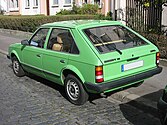
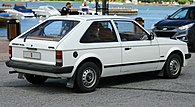
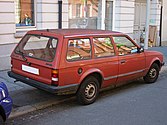
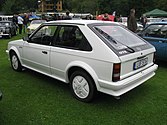
The Kadett D was introduced in the middle of August 1979, with deliveries on the home market beginning early in September 1979.[68] In November 1979 the car went on sale in the UK, some five months before the Vauxhall Astra Mark 1, the British version, was launched in April 1980. The cars were designed as three- or five-door hatchbacks and estates or station wagons. There were also two- and four-door sedans featuring separate boots/trunks, which shared the silhouettes of the hatchbacks: in the UK the sedan versions were soon withdrawn. For the first time since 1965 there was no coupé bodied Kadett in the range: the previous Kadett C coupé was indirectly replaced by the three-door 1.3 SR sports model.
Technologically, the Kadett D was a departure, as it was Opel and Vauxhall's first front-wheel-drive car. It also introduced the Family II engine design with an single overhead camshaft, aluminium-alloy cylinder head, hydraulic valve lifters, with capacities of 1,297 cc (producing 60 bhp and 75 bhp) and had a transaxle design that allowed the clutch to be replaced without removing the transmission unit. A carry-over 1,196 cc overhead valve engine producing 53 bhp and a top speed of 87 mph was also offered from launch,[69] and a new 1,600 cc, engine was offered later, followed by an 1800 cc version introduced for the Kadett/Astra GTE model. The Kadett D was also equipped with a 1600 cc diesel engine.
This range of engines was also used for later models of the Corsa/Nova, and the mid-sized Cavalier/Ascona.
It was also produced as IDA Kadett in Kikinda, Yugoslavia.
South Africa [edit]
The Opel Kadett D was also built in South Africa by General Motors South African (Pty) Ltd. The South African range was made up of four-door fastback sedans, five-door hatchbacks, and a five-door estate model called the Voyage.[70] The engines used are Opel's 1.2 litre overhead valve inline-four (L models only), or the OHC 1.3 liter (GL, GLS, and Voyage). Power is 60 PS (44 kW) and 75 PS (55 kW) respectively.[70] Later a 1.6 liter engine was added.
Kadett E (1984–1991) [edit]
| Also called | Opel Astra (East Africa; GMEA) Chevrolet Kadett/Ipanema (BRA) Daewoo LeMans/Racer (ROK) Opel Monza (RSA) Passport Optima Pontiac LeMans (US) & (AUS) Vauxhall Astra (GB) Vauxhall Belmont (GB) IDA Kadett (YUG)[citation needed] |
|---|---|
| Production | 1984–1991 |
| Platform | GM T platform |
| Engine | 1,196 cc 12SC OHV I4 1,196 cc 12ST I4 1,297 cc 13/C13 I4 1,396 cc I4 1,598 cc I4 1,796 cc 18SE I4 1,998 cc I4 1,998 cc 20XE/C20XE DOHC I4 1,488 cc 4EC1 TD I4 1,598 cc 16D diesel I4 1,686 cc 4EE1 TD I4 1,700 cc diesel I4 |
| Transmission | 5-speed manual 4-speed manual 3-speed automatic |
| Wheelbase | 99.5in 2520mm |
| Length | 4,482 mm (176.5 in) (saloon) 4,256 mm (168 in) (hatchback & convertible) |
| Width | 1,662 mm (65.4 in) |
| Height | 1,393 mm (54.8 in) |
| Related | Daewoo Nexia |
The Kadett E (Vauxhall Astra Mark 2 in the UK) was introduced in 1984, and was voted 1985 European Car of the Year.[71] The 1984 model was also developed into a more conventional three-box design with a boot (trunk), badged as the Vauxhall Belmont in the UK and the Opel Monza in South Africa, launched in January 1986. This was awarded 1985 Semperit Irish Car of the Year in Ireland. There was a station wagon called the "Caravan" available, with either three or five doors.
A convertible version was also available, for the first time in 1987, built by Bertone of Torino/Italy, bringing it to line with competitors such as the Ford Escort and Volkswagen Golf. For the 1988 model, capacities were raised to from 1.3 to 1.4, and a new 1,998 cc engine replaced the 1.8 hitherto used on the GSi and Vauxhall Astra GTE. In 1988, a 16-valve twin-cam version was developed for a high-performance GSi/GTE model, yielding 156 PS (115 kW) in non-catalyzed form, six less horsepower with a catalytic converter fitted.
The Kadett E has been seen as a grey import in the UK, but it is not as popular as the Vauxhall Astra Mark 2. It was never officially sold in Britain, and by 1989 General Motors was only marketing the Vauxhall brand in the UK.
In the early 1990s, South African Kadett GSi's were further upgraded based on their success in production car racing and initially 500 special units were built as road cars for homologation purposes. This was a minimum requirement for entry into the Stannic Group N races. They went against BMW's 325iS (A 2.7 litre homologation special from BMW). They featured more aggressive 276-degree camshafts made by Schrick with 2 different settings for timing overlap (110° and 107°), revised intake and exhaust modifications (4-in-1 branch manifold and freeflow exhaust), Irmscher spring kit, modified engine management system by Promotec, a limited slip differential developed by Andre Verwey and special Aluett 7Jx15-inch ET35 alloy wheels, they were nicknamed the "Superboss" and held the world record for the most torque per liter (114Nm per liter) until recently beaten by the Ferrari 458 (117Nm per liter). After the first 500 units were produced, many more were built to satisfy public demand.
The Kadett E was introduced in Brazil as the Chevrolet Kadett, but the three-door station wagon (later also five-door) was called the Chevrolet Ipanema. Brazilian production commenced in April 1989, with the Ipanema being added in October of the same year. From 1992 Brazilian Kadetts/Ipanemas received fuel injection. Brazilian cars received either 1.8 or 2.0-litre petrol fours.[72]
It formed the basis of the Daewoo LeMans (later known as the Daewoo Cielo, Racer and Nexia) in South Korea, and also as Heaven in Chile (Nexia being the HB version), which was sold in the United States and New Zealand as the Pontiac LeMans, and in Canada (initially) as the Passport Optima. LeMans sales ended in 1993. The Nexia is still being produced at UzDaewoo plant in Asaka, Uzbekistan. The Cielo was last being produced at Automobile Craiova, a semi-independent (from GM) plant in Craiova, Romania. Their license expired in the fall of 2006.
Kadett name [edit]
In 1992, GM Europe decided to standardise model names across its two brands, and Opel adopted Vauxhall's name for the Kadett, Astra, for the replacement car for Europe which debuted that year. Only in South Africa, the Kadett name continued on the first Opel Astra hatchback until 1999 (Astra/Kadett F), when all models took the Astra name.
However, under Opel's internal naming convention, successive generations of the Astra platform are treated as a logical continuation of the Kadett lineage - hence the original 1992 Astra was designated Astra F in relation to the previous Kadett E - this convention has continued through the Astra J.
References [edit]
- Oswald, Werner (2001 edition). Deutsche Autos 1920-1945, Band (vol) 2 (in German). Motorbuch Verlag. ISBN 3-613-02170-6.
- Oswald, Werner (2003 edition). Deutsche Autos 1945-1990, Band (vol) 3 (in German). Motorbuch Verlag. ISBN 3-613-02116-1.
- ^ Oswald 1920 - 45 (vol 2), p 325 "Mitte November 1936 folgte der Opel Kadett (Serie 11 234) als kleineres und bescheideneres [than the Olympia] Modell ..."
- ^ Oswald 1920 - 45 (vol 2), pp 325 & 326
- ^ Oswald 1920 - 45 (vol 2), pp 320 & 326
- ^ Oswald 1920 - 45 (vol 2), p 325
- ^ Oswald 1920 - 45 (vol 2), pp 328 & 329
- ^ Oswald 1920 - 45 (vol 2), p 325 "...Image des Arme-Leute-Autos..."
- ^ Oswald 1920 - 45 (vol 2), p 325
- ^ Oswald 1920 - 45 (vol 2), pp 287 & 325: Oswald's book (2001 edition) gives the figure of 106,608 in his table of production statistics but 107,608 in his text.
- ^ a b c Oswald 1945 - 90 (vol 3), p 197
- ^ Heinz Michaels (24 August 1962). "Opel bläst zum Angriff auf VW: Mit tausend „Kadetten“ pro Tag – Ein neues Firmen jahrhundert, eine neue Fabrik, ein neuer Wagen: ....In der letzten Hauptversammlung hatte der Vorstand alle Versuche, die hausväterisch wieder angesammelten Reserven anzugreifen, gerade deshalb entschlossen abgewiesen. Mahnend sagte Prof. Nordhoff damals: „Hinter beiden Unternehmen (General Motors und Ford) steht eine Finanzkraft, der kein deutsches Unternehmen etwas auch nur annähernd Gleichwertiges entgegenzusetzen hat, und der Wille des Eindringens in den deutschen Markt um jeden Preis scheint vorhanden zu sein.“"". ZEIT ONLINE. Retrieved 2013-05-12.
- ^ http://www.focus.de/finanzen/news/unternehmen/endgueltiges-aus-fuer-opel-werk-in-bochum-opel-baut-ab-2016-keine-autos-mehr-in-bochum_aid_878290.html
- ^ [1] abgerufen am 15. Dezember 2012
- ^ a b Oswald 1945 - 90 (vol 3), pp 197 & 198
- ^ a b c Günther Zink (2009). Oldtimer Katalog 23. Königswinter: HEEL Verlag. p. 264. ISBN 978-3-86852-067-52009 Check
|isbn=value (help). - ^ a b Oswald 1945 - 90 (vol 3), p 199
- ^ Oswald 1945 - 90 (vol 3), pp 197 & 199
- ^ Oswald 1945 - 90 (vol 3), p 213
- ^ Oswald 1945 - 90 (vol 3), pp 199 & 215
- ^ Oswald 1945 - 90 (vol 3), p 213: "Trotz seiner stilistisch mißglückten, dicklichen und hochbordigen Karosserieform ließ sich der Kadett B vom ersten bis zum letzten Tag ... ausgezeichnet verkaufen, denn er war ein problemloses, wirtschaftliches und zuverlässiges Auto."
- ^ Oswald 1945 - 90 (vol 3), p 214 & 218
- ^ Oswald 1945 - 90 (vol 3), p 214 & 221
- ^ Oswald 1945 - 90 (vol 3), pp 213 & 215
- ^ Oswald 1945 - 90 (vol 3), pp 213, 215, 217, 221 & 222
- ^ Oswald 1945 - 90 (vol 3), p 216
- ^ Oswald 1945 - 90 (vol 3), pp 213 & 223
- ^ Oswald 1945 - 90 (vol 3), pp 245, 246 & 246
- ^ Oswald 1945 - 90 (vol 3), p 216
- ^ Oswald 1945 - 90 (vol 3), pp 216, 219 & 228
- ^ Oswald 1945 - 90 (vol 3), pp 214 & 219
- ^ Oswald 1945 - 90 (vol 3), pp 214, 218, 219 & 220
- ^ Oswald 1945 - 90 (vol 3), pp 213 & 215
- ^ Oswald 1945 - 90 (vol 3), pp 213, 215, 217, 219, 221-223
- ^ Oswald 1945 - 90 (vol 3), pp 213, 215, 218 & 219
- ^ Oswald 1945 - 90 (vol 3), p 213
- ^ Oswald 1945 - 90 (vol 3), pp 213, 215, & 219
- ^ Oswald 1945 - 90 (vol 3), p 216
- ^ Oswald 1945 - 90 (vol 3), pp 244 & 251
- ^ Oswald 1945 - 90 (vol 3), pp 396 & 397: "Der grossere Teil der Produktion ging ins Ausland, weil der Ford Escort [Mk I] auf dem deutschen Markt wegen seiner pummeligen Form, seiner simplen Konstruktion, seiner holprigen Straßenlage und seines bescheidenen Komforts nur mäßigen Zuspruch fand... 848 388 [Escort Mk Is fertigten] die deutschen Ford-Werke, doch nur 234 667 Exemplaren fanden deutsche Käufer."
- ^ Abel, Richard L. Speaking Respect, Respecting Speech. p. 191. Retrieved 18 November 2012.
- ^ Oswald 1945 - 90 (vol 3), pp 236 & 239
- ^ Oswald 1945 - 90 (vol 3), p 237
- ^ Oswald 1945 - 90 (vol 3), p 236 "...unter Beibehaltung der bewährten Mechanik eine neue, nach damaligen Begriffen "flüssig" und elegant aussehende Karosserie, die sich zudem von Anfang an durch saubere und solide Verarbeitung auszeichnete..."
- ^ Oswald 1945 - 90 (vol 3), p 237 "...Der 1000 S-Motor und vor allem die relativ vielen damit ausgerüsteten Viertüren-Limousinen gingen ausschließlich in den Export."
- ^ Oswald 1945 - 90 (vol 3), p 237
- ^ Oswald 1945 - 90 (vol 3), pp 236, 241 & 243
- ^ Oswald 1945 - 90 (vol 3), pp 236 & 239
- ^ a b "Kurztest: Kadett Aero : Windjammer. Targa-Version von Bauer auf Kadett-Basis". Auto, Motor und Sport 17: 64–66. 18 August 1976.
- ^ Oswald 1945 - 90 (vol 3), p 237
- ^ Oswald 1945 - 90 (vol 3), pp 237, 239 & 241
- ^ Oswald 1945 - 90 (vol 3), p 237
- ^ Oswald 1945 - 90 (vol 3), pp 237, 239 & 241
- ^ Oswald 1945 - 90 (vol 3), p 237 "Mit [dem Einliter-Motor] zeigte der Kadett allerdings recht müde Fahrleistung, ohne im Betrieb entsprechend billiger zu sein als der 1200 N."
- ^ Oswald 1945 - 90 (vol 3), pp 214 & 236
- ^ Oswald 1945 - 90 (vol 3), pp 236 & 243
- ^ Oswald 1945 - 90 (vol 3), pp 239, 241 & 243
- ^ Oswald 1945 - 90 (vol 3), p 237
- ^ Oswald 1945 - 90 (vol 3), p 236
- ^ Oswald 1945 - 90 (vol 3), p 243
- ^ Oswald 1945 - 90 (vol 3), pp 236, 237 & 243
- ^ Oswald 1945 - 90 (vol 3), pp 237 & 243
- ^ http://bestcars.uol.com.br/classicos/chevette-1.htm
- ^ "Test: Kadett City: Modeerscheinung - Neue Variante mit schraegheck". Auto, Motor und Sport 17: 42–46. 16 August 1975.
- ^ Oswald 1945 - 90 (vol 3), p 265
- ^ Daily Express Guide to 1980 World Cars, page 52
- ^ a b Lösch, Annamaria, ed. (1981). World Cars 1981. Pelham, NY: The Automobile Club of Italy/Herald Books. p. 334. ISBN 0-910714-13-4.
- ^ "Previous winners". Car of the year. Retrieved 2010-10-02.
- ^ Büschi, Hans-Ulrich, ed. (1997). Automobil Revue 1997 (in German/French) 92. Berne, Switzerland: Hallwag. p. 205. ISBN 978-3-444-10479-4.
- This article incorporates information from the equivalent article on the German Wikipedia.
External links [edit]
| Wikimedia Commons has media related to: Opel Kadett |
|
||||||||||||||||||||||||||||||||||
| Opel car timeline, 1919–1950 next » | |||||||||||||||||||||||||||||||||
|---|---|---|---|---|---|---|---|---|---|---|---|---|---|---|---|---|---|---|---|---|---|---|---|---|---|---|---|---|---|---|---|---|---|
| Type | 1919 | 1920s | 1930s | 1940s | 1950s | ||||||||||||||||||||||||||||
| 9 | 0 | 1 | 2 | 3 | 4 | 5 | 6 | 7 | 8 | 9 | 0 | 1 | 2 | 3 | 4 | 5 | 6 | 7 | 8 | 9 | 0 | 1 | 2 | 3 | 4 | 5 | 6 | 7 | 8 | 9 | 0 | ||
| Small family car | 4/12 PS | 1.2 litre / P4 | |||||||||||||||||||||||||||||||
| 4/14 PS | 4/16 PS | 4/20 PS | 1.0 litre | 1.3 litre | Kadett | ||||||||||||||||||||||||||||
| Compact car | Olympia | Olympia | |||||||||||||||||||||||||||||||
| Large family car | 7/34 & 8/40 | 1.8 litre | 2.0 litre | ||||||||||||||||||||||||||||||
| Executive car | 10/40 | Super 6 | Kapitän | Kapitän | |||||||||||||||||||||||||||||
| Luxury Car | 12/50 | 14/50 | |||||||||||||||||||||||||||||||
| Regent | Admiral | ||||||||||||||||||||||||||||||||
| « previous Opel car timeline, 1947–1979 next » | ||||||||||||||||||||||||||||||||||
|---|---|---|---|---|---|---|---|---|---|---|---|---|---|---|---|---|---|---|---|---|---|---|---|---|---|---|---|---|---|---|---|---|---|---|
| Class | Type | 1940s | 1950s | 1960s | 1970s | |||||||||||||||||||||||||||||
| 7 | 8 | 9 | 0 | 1 | 2 | 3 | 4 | 5 | 6 | 7 | 8 | 9 | 0 | 1 | 2 | 3 | 4 | 5 | 6 | 7 | 8 | 9 | 0 | 1 | 2 | 3 | 4 | 5 | 6 | 7 | 8 | 9 | ||
| Small family car | Sedan | Kadett A | Kadett B | Kadett C | ||||||||||||||||||||||||||||||
| Olympia | Olympia A | |||||||||||||||||||||||||||||||||
| Large family car | Sedan | Olympia Rekord | Rekord P1 | Rekord P2 | Ascona A | Ascona B | ||||||||||||||||||||||||||||
| Full-size car | Sedan | Rekord A | Rekord B | Rekord C | Rekord D | Rekord E | ||||||||||||||||||||||||||||
| Coupé | Commodore A | Commodore B | Commodore C | |||||||||||||||||||||||||||||||
| Luxury vehicle | Limousine | Kapitän | Kapitän | Kapitän PI / PII | Kapitän A / Admiral A / Diplomat A | Kapitän B / Admiral B / Diplomat B | Senator | |||||||||||||||||||||||||||
| Sports car | Roadster | Manta A | Manta B | |||||||||||||||||||||||||||||||
| Coupé | GT | CD | ||||||||||||||||||||||||||||||||