


Luxury car

A luxury car is a car that provides above-average to high-end levels of comfort, features, and equipment. Often more expensive materials and surface finishes are used, and buyers expect better build quality. The usually higher pricing and more upscale appearance is often associated with higher social status of the users, compared to low and mid-market segment cars.
The term is relative and partially subjective, reflecting both objective qualities of a car, as well as the projected and perceived image of the car marque.[1] Luxury brands rank above premium brands, though there is no clear demarcation between the two.[2]
Traditionally, most luxury cars were large vehicles, though smaller sports-oriented models were always produced. "Compact" luxury vehicles such as hatchbacks, and off-road capable sport utility vehicles, are more recent expansions of luxury qualities in various cars.[1]
Increasing (comfort) features, materials quality, interior space, innovations, and or performance have consistently been competitive strategies between car makers, practically throughout the history of the automobile.
Classification standards[edit]
Several car classification schemes include a luxury category, such as:
- Australia: Since the year 2000, the Federal Government's luxury car tax applies to new vehicles over a certain purchase price, with higher thresholds applying for cars considered as fuel efficient.[3][4] As of 2019, the thresholds were approximately AU$66,000 (US$50,000) for normal cars and AU$76,000 (US$57,000) for fuel-efficient cars.[5]
- Europe: Luxury cars are classified as F-segment vehicles in the European Commission classification scheme.[6][7][8]
- Italy: The term "auto di lusso" is used for luxury cars.[9]
- France: The term "voiture de luxe" is used for luxury cars.[10]
- Germany: The term German: Oberklasse (upper class) is used for luxury cars.[11]
- Russia: The term (автомобиль представительского класса ("representative class vehicle, also translated as luxury vehicle) is used for luxury cars.[12]
- Rental cars: The ACRISS Car Classification Code is a system used by many car rental companies to define equivalent vehicles across brands. This system includes "Luxury" and "Luxury Elite" categories (along with "Premium" and "Premium Elite" categories).[13] The criteria for a vehicle to be considered "luxury" is not published.
Characteristics[edit]

Features[edit]
Luxury cars have traditionally emphasized higher levels of comfort and safety.[14] Manufacturers often introduce new safety technologies and comfort amenities on luxury models before they are available on more affordable models.[15] Some brands, like Audi and BMW have expanded their marketing by "introducing lesser priced and strip-down economy versions of their products."[16]
Luxury vehicles can be a status symbol for conspicuous consumption.[17] However, since many European luxury car buyers shy away from conspicuous consumption, brands offer buyers the option of removing exterior badges that identify the model name or engine size.[18]
The suspension system of most luxury cars is tuned to prioritize ride quality over handling, however, some cars are marketed as "sports luxury" and have a greater emphasis on handling characteristics.[19][20]
Layout and powertrain[edit]

Traditionally, luxury cars have used a front-engine, rear-wheel drive (FR) layout. The FR layout is more expensive to produce and produces lower fuel economy than a front-wheel drive layout, however, it allows for larger engines (particularly straight-six, V8, and V12) to be used.[18][21][22][23]
Some American luxury cars during the 1970s through the 1990s switched to a front-wheel drive layout with transverse engine, due to the Arab Oil Embargo of 1973 and the 1979 fuel crises which eliminated many FR platforms in favor of the more economical front-wheel drive (FF) layout.[24] From the early 2000s, several of these American luxury cars reverted to FR layouts.[25][26][27][28]
Since the introduction of the Bentley Continental GT in 2003, additional luxury cars feature all-wheel drive.[29]
History[edit]
European manufacturers[edit]

Prior to World War II, a wide array of European producers made luxury cars, including Rolls-Royce, Bugatti, Delage, Delahaye, Talbot-Lago, Bentley, Alvis, Avions Voisin, Isotta Fraschini, Horch, Simson, Stoewer, Maybach, Mercedes-Benz, Hispano Suiza, Daimler Company, and Spyker.[30][31]
France was a leading producer of powerful luxury automobiles prior to World War II.[32] After World War II, the French government used puissance fiscale tax regulations to encourage manufacturers to build cars with small engines, and French motorists to buy them.[32] The Maserati-powered Citroën SM and the Citroën C6 were arguably the last domestic French luxury cars.[33][34] In the 2010s, some French manufacturers have attempted to develop luxury cars, however the lack of a historical legacy has hindered these efforts.[35] In 2014, Citroën introduced DS Automobiles sub-brand to market luxury cars.[36][37]
Pre World War II intermediate car manufacturers like Renault, Fiat, Opel, Lancia, Škoda, Riley, Praga, Peugeot, Hillman and Tatra made luxury cars but were forced to make economy cars and superminis post World War II. Following World War II, Germany rose to become an export powerhouse, building on success with the Mercedes-Benz brand, later joined by BMW, which acquired Rolls-Royce Motor Cars in 1998, as well as Volkswagen which much later controlled or acquired additional brands such as Audi, Porsche, Bentley, Lamborghini, and Bugatti brands.[38][39]
In the Soviet Union, the manufacturer ZiL (then called Zis) began producing representational limousines in the mid-1930s. In the early 1950s GAZ joined with the somewhat smaller "Chaika" model range.
North American manufacturers[edit]
.jpg)
The luxury car phenomenon began at the start of the automobile industry when the wealthy frequently invested in the manufacture of such models to gain the social prestige associated thereby.[40] Emphasis was also placed on custom-built coachwork.[41] The 1920s and 1930s were the apogee of production of these very large luxury automobiles from many manufacturers. The significant North American manufacturers from 1910-1940 were Auburn, Buick, Cadillac, Chrysler, Continental, Cord, Daniels, DeSoto, Duesenberg, Franklin, Imperial, LaFayette, LaSalle, Lincoln, Marmon, Packard, Peerless, Pierce Arrow, Ruxton, Stearns-Knight, and Stutz. The Great Depression put many luxury car manufacturers out of business; others would hold on before going defunct during the postwar era.[citation needed][42][43]
.jpg)
From 1946 until the late 1990s, Cadillac was the top-selling brand of luxury cars in the U.S., while Lincoln was second.[44] The most successful and long-running model names during this era were the Cadillac DeVille, Lincoln Continental, and the Chrysler Imperial. The Lincoln Mark Series and Cadillac Eldorado were positioned in the personal luxury category and competition between them continued into the 1990s.[45]
The personal luxury car emerged into mass popularity and affordability as an America-specific category of popularly-priced cars made from the 1950s by the four domestic manufacturers (GM, Ford, Chrysler, and AMC) that reached peak popularity in the 1970s.[46] The cars were stylized, mass-produced two-door coupés or convertibles, relying on standard components.[47] These distinctively styled cars were targeting the needs of individual customers, not an entire family.[48] The longest running model lines were the 1958-1997 Ford Thunderbird, 1956-1998 Lincoln Mark Series, and the 1967-2002 Cadillac Eldorado.
In 1990, American luxury brands dominated with Cadillac selling over a quarter-million cars and Lincoln had its best year ever at 231,660 units.[49] However, the market was changing with an ever greater acceptance of smaller, more efficient imported luxury brands while at the same time, the domestic manufacturers were downsizing their models with product decisions that backfired on quality and brand respect.[49]
Since the late 1990s, Japanese and German brands have sold the most luxury-type cars in the United States. However, the Cadillac Escalade has led the luxury SUV segment sales in the United States since its introduction in 1998, with the highest sales for 15 out of its first 20 years on the market.[50][51]
In the 2000s, both Ford and General Motors produced luxury pickups: 2002-2013 Cadillac Escalade EXT, 2002-2003 Lincoln Blackwood, and 2006-2014 Lincoln Mark LT. In the late 2000s, the Cadillac CTS and Cadillac DTS led to a resurgence in the brand's luxury sedans.[52] The equivalent sedan from the Ford group, the 2008 Lincoln MKS, was also regarded as a significant improvement over previous models.[53] In 2010, BMW was the best-selling luxury vehicle manufacturer by sales, with Audi and Mercedes-Benz the second and third highest selling luxury brands.[54]
East Asian manufacturers[edit]
.jpg)

Chinese manufacturer Hongqi was launched in 1958, making it the oldest Chinese luxury car marque.[55] Later newcomers joined taking advantage of the rise of electric powertrains, with NEV brands such as Nio in 2014, Li Auto in 2015, HiPhi in 2019, and BYD in 2020 producing luxury electric and hybrid vehicles.
Japanese manufacturers have been producing luxury cars since the 1950s, including the Toyota Crown (1955–present),[56][57] Prince/Nissan Gloria (1959–2004), Nissan Cedric (1960–2015), Mitsubishi Debonair (1964–1998), Nissan President (1965–2010), Toyota Century (1967–present), Mazda Luce/929 (1969–1991), and Honda Legend (1985–present).
Since the 1980s, overseas sales of Japanese luxury cars have increased, challenging traditional European luxury brands.[58]
Several East Asian manufacturers have created sub-brands for the marketing of luxury cars. The first of these was the 1986 launch of Acura (a Honda sub-brand), followed by Lexus (Toyota) in 1989, Infiniti (Nissan) in 1989, and Genesis (Hyundai) in 2015.[58]
Global financial crisis[edit]
The late-2000s global financial crisis was the first time since the Great Depression of the 1930s that the luxury car market suffered considerably, something not seen in previous economic downturns. Many such customers saw their net worth decline following the collapse in financial markets and real-estate values.[17][59] For example, some of the steepest drop-offs came at the high end, including the BMW 7 Series and Rolls-Royce Phantom, and in 2010 Mercedes-Benz dropped the price of the W212 E-Class. The unusually sharp decline in luxury car sales has led observers to believe that there is a fundamental shift and reshaping of the luxury automotive market, with one industry official suggesting that the marques no longer command the premiums that they used to, and another saying that conspicuous consumption was no longer attractive in poor economic conditions.[58] Additionally, mainstream brands have been able to offer amenities and devices such as leather, wood, and anti-lock brakes, previously found only on luxury cars, as the costs decline.[58]
However, luxury vehicle sales did not collapse as much as their non-luxury counterparts.[60][61] This was aided by growing interest in luxury vehicles from emerging markets such as China and Russia.[58]
Sales in the entry-level luxury segment remained strong throughout the GFC, due to prices being lowered to compete with well-equipped non-luxury cars.[62][63] For example, in Canada, several luxury manufacturers set sales records in August 2009, due mostly to discounted pricing on entry-level luxury vehicles.[64][65]
Brands[edit]


.jpg)

Some auto manufacturers market their luxury models using the same marque as the rest of their line. Others have created a separate marque (e.g. Lexus, launched by Toyota in 1989)[71] or purchased one (e.g. Bentley, by Volkswagen in 1998).[72][73]
Occasionally, a luxury car is initially sold under a mainstream marque and is later rebranded under a specific luxury marque (for example the Hyundai's Genesis to Genesis G80 as well as the Citroën DS to DS 5).[74][75]
For mass-produced luxury cars, sharing of platforms or components with other models is common,[76] as per modern automotive industry practice.
Market categories[edit]
[edit]
The premium compact class is the category of the smallest luxury cars. It became popular in the mid-2000s, when European manufacturers (such as Audi, Volvo, BMW, and Mercedes-Benz) introduced new entry-level models that were smaller and cheaper than their compact executive models.[96] The premium compact cars are usually based on the platform of a compact car (also known as "small family car" or C-segment), while some models may be based on a subcompact car (also known as supermini or B-segment).
Examples include the Mercedes-Benz A-Class and CLA-Class, Audi A3, Volvo S40, BMW 1 Series, and 2 Series.[97] Premium compacts compete with well-equipped mid-size cars, and highly optioned premium compact cars can have pricing and features that overlap models in the compact executive segment.[98]
-
 Mercedes-Benz A-Class hatchback (2018–present)
 -
 BMW 2 Series Gran Coupé (2019–present)
 -
 Audi A3 sedan (2020–present)


Compact executive / compact luxury[edit]
A compact executive car or a compact luxury car is a premium car larger than a premium compact and smaller than an executive car. In European classification, compact executive cars are part of the D-segment. In North American terms, close equivalents are "compact premium car", "compact luxury car",[99] "entry-level luxury car" and "near-luxury car".[100] Compact executive cars are usually based on the platform of a mid-size car (also known as large family car or D-segment), while some models may be based on a compact car (also known as small family car or C-segment).
-
 Mercedes-Benz C-Class (2021–present)
 -
 Alfa Romeo Giulia (2015–present)
 -
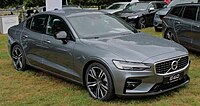 Volvo S60 (2019–present)


Executive / mid-size luxury[edit]
Executive car is a British term for an automobile larger than a large family car. In official use, the term is adopted by Euro NCAP, a European organization founded to test for car safety. It is a passenger car classification defined by the European Commission.
-
 Mercedes-Benz E-Class (2017–present)
 -
 BMW 5 Series (2017–present)
 -
 Genesis G80 (2016–present)


Luxury saloon / full-size luxury sedan[edit]
The next category of luxury cars is known in Great Britain as a "luxury saloon" or "luxury limousine,"[101][102][103][104] and is known in the United States as a full-size luxury sedan, large luxury sedan, or flagship sedan.[105][106][107][108] It is the equivalent of the European F-segment and the German Oberklasse segment.
Many of these luxury saloons are the flagship for the marque and include the newest automotive technology.[109] Several models are available in long-wheelbase versions, which provide additional rear legroom and may have a higher level of standard features.[110]
Examples of luxury saloons / full-size luxury sedans include the BMW 7 Series,[111] Jaguar XJ, Cadillac CT6,[112][113] Genesis G90,[112] Audi A8,[114] Mercedes-Benz S-Class,[111] Lexus LS,[112]Hongqi H9, Porsche Panamera and Maserati Quattroporte.[111]
-
 Mercedes-Benz S-Class (2020–present)
 -
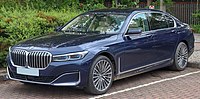 BMW 7 Series (2015–present)
 -
 Audi A8 (2018–present)


_%E2%80%93_Frontansicht,_24._Dezember_2017,_Velbert.jpg)
Ultra-luxury[edit]
Luxury cars costing over US$100,000 (as of 2007) can be considered as "ultra-luxury cars".[115] Examples include the Rolls-Royce Phantom, Maybach 57 and 62, Hongqi L5, Bentley Mulsanne, Toyota Century, and Aurus Senat.[115][116][117] High-end sports cars which are targeted towards performance rather than luxury are not usually classified as ultra-luxury cars, even when their cost is greater than US$100,000.[115] The history of a brand and the exclusivity of a particular model can result in price premiums compared to luxury cars with similar features from less prestigious manufacturers.[118] Ultra-luxury cars are usually selected as the official state car.[119]
-
 Rolls-Royce Phantom VIII
(2017–present) -
 Bentley Mulsanne
(2010–2020)

.jpg)
Grand tourer[edit]
Grand tourers are essentially high-performance vehicles. These vehicles are generally 2-door coupes and are made for long-distance driving, combined with the luxury of an executive car or full-size luxury car.[120]
-
 Lexus LC
(2017–present) -
 Bentley Continental GT
(2018–present)


Luxury SUV / crossover[edit]
Long before the luxury SUV segment was defined and became popular, the 1966 Jeep Super Wagoneer was marketed at the time as a fully-equipped station wagon.[121][122][123][124]: 3 It was the first off-road SUV to offer a V8 engine and automatic transmission along with luxury car trim and equipment.[125] Standard features included bucket seating, a center console, air conditioning, a seven-position tilt steering wheel, a vinyl roof, and gold-colored trim panels on the body sides and tailgate.[124]: 3 By the late 1970s, optional equipment included an electric sunroof.[124]: 4 The 1978 Jeep Wagoneer Limited was the spiritual successor to the Super Wagoneer and was the first four-wheel drive car to use leather upholstery.[124]: 5
The Range Rover was released in 1970 as a two-door vehicle for off-road durability with few "creature comforts."[126] A four-door version was added in 1981, and the model was pushed upmarket in 1983 by introducing an automatic transmission (Chrysler's A727 TorqueFlite) as an option.[127] The Range Rover had a long-travel coil-spring suspension and an aluminium V8 engine.[128]
In the mid-1990s, the SUV market expanded with new entrants. By the mid-1990s, the entry-level Ford Explorer and upscale Jeep Grand Cherokee were the market leaders for SUVs.[129] The fastest-growing sector of this market was for the so-called luxury SUVs, which included the Jeep Grand Cherokee ... the Grand Cherokee's allure: "This vehicle is proof you can have a true off-road vehicle without giving up luxuries and amenities" with the Jeep providing a crucial new intangible factor for buyers—image.[130]
The SUV models generated higher profit margins than passenger cars, and car manufacturers began introducing new luxury SUVs during the late 1990s.[131] SUVs such as the 1995 Lexus LX, 1997 Mercedes-Benz M-Class, and 1998 Lincoln Navigator were the first SUVs produced by these luxury car brands. Some of these early luxury SUV models used unibody construction, becoming part of the trend moving away from the body-on-frame construction traditionally used by off-road vehicles.
During the mid-2000s, SUVs from luxury car brands grew by almost 40% in the United States to more than 430,000 vehicles (excluding SUV-only brands like Hummer and Land Rover), at a time when luxury car sales suffered a 1% decline, and non-luxury SUV sales were flat. By 2004, 30% of major luxury brands' U.S. sales were SUVs. Crossover SUVs became increasingly popular in the mid-2000s, and manufacturers also began to produce luxury versions of crossovers. The Lexus RX was the earliest luxury crossover on the market, and it has since been the best-selling luxury vehicle in the US.[132] Some luxury crossovers are built on a platform shared with sedans or hatchbacks. For example, the Infiniti FX is based upon the same platform as the Infiniti G35 sedans and coupes.[133] While early luxury crossovers released in the late 1990s have resembled traditional boxy SUVs, later crossovers, such as the Infiniti FX and BMW X6, have been designed with a sporting appearance.[134][135][136]
Despite the increased popularity of crossover models, traditional luxury SUVs remain in production. Examples include the Lexus LX, Infiniti QX80, and Lincoln Navigator.[137]
Research data from the mid-2000s suggested that luxury SUV buyers did not consider traditional luxury cars (e.g. sedans and coupes), therefore the SUV is becoming the key to bringing new customers into luxury dealerships.[138]
Luxury car companies have increasingly introduced SUV or crossover models in the 2010s. For example, Rolls-Royce Cullinan, Bentley Bentayga, Aston Martin DBX, Maserati Levante, and Lamborghini Urus. Ferrari has announced that they will release an SUV model Ferrari Purosangue in 2023.[139] Some brands, such as Lincoln, have even moved to an all SUV and/or crossover lineup.
-
 Lamborghini Urus
(2018–present) -
 Maserati Levante
(2017–present) -
 Aston Martin DBX
(2020–present)
.jpg)


See also[edit]
References[edit]
- ^ a b Anurit, Jakrapan; Newman, Karin; Chansarkar, Bal (1998). "Consumer Behaviour of Luxury Automobiles: A Comparative Study between Thai and UK Customers' Perceptions" (PDF). Economics Web Institute. Archived (PDF) from the original on 30 October 2020. Retrieved 3 July 2022.
- ^ Kapferer, Jean-Noël; Bastien, Vincent (2009). The Luxury Strategy: Break the Rules of Marketing to Build Luxury Brands. Kogan Page. p. 43. ISBN 978-0-7494-5477-7.
- ^ "Tax Laws Amendment (Luxury Car Tax) Bill 2008". Australian Government ComLaw. 2008. Archived from the original on 6 July 2022. Retrieved 3 July 2022.
- ^ McCowen, David (2 August 2017). "The breakdown: Luxury Car Tax – Why luxury cars cost too much in Australia". Drive. Archived from the original on 24 March 2019. Retrieved 3 July 2022.
- ^ "Luxury car tax rate and thresholds". ato.gov.au. 1 June 2022. Archived from the original on 2 July 2022. Retrieved 3 July 2022.
- ^ "Case No COMP/M.1406 – Hyundai/Kia – Regulation (EEC) No 4064/89 Merger Procedure" (PDF). Office for Official Publications of the European Communities. 17 March 1999. Archived (PDF) from the original on 23 June 2022. Retrieved 3 July 2022.
- ^ "Case No IV/M.1326 – Toyota/Daihatsu – Merger Decision IV/M.1326" (PDF). Office for Official Publications of the European Communities. 6 November 1998. Archived (PDF) from the original on 4 July 2022. Retrieved 3 July 2022.
- ^ "Case No COMP/M.5219 – VWAG/OFH/VWGI – Regulation (EC) No 139/2004 Merger Procedure". Office for Official Publications of the European Communities. 25 September 2008. Archived from the original on 19 April 2012. Retrieved 3 July 2022.
- ^ "Lusso Means Luxury". Forbes. 7 October 2003. Archived from the original on 9 November 2022. Retrieved 8 November 2022.
- ^ Mingot, Leo (28 December 2011). "Ecologie: les reines du CO2". autonews.fr (in French). Archived from the original on 13 October 2013. Retrieved 3 July 2022.
- ^ "Crashtest: Obere Mittelklasse Übersicht A – Z" (in German). ÖAMTC. 2015. Archived from the original on 15 July 2015. Retrieved 3 July 2022.
- ^ "Car of the Year Russia". 2015. Archived from the original on 16 November 2016. Retrieved 16 January 2015.
- ^ "ACRISS Car Classification Code". autocardatabase.com. Archived from the original on 3 July 2022. Retrieved 3 July 2022.
- ^ Lienert, D. (14 May 2007). "Safest Cars 2007". Forbes. Archived from the original on 4 February 2023. Retrieved 4 February 2023.
- ^ Maley, Will (3 August 2016). "Luxury Features You Can Find in Affordable Cars". U.S. News & World Report. Archived from the original on 25 September 2020. Retrieved 16 May 2022.
- ^ "Luxury Car Makers should focus on Detailing and Lifestyle marketing: Frost & Sullivan". The Economic Times. 26 February 2014. Archived from the original on 16 May 2022. Retrieved 16 May 2022.
- ^ a b Elliott, Hannah (27 February 2009). "Ten Reasons To Buy A Luxury Car". Forbes. Archived from the original on 31 July 2017. Retrieved 11 March 2014.
- ^ a b Ulrich, Lawrence (13 August 2010). "In Some Classes, Buyers Are Not Ready to Give Up Their V-8s". The New York Times. Archived from the original on 31 July 2017. Retrieved 11 March 2014.
- ^ Chase, Chris (9 September 2009). "Test Drive: 2009 BMW 328i xDrive". Autos. Canada. Archived from the original on 18 February 2014. Retrieved 27 April 2016.
- ^ "2010 Buick LaCrosse CXS vs. 2009 Lexus ES 350 Comparison Test and Video on Inside Line". Edmunds.com. 30 August 2009. Archived from the original on 4 September 2009. Retrieved 14 September 2009.
- ^ "Automaker Ratings". Rearwheeldrive.org. Archived from the original on 27 July 2011. Retrieved 29 September 2009.
- ^ Stewart, Ben. "Comparison Test: Front-Wheel Drive Vs. Rear-Wheel Drive". Popular Mechanics. Retrieved 29 September 2009.
- ^ "U.S. luxury car manufacturers are rethinking rear wheel drive]. (Auto Weekend)". The Washington Times. Washington, D.C. 13 October 2009. Archived from the original on 6 November 2012. Retrieved 17 January 2011.
- ^ Baruth, Jack (13 September 2018). "Why GM's Front-Drive Luxury Cars Were Great, And Why They Failed Anyway". Road & Track. Archived from the original on 4 February 2023. Retrieved 4 February 2023.
- ^ Meredith, Robyn (12 November 1999). "The media: Advertising: Cadillac is redesigning its image before its retooled cars appear". The New York Times. Archived from the original on 26 March 2023. Retrieved 4 February 2023.
- ^ Kaus, Mickey (9 May 2003). "Advance to the Rear". Slate. Archived from the original on 4 February 2023. Retrieved 3 February 2023.
- ^ Johnson, Drew (14 February 2008). "2011 Chrysler 300, Dodge Charger to remain rear-wheel drive". Leftlanenews. Archived from the original on 26 August 2009. Retrieved 11 March 2014.
- ^ "Lincoln Town Car wins stay of execution". Spero News. 19 September 2006. Archived from the original on 19 February 2010. Retrieved 11 March 2014.
- ^ Ryan, Colin (2017). "10 Best Luxury Cars with AWD". autobytel.com. Archived from the original on 13 November 2022. Retrieved 12 November 2022.
- ^ "10 Luxury Car Brands That Time Forgot". Car and Driver. 9 October 2015. Archived from the original on 9 November 2022. Retrieved 8 November 2022.
- ^ Miterko, Andrew (17 April 2019). "Pre-War Luxury and Opulence: Riding in Luxury—Arriving in Style". RM Sotheby's. Archived from the original on 9 November 2022. Retrieved 8 November 2022.
- ^ a b Sedgwick, Michael (1 March 2017). "The Facel Vega 1954 – 1964". facel-vega.com. Archived from the original on 11 May 2018. Retrieved 1 February 2018.
- ^ "Is The French Luxury Car Finally Back?". oppositelock.kinja.com. 9 April 2014. Archived from the original on 2 February 2018. Retrieved 1 February 2018.
- ^ Holloway, Hilton (12 December 2012). "Is it time to bid adieu to the French luxury car?". autocar.co.uk. Archived from the original on 2 February 2018. Retrieved 1 February 2018.
- ^ Schechner, Sam; Pearson, David (5 October 2012). "French Begin New Luxury Car Drive". The Wall Street Journal. Archived from the original on 2 February 2018. Retrieved 1 February 2018.
- ^ "DS range: Our current vehicles". DS Automobiles. Archived from the original on 10 January 2018. Retrieved 1 February 2018.
- ^ Barry, Maggie (18 January 2018). "DS 7 – lighting the way and pushing ahead". Scottish Daily Record. Archived from the original on 2 February 2018. Retrieved 1 February 2018.
- ^ Johnson, Maureen (30 March 1998). "BMW To Buy Rolls-Royce for $570M". AP News. Archived from the original on 16 May 2023. Retrieved 16 May 2023.
- ^ "What Brands Does Volkswagen Own?". MotorTrend. 4 June 2020. Archived from the original on 16 May 2023. Retrieved 16 May 2023.
- ^ Davis, Donald Finlay (1988). Conspicuous production: automobiles and elites in Detroit, 1899-1933. Temple University Press. ISBN 978-0-87722-549-2.
- ^ Carson, Richard Burns (1988). The Olympian Cars: the great American luxury automobiles of the twenties & thirties (Second ed.). Beaver's Pond Press. ISBN 978-1-890676-02-5.
- ^ Rhodes, David; Stelter, Daniel (16 February 2010). "The Great Depression put many luxury car manufacturers out of business". Boston Consulting Group. Archived from the original on 25 May 2022. Retrieved 3 July 2022.
Virtually all the smaller companies competed in the expensive or midpriced segments of the market. They were highly exposed to sharp drops in sales as demand fell away. They were slow to cut costs and introduce low-priced models. Apart from Chrysler, the small players either went out of business or lost so much market share that they could no longer compete effectively.
- ^ "How the Big Three survived Depression". wheels.ca. 9 May 2009. Archived from the original on 4 July 2022. Retrieved 4 July 2022.
Many of the smaller automakers folded during the 1930s, including Cord, Durant, Franklin, Peerless, Pierce-Arrow and Stutz. Others survived the Depression, but were so damaged they eventually went out of business, including Graham-Paige, Hudson, Nash, Packard, Studebaker and Willys-Overland.
- ^ O'Dell, John (6 May 1999). "Cadillac Apologizes to Lincoln for Inflating Sales Numbers". Los Angeles Times. Archived from the original on 12 March 2014. Retrieved 11 March 2014.
- ^ Hunting, Benjamin (14 September 2021). "Arch Rivals: Cadillac Eldorado versus Lincoln Continental Mark". driving.ca. Archived from the original on 27 October 2021. Retrieved 12 November 2022.
- ^ "Chrysler and AMC lost the plot with 1970s personal luxury coupes". Indie Auto. 30 March 2022. Archived from the original on 4 February 2023. Retrieved 4 February 2023.
- ^ Spinelli, Mike (6 May 2011). "What's The Ultimate Personal Luxury Car?". Jalopnik. Archived from the original on 26 March 2023. Retrieved 4 February 2023.
- ^ Gartman, David (2013). Auto-Opium: A Social History of American Automobile Design. Routledge. pp. 180–181, 193–194. ISBN 978-1-135-09427-0. Retrieved 27 August 2019.
- ^ a b Robertson, Barry (30 November 2016). "How Boomers Revolutionized The Luxury Car Market". Coming of Age. Archived from the original on 28 August 2019. Retrieved 28 August 2019.
- ^ "Mercedes SUV to Dethrone the Cadillac Escalade?". Top Speed. Retrieved 24 November 2019.
- ^ "Cadillac Escalade: 20 Years on the Road". Cadillac Magazine. 30 August 2018. Archived from the original on 20 January 2020. Retrieved 24 November 2019.
- ^ Lienert, Dan (12 December 2005). "Best-Selling Luxury Cars 2005". Forbes. Archived from the original on 27 September 2010. Retrieved 11 March 2014.
- ^ English, Bob (24 June 2009). "Lincoln measures up to stiff competition". The Globe and Mail. Toronto. Archived from the original on 17 October 2015. Retrieved 11 March 2014.
- ^ "3rd Update: BMW Lifts 2010 Guidance As Demand Improves". The Wall Street Journal. 13 June 2010. Archived from the original on 28 July 2010. Retrieved 15 March 2014.
- ^ "About FAW > Key Events". China: First Automobile Works. Archived from the original on 4 March 2009.
- ^ "Toyota – history of the car company". toyoland.com. Archived from the original on 2 August 2018. Retrieved 25 January 2019.
- ^ "History of the Toyota Crown". toyota.co.uk. 6 August 2015. Archived from the original on 1 November 2020. Retrieved 25 January 2019.
- ^ a b c d e Eisenstein, Paul A. (18 September 2009). "Luxury car market may never look the same". MSNBC. Archived from the original on 2 October 2009. Retrieved 11 March 2014.
- ^ Gupta, Poornima (11 September 2009). "Bentley sees signs of revival in luxury car class". Reuters. Archived from the original on 14 March 2020. Retrieved 11 March 2014.
- ^ "Drop in Germany luxury car sales eases". Agence France-Presse. 8 September 2009. Archived from the original on 11 December 2011. Retrieved 11 March 2014.
- ^ Rogoski, Richard R. (1 December 2008). "Recession not a roadblock for luxury-car sales". Triangle Business Journal. Archived from the original on 26 May 2011. Retrieved 11 March 2014.
- ^ Van, Nicolas (8 September 2009). "Luxury makers smash August sales records in Canada". Ottawa Citizen. Archived from the original on 20 March 2012. Retrieved 11 March 2014.
- ^ "How Mercedes got its groove back". The Business Journals. 30 August 1998. Archived from the original on 16 January 2021. Retrieved 27 November 2019.
- ^ Van, Nicolas (4 June 2009). "Luxury makers smash August sales records in Canada". Ottawa Citizen. Archived from the original on 20 March 2012. Retrieved 10 September 2009.
- ^ Vaughan, Michael (9 September 2009). "Incentives are 'an expensive way to sell'". The Globe and Mail. Toronto. Archived from the original on 17 September 2009. Retrieved 14 September 2012.
- ^ Roe, Fred (1986). Duesenberg – The Pursuit of Perfection. Dalton Watson. ISBN 978-0-901564-37-5.
- ^ DeMauro, Thomas A. (May 2016). "The Duesenberg From Kenosha - 1933 Nash Ambassador Brougham". Hemmings Classic Car. Retrieved 8 November 2022.
- ^ "1930 Isotta Fraschini Tipo 8A news, pictures, and information". conceptcarz.com. Archived from the original on 12 March 2014. Retrieved 11 March 2014.
- ^ "Delage D8-120" (PDF). Mullin Automotive Museum. Archived (PDF) from the original on 9 July 2021. Retrieved 5 July 2021.
- ^ Branch, Ben (9 July 2014). "1934 Mercedes-Benz 500K/540K Spezial Roadster". Silodrome. Archived from the original on 9 July 2021. Retrieved 5 July 2021.
- ^ "The History of Lexus" (Press release). US: Lexus. 19 April 2013. Retrieved 10 January 2019.
- ^ "A Look at Bentley Through the Ages". robbreport.com. Archived from the original on 6 January 2019. Retrieved 6 January 2019.
- ^ "Bentley History". rolls-royceandbentley.co.uk. Archived from the original on 15 January 2019. Retrieved 6 January 2019.
- ^ "Hyundai Genesis Review". Car and Driver. US. Archived from the original on 22 March 2016. Retrieved 22 March 2016.
- ^ Lorio, Joe (4 November 2015). "Genesis 2.0: Hyundai's Genesis to Become Separate Luxury Brand". Car and Driver. US. Archived from the original on 10 January 2018. Retrieved 22 March 2016.
- ^ Wendler, Andrew (January 2012). "2013 Acura ILX Concept – This concept previews a production Civic-based compact for Honda's luxury brand". Car and Driver. Retrieved 11 March 2014.
- ^ "BYD-Daimler JV builds Denza EV production line in Pingshan, Shenzhen". Just Auto. 18 April 2013. Archived from the original on 26 April 2013. Retrieved 23 April 2013.
- ^ Yang, Allen (15 September 2022). "GAC AION Officially Launched Aion Hyper SSR with 1.9s 0-100km/h Acceleration performance". carnewschina.com. Archived from the original on 2 January 2023. Retrieved 15 September 2022.
- ^ "This is Volvo". media.volvocars.com. 2022. Archived from the original on 24 March 2022. Retrieved 16 March 2022.
Volvo Car Group (Volvo Cars) is owned by Zhejiang Geely Holding (Geely Holding) of China.
- ^ Dummett, Ben; Boston, William (4 October 2021). "Chinese-owned Volvo seeking to raise $2.86 billion in Stockholm IPO". MarketWatch. Archived from the original on 17 February 2022. Retrieved 17 February 2022.
- ^ "LYNK & CO – Zhejiang Geely Holding Group". 2022. Archived from the original on 19 October 2022. Retrieved 16 March 2022.
- ^ "Polestar – Zhejiang Geely Holding Group". 2022. Archived from the original on 16 March 2022. Retrieved 16 March 2022.
- ^ Danny Tan (5 January 2022). "Zeekr, Intel's Mobileye to collaborate on autonomous cars – goal is world's first consumer L4 AVs by 2024". paultan.org. Archived from the original on 23 September 2022. Retrieved 5 January 2022.
- ^ "Jidu Auto to invest billions in electrification by 2026". electrive.com. 27 April 2021. Archived from the original on 7 November 2022. Retrieved 24 September 2021.
- ^ "Hudson Great Eight Market". classic.com. Archived from the original on 25 June 2021. Retrieved 20 March 2021.
- ^ "1930 Hudson Great Eight is still a grand touring car". The Washington Times. 29 February 2008. Archived from the original on 19 September 2021. Retrieved 20 March 2021.
- ^ McCourt, Mark J. (May 2005). "1954 Final Flight of Fancy - 1954 Hudson Italia". Hemmings Classic Car. Retrieved 20 March 2021.
premium coachbuilt grand tourer ... handcrafted coupe
- ^ a b Herbez, Vukasin (11 November 2018). "12 American Cars With European Designs You Probably Didn't Know". Motor Junkie. Archived from the original on 25 May 2022. Retrieved 20 March 2021.
- ^ Karr, Anthony (15 May 2019). "De Tomaso Is Coming Back, New Car To Debut At Goodwood FoS". Motor1. Archived from the original on 4 July 2019. Retrieved 4 July 2019.
- ^ "Nash Ambassador Market". classic.com. Archived from the original on 10 April 2021. Retrieved 20 March 2021.
- ^ Bremner, Richard (10 September 2020). "Nash! The excellent car company you've (probably) never heard of". msn.com. Retrieved 20 March 2021.
- ^ "A New EV Brand is Born – China's IM Motors is Officially Launched; Backed by Alibaba". autofutures.tv. 16 January 2021. Archived from the original on 11 September 2021. Retrieved 11 September 2021.
- ^ "Last Packard—the classic American luxury car—produced". History.com. 23 June 2020. Archived from the original on 25 February 2021. Retrieved 20 March 2021.
- ^ "The Toyota Century Is Just As Luxurious As Any German Sedan". hotcars.com. 20 June 2022. Archived from the original on 29 October 2022. Retrieved 20 June 2022.
- ^ "World Premiere of the All-New Crown Series". global.toyota/en/newsroom (Press release). 15 July 2022. Retrieved 15 July 2022.
- ^ "2014 Mercedes-Benz CLA-Class Review". Edmunds.com. Archived from the original on 20 August 2013. Retrieved 11 March 2014.
- ^ "2011 AutoPacific Ideal Vehicle Awards: Premium Compact Car". autobytel.com. Archived from the original on 10 January 2019. Retrieved 10 January 2019.
- ^ Cato, Jeremy (29 November 2013). "Uptown Runs Downtown with Less Expensive Autos". ClassifiedsTT. Archived from the original on 18 December 2014. Retrieved 11 March 2014.
- ^ Cotta, Rick (30 October 2008). "The Consumer Guide to 2008 Premium Compact Cars". Consumer Guide Automotive. Archived from the original on 9 November 2008. Retrieved 25 April 2012.
- ^ "Car Rankings: Best Upscale Midsize Cars – Best Cars & Trucks". U.S. News & World Report. Archived from the original on 8 April 2015. Retrieved 8 April 2015.
- ^ "Jaguar XJ Review (2019)". autocar.co.uk. Archived from the original on 29 January 2019. Retrieved 13 January 2019.
- ^ "Mercedes-Benz S-Class saloon review". parkers.co.uk. Archived from the original on 13 January 2019. Retrieved 13 January 2019.
- ^ "New Audi A8 55 TFSI 2018 review". Auto Express. Archived from the original on 13 January 2019. Retrieved 13 January 2019.
- ^ "Lexus LS 500h Saloon (2017 – ) review". autotrader.co.uk. Archived from the original on 13 January 2019. Retrieved 13 January 2019.
- ^ "2019 Audi A8 First Look". motortrend.com. Archived from the original on 13 January 2019. Retrieved 13 January 2019.
- ^ "2019 Lexus LS 500: A suitably cushy flagship with a polarizing visual edge". autoweek.com. Archived from the original on 13 January 2019. Retrieved 13 January 2019.
- ^ "2019 Infiniti Q70 Reviews". caranddriver.com. Archived from the original on 12 January 2019. Retrieved 13 January 2019.
- ^ "2018 Genesis G90 Review, Ratings, Specs, Prices, and Photos". thecarconnection.com. Archived from the original on 13 January 2019. Retrieved 13 January 2019.
- ^ "2010 Mercedes-Benz S-Class – Consumer Guide Automotive". luxuryvehiclealabama.tumblr.com. Archived from the original on 24 June 2015. Retrieved 23 June 2015.
- ^ Winfield, Barry (January 2007). "2006 Jaguar Super V-8 vs. 2007 M-B S550, 2006 Audi A8L, 2007 Lexus LS460L, 2006 BMW 750Li – Comparison Tests". Car and Driver. Retrieved 11 March 2014.
- ^ a b c "European sales 2017 Limousine segment". carsalesbase.com. Archived from the original on 19 January 2021. Retrieved 13 January 2019.
- ^ a b c "US car sales analysis 2018 Q2 – Limousine segment". carsalesbase.com. 13 August 2018. Archived from the original on 23 January 2019. Retrieved 13 January 2019.
- ^ "Cadillac CT6". caranddriver.com. Archived from the original on 14 July 2015. Retrieved 12 July 2015.
- ^ "US car sales analysis 2018 Q2 - Limousine segment". carsalesbase.com. 13 August 2018. Archived from the original on 19 January 2021. Retrieved 4 January 2021.
- ^ a b c "Ultra-Luxury Cars". MSN. Archived from the original on 7 July 2014.
- ^ "18 of the Most Luxurious Cars You Can Buy". Road & Track. 16 November 2018. Archived from the original on 15 January 2019. Retrieved 15 January 2019.
- ^ "8 Most Luxurious Cars That Aren't A Rolls-Royce". hotcars.com. 6 March 2021. Archived from the original on 24 June 2021. Retrieved 23 June 2021.
- ^ Ulrich, Lawrence (30 September 2011). "A Threat to the Job Security of Chauffeurs". The New York Times. Archived from the original on 19 February 2017. Retrieved 11 March 2014.
- ^ "The most powerful people in the world and their cars". The Times of India. 16 November 2016. Archived from the original on 19 November 2016. Retrieved 22 June 2021.
- ^ "Top 10 best grand tourers 2023". Autocar.
- ^ "A Look Back at the History of the Jeep Wagoneer". miamilakesautomall.com. Archived from the original on 17 August 2022. Retrieved 3 July 2022.
- ^ Gunnell, John (2005). American Cars of the 1960s: A Decade of Diversity. Krause Publications. p. 213. ISBN 978-0-89689-131-9.
- ^ Lame, Gleni (6 June 2021). "The 1966 Jeep Super Wagoneer Was Probably The World's First Luxury SUV". HotCars. Archived from the original on 13 November 2022. Retrieved 12 November 2022.
- ^ a b c d "1966 Jeep Wagoneer". How Stuff Works. 29 August 2007. Archived from the original on 30 June 2022. Retrieved 3 July 2022.
- ^ Foster, Patrick (January 2008). "1963 Jeep Wagoneer – Landmark Vehicle". 4 Wheel Drive & Sport Utility Magazine. Archived from the original on 14 January 2014. Retrieved 3 July 2022.
- ^ "Flat-out in a unique rally Range Rover". Classic & Sports Car. 2 November 2021. Archived from the original on 13 November 2022. Retrieved 12 November 2022.
- ^ "Range Rover 1983 (press release)". range-rover-classic.com. Archived from the original on 25 May 2022. Retrieved 3 July 2022.
- ^ "The Land Rover History: Timeline". winwaed.com. Archived from the original on 15 December 2022. Retrieved 3 July 2022.
- ^ Oldham, Scott; Lamm, Michael (May 1996). "Happy 100th!". Popular Mechanics. Vol. 173, no. 5. Retrieved 11 March 2014.
- ^ Riggs, Thomas (2006). Encyclopedia of major marketing campaigns. Vol. 2. Gale Group. p. 390. ISBN 978-0-7876-7356-7. Retrieved 11 March 2014.
- ^ Frankel, Ernst G. (2006). Challenging American Leadership: Impact of National Quality on Risk of Losing Leadership. Springer-Verlag. p. 35. ISBN 978-1-4020-4892-0.
- ^ Gross, Ken (1 September 2000). "Lexus The Truckmaker". Automotive Industries. Archived from the original on 30 December 2008. Retrieved 15 November 2008.
- ^ Laturnus, Ted (4 March 2021). "'Infiniti Q50 Infogaphic". Pinterest. Archived from the original on 26 March 2023. Retrieved 4 March 2021.
- ^ "Inifiti FX35 Review (MY 2010)". Edmunds.com. 2009. Archived from the original on 11 December 2009. Retrieved 21 January 2010.
- ^ Thomas, David (15 September 2008). "2009 Infiniti FX35". cars.com. Archived from the original on 7 August 2016. Retrieved 11 March 2014.
- ^ Dyer, Ezra (22 June 2008). "New-Age Mutant Ninja Wagons". The New York Times. Archived from the original on 31 July 2017. Retrieved 11 March 2014.
- ^ "2014 Lexus LX Reviews, Pictures and Prices". U.S. News Rankings and Reviews. Archived from the original on 12 March 2014. Retrieved 11 March 2014.
- ^ Isidore, Chris (7 January 2004). "Luxury SUVs: key to growth for luxury brands, SUV segment". CNN. Archived from the original on 21 September 2020. Retrieved 11 March 2014.
- ^ Burn, Jonathan (19 March 2018). "Ferrari SUV confirmed fastest SUV crown targeted". Auto Express. Archived from the original on 3 September 2019. Retrieved 10 November 2019.