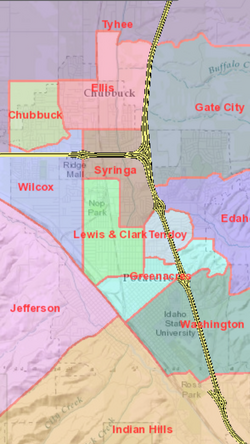
Shoshone and Bannock Indigenous tribes inhabited southeastern Idaho for hundreds of years before the Lewis and Clark Expedition across Idaho in 1805. [6]The expedition's reports of the many riches of the region attracted fur trappers and traders to southeastern Idaho. The city is named after Chief Pocatello, a 19th-century Northern Shoshone leader.
Nathaniel Wyeth of Massachusetts established one of the first permanent settlements at Fort Hall in 1834, which is only a few miles northeast of Pocatello. When over-trapping and a shift in fashion to silk hats put an end to the fur trade, Fort Hall became a supply point for immigrants traveling the Oregon Trail.
Although thousands of immigrants passed through Idaho, it was not until the discovery of gold in 1860 that Idaho attracted settlers in large numbers. The gold rush brought a need for goods and services to many towns, and the Portneuf Valley, home of Pocatello, was the corridor initially used by stage and freight lines. The coming of the railroad provided further development of Idaho's mineral resources and "Pocatello junction" became an important transportation crossroads as the Union Pacific Railroad expanded its service.
After its founding in 1889, Pocatello became known as the "Gate City"[7] for being a gateway to Idaho and the Pacific Northwest. As pioneers, gold miners and settlers traveled the Oregon Trail, they passed through the Portneuf Gap south of town. Stage and freight lines and the railroad soon followed, turning the community into a trade center and transportation junction.
Advertisement of Pocatello for homesteaders in the Sunset Travel Bureau of Information, April 1910.
After the gold rush played out, the settlers who remained turned to agriculture. With the help of irrigation from the nearby Snake River, the region became a large supplier of potatoes, grain and other crops. Residential and commercial development gradually appeared by 1882.
The adjacent city of Alameda was consolidated into Pocatello in 1962,[8][9]Chubbuck, further north, opposed a similar merger and remained a separate municipality.[9] In the 1960 census, Alameda had a population of 10,660 and Pocatello was at 28,534; the consolidation made Pocatello the state's largest city based on those numbers, passing Boise and Idaho Falls.[8][9]
Pocatello's original city logo, considered to be the worst city flag in North America
The Pocatello flag used from 2001 to 2017 was considered by the North American Vexillological Association to be the worst city flag in North America.[10] In April 2016, the city's newly created flag design committee met for the first time. Attending the meeting was Roman Mars – whose 2015 TED Talk made Pocatello's flag infamous.[11] On July 20, 2017, after a year and a half of work by the flag committee, the Pocatello City Council approved the adoption of a new flag with the informal name of "Mountains Left" out of a total of 709 designs.[12][13][14]
According to the United States Census Bureau, the city has a total area of 33.36 square miles (86.40 km2), of which 32.22 square miles (83.45 km2) is land and 0.16 square miles (0.41 km2) is water.[15][16]
A main water feature of Pocatello is the Portneuf River, which runs southeast to northwest on the western side of the city. Since 1992, the city and the Portneuf Greenway Foundation [1] have worked to create a system of trails that follow the river and connect to other trails in the greater Portneuf Valley. Currently, 15+ miles of trails have been constructed with 27 planned total miles.
According to the Köppen Climate Classification system, Pocatello has a warm-summer humid continental climate, abbreviated "Dfb" on climate maps. The hottest temperature recorded in Pocatello was 104 °F (40 °C) on August 2, 1969, August 8, 1990, July 22, 2000, and July 31, 2020, while the coldest temperature recorded was −33 °F (−36 °C) on February 1, 1985.[17]
Climate data for Pocatello, Idaho (Pocatello Regional Airport), 1991–2020 normals, extremes 1939–present
The 2020 census showed Pocatello's population to be 56,320, an increase of 3.73% from the 2010 census.[16] There were 21,277 households, and the population density was 1,688.1 inhabitants per square mile.
The Federal Bureau of Investigation is building a data center in Pocatello as part of an initiative to consolidate operations into three enterprise data centers.[24]
Idaho State University's L.E. and Thelma E. Stephens Performing Arts Center is the largest such complex in Pocatello and hosts dance, theater, music, and other entertainment events. The grand concert hall seats up to 1,200 people.
The Westside Players is a non-profit community theatre company that hosts shows at The Warehouse in the Warehouse District of Pocatello.
St. Joseph's Catholic Church Pocatello (built 1897)
Holt Arena, Idaho State University, Pocatello, Idaho
Pocatello is home to Holt Arena, a multipurpose indoor stadium that opened in 1970 on the ISU campus. Known as the "Minidome" until 1988, Holt Arena was the home of the Real Dairy Bowl, a junior college football Bowl game. Holt Arena also plays host to the Simplot Games, the nation's largest indoor high school track-and-field meet.
The Pocatello Marathon and Half Marathon are held annually. Times from the course may be used to qualify for the Boston and New York marathons.[27]
Outdoor sports, both winter and summer, play an important role in the culture of Pocatello. Pebble Creek, Idaho is a ski resort located just south of Pocatello and offers skiing and snowboarding.[28]
Pocatello is also home to a semi-pro baseball team, the Gate City Grays, who are a member of the Northern Utah League. The Grays play in Halliwell Park located at 1100 W. Alameda.[29] They were NUL champions in both 2015 and 2016.
All of the Bannock County portion of Pocatello is served by the Pocatello/Chubbuck School District #25.[30] The district is home to three public high schools, four public middle schools and thirteen public elementary schools.
Additionally, there are two public charter schools, and various alternative and church-based private schools and academies.
Idaho State University (ISU) is a public university operated by the state of Idaho. Originally an auxiliary campus of the University of Idaho and then a state college, it became the second university in the state in 1963. The ISU campus is in Pocatello, with outreach programs in Coeur d'Alene, Idaho Falls, Boise, and Twin Falls. The university's 123,000-square-foot (11,400 m2) L.E. and Thelma E. Stephens Performing Arts Center occupies a prominent location overlooking Pocatello and the lower Portneuf River Valley. The center's three venues provide performance space, including the Joseph C. and Cheryl H. Jensen Grand Concert Hall.
Idaho State's athletics teams compete in the Big Sky Conference, the football and basketball teams play in Holt Arena.
Commercial air service is available via Pocatello Regional Airport. Pocatello Regional Transit provides bus service on five hourly routes, Monday through Saturday. There is currently no evening or Sunday service.
In the Roger Edens - Leonard Gershe song "Born in a Trunk", which featured in the film A Star is Born (1954), the character Esther Blodgett (Judy Garland) sings about being "born in a trunk at the Princess Theater in Pocatello, Idaho".
The Great Food Truck Race Season 4, Episode 3, "Potatoes in Pocatello". Pocatello, Idaho is the location of episode 3 food truck race challenge. Much of the city is shown, as well as the local foot traffic.[39]
^Wrigley, Robert L. “The Early History of Pocatello, Idaho.” The Pacific Northwest Quarterly, vol. 34, no. 4, 1943, pp. 353–65. JSTOR, JSTOR40486626. Accessed 18 Nov. 2023.





.jpg)
.jpg)


.jpg)
,_00.jpg)