


Proctor (Martian crater)
 Viking Orbiter 1 mosaic | |
| Planet | Mars |
|---|---|
| Region | Noachis Terra |
| Coordinates | 48°00′S 330°30′W / 48°S 330.5°W |
| Quadrangle | Noachis |
| Diameter | 172.56 km (107.22 mi) |
| Eponym | Richard A. Proctor |
Proctor is a large crater in the Noachis quadrangle of Mars. It was named in 1973 after Richard A. Proctor, a British astronomer (1837–1888).[1]
Dune fields[edit]
The crater contains a 35 x 65 km dark dune field.[2][3] It was one of the first sand dune fields ever recognized on Mars based on Mariner 9 images.[4] The crater's dunes are being monitored by HiRISE to identify changes over time.[5]
-
 Topographical map showing location of Proctor crater and other nearby craters
 -
 Another Viking image of the dunes in Proctor and in nearby craters
 -
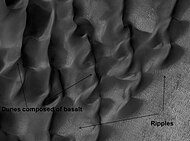 Proctor crater transverse aeolian ridges and Dunes, as seen by HiRISE
 -
 HiRISE image of the crater with transverse aeolian ridges surrounding a large dune
 -
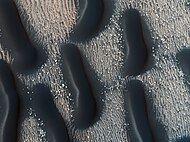 The edge of a dark dune field on the floor of Proctor crater
 -
 Dune field on floor of Proctor crater, as seen by CTX camera on Mars Reconnaissance Orbiter.
 -
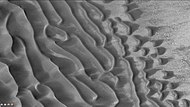 Close-up of dunes on floor of Proctor crater, as seen by CTX camera on Mars Reconnaissance Orbiter. This is an enlargement of part of previous image.


See also[edit]
References[edit]
- ^ "Gazetteer of Planetary Nomenclature | Proctor". usgs.gov. International Astronomical Union. Retrieved 8 March 2024.
- ^ Fenton, L. K. (2005). "Seasonal Movement of Material on Dunes in Proctor Crater, Mars: Possible Present-Day Sand Saltation" (PDF). Lunar and Planetary Science XXXVI (2005).
- ^ Mary Chapman, ed. (2007). The Geology of Mars: Evidence from Earth-Based Analogs. Cambridge University Press. p. 250. ISBN 978-0-521-83292-2.
- ^ "Dune Activity in Proctor Crater". Mars Global Surveyor - Mars Orbiter Camera - MGS MOC Release No. MOC2-170. Malin Space Science Systems. 10 August 1999.
- ^ Bridges, Nathan (9 March 2009). "Sand Dunes and Ripples in Proctor Crater". HiRISE Operations Center.
External links[edit]
 Media related to Proctor (Martian crater) at Wikimedia Commons
- Nemiroff, Robert; Bonnell, Jerry (February 26, 2002). "Sand Dunes on Mars". Astronomy Photo of the Day (APOD).

