


Hellas Planitia
 Viking orbiter image mosaic of Hellas Planitia | |
| Planet | Mars |
|---|---|
| Region | Hellas quadrangle, south of Iapygia |
| Coordinates | 42°24′S 70°30′E / 42.4°S 70.5°E |
| Quadrangle | Hellas |
| Diameter | 2,300 km (1,400 mi) |
| Depth | 7,152 m (23,465 ft) |

Hellas Planitia /ˈhɛləs pləˈnɪʃiə/ is a plain located within the huge, roughly circular impact basin Hellas[a] located in the southern hemisphere of the planet Mars.[3] Hellas is the third- or fourth-largest known impact crater in the Solar System. The basin floor is about 7,152 m (23,465 ft) deep, 3,000 m (9,800 ft) deeper than the Moon's South Pole-Aitken basin, and extends about 2,300 km (1,400 mi) east to west.[4][5] It is centered at 42°24′S 70°30′E / 42.4°S 70.5°E.[3] Hellas Planitia spans the boundary between the Hellas quadrangle and the Noachis quadrangle.
Description[edit]
With a diameter of about 2,300 km (1,400 mi),[6] it is the largest unambiguous impact structure on the planet; the obscured Utopia Planitia is slightly larger (the Borealis Basin, if it proves to be an impact crater, is considerably larger). Hellas Planitia is thought to have been formed during the Late Heavy Bombardment period of the Solar System, approximately 4.1 to 3.8 billion years ago, when a protoplanet or large asteroid hit the surface.[7]
The altitude difference between the rim and the bottom is over 9,000 m (30,000 ft). The crater's depth of 7,152 m (23,465 ft)[1] below the topographic datum of Mars explains the atmospheric pressure at the bottom: 12.4 mbar (1240 Pa or 0.18 psi) during winter, when the air is coldest and reaches its highest density.[b] This is 103% higher than the pressure at the topographical datum (610 Pa, or 6.1 mbar, or 0.09 psi) and above the triple point of water, suggesting that the liquid phase could be present under certain conditions of temperature, pressure, and dissolved salt content.[9] It has been theorized that a combination of glacial action and explosive boiling may be responsible for gully features in the crater.
Some of the low elevation outflow channels extend into Hellas from the volcanic Hadriacus Mons complex to the northeast, two of which Mars Orbiter Camera images show contain gullies: Dao Vallis and Reull Vallis. These gullies are also low enough for liquid water to be transient around Martian noon, if the temperature were to rise above 0 Celsius.[10]
Hellas Planitia is antipodal to Alba Patera.[11][12][13] It and the somewhat smaller Isidis Planitia together are roughly antipodal to the Tharsis Bulge, with its enormous shield volcanoes, while Argyre Planitia is roughly antipodal to Elysium, the other major uplifted region of shield volcanoes on Mars. Whether the shield volcanoes were caused by antipodal impacts like that which produced Hellas, or if it is mere coincidence, is unknown.
-
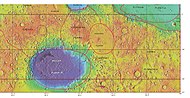 MOLA map showing boundaries of Hellas Planitia and other regions
 -
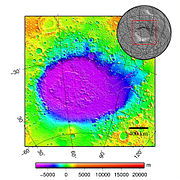 Geographic context of Hellas
 -
 This elevation map shows the surrounding elevated ring of ejecta
 -
 Apparent viscous flow features on the floor of Hellas, as seen by HiRISE.
 -
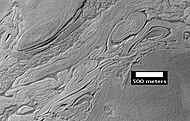 Twisted terrain in Hellas Planitia (actually located in Noachis quadrangle).
 -
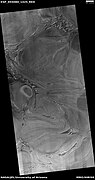 Twisted bands on the floor of Hellas Planitia, as seen by HiRISE under HiWish program
 -
 Twisted bands on the floor of Hellas Planitia, as seen by HiRISE under HiWish program These twisted bands are also called "taffy pull" terrain.


Discovery and naming[edit]
Due to its size and its light coloring, which contrasts with the rest of the planet, Hellas Planitia was one of the first Martian features discovered from Earth by telescope. Before Giovanni Schiaparelli gave it the name Hellas (which in Greek means Greece), it was known as Lockyer Land, having been named by Richard Anthony Proctor in 1867 in honor of Sir Joseph Norman Lockyer, an English astronomer who, using a 16 cm (6.3 in) refractor, produced "the first really truthful representation of the planet" (in the estimation of E. M. Antoniadi).[14]
Possible glaciers[edit]


Radar images by the Mars Reconnaissance Orbiter (MRO) spacecraft's SHARAD radar sounder suggest that features called lobate debris aprons in three craters in the eastern region of Hellas Planitia are actually glaciers of water ice lying buried beneath layers of dirt and rock.[15] The buried ice in these craters as measured by SHARAD is about 250 m (820 ft) thick on the upper crater and about 300 m (980 ft) and 450 m (1,480 ft) on the middle and lower levels respectively. Scientists believe that snow and ice accumulated on higher topography, flowed downhill, and is now protected from sublimation by a layer of rock debris and dust. Furrows and ridges on the surface were caused by deforming ice.
Also, the shapes of many features in Hellas Planitia and other parts of Mars are strongly suggestive of glaciers, as the surface looks as if movement has taken place.
Honeycomb terrain[edit]
These relatively flat-lying "cells" appear to have concentric layers or bands, similar to a honeycomb. This honeycomb terrain was first discovered in the northwestern part of Hellas.[16] The geologic process responsible for creating these features remains unresolved.[17] Some calculations indicate that this formation may have been caused by ice moving up through the ground in this region. The ice layer would have been between 100 m and 1 km thick.[18][19][16] When one substance moves up through another denser substance, it is called a diapir. So, it seems that large masses of ice have pushed up layers of rock into domes that were subsequently eroded. After erosion removed the top of the layered domes, circular features remained.
-
 Honeycomb terrain, as seen by HiRISE under HiWish program
 -
 Close, color view of honeycomb terrain, as seen by HiRISE under HiWish program
 -
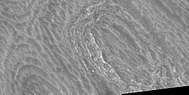 Close view of honeycomb terrain, as seen by HiRISE under HiWish program
 -
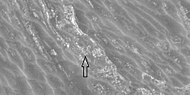 Close view of honeycomb terrain, as seen by HiRISE under HiWish program This enlargement shows material breaking up into blocks. Arrow indicates a cube-shaped block.


-
Twisted bands on the floor of Hellas Planitia, as seen by HiRISE under HiWish program
-
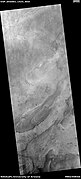 Floor features in Hellas Planitia, as seen by HiRISE under HiWish program
 -
 Floor features in Hellas Planitia, as seen by HiRISE under HiWish program


Layers[edit]
-
 Layers in depression in crater, as seen by HiRISE under HiWish program A special type of sand ripple called Transverse aeolian ridges, TAR's are visible and labeled.
 -
 Wide view of layers, as seen by HiRISE under HiWish program
 -
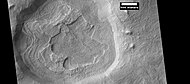 Close view of layered deposit in crater, as seen by HiRISE under HiWish program
 -
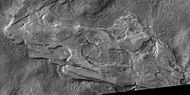 Layered formation, as seen by HiRISE under HiWish program
 -
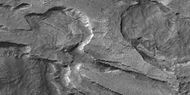 Close view of layers from previous image, as seen by HiRISE under HiWish program


Interactive Mars map[edit]

 Interactive image map of the global topography of Mars. Hover your mouse over the image to see the names of over 60 prominent geographic features, and click to link to them. Coloring of the base map indicates relative elevations, based on data from the Mars Orbiter Laser Altimeter on NASA's Mars Global Surveyor. Whites and browns indicate the highest elevations (+12 to +8 km); followed by pinks and reds (+8 to +3 km); yellow is 0 km; greens and blues are lower elevations (down to −8 km). Axes are latitude and longitude; Polar regions are noted.
In popular culture[edit]
- Hellas Basin was a primary location in the 2017 video game Destiny 2. The location is part of the second game's Warmind downloadable content.
- It is also featured as a main location in the 2016 Bethesda video game reboot Doom.
- In Planet-Size X-Men #1, the X-Men terraform Mars, turning the basin into Lake Hellas and building the Lake Hellas Diplomatic Ring, where galactic ambassadors can meet within the Sol system.
See also[edit]
- Argyre Planitia
- Atmosphere of Mars e.g. pressure at floor of Hellas Planitia
- Dune
- Gale crater
- Geography of Mars
- Glaciers on Mars
- Groundwater on Mars
- List of plains on Mars
- Water on Mars
Notes[edit]
References[edit]
- ^ a b "Martian weather observation". Mars Global Surveyor. Palo Alto, California: Stanford University. Archived from the original on 31 May 2008. MGS radio science measured 11.50 mbar at 34.4° S 59.6° E −7152 meters
- ^ "Hellas". USGS Astrogeology Science Center. Gazetteer of Planetary Nomenclature. United States Geological Survey. Retrieved 10 March 2015.
- ^ a b "Hellas Planitia". Gazetteer of Planetary Nomenclature. USGS Astrogeology Science Center. Retrieved 10 March 2015.
- ^ The part below zero datum, see Geography of Mars#Zero elevation
- ^ "Section 19-12". Goddard Space Flight Center. Remote sensing tutorial. NASA. Archived from the original on 30 October 2004.
- ^ Schultz, Richard A.; Frey, Herbert V. (1990). "A new survey of multi-ring impact basins on Mars". Journal of Geophysical Research. 95: 14175. Bibcode:1990JGR....9514175S. doi:10.1029/JB095iB09p14175.
- ^ Acuña, M. H.; et al. (1999). "Global Distribution of Crustal Magnetization Discovered by the Mars Global Surveyor MAG/ER Experiment". Science. 284 (5415): 790–793. Bibcode:1999Sci...284..790A. doi:10.1126/science.284.5415.790. PMID 10221908.
- ^ Haberle, Robert M.; McKay, Christopher P.; Schaeffer, James; Cabrol, Nathalie A.; Grin, Edmon A.; Zent, Aaron P.; Quinn, Richard (25 October 2001). "On the possibility of liquid water on present-day Mars". Journal of Geophysical Research. 106 (EL0): 23, 317–23, 326. Bibcode:2001JGR...10623317H. doi:10.1029/2000JE001360.
- ^ "Making a splash on Mars" (Press release). NASA. 29 June 2000.
- ^ Heldmann, Jennifer L.; et al. (2005). "Formation of Martian gullies by the action of liquid water flowing under current Martian environmental conditions". Journal of Geophysical Research. 110: E05004. CiteSeerX 10.1.1.596.4087. doi:10.1029/2004JE002261. S2CID 1578727. – page 2, para 3: Martian Gullies Mars#References
- ^ Peterson, J. E. (March 1978). "Antipodal Effects of Major Basin-Forming Impacts on Mars". Lunar and Planetary Science. IX: 885–886. Bibcode:1978LPI.....9..885P.
- ^ Williams, D.A.; Greeley, R. (1991). "The Formation of Antipodal-Impact Terrains on Mars" (PDF). Lunar and Planetary Science. XXII: 1505–1506. Retrieved 4 July 2012.
- ^ Williams, D.A.; Greeley, R. (August 1994). "Assessment of Antipodal-Impact Terrains on Mars". Icarus. 110 (2): 196–202. Bibcode:1994Icar..110..196W. doi:10.1006/icar.1994.1116.
- ^ Sheehan, William (1996). The Planet Mars: A history of observation and discovery. Tucson, AZ: University of Arizona Press. Chapter 4. ISBN 9780816516414. Retrieved 19 February 2021.
- ^ "PIA11433: Three craters". NASA. Retrieved 24 November 2008.
- ^ a b Bernhardt, H.; et al. (2016). "The honeycomb terrain on the Hellas basin floor, Mars: A case for salt or ice diapirism: Hellas honeycombs as salt / ice diapirs". J. Geophys. Res. 121 (4): 714–738. Bibcode:2016JGRE..121..714B. doi:10.1002/2016je005007.
- ^ "HiRISE | to Great Depths (ESP_049330_1425)".
- ^ Weiss, D.; Head, J. (2017). "Hydrology of the Hellas basin and the early Mars climate: Was the honeycomb terrain formed by salt or ice diapirism?". Lunar and Planetary Science. XLVIII: 1060.
- ^ Weiss, D.; Head, J. (2017). "Salt or ice diapirism origin for the honeycomb terrain in Hellas basin, Mars?: Implications for the early martian climate". Icarus. 284: 249–263. Bibcode:2017Icar..284..249W. doi:10.1016/j.icarus.2016.11.016.
Further reading[edit]
- Antoniadi, E.M. (July 1897). "The hourglass sea on Mars". Knowledge. pp. 169–172.
- Grotzinger, J.; Milliken, R., eds. (2012). Sedimentary Geology of Mars. SEPM.
- Lockyer, J.N. (1863). "Observations on the planet Mars". Monthly Notices of the Royal Astronomical Society (abstract). 23: 246. Bibcode:1863MNRAS..23..246L. doi:10.1093/mnras/23.8.246.
External links[edit]

- Ravenscroft, Peter (16 August 2000). "The Hellas of catastroph". Space Daily.
- "Mars scrollable map". – centered on Hellas
- Secosky, Jim. Martian ice (video lecture). 16th Annual International Mars Society Convention. Archived from the original on 21 December 2021 – via YouTube.
- Cabrol, Nathalie. Lakes on Mars (video lecture). SETI Talks. Archived from the original on 21 December 2021 – via YouTube.


| Authority control databases: National |
|---|
