


Smilax ornata
| Smilax ornata | |
|---|---|

| |
Scientific classification 
| |
| Kingdom: | Plantae |
| Clade: | Tracheophytes |
| Clade: | Angiosperms |
| Clade: | Monocots |
| Order: | Liliales |
| Family: | Smilacaceae |
| Genus: | Smilax |
| Species: | S. ornata
|
| Binomial name | |
| Smilax ornata | |
| Synonyms[2] | |
| |
Smilax ornata is a perennial trailing vine with prickly stems that is native to Mexico and Central America.[3] Common names include sarsaparilla,[4] Honduran sarsaparilla,[4] and Jamaican sarsaparilla.[4]
It is known in Spanish as zarzaparrilla, which is derived from the words zarza meaning "bramble" (from Basque sartzia "bramble"), and parrilla, meaning "little grape vine".[5][6][7][8][9]
Uses[edit]
Food[edit]
Smilax ornata is used as the basis for a soft drink frequently called sarsaparilla. It is also a primary ingredient in old fashioned-style licorice,[10] in conjunction with sassafras,[11] which was more widely available prior to studies of its potential health risks.[12]
Traditional medicine[edit]
Smilax ornata was considered by Native Americans to have medicinal properties, and was a popular European treatment for syphilis when it was introduced from the New World.[13] From 1820 to 1910, it was registered in the U.S. Pharmacopoeia as a treatment for syphilis.[citation needed]
Chemical constituents gallery[edit]
-
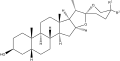 Triterpenes, a constituent of sarsaparilla
 -
 Sarsaparilloside, a constituent of sarsaparilla
 -
 Sarsaparilla R1, a constituent of sarsaparilla
 -
 Sarsaparilla R2, a constituent of sarsaparilla
 -
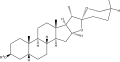 Parillin, a constituent of sarsaparilla


See also[edit]
- Hemidesmus indicus, Indian sarsaparilla
- Aralia nudicaulis, wild sarsaparilla or false sarsaparilla
- Sweet sarsaparilla (Smilax glyciphylla), a vine native to eastern Australia[14]
References[edit]
- ^ "Tropicos.org". Retrieved 11 August 2014.
- ^ "The Plant List: A Working List of All Plant Species". Retrieved 12 August 2014.
- ^ Kew World Checklist of Selected Plant Families
- ^ a b c "Smilax regelii". Germplasm Resources Information Network. Agricultural Research Service, United States Department of Agriculture. Retrieved 11 August 2014.
- ^ Sarsaparilla
- ^ Davidse, G. & al. (eds.) (1994). Flora Mesoamericana 6: 1–543. Universidad Nacional Autónoma de México, México, D.F.
- ^ Balick, M.J., Nee, M.H. & Atha, D.E. (2000). Checklist of the Vascular Plants of Belize with Common Names an Uses: 1-246. New York Botanic Garden Press, New York.
- ^ Espejo Serena, A. & López-Ferrari, A.R. (2000). Las Monocotiledóneas Mexicanas una Sinopsis Florística 1(9-11): 1–337. Consejo Nacional de la Flora de México, México D.F.
- ^ Nelson Sutherland, C.H. (2008). Catálogo de las plantes vasculares de Honduras. Espermatofitas: 1-1576. SERNA/Guaymuras, Tegucigalpa, Honduras.
- ^ Encyclopædia Britannica. "sarsaparilla (flavouring) – Britannica Online Encyclopedia". Britannica.com. Retrieved 15 July 2010.
- ^ Era, P (1893). The era formulary: 5000 formulas for druggists. A collection of original and prize formulas, to which has been added a selection of formulas from standard authorities in the English, French and German ... D. O. Haynes & company. p. 400. ISBN 978-1-145-42702-0.
- ^ Dietz, B; Bolton, Jl (April 2007). "Botanical Dietary Supplements Gone Bad". Chemical Research in Toxicology. 20 (4): 586–90. doi:10.1021/tx7000527. ISSN 0893-228X. PMC 2504026. PMID 17362034.
- ^ Wilson, H. (22 April 1843). "Sarsaparilla in Syphilis". Provincial Medical Journal and Retrospect of the Medical Sciences. 6 (134): 71. doi:10.1136/bmj.s1-6.134.71. PMC 2557820. PMID 21379157.
- ^ "PlantNET – FloraOnline". Plantnet.rbgsyd.nsw.gov.au. Retrieved 15 July 2010.
External links[edit]

- Whatever happened to the soft drink sarsaparilla? Cecil Adams, 1977