


Lavandula angustifolia
| Lavandula angustifolia | |
|---|---|

| |
| Common lavender (Lavandula angustifolia) | |
Scientific classification 
| |
| Kingdom: | Plantae |
| Clade: | Tracheophytes |
| Clade: | Angiosperms |
| Clade: | Eudicots |
| Clade: | Asterids |
| Order: | Lamiales |
| Family: | Lamiaceae |
| Genus: | Lavandula |
| Species: | L. angustifolia
|
| Binomial name | |
| Lavandula angustifolia | |
| Synonyms[1] | |
Lavandula angustifolia, formerly L. officinalis, is a flowering plant in the family Lamiaceae, native to the Mediterranean (Spain, France, Italy, Croatia etc.). Its common names include lavender, true lavender and English lavender[2] (though not native to England); also garden lavender,[3] common lavender and narrow-leaved lavender.
Description[edit]
It is a strongly aromatic shrub growing as high as 1 to 2 metres (3+1⁄2 to 6+1⁄2 ft) tall. The leaves are evergreen, 2–6 centimetres (1–2+1⁄2 inches) long, and 4–6 millimetres (3⁄16–1⁄4 in) broad. The flowers are pinkish-purple (lavender-coloured), produced on spikes 2–8 cm (1–3 in) long at the top of slender, leafless stems 10–30 cm (4–12 in) long.
-
 Stems and flowers
 -
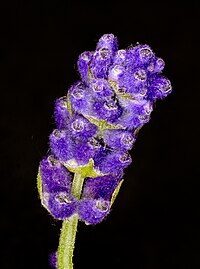 Flower spike before the petals emerge
 -
 Calyx (purple) and flower bracts (light brown)
 -
 Calyx and corolla
 -
 Corolla (petals)
 -
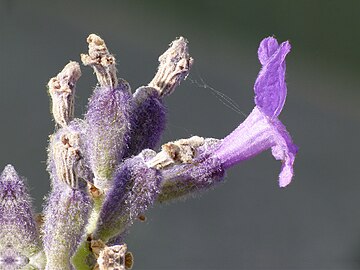 Calyx and corolla (side view)


Etymology[edit]
The species name angustifolia is Latin for "narrow leaf". Previously, it was known as Lavandula officinalis, referring to its medicinal properties.
Cultivation[edit]
English lavender is commonly grown as an ornamental plant. It is popular for its colourful flowers, its fragrance, and its ability to survive with low water consumption. It does not grow well in continuously damp soil and may benefit from increased drainage provided by inorganic mulches such as gravel. It does best in Mediterranean climates similar to its native habitat, characterised by wet winters and dry summers. It is fairly tolerant of low temperatures and is generally considered hardy to Royal Horticultural Society zone H6, or USDA zone 5.[4] It tolerates acid soils but favours neutral to alkaline soils, and in some conditions it may be short-lived.[5]
Cultivars[edit]
AGM cultivars[edit]
The following cultivars of L. angustifolia and its hybrids have gained the Royal Horticultural Society's Award of Garden Merit:-[6]
- L. × intermedia 'Alba'[7] (large white)
- L. angustifolia 'Beechwood Blue' [8]
- L. angustifolia 'Hidcote' [9]
- L. × intermedia 'Hidcote Giant' [10]
- L. angustifolia 'Imperial Gem' [11]
- L. angustifolia Little Lottie='Clarmo'[12]
- L. angustifolia 'Miss Katherine' [13]
- L. angustifolia Miss Muffet='Scholmis'[14]
- L. angustifolia 'Nana Alba'[15] (dwarf white)
- L. × intermedia Olympia='Downoly' [16]
- L × chaytoriae 'Richard Gray'[17]
- L. × chaytoriae 'Sawyers'[18]
- L. × intermedia 'Sussex'[19]
Dwarf cultivars[edit]
Compacta, Folgate, Dwarf Blue, Dwarf White, Hidcote Pink, Hidcote Superior, Munstead, Nana Atropurpurea, Nana Rosea, Sarah, Summerland Supreme, Lady Lavender
- 'Hidcote Superior', a compact evergreen shrub 40 cm × 45 cm (16 in × 18 in) with fragrant gray-green foliage and deep violet-blue flowers in summer, prefers full sun, well drained soil, low water, hardy to −30 °C (−20 °F), western Mediterranean species
- 'Munstead' (syn. Dwarf Munstead, Munstead Blue and Munstead Variety) L. angustifolia variety, 30 cm (12 in) tall, having pink-purple to lavender-blue inflorescences that are slightly fragrant,[20] named after Munstead Wood in Surrey, which was the home of Gertrude Jekyll
- 'Sarah', grows to 15–60 cm (6–24 in), the flowers are petite, as is the plant, used as a short edging, or as a very fragrant addition to the window box, dark violet flowers
- 'Lady Lavender', grows to 45 cm (18 in), fragrant, gray-green foliage and lavender-blue flowers in summer, prefers full sun, well-drained soil, low water, hardy to −30 °C (–20 °F)
Semi-dwarf cultivars[edit]
Bowles Early, Hidcote Variety, Loddon Blue, Martha Roderick, Jean Davis, Twickle Purple, Pink Perfume
- 'Hidcote' (syn. Hidcote Variety, Hidcote Blue, Hidcote Purple) L. angustifolia variety. 40 to 50 cm (15 in to 20 in) tall, with silver-gray foliage and deep violet-blue inflorescences, named after Hidcote Manor in England as it was cultivated there by Lawrence Johnston
- 'Jean Davis' 50–60 cm (20–24 in) tall, up to 1 m (3 ft). A pale pink flowered lavender with exceptionally fruity taste
- 'Pink Perfume' 60 cm × 45 cm (24 in × 18 in)
Giant cultivars[edit]
Alba, Backhouse Purple, Biostos, Bridestowe, Graves, Gray Lady, Gwendolyn Anley, Hidcote Giant, Irene Doyle, Mailette, Middachten
- 'Hidcote Giant'. A Lavandula × intermedia lavandin. Very vigorous grower (90 to 100 cm; 36–40 in) with a lovely strong fragrance. This has large deep lavender-purple flowers on very long 60 cm (24 in) stems.
- 'Vera' 75 to 90 cm (30–36 in). Thought to be the original species lavender, harvested for its oil.
Uses[edit]

The flowers and leaves are used as a herbal medicine,[21] either in the form of lavender oil or as a herbal tea, to alleviate symptoms such as anxiety,[22] and difficulty falling asleep.
The flowers are also used as a culinary herb, most often as part of the North American version of the French herb blend called herbes de Provence.
Lavender essential oil, when diluted with a carrier oil, is commonly used as a relaxant with massage therapy. Products for home use, such as lotions, eye pillows (including lavender flowers or the essential oil itself) and bath oils, etc., are also used. Both the petals and the oil are the most popular ingredients in handmade soap.
Dried lavender flowers and lavender essential oil are also used as a prevention against clothing moths, which do not like their scent.[citation needed]
Lavandula angustifolia is included in the Tasmanian Fire Service's list of low flammability plants, indicating that it is suitable for growing within a building protection zone.[23]
Subspecies[edit]
Hybrids[edit]
Lavandula hybrids are referred to as lavandins. Hybrids between L. angustifolia and L. latifolia (spike lavender) are called Lavandula × intermedia. They bloom later than the ordinary English lavenders.
See also[edit]
References[edit]
- ^ a b c d "Lavandula angustifolia". Germplasm Resources Information Network. Agricultural Research Service, United States Department of Agriculture. Retrieved 2008-04-12.
- ^ USDA, NRCS (n.d.). "Lavandula angustifolia". The PLANTS Database (plants.usda.gov). Greensboro, North Carolina: National Plant Data Team. Retrieved 23 January 2016.
- ^ BSBI List 2007 (xls). Botanical Society of Britain and Ireland. Archived from the original (xls) on 2015-06-26. Retrieved 2014-10-17.
- ^ USDA Plant Hardiness Zone Map Archived 2012-07-04 at the Wayback Machine. Retrieved on 2008-05-22.
- ^ RHS A-Z encyclopedia of garden plants. United Kingdom: Dorling Kindersley. 2008. p. 1136. ISBN 978-1405332965.
- ^ "AGM Plants - Ornamental" (PDF). Royal Horticultural Society. July 2017. p. 59. Retrieved 19 March 2018.
- ^ "RHS Plant Selector - Lavandula × intermedia 'Alba'". Royal Horticultural Society. Retrieved 1 October 2020.
- ^ "Lavandula angustifolia 'Beechwood Blue'". RHS. Retrieved 1 October 2020.
- ^ "Lavandula angustifolia 'Hidcote'". RHS. Retrieved 1 October 2020.
- ^ "Lavandula × inermedia 'Hidcote Giant'". RHS. Retrieved 1 October 2020.
- ^ "Lavandula angustifolia 'Imperial Gem'". RHS. Retrieved 1 October 2020.
- ^ "RHS Plantfinder - Lavandula angustifolia Little Lottie = 'Clarmo'". Retrieved 19 March 2018.
- ^ "Lavandula angustifolia 'Miss Katherine'". RHS. Retrieved 1 October 2020.
- ^ "RHS Plantfinder - Lavandula angustifolia Miss Muffet = 'Scholmis'". Retrieved 19 March 2018.
- ^ "RHS Plant Selector - Lavandula angustifolia 'Nana Alba'". Royal Horticultural Society. Retrieved 1 October 2020.
- ^ "Lavandula × intermedia Olympia='Downoly'". RHS. Retrieved 1 October 2020.
- ^ "RHS Plant Selector - Lavandula × chaytoriae 'Richard Gray'". Royal Horticultural Society. Retrieved 1 October 2020.
- ^ "RHS Plant Selector - Lavandula × chaytoriae 'Sawyers'". Royal Horticultural Society. Retrieved 1 October 2020.
- ^ "RHS Plant Selector - Lavandula × intermedia 'Sussex'". Royal Horticultural Society. Retrieved 1 October 2020.
- ^ Ohio State University: Lavandula Archived 2010-07-15 at the Wayback Machine
- ^ "Plants for a Future- Lavandula angustifolia - Mill". www.pfaf.org, Plants for a Future. Retrieved 22 November 2020.
- ^ Kasper, Siegfried; Gastpar, Markus; Müller, Walter E.; Volz, Hans-Peter; Möller, Hans-Jürgen; Schläfke, Sandra; Dienel, Angelika (2014-06-01). "Lavender oil preparation Silexan is effective in generalized anxiety disorder – a randomized, double-blind comparison to placebo and paroxetine". International Journal of Neuropsychopharmacology. 17 (6): 859–869. doi:10.1017/S1461145714000017. ISSN 1461-1457. PMID 24456909.
- ^ Chladil and Sheridan, Mark and Jennifer. "Fire retardant garden plants for the urban fringe and rural areas" (PDF). www.fire.tas.gov.au. Tasmanian Fire Research Fund.
External links[edit]


| Authority control databases: National |
|---|
