


British Rail Class 43 (HST)
 | This article needs additional citations for verification. (February 2011) |
| British Rail Class 43 (HST) | |||||||||||||||||||||||||||||||||||||||
|---|---|---|---|---|---|---|---|---|---|---|---|---|---|---|---|---|---|---|---|---|---|---|---|---|---|---|---|---|---|---|---|---|---|---|---|---|---|---|---|
 Power car 43002 Sir Kenneth Grange in May 2016 | |||||||||||||||||||||||||||||||||||||||
| |||||||||||||||||||||||||||||||||||||||
| |||||||||||||||||||||||||||||||||||||||
| |||||||||||||||||||||||||||||||||||||||
| |||||||||||||||||||||||||||||||||||||||
The British Rail Class 43 (HST) is the TOPS classification used for the InterCity 125 High Speed Train (formerly Classes 253 and 254) diesel-electric power cars, built by British Rail Engineering Limited from 1975 to 1982, and in service in the UK since 1976.
The class is officially the fastest diesel locomotive in the world, with an absolute maximum speed of 148.5 mph (239.0 km/h), and a regular service speed of 125 mph (201 km/h). The record run was led by 43102 (43302) and trailed by 43159.[3][4]
History and background
[edit]In the early 1970s, the British Railways Board made the decision to replace its main-line express diesel traction. Financial limitations were tight, so mass electrification was not possible. As a result, a new generation of high-speed diesel trains had to be developed.
Experience with the high-speed Class 55 Deltic locomotives had shown that a low axle weight was essential to avoid damage to the track at sustained high speed, and that high-speed engines were the only way to provide a good enough power-to-weight ratio for diesels. To power the HST at up to 125 mph (201 km/h), each power car had a new diesel engine, the 12-cylinder Paxman Valenta, running at 1,500 rpm and developing 2,250 bhp (1,680 kW). The 70-tonne weight of the power car gave it a 17.5-tonne axle loading.
Development and design
[edit]Prototype
[edit]
The prototype set was developed at the Railway Technical Centre, Derby, the power cars having been constructed by British Rail Engineering Limited's (BREL) Crewe Works and the British Rail Mark 3 passenger cars by BREL's Derby Litchurch Lane Works. The engine used in the prototype power cars was the Paxman 'Valenta' 12RP200L, which developed 2,250 horsepower (1,680 kW). The electrical equipment was supplied by Brush. The power cars had a main driver's position at one aerodynamically shaped end with the other flat and gangwayed end having only an auxiliary driving position for shunting purposes.
The two prototype power cars emerged from the works in June and August 1972 and were initially numbered 41001 and 41002, but after a short period the entire set, including the passenger coaches, became reclassified as a diesel-electric multiple unit: British Rail Class 252. The power cars were given the coaching stock numbers 43000 and 43001. After proving trials on the Eastern Region the prototype High Speed Diesel Train (HSDT) was transferred to the Western Region, where it was deployed on Paddington – Bristol – Weston-super-Mare services.
Production series
[edit]
The design was successful and led to production orders being placed for similar trains for the Western, Eastern, Scottish and London Midland regions. The production power cars featured a redesigned front end without conventional buffers, although a rigid drawbar can be used to connect an HST to an ordinary locomotive. Following the introduction of production HST sets, the prototype unit was withdrawn, the power cars passing to the Research Division at Derby. Of the ten prototype coaches, two were adapted for use in the Royal Train,[5] five were modified for use with the production HSTs,[6] and three were transferred to Departmental stock.[7]
The 197 power cars produced are numbered 43002-43198. 43001 was applied to the second of the two prototype power cars, while the first of the pair (now preserved at the NRM; formerly operational on the GCR) became 43000, which is unusual because BR TOPS classification numbered its locomotives from 001 upwards (this was because it was not, at the time, classified as a locomotive).
Buffered units
[edit] | This article needs additional citations for verification. (May 2013) |

In 1987, as electrification of the East Coast Main Line was under way, British Rail realised that the new Mark 4 carriages for the Class 89 and Class 91 locomotives were not going to be finished in time for the introduction of electric services on the East Coast Main Line so, in late 1987, a total of eight Eastern Region power car conversions were carried out at the Derby Engineering Development Unit, whilst the other six were converted by the diesel repair shop at Stratford to have the lower valancing removed and buffers fitted.
After being fitted with buffers, these power cars began work as surrogate DVTs to work with the Class 91s and 89. The locomotives, working with conventional Mark 3 stock, worked on the line between 1987 and 1991, when the last Class 91 locomotives entered service. As well as buffers being fitted to these power cars, special remote control equipment was also added to the locomotives so they could be controlled by the locomotive at the front. Once these locomotives left DVT duties, the remote equipment was removed.
After privatisation, these power cars joined the Virgin Trains fleet working both Virgin CrossCountry and Virgin Trains West Coast routes, where they displaced loco-hauled stock. All the units were repainted from their original InterCity colours to the Virgin red livery. Later, Virgin Trains withdrew the HSTs when new Class 220 and 221 units were delivered, and nearly all of these power cars went into storage at Long Marston.
After years of storage, several of the power cars were bought by Midland Mainline to be part of Project Rio, special services running from London St Pancras to Manchester while major engineering works were undertaken on the West Coast Main Line. These units were kept in the de-branded Virgin Trains livery throughout their time with Midland Mainline and put back in storage once Project Rio had finished in 2006.
Two units joined Network Rail's New Measurement Train in 2003 and have continued to work with this service ever since. Both of these units have now had MTU engines fitted.
One unit was leased to GNER as a one-off power car, working as a spare unit that could be easily called for if an HST failed. For most of its time with GNER, it was based at Craigentinny yard in Edinburgh and was painted into GNER colours. This locomotive's lease ended in 2006 and it was returned to storage at Long Marston.
In 2007, Grand Central took an interest in the stored power cars and amalgamated them into its fleet of three HST sets. In total, six were bought by the company and ran high-speed services between Sunderland and London Kings Cross. Two were the final operational Paxman Valenta power cars, being re-engined in 2010 with the MTU treatment. While at the works being re-engined, Grand Central added the orange stripe that appears on its Class 180 units, re-painted the front ends (making them look more like the non-buffered HSTs), and re-numbered the power cars into the four-hundreds. They were withdrawn from Grand Central service in 2017 after more Class 180s were acquired.[8]
Engines
[edit].JPG)
British Rail experimented with Mirrlees Blackstone MB190 engines in four Western region examples (43167–43170) between 1987 and 1996, but this experiment was unsuccessful and the standard Paxman Valenta engines re-installed.
Paxman began development of the Valenta's successor, the Paxman VP185, in 1987. The suggestion that British Rail participate in a trial of the new VP185 engine in the IC125 was first mooted in January 1991, and a formal agreement for the trial was signed in May 1993.[9]
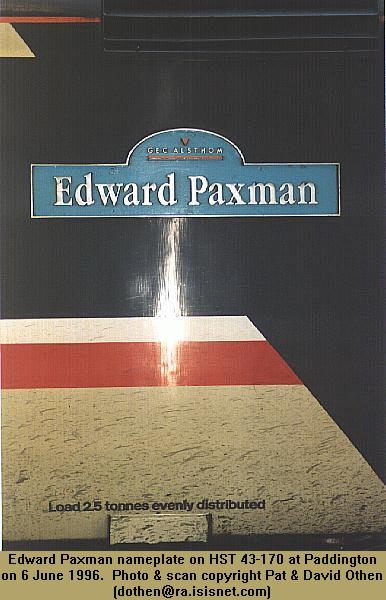
A qualifying requirement for the trial was that the engine should undergo a British Rail Type Test which was carried out between December 1993 and February 1994.[9] The test involved completion of 3,000 cycles, each of 10 minutes duration, with four minutes at the maximum power of 2,611 kW (3,501 bhp) and six minutes at idle, simulating the typical 'on-off' nature of IC125 duty. The test was much more severe than operational duty, where the train operates at a maximum of 1,678 kW (2,250 bhp). The successful results of the test cleared the way for installation of a VP185 in Power Car 43170 at Plymouth Laira Depot for in-service trials in the summer of 1994. Power car 43170 entered service on 22 September 1994.[9] 43170 was given the nameplate "Edward Paxman".[10]
During the late 1990s twenty-five HST power cars were re-engined with Paxman VP185 engines in order to improve fuel consumption and reduce emissions.
The last VP185 engine to be manufactured at Paxman's Colchester Works was despatched from the factory on 15 September 2003 as part of a programme to convert 14 Midland Mainline power cars to VP185 engines to supplement the four already converted during 1994/95, and this led to 43043/045/048-050/052/055/060/061/072/073/076/082 joining 43047/059/074/075 with this engine type.[11]
Today there are no production power cars fitted with a Paxman Valenta engine, although the 125 Group have reinstalled a Paxman Valenta in the surviving prototype power car, 41001 (formerly 43000). The 125 group are also in the process of reinstalling a Valenta into 43044 for preservation.[12]
Diesel-battery hybrid trial
[edit]In 2007, Brush Traction and Hitachi equipped Paxman Valenta powered 43089 and a semi-permanently coupled Mark 3 coach with a diesel-battery hybrid power system for experimental trials. The power car was named "Hayabusa" (Hayabusa, はやぶさ, Japanese for Peregrine falcon, project name 'V-Train 2').[13][14][15] It returned to normal service with East Midlands Trains.
Life extension
[edit]The HST fleet, having been in operation since the late 1970s, has been largely replaced by the Intercity Express Programme.
- During 2005, two Class 43 power cars (43004 and 43009) operated by First Great Western were fitted with new MTU V16 4000 engines before being tested in passenger operation on the Great Western Line. In December 2005, First announced that all its power cars would receive the MTU engine. The MTU engine offers improvements over the existing Paxman 12RP200 'Valenta' engines, with reduced noise, smoke and exhaust emissions, improved reliability and fuel efficiency.[16]
- East Coast also re-engined its fleet with MTU engines, a process begun under its predecessor GNER. East Coast's fleet of re-engined power cars have been renumbered into the 432xx and 433xx series by adding 200 to the existing power car number.
- East Midlands Trains stated that it would install Paxman VP185 engines in all its power cars before the end of its franchise. It has since completed this operation, though the re-engined power cars retain their original numbers
- Grand Central had fitted their HST fleet with MTU engines, with the first pair entering service on 21 September 2010; they have also been repainted with an orange stripe to match Grand Central's Class 180s.[17] 43123 was the final Valenta power car; it now carries a plaque reading "Valenta 1972-2010". The final passenger service of a Valenta engined power car was on 19 December 2010. On 22 December 2010 the Valenta was used in four farewell tours between York and Sunderland using 43123. All power cars have been re-engined by Brush Traction, Loughborough, and have been renumbered in the 43/4 range.
- CrossCountry's first CrossCountry-liveried HST power car, 43301 (formerly 43101) was released from its overhaul at Brush Traction, Loughborough on 16 July 2008. CrossCountry also renumbered all its HST units by adding 200 to the old number.
- In 2003, Network Rail's launched its New Measurement Train, a specially converted InterCity 125 set. Its yellow livery has earned it the nickname "The Flying Banana".[citation needed]
Operations
[edit]
.jpg)
When Crewe Works built them, the InterCity 125 units were considered to be diesel multiple units, and were allocated Classes 253 and 254 for Western and Eastern Region services respectively. The locomotives were introduced in the Midland region later.
Until the HST's introduction, the maximum speed of British trains was limited to 100 mph (160 km/h). The increased speed and rapid acceleration and deceleration of the HST made it ideal for passenger use, and it slashed journey times around the country. The prototype InterCity 125 (power cars 43000 and 43001) set the world record for diesel traction at 143 mph (230 km/h) on 12 June 1973. An HST also holds the world speed record for a diesel train carrying passengers. On 27 September 1985, a special press run for the launch of a new Tees-Tyne Pullman service from Newcastle to London King's Cross, formed of a shortened 2+5 set, briefly touched 144 mph (232 km/h) north of York.
During 1987, eight HST power cars were converted for use as driving van trailers (DVTs) with Class 91 locomotives during trials on the East Coast Main Line. The power cars were fitted with buffers and time-division multiplex equipment that allowed them to directly control a Class 91, and were moved over to the ECML where they were used on workings with Class 89 and then Class 91 locomotives from London to Leeds. After the Mk 4 stock had been delivered, the HST power cars had the TDM equipment removed, and then reverted to their normal duties. The power cars used for this project can be easily identified as they are still fitted with buffers. They were then transferred to Virgin Cross Country, and put in storage when Virgin replaced its HST fleet with Bombardier Voyagers (though Arriva, upon later taking over the franchise, acquired ten power cars, four of which were buffered). Grand Central bought six of these for services from Sunderland to London, the remaining two having been integrated into Network Rail's New Measurement Train.
After the privatisation of British Rail the HST sets continued to be used. 193 of the 197 locomotives built remained in service, five power cars, 43173, 43011, 43019, 43140 and 43030, having been written off by fatal rail accidents in 1997, 1999, 2004 and 2020 respectively.

In 2018-19, Great Western Railway and London North Eastern Railway replaced their HST-worked services with ones operated by Class 800/801/802s. LNER retained none of its HSTs; GWR retained 24 power cars to form 11 four-carriage formations known as "Castle Class" sets for use on local services between Cardiff and Penzance, which had not been worked by HSTs before.[18]
Twenty-seven sets each with four or five carriages moved from Great Western Railway to Abellio ScotRail and were refurbished with controlled emission tanks and plug automatic doors. These operate on services between either Edinburgh or Glasgow and either Aberdeen or Inverness.[19][20][21][22] The first two were delivered to Craigentinny TMD for crew training in September 2017.[23] The first entered service in October 2018.[24]
Future
[edit]GB Railfreight have expressed interest in the possibility of converting displaced HST sets for use carrying parcels and other mail.[25]
In 2021, RailAdventure acquired the six 43/4 power cars, plus an additional two for spares, for use on stock movements as part of its entrance into the UK market through the acquisition of Hanson and Hall Rail Services.[26][27] Two were moved to Germany for display at a trade show in September 2021.[28] They returned in November 2021.[29]
On 25 November 2022, GWR announced it would be retiring their 'Castle' fleet. The withdrawals are expected to take place over a two-year period.[30]
In early August 2023, three power cars and 11 Mark 3 coaches were exported to Mexico for use on the Tren Interoceánico.[31][32][33] They arrived in early September 2023.[34]
Fleet details
[edit]| Status/Operator | Image | Qty. | Vehicle nos. |
|---|---|---|---|
| Colas Rail | 
|
8 | 43251, 43257, 43272, 43274, 43277, 43285, 43321, 43357[35] |
| Data Acquisition & Testing Services | 
|
4 | 43050, 43054, 43066, 43076[36] |
| Great Western Railway | 
|
12 | 43004, 43042, 43092–43093, 43097–43098, 43156, 43186–43189, 43198[35] |
| Locomotive Services Limited | 
|
7 | 43046–43047, 43049, 43055, 43058–43059, 43083[37] |
| Network Rail | 
|
5 | 43013–43014, 43062, 43290, 43299[36] |
| RailAdventure | 
|
8 | 43296, 43308, 43423, 43465, 43467-43468, 43480, 43484[36][38] |
| ScotRail | 
|
52 | 43003, 43012, 43015, 43021, 43026, 43028, 43031–43037, 43124–43139, 43141–43152, 43163–43164, 43168–43169, 43175–43177, 43179, 43181–43183[36] |
| Tren Interoceánico | 
|
11 | 43007, 43022, 43158, 43170, 43295, 43303, 43306-43307, 43316, 43320, 43378[39] |
| Exported to Nigeria | 10 | 43008-43010, 43016, 43040, 43172, 43184, 43192, 43239, 43304, 43366[39] | |
| Preserved | 
|
19 | 43002, 43018, 43023, 43025, 43044–43045, 43048, 43056, 43060, 43071, 43073, 43081–43082, 43089, 43159, 43165, 43300, 43302[40][36] |
| Stored | 37 | 43017, 43020, 43024, 43027, 43029, 43063, 43088, 43091, 43094, 43122, 43153-43155 43160–43162, 43174, 43185, 43190–43191, 43194, 43206, 43238, 43305, 43309-43312, 43314–43320, 43367,[35][40] | |
| Scrapped | 26 | 43005, 43011, 43019, 43030, 43041, 43043, 43052-43053, 43061, 43064, 43069–43070, 43075, 43078–43079, 43086–43087, 43140, 43170-43171, 43173, 43180, 43193, 43195–43197, 43313[35][40] | |
Fortieth anniversary
[edit]_43185.JPG)
On 2 May 2016 an open day was held at Bristol St Philip's Marsh depot with a line up of Class 43s from each operator (except CrossCountry) to celebrate the HST's fortieth anniversary. Several locomotives and passenger trains also appeared, such as 150 247 and 166 214 both in their new GWR liveries, 158 798 in its Springboard Opportunity Group livery and the prototype Class 41 HST. At the event, power car 43002 (Numbered 253 001 as a Diesel Multiple Unit) was unveiled in original Intercity 125 livery, and named Sir Kenneth Grange after the Class 43's bodyshell designer.[41] On 2 October 2016, power car 43185 was unveiled in InterCity Swallow livery.[42] Both were operated by Great Western Railway (First Great Western) and 43002 is now preserved, Residing at the National Railway Museum at York.[43]
Accidents
[edit]There have also been four serious incidents involving Class 43s; these accidents resulted in five power cars being written off.
- Southall rail crash: on 19 September 1997, 43173 leading a Swansea to London Paddington service which failed to stop at a red signal, which resulted in a high-speed collision with a freight train.
- Ladbroke Grove rail crash: on 5 October 1999, a British Rail Class 165 unit 165 115, passed a signal set at danger while leaving London Paddington on a Thames Trains service. This resulted in a serious collision with 43011, forming a London-bound HST service; 31 people were killed, including the drivers of both trains involved.
- Ufton Nervet rail crash: on 6 November 2004, 43019 leading a London to Plymouth service, collided with a car on the Ufton Nervet level crossing. The impact with the car resulted in a serious derailment which killed six people aboard the train, including the driver; the investigation established that the collision was caused by the suicide of the car driver.
- Stonehaven derailment: on 12 August 2020 an Abellio ScotRail service that struck a landslide near Stonehaven on the Dundee-Aberdeen line, derailing the train and killing three. Both powercars, 43140 and 43030, were written off.[44][45][46]
There have been minor incidents involving Class 43s, among which have been:
- On 28 August 1979, power car 43110 derailed south of Northallerton. The cause was attributed to low gearbox oil lubricant which caused the pinion to fail and lock the leading wheels on the train in place. With the rear power car pushing the train, this caused the locked wheels to skid, wearing a groove which developed false flanges on their outsides, one of which struck the points south of the station, which buckled the rail.[47]
- On 16 March 1986, power car 43118 received collision damage after running through a buffer stop and derailing, while leaving Neville Hill TMD.[48]
- On 3 April 2016, power car 43160 was involved in what was described as a 'low impact' collision at Plymouth railway station. A local commuter service collided with a Plymouth to London Paddington train at low speed and the power car received damage to its nose and valancing.[49]
- On 20 August 2017, 43188 partly derailed on departure at Paddington while forming the rear power car of the 11:57 Great Western Railway service to Penzance. This was due to a track fault.[50]
- On 31 December 2017, 43195 hit a tree near Hemerdon, Plymouth.[51][52]
- On 17 April 2018, 43138 suffered damage due to an engine fire whilst at Penzance station.[53]
- On 6 April 2019, 43045 caught fire at Leicester whilst working 14:45 Nottingham-London St Pancras.[54][55][56]
- On 13 June 2019, 43054 collided with aggregate that had been washed-out from a cutting slope near Corby, Northamptonshire.[57][58]
- On 13 November 2019, 43300 collided with an LNER Class 800 Azuma at Neville Hill TMD, Leeds.[59]
- On 10 April 2021, 43012 was derailed near Dalwhinnie. The line between Aviemore and Pitlochry was closed.[60][61]
- On 27 December 2023, 43129 crashed into a fallen tree near Arbroath Station. The front cab was severely damaged.[62]
Replacement
[edit]
The HST fleet is now in its sixth decade, and replacements are underway. This project, the Intercity Express Programme, is being spearheaded by the Department for Transport. A consortium headed by Hitachi has designed and built the new units, initially named "Super Express Train". Various formations are being built; both electric and bi-mode (electro-diesel) versions in five- or nine-coach lengths. The first batches have replaced HSTs on the Great Western Main Line and the East Coast Main Line.[citation needed]
On the Greater Western franchise, the last of the full-length HSTs was withdrawn in June 2019. Between 12 and 20 HST sets were originally to be retained and refurbished to carry on providing services between London, Devon and Cornwall, where no electrification was planned, and where the Class 800's diesel engines would not be capable of negotiating the steep gradients along the South Devon Banks, through to the mid-2020s.[63] A report published in 2011 concluded that the Mark 3 coaches could remain in service as late as 2035, subject to some minor rewiring and enhancements required under disability legislation.[64] However, it was announced in March 2015 that the HST would instead be replaced with the Class 802, a more powerful derivative of the bi-mode Class 800s.[65]
Initially, high-speed Bombardier Voyager and Alstom Class 180 Adelante replaced numerous HST units, but all locomotives and sets were brought back into service as a result of increasing demand. Some Great Western sets were cascaded to Abellio ScotRail to replace the Class 170 units, while others were retained by GWR to operate local services.[66] GWR will retire these units in favour of Class 802s by December 2023.[67]
Grand Central Railway leased five more Class 180 units cascaded from GWR to replace its HST trains and increase its overall fleet size.[68] This in turn allowed the HSTs to be cascaded to East Midlands Trains.[69] The East Midlands Trains sets were passed to the new East Midlands Railway franchise, which announced it would replace them with a combination of Class 180 and Class 222 units, enabled owing to the electrification of the MML as far north as Corby, to be replaced ultimately by Class 810 bi-mode units.[70]
Upon being retired, locomotive 43002 was preserved by the National Railway Museum in York.[71] It was joined by 43102 (43302)[72]
Preservation
[edit]Thirteen Class 43 power cars have currently been saved for preservation.[citation needed]
The National Railway Museum in York has preserved 43002, the first production power car.[73] The Railway Heritage Designation Advisory Board nominated 43102 (43302) for preservation as holder of the record for being the fastest diesel locomotive on the planet.[74] The power car was donated to the NRM upon its withdrawal from service in May 2021,[75] and it is currently located at the NRM's museum at Shildon.[citation needed]
Angel Trains donated 43018 to Crewe Heritage Centre following its use as a spares donor for Abellio ScotRail.[76] Porterbrook also donated 43081, the 8,000th locomotive built at Crewe, to the museum in 2021. Porterbrook donated 43048 and 43089 to the 125 Group. Both moved to the group when their lease ended with East Midlands Railway.[77] The group later purchased 43044 from Porterbrook in 2021,[78] with 43159 being donated in June that year.[79]
43045 has been preserved at the Long Marston Rail Innovation Centre following its period in service with Colas Rail and its time in storage.[80]

The University of Birmingham leased 43056 for use as a research & development vehicle.[81] In November 2021, the power car was donated to the Welsh Railways Trust based at the Gwili Railway.[82] 125 Heritage Ltd, based at the Colne Valley Railway, has saved three power cars, 43071, 43073, and 43082.[83]
In addition to these twelve, Locomotive Services Limited have saved seven power cars, 43046, 43047, 43049, 43055, 43058, 43059 and 43083 along with three sets of Mark 3 coaches for use on excursion trains. 43046 and 43055 have been refurbished and reliveried, along with a set of coaches, as a recreation of the Midland Pullman train.
Models
[edit]
In 1977 Hornby Railways launched its first version of the BR Class 43 (HST) in OO gauge.[84][85]
Lima have released an HST model in OO gauge.[86]
Graham Farish and Dapol have both released HST models in British N gauge.[87][88] Dapol introduced East Midlands Trains and Arriva Cross Country liveries, for the model, in 2012.[89]
See also
[edit]- List of British Rail Class 43 (HST) power cars - Names and conditions of all locomotives.
- High-speed rail in the United Kingdom - General history of UK high-speed rail transport.
- XPT (Express Passenger Train) - Australian high-speed train whose design was derived from the HST.
- Passenger locomotives in use in the UK
Notes
[edit]- ^ Power cars 43013–43014 and 43062 only, as part of 'first in class' testing for the East Coast Main Line digital signalling programme.[1]
References
[edit]- ^ Clinnick, Richard (April 2023). "Modernising the Moorgate branch". Rail Express. No. 323. Horncastle: Mortons Media Group. p. 87. ISSN 1362-234X.
New Measurement Train [HST] power cars Nos. 43013/014/062 have visited the [RIDC] at Old Dalby for 'first in class' testing...
- ^ "Refurbished and repainted HSTs find new home in Nigeria". Network News. Rail Magazine. No. 1007. 17 April 2024. p. 16.
- ^ "FROM THE ARCHIVES: "Everybody is sad to see them go"". RAIL. Archived from the original on 1 July 2019. Retrieved 1 July 2019.
- ^ "HST Diesel Train World Speed Record - Art Print". 125 Group. Archived from the original on 1 July 2019. Retrieved 1 July 2019.
- ^ Fox, Peter (1989). Coaching Stock Pocket Book (12th ed.). Sheffield: Platform 5 Publications. p. 9. ISBN 0-906579-89-9.
- ^ Fox 1989, p. 54
- ^ Fox, Peter (1984). Departmental Coaching Stock (1st ed.). Sheffield: Platform 5 Publishing. pp. 20, 23, 26. ISBN 0-906579-37-6.
- ^ "Grand farewell for Grand Central HST fleet | Grand Central Rail". www.grandcentralrail.com. Archived from the original on 8 March 2022. Retrieved 19 September 2021.
- ^ a b c Paxman and Diesel Rail Traction (A New Engine for the InterCity 125) Archived 27 May 2011 at the Wayback Machine - Paxman History Pages - Paxman and Diesel Rail Traction. Retrieved 8 January 2011.
- ^ brpaxman.jpg Archived 6 January 2021 at the Wayback Machine - Railfaneurope.net. Retrieved 22 July 2013.
- ^ Privatisation 1993 - 2005 Archived 30 September 2011 at the Wayback Machine - 125 Group. Retrieved 17 July 2013.
- ^ "43044". 125 Group. 19 February 2021. Archived from the original on 15 July 2023. Retrieved 15 July 2023.
- ^ Grantham, Andrew (4 May 2007). "Hybrid HST unveiled". Railway Gazette International. Archived from the original on 20 May 2020. Retrieved 29 July 2009.
- ^ "V-Train 2". www.hitachirail-eu.com. Archived from the original on 6 January 2021. Retrieved 16 September 2017.
- ^ Hirofumi Ojima (February 2008). "Towards Sustainable Technology in Transport Sector - Developing Trains with lower CO2 Emissiosn" (PDF). Hitachi Europe. 4. Hybrid diesel train – Trial in UK. Archived from the original (PDF) on 28 March 2014. Retrieved 29 June 2012.
- ^ "Fitting the MTU power unit into the HSTs". RailwayPeople.com. 15 August 2008. Archived from the original on 15 July 2011. Retrieved 27 February 2010.
- ^ "New engines and new look for Grand Central HSTs". Rail. No. 654. Peterborough. 6 October 2010. p. 11.
- ^ "GWR to retain 11 HSTs for local services". Today's Railways UK. No. 181. January 2017. p. 67.
- ^ "Abellio awarded ScotRail franchise". Railway Gazette. London. 8 October 2014. Archived from the original on 5 April 2016.
- ^ "Cheaper advance fares among Abellio ScotRail plans". The Scotsman. Edinburgh. 8 October 2014. Archived from the original on 6 January 2021.
- ^ "Quality and more trains key to Abellio's SR franchise". Rail. No. 760. 29 October 2014. p. 10.
- ^ "More Details of SR HSTs". Today's Railways UK. No. 181. January 2017. p. 67.
- ^ "First HST for ScotRail arrives in Scotland". Rail. 1 September 2017. Archived from the original on 6 January 2021.
- ^ "ScotRail HSTs ready to enter service". Railway Gazette International. 10 October 2018. Archived from the original on 3 November 2018.
- ^ "EXCLUSIVE: Rail industry urged to back HSTs for freight plan". Rail. 28 March 2018. Archived from the original on 4 April 2018. Retrieved 4 April 2018.
- ^ "Class 43 locomotives unveiled in RailAdventure livery". railadvent.co.uk. 19 April 2021. Archived from the original on 20 April 2021. Retrieved 20 April 2021.
- ^ "RailAdventure moves into the UK". Rail Insider. Archived from the original on 17 October 2021. Retrieved 15 June 2022.
- ^ "Stock Update". The Railway Magazine. No. 1447. October 2021. p. 95.
- ^ "Rail Adventure". Rail Express. No. 309. February 2022. p. 25.
- ^ Holden, Michael (25 November 2022). "'Castle' HSTs to be withdrawn by Great Western Railway". RailAdvent. Archived from the original on 25 November 2022. Retrieved 28 November 2022.
- ^ "Stored HSTs exported to Mexico". Rail Express. No. 328. September 2023. p. 11.
- ^ "More locomotives arrived for the Interoceanic Train in Coatzacoalcos". diariodelistmo.com (in Spanish). 4 September 2023. Archived from the original on 3 June 2024. Retrieved 5 September 2023.
- ^ Meganoticias. "Mexican government acquires locomotives and wagons used in the United Kingdom". MEGANOTICIAS (in Mexican Spanish). Archived from the original on 22 October 2023. Retrieved 21 September 2023.
- ^ "Exported HSTs arrive in Mexico". Rail Express. No. 329. Horncastle: Mortons Media Group. October 2023. p. 13.
- ^ a b c d "HST power car news". Fleet Review. Railways Illustrated. No. 253. March 2024. p. 19.
- ^ a b c d e "CrossCountry to withdraw its HST fleet by October". Rail Express. No. 323. Horncastle: Mortons Media Group. April 2023. p. 12. ISSN 1362-234X.
- ^ "LSL acquires more power cars". Rail Magazine. No. 931. Peterborough: Bauer Consumer Media. 19 May 2021. p. 27.
- ^ Bendall, Simon; Coward, Andy (May 2024). "Another two HST power cars reactivated for RailAdventure". Fleet Review. Railways Illustrated. No. 255. p. 21.
- ^ a b Bendall, Simon; Clinnick, Richard; Coward, Andy (April 2024). "Adiós, amigos! Another batch of HST vehicles heads to Mexico". Fleet Review. Railways Illustrated. No. 254. p. 28.
- ^ a b c "Fleet Survey:The Class 43s". Railways Illustrated. No. 251. January 2024. pp. 40–41.
- ^ "GWR celebrates 40th anniversary of iconic HST". www.railmagazine.com. Archived from the original on 3 January 2019. Retrieved 16 February 2019.
- ^ "Celebrate 40 years of high speed trains at the National Railway Museum" (Press release). National Railway Museum. 23 September 2016. Archived from the original on 7 March 2019. Retrieved 6 March 2019.
- ^ "InterCity 125: Sir Kenneth Grange | National Railway Museum". www.railwaymuseum.org.uk. Archived from the original on 13 May 2024. Retrieved 13 May 2024.
- ^ "HST Power Car Round-Up". Railways Illustrated. No. 240. Horncastle: Mortons Media Group. February 2023. p. 19.
- ^ "Three dead, six injured in horrific Scottish HST derailment". The Railway Magazine. Vol. 166, no. 1434. Horncastle: Mortons Media Ltd. September 2020. pp. 6–7. ISSN 0033-8923.
- ^ "'Serious injuries' after train derails during storms". BBC News. 12 August 2020. Archived from the original on 12 August 2020. Retrieved 12 August 2020.
- ^ King, A.G.B. (8 June 1983). "Report on the Derailment that occurred on 28th August 1979 at Northallerton" (PDF). London: Her Majesty's Stationery Office. Archived from the original on 26 February 2021. Retrieved 23 November 2019.
- ^ "Works report". Rail Enthusiast. No. 57. EMAP National Publications. June 1986. p. 19. ISSN 0262-561X. OCLC 49957965.
- ^ "Plymouth 'low impact' train crash leaves 18 injured". BBC News. 4 April 2016. Archived from the original on 4 April 2016. Retrieved 4 April 2016.
- ^ Nagesh, Ashitha (20 August 2017). "Train derails as it leaves London Paddington Station". Metro. Associated Newspapers Ltd. Archived from the original on 6 January 2021. Retrieved 20 August 2017.
- ^ News Round-Up Rail Express issue 265 JUne 2018 page 81
- ^ "HST train cab struck by tree in Plymouth". RailStaff. 4 January 2018. Archived from the original on 8 July 2019. Retrieved 8 July 2019.
- ^ "Live updates - Train on fire at Penzance railway station". Plymouth Herald. 17 April 2018. Archived from the original on 18 April 2018. Retrieved 18 April 2018.
- ^ "TRAIN FIRE LEICESTER - Leicestershire Fire and Rescue Service". Leicestershire Fire and Rescue Service. Archived from the original on 8 July 2019. Retrieved 8 July 2019.
- ^ "Trains came to a standstill after train caught fire at Leicester station". Nottinghamshire Live. 6 April 2019. Archived from the original on 6 January 2021. Retrieved 8 July 2019.
- ^ "Fire on train stops all services at Leicester station". Leicestershire Live. 6 April 2019. Archived from the original on 6 January 2021. Retrieved 8 July 2019.
- ^ "England flooding: Flood passengers stranded on rescue train". BBC News. 13 June 2019. Archived from the original on 5 July 2019. Retrieved 28 June 2019.
- ^ "Train collision with washed-out aggregate, Corby". GOV.UK. Archived from the original on 28 June 2019. Retrieved 28 June 2019.
- ^ "LNER delays after trains crash at Leeds depot". BBC News Online. 14 November 2019. Archived from the original on 6 January 2021. Retrieved 15 November 2019.
- ^ Mitchell, Jenness (10 April 2021). "Railway line closed after train derails during testing". STV. Archived from the original on 10 April 2021. Retrieved 10 April 2021.
- ^ Rail Accident Investigation Branch [@raibgovuk] (10 April 2021). "RAIB is deploying inspectors to gather evidence following the #derailment of a test train at #Dalwhinnie on the Highland Line in Scotland. The train consisted of a short-form HST that was travelling south when the last two vehicles derailed in proximity to points" (Tweet) – via Twitter.
- ^ Loudon, Calum (27 December 2023). "Front of train destroyed following 'shocking' crash with fallen tree". STV. Archived from the original on 5 January 2024. Retrieved 5 January 2024.
- ^ "First pledges co-operation as franchise end nears". Modern Railways. London. August 2011. p. 36.
- ^ "HSTs are good to 2035". Railway Gazette. 8 April 2011. Archived from the original on 6 January 2021. Retrieved 4 October 2012.
- ^ Demanyk, G. (23 March 2015). "New train fleet to replace Devon, Cornwall and Somerset's ageing inter-cities". Western Morning News. Plymouth. Archived from the original on 10 April 2015. Retrieved 6 April 2015.
- ^ "ScotRail HST fleet plans". Rail. Peterborough. 1 September 2015. Archived from the original on 16 October 2015. Retrieved 1 September 2015.
- ^ "GWR HSTs to go in December". Modern Railways. 15 December 2022. Archived from the original on 31 January 2023. Retrieved 6 February 2023.
- ^ "Grand Central to acquire five FGW 180s". Rail. No. 759. Peterborough. 15 October 2014. p. 11.
- ^ Pritchard, Robert (December 2017). "GC HSTs set for March withdrawal and transfer to EMT". Today's Railways UK. No. 192. Sheffield. p. 67.
- ^ "Abellio selected for East Midlands franchise". International Railway Journal. 10 April 2019. Archived from the original on 15 April 2019.
- ^ "NRM stops main line diesel operation". Rail. No. 876. 10 April 2019. p. 19.
- ^ Milner, Chris, ed. (December 2019). "LNER HST to receive historic BR livery". Headline News. The Railway Magazine. Vol. 165, no. 1425. Horncastle: Morton's Media Group. p. 7. ISSN 0033-8923.
- ^ "HST joins National Collection". Rail Express. No. 282. November 2019. p. 6.
- ^ "Second HST power car designated by RHDAB". Rail Express. No. 285. February 2020. p. 77.
- ^ Banks, Georgia (27 May 2021). "World's fastest diesel engine donated to Shildon museum". The Northern Echo. High Wycombe: Newsquest Media Group. Archived from the original on 27 May 2021. Retrieved 27 May 2021.
- ^ "Angel Trains donate a HST power car". Crewe Heritage Centre. 21 October 2020. Archived from the original on 24 October 2020. Retrieved 21 October 2020.
- ^ "Porterbrook donates power cars to 125 Group". Rail Express. No. 283. December 2019. p. 78.
- ^ "Mission Complete (Well, Almost.....)". 125 Group. 19 February 2021. Archived from the original on 19 February 2021. Retrieved 19 February 2021.
- ^ Heelas, Gary (20 June 2021). "Porterbrook's generous donation completes HST story showcase". 125 Group. Archived from the original on 21 June 2021. Retrieved 20 June 2021.
- ^ "Preserved locomotives and & multiple units (additions)". Today's Railways UK. No. 242. April 2022. p. 77.
- ^ "HST Leased to University". Rail Express. No. 282. November 2019. p. 8.
- ^ Smith, Roger (20 November 2021). "Porterbrook donates an HST power car to the Welsh Railways Trust". RailAdvent. Archived from the original on 7 December 2021. Retrieved 7 December 2021.
- ^ "Our Vehicles". 125 Heritage. Archived from the original on 7 December 2021. Retrieved 7 December 2021.
- ^ "Hornby 1977 - B.R. High Speed Train Set". Hornby Railways Collector Guide. Archived from the original on 14 May 2020. Retrieved 1 February 2020.
- ^ "HST - InterCity 125 (Class 43)". Hornby Railways Collector Guide. Archived from the original on 14 May 2020. Retrieved 1 February 2020.
- ^ "www.hattons.co.uk - Lima L106506 Class 43 HST in Virgin livery 4 car train pack 43122 & 43178". www.hattons.co.uk. Archived from the original on 7 August 2022. Retrieved 23 March 2021.
- ^ Wild, Mike (August–September 2007). "HSTs return in 'N' gauge". Hornby Magazine. No. 3. Hersham: Ian Allan Publishing. p. 82. ISSN 1753-2469. OCLC 226087101.
- ^ "HST". www.dapol.co.uk. Archived from the original on 27 June 2017. Retrieved 23 March 2021.
- ^ "New liveries for Dapol's HST". British Railway Modelling. Vol. 20, no. 9. Bourne: Warners Group Publications. December 2012. pp. 84–85. ISSN 0968-0764. OCLC 1135061879.
Further reading
[edit]- Marsden, Colin J.; Fenn, Graham B. (1988). British Rail Main Line Diesel Locomotives. Sparkford: Haynes. pp. 180–183. ISBN 978-0-86093-318-2. OCLC 17916362.
- 125 Group (2019). Inter-City 125 Owners' Workshop Manual. Haynes. ISBN 978-1-78521-266-6.
- 125 Group (2018). 125 The Enduring Icon. Amberley. ISBN 978-1-4456-7859-7.
- "HST nameplate review". Rail. No. 317. EMAP Apex Publications. 5–18 November 1997. p. 52. ISSN 0953-4563. OCLC 49953699.
External links
[edit] Media related to British Rail Class 43 at Wikimedia Commons

| Lines | |
|---|---|
| Rolling stock | |
| Connecting rail systems | |
| Related articles | |


- British Rail diesel locomotives
- BREL locomotives
- Bo-Bo locomotives
- British Rail diesel multiple units
- High-speed trains of the United Kingdom
- Railway locomotives introduced in 1976
- Standard gauge locomotives of Great Britain
- Standard gauge locomotives of Mexico
- Diesel-electric locomotives of Great Britain
- Diesel-electric locomotives of Mexico