


Environment of China
 |

The environment of China (Chinese: 中国的环境) comprises diverse biotas, climates, and geologies. Rapid industrialization, population growth, and lax environmental oversight have caused many environmental issues and large-scale pollution.[1]
Geology[edit]
.jpeg)

.jpg)

The geology of China (or the geological structure of the People's Republic of China) consists of three Precambrian cratons surrounded by a number of orogenic belts. The modern tectonic environment is dominated by the continued collision of India with the rest of Asia starting 40–50 million years ago. This has formed the Himalayas and continues to deform most of China.[2] China has vast mineral reserves,[3] a significant earthquake risk in its western regions and rare isolated active volcanoes throughout the country.[4]
Many geological concepts were discovered very early in China's history. However, it was not until the adoption of European natural science in the late 19th century that geology became a science in China.[5]Biota[edit]
Wildlife[edit]

.jpg)
China's vast and diverse landscape is home to a profound variety and abundance of wildlife. As of one of 17 megadiverse countries in the world,[6] China has, according to one measure, 7,516 species of vertebrates including 4,936 fish, 1,269 bird, 562 mammal, 403 reptile and 346 amphibian species.[7] In terms of the number of species, China ranks third in the world in mammals,[8] eighth in birds,[9] seventh in reptiles[10] and seventh in amphibians.[11]
Many species of animals are endemic to China, including the country's most famous wildlife species, the giant panda. In all, about one-sixth of mammal species and two-thirds of amphibian species in China are endemic to the country.[8][11]
Wildlife in China share habitat with and bear acute pressure from the world's largest population of humans. At least 840 species are threatened, vulnerable or in danger of local extinction in China, due mainly to human activity such as habitat destruction, pollution and poaching for food, fur and ingredients for traditional Chinese medicine.[12] Endangered wildlife is protected by law, and as of 2005, the country has over 2,349 nature reserves, covering a total area of 149.95 million hectares (578,960 square miles), about 15 percent of China's total land area.[13]
Flora[edit]

.jpg)
Climate[edit]

Owing to tremendous differences in latitude, longitude, and altitude, the climate of China is extremely diverse, ranging from tropical in the far south to subarctic in the far north and alpine in the higher elevations of the Tibetan Plateau. Monsoon winds, caused by differences in the heat-absorbing capacity of the continent and the ocean, dominate the climate. During the summer, the East Asian Monsoon carries warm and moist air from the south and delivers the vast majority of the annual precipitation in much of the country. Conversely, the Siberian anticyclone dominates during winter, bringing cold and comparatively dry conditions. The advance and retreat of the monsoons account in large degree for the timing of the rainy season throughout the country. Although most of the country lies in the temperate belt, its climatic patterns are complex.
The northern extremities of both Heilongjiang and Inner Mongolia have a subarctic climate; in contrast, most of Hainan Island and parts of the extreme southern fringes of Yunnan have a tropical climate. Temperature differences in winter are considerable, but in summer the variance is considerably less. For example, Mohe County, Heilongjiang has a 24-hour average temperature in January approaching −30 °C (−22 °F), while the corresponding figure in July exceeds 18 °C (64 °F). By contrast, most of Hainan has a January mean in excess of 17 °C (63 °F), while the July mean there is generally above 28 °C (82 °F).
Precipitation is almost invariably concentrated in the warmer months, though annual totals range from less than 20 millimetres (0.8 in) in northwestern Qinghai and the Turpan Depression of Xinjiang to easily exceeding 2,000 millimetres (79 in) in Guangdong, Guangxi, and Hainan. Only in some pockets of the Dzungaria region of Xinjiang is the conspicuous seasonal variation in precipitation that defines Chinese (and, to a large extent, East Asian) climate absent.
Annual sunshine duration ranges from less than 1,100 hours in parts of Sichuan and Chongqing to over 3,400 hours in northwestern Qinghai. Seasonal patterns in sunshine vary considerably by region, but overall, the north and the Tibetan Plateau are sunnier than the south of the country.
-

-

-
 Snow encircling the area around the Bo Hai
 -
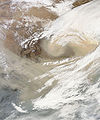 The first day of spring 2010 brought a massive sandstorm blowing from Inner Mongolia
 -
 On November 11, 2010, a wall of sand blew across northern China, covering much of the North China Plain and Shandong Peninsula.
 -
 Smog from Eastern China spread over neighboring areas in February 2004.
 -

-
 Natural color satellite image of a smog event in the heart of northern China
 -
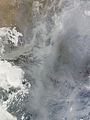 Dense smog settled over the North China Plain on February 20, 2011.
.png)


Climate change[edit]

Climate change is having major effects on the Chinese economy, society and the environment.[19][20] China is the largest emitter of carbon dioxide, through an energy infrastructure heavily focused on coal. Other industries, such as a burgeoning construction industry and industrial manufacturing, contribute heavily to carbon emissions. However, like other developing countries, on a per-capita basis, China's carbon emissions are considerably less than countries like the United States.[21] It has also been noted that higher-income countries have outsourced emissions-intensive industries to China.[22][23] On the basis of cumulative CO2 emissions measured from 1751 through to 2017, China is responsible for 13% globally and about half of the United States' cumulative emissions.[24][25] China is now the world's largest polluter and in 2023 recorded it's hottest year on record with an average temperature of 10.7 C.[26]
China is suffering from the negative effects of global warming in agriculture, forestry and water resources, and is expected to continue to see increased impacts. China's government is taking some measures to increase renewable energy, and other decarbonization efforts, vowing to hit peak emissions before 2030 and be carbon neutral by 2060 by adopting "more vigorous policies and measures."[27] The GHG emissions of China will probably peak in 2025, and by 2030 they will return to 2022 levels. However, such pathway still leads to 3 degree temperature rise.[28]Protected areas of China[edit]
This is a list of the nationally designated protected areas of China. There are many forms of protected areas in China. Based on their relative importance, each type of protected area can be further graded into two to three levels (national, provincial and prefectural/county level). Nevertheless, the highest rank for "pocket nature preserve" (social and mass-based), "no-hunting area", "no-fishing area", "no-logging area", "wild medicinal material resources conservation area", "crop germplasm resources conservation area", "forest tree germplasm resources conservation area" or "source water protection area" is practically restricted to provincial level. The local government at county level is also responsible for the delimitation and declaration of "basic farmland protection area" and "basic grassland".
Take note that many protected areas in China have multiple official designations, and the statutory boundaries of these multi-designated PAs may be identical or may vary one from the other. For instance, the boundaries of Huangshan NSHA coincide with those of the Huangshan NGP, whereas Fujian province's Wuyi Mountains NNR, NSHA and NFP are adjacent to each other. In Heilongjiang, 27,642.14 hectares out of 115,340.27 hectares of Huzhong NFP are intersected with the experiment zone of Huzhong NNR.Environmental issues[edit]


Rapid industrialization, population growth, and lax environmental oversight have caused many environmental issues, such as large-scale pollution in China.[29] As of 2013, Beijing, which lies in a topographic bowl, has significant industry, and heats with coal, is subject to air inversions resulting in extremely high levels of pollution in winter months.[30]
In January 2013, fine airborne particulates that pose the largest health risks, rose as high as 993 micrograms per cubic meter in Beijing, compared with World Health Organization guidelines of no more than 25. The World Bank estimates that 16 of the world's most-polluted cities are located in China.[31]
According to Jared Diamond, the six main categories of environmental problems of China are: air pollution, water problems, soil problems, habitat destruction, biodiversity loss and mega projects.[32] Diamond also states that, "China is noted for the frequency, number, extent, and damage of its natural disasters".[32]
Many of the Chinese citizens started to wonder if air pollution is the cause of the increase of lung cancer. This question began to rise because the citizens in China must constantly wear face masks to avoid breathing in the hazardous particles from their polluted skies. Some experts agree that it is the reason, but others say there isn't enough evidence. Wang Ning, deputy director of the Beijing Office for Prevention and Control, says he has seen a rise in a certain cancer called adenicarcinoma, which is a mucus that is seen as a side effect from pollution. China's lung cancer rate is 32% of the entire world's lung cancer patients. Meanwhile, as lung cancer increases, gastric, esophageal, and cervical cancer have all decreased in China.[33]
See also[edit]
- Environmental policy in China
- Environmentalism in China
- Geographic Information Systems in China
- Hot summer cold winter zone
- Land use in China
References[edit]
- ^ Edward Wong (21 March 2013). "As Pollution Worsens in China, Solutions Succumb to Infighting". The New York Times. Retrieved 22 March 2013.
- ^ "Asia - Geologic history". Encyclopedia Britannica. Retrieved 8 April 2019.
- ^ "Land and Mineral Resources". www.china.org.cn. Retrieved 11 April 2019.
- ^ Weller, J. Marvin (1944). "Outline of Chinese Geology". AAPG Bulletin. 28. doi:10.1306/3D9336BA-16B1-11D7-8645000102C1865D.
- ^ Zhang, Dazheng; Faul, Carol (1988). "A history of geology and geological education in China (to 1949)". Earth Sciences History. 7 (1): 27–32. Bibcode:1988ESHis...7...27Z. doi:10.17704/eshi.7.1.e6337776367421x4. ISSN 0736-623X. JSTOR 24136865.
- ^ "Biodiversity Theme Report". Environment.gov.au. 2009. Archived from the original on 8 December 2008. Retrieved 27 April 2010.
- ^ "China: vertebrate species by type 2015 - Statistic". Statista.com. Retrieved 6 January 2018.
- ^ a b IUCN Initiatives – Mammals – Analysis of Data – Geographic Patterns 2012. IUCN. Retrieved 24 April 2013. Data does not include species in Taiwan.
- ^ Countries with the most bird species. Mongabay.com. 2004 data. Retrieved 24 April 2013.
- ^ Countries with the most reptile species. Mongabay.com. 2004 data. Retrieved 24 April 2013.
- ^ a b IUCN Initiatives – Amphibians – Analysis of Data – Geographic Patterns 2012. IUCN. Retrieved 24 April 2013. Data does not include species in Taiwan.
- ^ Top 20 countries with most endangered species IUCN Red List. 5 March 2010. Retrieved 24 April 2013.
- ^ "Nature Reserves". China.org.cn. Retrieved 2 December 2013.
- ^ Wu, Z. Y., P. H. Raven & D. Y. Hong, eds. 2006. Flora of China. Vol. 22 (Poaceae). Science Press, Beijing, and Missouri Botanical Garden Press, St. Louis
- ^ Fang, R., et al. (2018). Country focus: China. In: K. J. Willis (ed.), State of the World's Fungi. Report. Royal Botanic Gardens, Kew. pp. 48–55
- ^ Hu, R (1990). Distribution of Bryophytes in China (PDF).
- ^ Huang J, Ma K, Huang J (2017). Species Diversity Distribution Patterns of Chinese Endemic Seed Plants Based on Geographical Regions. PLoS ONE 12(1): e0170276 https://doi.org/10.1371/journal.pone.0170276
- ^ Hong, D. Y., & Blackmore, S. (Eds.). (2015). Plants of China: A companion to the flora of China. Cambridge University Press
- ^ World Bank. "China Country Climate and Development Report" (PDF).
- ^ "China National communication 3: Part III Impacts of Climate Change and Adaptation". unfccc.int. Archived from the original on 14 November 2019. Retrieved 26 September 2019.
- ^ "DataBank - CO2 emissions (metric tons per capita)". The World Bank. Archived from the original on 3 October 2020. Retrieved 10 August 2020.
- ^ Malik, Arunima; Lan, Jun (2 April 2016). "The role of outsourcing in driving global carbon emissions". Economic Systems Research. 28 (2): 168–182. doi:10.1080/09535314.2016.1172475. ISSN 0953-5314. S2CID 156212231. Archived from the original on 24 July 2021. Retrieved 24 July 2021.
high-income resource-poor nations such as the United Kingdom, Germany and France (...) outsource carbon-intensive production to China
- ^ Plumer, Brad (4 September 2018). "You've Heard of Outsourced Jobs, but Outsourced Pollution? It's Real, and Tough to Tally Up". The New York Times. ISSN 0362-4331. Archived from the original on 25 July 2021. Retrieved 24 July 2021.
- ^ "Who has contributed most to global CO2 emissions?". Our World in Data. Archived from the original on 25 October 2021. Retrieved 28 October 2021.
- ^ "The hard truths of climate change — by the numbers". www.nature.com. Archived from the original on 26 August 2022. Retrieved 28 October 2021.
- ^ Regan, Helen (5 January 2024). "2023 was China's hottest year on record, marked by multiple deadly extreme weather events". CNN. Retrieved 7 January 2024.
- ^ "Climate change: China aims for 'carbon neutrality by 2060'". BBC News. 22 September 2020. Archived from the original on 26 January 2021. Retrieved 22 September 2020.
- ^ Lui, Swithin (19 May 2022). "Guest post: Why China is set to significantly overachieve its 2030 climate goals". Carbon Brief. Archived from the original on 23 May 2022. Retrieved 24 May 2022.
- ^ Edward Wong (29 March 2013). "Cost of Environmental Damage in China Growing Rapidly Amid Industrialization". The New York Times. Retrieved 30 March 2013.
- ^ "2 Major Air Pollutants Increase in Beijing". The New York Times. 3 April 2013. Retrieved 4 April 2013.
- ^ Bloomberg News (14 January 2013). "Beijing Orders Official Cars Off Roads to Curb Pollution". Bloomberg. Retrieved 27 July 2013.
- ^ a b Jared Diamond, Collapse: How Societies Choose to Fail or Succeed, Penguin Books, 2005 and 2011 (ISBN 9780241958681). See chapter 12 entitled "China, Lurching Giant" (pages 258-377).
- ^ Burkitt, Laurie (10 March 2014). "Pollution: Causing Lung Cancer in China?". WSJ. Retrieved 5 May 2017.
Further reading[edit]
- Elvin, Mark. The retreat of the elephants: an environmental history of China (Yale University Press, 2004). excerpt
- Heijdra, Martin. "Texts, Space and Time: New Insights into Chinese Environmental History." Journal of the Economic and Social History of the Orient 42.4 (1999): 549-565.
- Maohong, Bao. "Environmental history in China." Environment and History (2004): 475-499. online
- Marks, Robert B. China: An environmental history (Rowman & Littlefield, 2017). excerpt


