


Kaluga
Kaluga
Калуга | |
|---|---|
.jpg) Space museum, Rocket Vostok, House store of Rakov, Kaluga from a birds-eye view, Trolleybus, corner of Moskovskaya and Dostoyevskogo st. | |
 Flag  Coat of arms | |
Location of Kaluga  | |
  Kaluga Location of Kaluga  Kaluga Kaluga (Kaluga Oblast) | |
| Coordinates: 54°33′N 36°17′E / 54.550°N 36.283°E | |
| Country | Russia |
| Federal subject | Kaluga Oblast[1] |
| First mentioned | 1371[2] |
| Government | |
| • Body | City Duma[3] |
| • City Head[5] | Dmitry Denisov[4] |
| Area | |
• Total | 170.5 km2 (65.8 sq mi) |
| Elevation | 190 m (620 ft) |
| Population | |
• Total | 324,698 |
• Estimate (2018)[8] | 340,851 (+5%) |
| • Rank | 55th in 2010 |
| • Density | 1,900/km2 (4,900/sq mi) |
| • Subordinated to | City of Kaluga[1] |
| • Capital of | Kaluga Oblast,[1] City of Kaluga[1] |
| • Urban okrug | Kaluga Urban Okrug[9] |
| • Capital of | Kaluga Urban Okrug[9] |
| Time zone | UTC+3 (MSK  [10]) [10]) |
| Postal code(s)[11] | 248xxx |
| Dialing code(s) | +7 4842[12] |
| OKTMO ID | 29701000001 |
| City Day | Second Saturday of September[13] |
| Website | www |
Kaluga (Russian: Калу́га, IPA: [kɐˈɫuɡə]) is a city and the administrative center of Kaluga Oblast, Russia. It stands on the Oka River 150 kilometers (93 mi) southwest of Moscow. Its population was 337,058 at the 2021 census.[14]
Kaluga's most famous resident, the space travel pioneer Konstantin Tsiolkovsky, worked there as a school teacher from 1892 to 1935. The Tsiolkovsky State Museum of the History of Cosmonautics in Kaluga is dedicated to his theoretical achievements and to their practical implementations for modern space research, hence the motto on the city's coat of arms: Колыбель Космонавтики, Kolybélʹ kosmonávtiki ("The Cradle of Space-Exploration").
History
[edit]Kaluga, founded in the mid-14th century as a border fortress on the southwestern borders of the Grand Duchy of Moscow, first appears in the historical record in chronicles in the 14th century as Koluga; the name comes from Old Russian kaluga is "bog, quagmire".[15] During the period of Tartar raids it was the western end of the Oka bank defense line. The Great stand on the Ugra River was fought just to the west. In the Middle Ages Kaluga was a minor settlement owned by the Princes Vorotynsky. The ancestral home of these princes lies southwest of the modern city.
On 19 January 1777, the Kaluga drama theatre opened its first theatrical season, established with the direct participation of the Governor-General Mikhail Krechetnikov.[16]
Kaluga is connected to Moscow by a railway line and by the ancient roadway, the Kaluga Road (now partly within Moscow (as the Old Kaluga Highway), partly the A101 road).[17] This road offered Napoleon his favored escape route from the Moscow trap in the fall of 1812. But General Kutuzov repelled Napoleon's advances in this direction and forced the retreating French army onto the old Smolensk road, previously devastated by the French during their invasion of Russia.
On several occasions during the Russian Empire Kaluga was the residence of political exiles and prisoners such as the last Crimean khan Şahin Giray (1786), the Kyrgyz sultan Arigazi-Abdul-Aziz (1828), the Georgian princess Thecla (1834–1835), and the Avar leader Imam Shamil (1859–1868).[18]
The German army briefly occupied Kaluga during the climactic Battle of Moscow, as part of Operation Barbarossa. The city was under full or partial German occupation from October 12 to December 30, 1941. In 1944, the Soviet Government used its local military buildings to intern hundreds of Polish prisoners of war — soldiers of the Polish underground Home Army — whom the advancing Soviet front had arrested in the area around Vilnius.
Demographics
[edit]| Year | Pop. | ±% |
|---|---|---|
| 1897 | 49,513 | — |
| 1926 | 49,425 | −0.2% |
| 1939 | 89,396 | +80.9% |
| 1959 | 134,235 | +50.2% |
| 1970 | 210,906 | +57.1% |
| 1979 | 265,013 | +25.7% |
| 1989 | 311,399 | +17.5% |
| 2002 | 334,751 | +7.5% |
| 2010 | 324,698 | −3.0% |
| 2021 | 337,058 | +3.8% |
| Source: Census data | ||
As of the 2021 Census, the ethnic composition of Kaluga was:[19]
|
Administrative and municipal status
[edit]Kaluga is the administrative center of the oblast.[1] Within the framework of administrative divisions, it is, together with seventy-two rural localities, incorporated as the City of Kaluga—an administrative unit with the status equal to that of the districts.[1] As a municipal division, the City of Kaluga, together with one rural locality in Ferzikovsky District (the selo of Novozhdamirovo), is incorporated as Kaluga Urban Okrug.[9]
Economy
[edit]The Kaluga Turbine Plant is located here as is Kaluga Machine Works, which manufactures track machines for railways. In recent years, Kaluga has become one center of the Russian automotive industry, with a number of foreign companies opening assembly plants in the area:[20]
On 28 November 2007, Volkswagen Group opened a new assembly plant in Kaluga, which further expanded by 2009. The investment has reached more than 500 million Euro. As of 2014[update] the plant assembled the Volkswagen Passat, Škoda Fabia and Škoda Rapid.[21]
On 15 October 2007, the Volvo Group broke ground on a new truck assembly plant, that was inaugurated on 19 January 2009,[22] with a yearly capacity of 10,000 Volvo and 5,000 Renault trucks.[23]
On 12 December 2007, PSA Peugeot Citroën announced its decision to build a new assembly plant in Kaluga.[24]
Transportation
[edit]The city is served by the Grabtsevo Airport. Since 1899, there has been a railway connection between Kaluga and Moscow.[25]
Public transportation is represented by the trolleybuses, buses, and marshrutkas (routed taxis).
-
 ZiU-682 trolleybus
 -
 ZiU-682 trolleybus
 -
 BKM-321 low-floor trolleybus
 -
 Kaluga Airport
 -
 Kaluga Railway Station


_KLF_UUBC_(33977439235).jpg)

Climate
[edit]Kaluga has a humid temperate continental (Köppen climate classification: Dfb), with warm and humid summers; and long, cold and snowy winters. Winter extreme records can be as low as −45 °C (−49 °F), while summer heat may reach up +40 °C (104 °F), but normal variation is between −5 °C (23 °F) and −20 °C (−4 °F) during winter and between 15 °C (59 °F) and 30 °C (86 °F) during summer in Kaluga.
| Climate data for Kaluga, Russia (period 1961–1990) | |||||||||||||
|---|---|---|---|---|---|---|---|---|---|---|---|---|---|
| Month | Jan | Feb | Mar | Apr | May | Jun | Jul | Aug | Sep | Oct | Nov | Dec | Year |
| Mean daily maximum °C (°F) | −6.6 (20.1) |
−5.0 (23.0) |
0.4 (32.7) |
10.3 (50.5) |
18.7 (65.7) |
21.5 (70.7) |
23.0 (73.4) |
21.9 (71.4) |
15.7 (60.3) |
9.0 (48.2) |
0.7 (33.3) |
−3.7 (25.3) |
7.2 (45.0) |
| Daily mean °C (°F) | −10.1 (13.8) |
−9.0 (15.8) |
−3.5 (25.7) |
5.7 (42.3) |
12.7 (54.9) |
15.8 (60.4) |
17.5 (63.5) |
16.3 (61.3) |
10.9 (51.6) |
5.4 (41.7) |
−1.9 (28.6) |
−6.6 (20.1) |
4.4 (39.9) |
| Mean daily minimum °C (°F) | −13.5 (7.7) |
−12.9 (8.8) |
−7.4 (18.7) |
1.0 (33.8) |
6.7 (44.1) |
10.1 (50.2) |
12.0 (53.6) |
10.7 (51.3) |
6.1 (43.0) |
1.8 (35.2) |
−4.5 (23.9) |
−9.5 (14.9) |
0.1 (32.2) |
| Average precipitation mm (inches) | 39 (1.5) |
33 (1.3) |
35 (1.4) |
39 (1.5) |
43 (1.7) |
77 (3.0) |
80 (3.1) |
71 (2.8) |
55 (2.2) |
50 (2.0) |
53 (2.1) |
55 (2.2) |
630 (24.8) |
| Source: www.meteoinfo.ru
"www.meteoinfo.ru". Retrieved 3 September 2012. | |||||||||||||
Notable people
[edit]Kaluga's most famous resident was rocket science pioneer Konstantin Tsiolkovsky.
Other notable people include:
- Sergei Avagimyan, former professional footballer. Born in Russia, he played for the Armenian national football team.
- Alexander Amfiteatrov
- Yuri Averbakh, chess grandmaster
- Mykola Azarov
- Pafnuty Chebyshev, mathematician
- Alexander Chizhevsky
- David Edelstadt
- Alexander Gretchaninov, Russian-American composer
- Jonah of Hankou
- Andrei Kalaychev
- Valery Kobelev, ski jumper
- Mikhail Linge
- Pavel Popovich, cosmonaut, the only person to receive two honorary citizenships of Kaluga (1962 and 1964)[26]
- Larisa Popugayeva
- Nikolai Rakov
- Imam Shamil
- Nikolay Skvortsov, swimmer
- Yuliya Tabakova
- Georgy Zhukov
- Olesya Zykina, 400m athlete
- Bulat Okudzhava, lived and taught Literature in public school in the 1980s.
- Serafim Tulikov
- Ivan Kuliak
- Lyubov Kamyrina
Twin towns – sister cities
[edit]


Partner cities
[edit]In addition to twin towns, Kaluga cooperates with:[27]
 Clearwater, United States (1992)
 Xianyang, China (2000)
 Tula, Russia (2002)
- Oryol, Russia (2003)
- Smolensk, Russia (2003)
- Makhachkala, Russia (2012)
- Tsiolkovsky, Russia (2016)
- Ryazan, Russia (2017)
- Tambov, Russia (2017)


Gallery
[edit]-
 Kaluga. Main Square
 -
 Kaluga. Polman House
 -
 Kaluga Region Drama Theatre building
 -
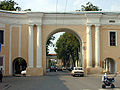 Kaluga. Eastern archway at the Administration Building
 -
 Kaluga. Moscow State Technical University (local branch)
 -
 Streetside stores in Kaluga
 -
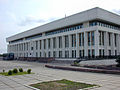 Kaluga. Region administration
 -
 Trolleybus in Kaluga
 -
 Astronautics Museum


.jpg)

.jpg)
References
[edit]Notes
[edit]- ^ a b c d e f g Charter of Kaluga Oblast
- ^ Из фразы Гагарина в столице сделали артобъект
- ^ Representative bodies of the municipality City of Kaluga
- ^ Губернатор произвел кадровые перестановки (in Russian). vest-news.ru. 27 March 2018. Retrieved 27 March 2018.
- ^ Устав муниципального образования "Город Калуга" (in Russian). kaluga-gov.ru. 19 September 2011. Retrieved 27 March 2018.
- ^ Калуги стало больше Калужский перекрёсток, 14 апреля 2011
- ^ Russian Federal State Statistics Service (2011). Всероссийская перепись населения 2010 года. Том 1 [2010 All-Russian Population Census, vol. 1]. Всероссийская перепись населения 2010 года [2010 All-Russia Population Census] (in Russian). Federal State Statistics Service.
- ^ "26. Численность постоянного населения Российской Федерации по муниципальным образованиям на 1 января 2018 года". Federal State Statistics Service. Retrieved 23 January 2019.
- ^ a b c Law #7-OZ
- ^ "Об исчислении времени". Официальный интернет-портал правовой информации (in Russian). 3 June 2011. Retrieved 19 January 2019.
- ^ Почта России. Информационно-вычислительный центр ОАСУ РПО. (Russian Post). Поиск объектов почтовой связи (Postal Objects Search) (in Russian)
- ^ Phcode.ru
- ^ День города перенесли в Калуге Калужский перекрёсток, 22 апреля 2015
- ^ Russian Federal State Statistics Service. Всероссийская перепись населения 2020 года. Том 1 [2020 All-Russian Population Census, vol. 1] (XLS) (in Russian). Federal State Statistics Service.
- ^ E.M. Pospelov, Geograficheskie nazvaniya mira (Moscow: Russkie slovari, 1998), p. 181.
- ^ Ассонов В. И. (1911) [Извѣстія Калужской Ученой Архивной Комиссіи. Выпускъ XXI]. "К истории театра в Калуге". Известия Калужской Ученой Архивной Комиссии. Выпуск XXI. Калуга: Типография Е. Г. Архангельской. pp. 56–69.
- ^ Сергей Алтухов (13 September 2011). "Товарные знаки — тоже искусство". Retrieved 6 December 2018.
- ^ "Историки указали на стереотипность мнений про пленение Шамиля". Кавказский узел. 8 September 2018. Archived from the original on 13 February 2023. Retrieved 13 February 2023.
- ^ "Территориальный орган Федеральной службы государственной статистики по Калужской области" (PDF). Retrieved 24 May 2023.
- ^ "О Стратегии социально-экономического развития Калужской области до 2030 года (с изменениями на 12 февраля 2016 года)". Archived from the original on 27 July 2017. Retrieved 22 July 2017.
- ^ "Škoda Annual Report 2014" (PDF). Archived from the original (PDF) on 24 September 2015. Retrieved 3 January 2016.
- ^ Volvo Truck starts production at Kaluga plant, Just-auto.com, 19 January 2009.
- ^ New Volvo Group assembly plant in Kaluga, Volvo Group corporate news, 15 October 2007.
- ^ PSA Peugeot Citroën to Build Plant in Kaluga, Russia Archived December 30, 2007, at the Wayback Machine, PSA Peugeot Citroën press release, 12 December 2007
- ^ "Train Station in Kaluga" (in Russian). Nnov-airport.ru. Archived from the original on 29 September 2013. Retrieved 24 February 2014.
- ^ "Ими гордится Калуга ("They Bring Pride to Kaluga")" (in Russian). Kaluga: Office of the Affairs of the Mayor of Kaluga. Retrieved 1 October 2009.
- ^ a b "Города-побратимы". kaluga-gov.ru (in Russian). Kaluga. Retrieved 5 February 2020.
Sources
[edit]- Законодательное Собрание Калужской области. №473 27 марта 1996 г. «Устав Калужской области», в ред. Закона №681-ОЗ от 27 февраля 2015 г. «О внесении изменений в Устав Калужской области». Опубликован: "Весть", №79, 9 апреля 1996 г. (Legislative Assembly of Kaluga Oblast. #473 March 27, 1996 Charter of Kaluga Oblast, as amended by the Law #681-OZ of February 27, 2015 On Amending the Charter of Kaluga Oblast. ).
- Законодательное Собрание Калужской области. Закон №7-ОЗ от 28 декабря 2004 г. «Об установлении границ муниципальных образований, расположенных на территории административно-территориальных единиц "Бабынинский район", "Боровский район", "Дзержинский район", "Жиздринский район", "Жуковский район", "Износковский район", "Козельский район", "Малоярославецкий район", "Мосальский район", "Ферзиковский район", "Хвастовичский район", "город Калуга", "город Обнинск", и наделении их статусом городского поселения, сельского поселения, городского округа, муниципального района», в ред. Закона №620-ОЗ от 29 сентября 2014 г. «О внесении изменений в Закон Калужской области "Об установлении границ муниципальных образований, расположенных на территории административно-территориальных единиц "Бабынинский район", "Боровский район", "Дзержинский район", "Жиздринский район", "Жуковский район", "Износковский район", "Козельский район", "Малоярославецкий район", "Мосальский район", "Ферзиковский район", "Хвастовичский район", "город Калуга", "город Обнинск", и наделении их статусом городского поселения, сельского поселения, городского округа, муниципального района"». Вступил в силу после официального опубликования, за исключением положений о муниципальном образовании "Город Калуга", для которых установлены иные сроки вступления в силу. Опубликован: "Весть", №402–404, 29 декабря 2004 г. (Legislative Assembly of Kaluga Oblast. Law #7-OZ of December 28, 2004 On Establishing the Borders of the Municipal Formations Located on the Territory of the Administrative-Territorial Units of "Babyninsky District", "Borovsky District", "Dzerzhinsky District", "Zhizdrinsky District", "Zhukovsky District", "Iznoskovsky District", "Kozelsky District", "Maloyaroslavetsky District", "Mosalsky District", "Ferzikovsky District", "Khvastovichsky District", "City of Kaluga", "City of Obninsk", and on Granting Them the Status of an Urban Settlement, Rural Settlement, Urban Okrug, Municipal District, as amended by the Law #620-OZ of September 29, 2014 On Amending the Law of Kaluga Oblast "On Establishing the Borders of the Municipal Formations Located on the Territory of the Administrative-Territorial Units of "Babyninsky District", "Borovsky District", "Dzerzhinsky District", "Zhizdrinsky District", "Zhukovsky District", "Iznoskovsky District", "Kozelsky District", "Maloyaroslavetsky District", "Mosalsky District", "Ferzikovsky District", "Khvastovichsky District", "City of Kaluga", "City of Obninsk", and on Granting Them the Status of an Urban Settlement, Rural Settlement, Urban Okrug, Municipal District". Effective as of after the official publication, with the exception of the clauses regarding the municipal formation of the "City of Kaluga", for which different dates of taking effect are specified.).
External links
[edit] Media related to Kaluga at Wikimedia Commons
- . Encyclopædia Britannica. Vol. 15 (11th ed.). 1911. p. 644.
- Official website of Kaluga
- Kaluga Business Directory (in Russian)
- Article in German about Kaluga plant
- Kaluga, Russia at JewishGen
| International | |
|---|---|
| National | |
| Geographic | |
| Other | |