Following their review of parliamentary boundaries in Nottinghamshire, the Boundary Commission for England made changes to the constituency for the 2010 general election to allow for population changes, most noticeably by returning the town of Retford from Newark, offset by moving the small town of Market Warsop into Mansfield constituency.
The constituency includes 22 electoral wards from Bassetlaw District Council:
Further to the 2023 Periodic Review of Westminster constituencies, enacted by the Parliamentary Constituencies Order 2023, the composition of the constituency from the next general election, due by January 2025, will be reduced to bring the electorate within the permitted electoral range by transferring the two small wards of Clayworth, Sturton to Newark.[6]
In 1950, the five Parliamentary Divisions of Nottinghamshire were reorganised as six County Constituencies. Local government boundary changes in the 1930s now meant that Bassetlaw County Constituency was defined as comprising the Municipal Boroughs of East Retford and Worksop, the Urban District of Warsop and the Rural Districts of East Retford and Worksop.
In 1955, the Urban District of Warsop was moved into the Mansfield constituency.
The constituency's boundaries then remained unchanged until 1983. In that year, the town of East Retford and the neighbouring areas were transferred to the redrawn Newark constituency. Bassetlaw constituency then comprised Worksop and surrounding areas in the Bassetlaw district as well as the town of Warsop in the Mansfield district (see list of wards during this period below). There were no boundary changes in 1997.
From 1983 to 2010, the constituency comprised the following Bassetlaw district wards:
Beckingham, Blyth, Carlton, Clayworth, Everton, Harworth East, Harworth West, Hodsock, Misterton, Rampton, Ranskill, Sturton, Sutton, Welbeck, Worksop East, Worksop North, Worksop North East, Worksop North West, Worksop South, Worksop South East
along with two Mansfield district wards:
Birklands, Meden (both in the Warsop area).
In 2010 the two Mansfield District wards were transferred to the Mansfield constituency and the town of Retford was regained from Newark.
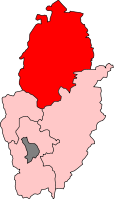
Bassetlaw constituency boundaries, shown within the county of Nottinghamshire
Bellenger held the seat until he died in 1968. A by-election followed. The seat was retained for the Labour Party by Joe Ashton with a slender 1.72% majority, the narrowest since the 1920s. He held the seat until retirement at the 2001 general election. He was succeeded at that year's election by fellow Labour politician John Mann, who retained the seat at the next four elections. In 2019, Mann resigned being having been appointed to head a government inquiry on tackling anti-Semitism and to take a seat in the House of Lords.[7] The Labour candidate initially chosen to replace Mann, Sally Gimson, was deselected before the election by the party's National Executive Committee over what were described as "very serious allegations".[8] Gimson referred to the process as a "kangaroo court", and Mann called the decision a stitch-up;[8] Gimson started legal action against the party, but dropped the case several days later.[9] Keir Morrison, a councillor in the Ashfield District, replaced Gimson as the Labour candidate.[10]
In the December 2019 general election, the Conservatives won the seat with a swing from Labour of 18.4%, the largest recorded in the election.[11] The fall in Labour's vote, 24.9%, was the greatest of any seat in the election.[12]
Another General Election was required to take place before the end of 1915. The political parties had been making preparations for an election to take place and by July 1914, the following candidates had been selected;





 1885 to 1918
 1950 to 1983
 1983 to 2010
 Since 2010


 11.9
11.9
 24.9
24.9


