


Eötvös Loránd University
Eötvös Loránd Tudományegyetem (Hungarian) | |
 | |
| Latin: Universitas Budapestinensis de Rolando Eötvös nominata | |
| Motto | Community of Knowledge |
|---|---|
| Type | Public research university |
| Established | 1635 |
| Affiliation | |
| Chancellor | Gyula Scheuer |
| Rector | László Borhy, D.Sc |
Academic staff | 1,800[1] |
| Students | cca. 27,000[2] |
| Undergraduates | 16,017[3] |
| Postgraduates | 8,547 |
| 1,442 | |
| Location | , 47°29′26″N 19°03′31″E / 47.4906°N 19.0585°E |
| Campus | Urban |
Sporting affiliations | Budapesti EAC |
| Website | www |

Eötvös Loránd University (Hungarian: Eötvös Loránd Tudományegyetem, ELTE, also known as University of Budapest) is a Hungarian public research university based in Budapest. Founded in 1635, ELTE is one of the largest and most prestigious[4] public higher education institutions in Hungary. The 28,000 students at ELTE are organized into nine faculties, and into research institutes located throughout Budapest and on the scenic banks of the Danube. ELTE is affiliated with 5 Nobel laureates, as well as winners of the Wolf Prize, Fulkerson Prize and Abel Prize, the latest of which was Abel Prize winner László Lovász in 2021.
The predecessor of Eötvös Loránd University was founded in 1635 by Cardinal Péter Pázmány in Nagyszombat, Kingdom of Hungary (today Trnava, Slovakia) as a Catholic university for teaching theology and philosophy. In 1770, the university was transferred to Buda. It was named Royal University of Pest until 1873, then University of Budapest until 1921, when it was renamed Royal Hungarian Pázmány Péter University after its founder Péter Pázmány. The Faculty of Science started its autonomous life in 1949, when The Faculty of Theology was separated from the university (now Pázmány Péter Catholic University). The university received its current name in 1950, after one of its most well-known physicists, Baron Loránd Eötvös.
History[edit]

The university was founded in 1635 in Nagyszombat, Kingdom of Hungary (today Trnava, Slovakia) by the archbishop and theologian Péter Pázmány. Leadership was given over to the Jesuits. Initially the university only had two faculties (Faculty of Arts and Faculty of Theology). The Faculty of Law was added in 1667 and the Faculty of Medicine was started in 1769. After the dissolution of the Jesuit order, the university was moved to Buda (today part of Budapest) in 1777 in accordance with the intention of the founder. The university moved to its final location in Pest (now also part of Budapest) in 1784. The language of education was Latin until 1844, when Hungarian was introduced as an exclusive official language. Women have been allowed to enroll since 1895.[5]
Although several Hungarian universities opted for the new foundation model, Eötvös Loránd University remained state-owned.[6]
On 3 October 2023, a former student of the Faculty of Science, Ferenc Krausz was awarded Nobel Prize in Physics.[7]
Academic profile[edit]
ELTE is Hungary's largest scientific establishment with 118 PhD programs at 17 doctoral schools, and also offers 38 bachelor's programs, 96 master's programs, and over 50 degree programs in foreign languages. The course credits awarded are transferable to universities in Europe through the Bologna process.[8]
The nine faculties are (active faculties are in bold):
| Faculty | Code | Founded[9] | Defunct[9] | Institutions | Educators[10] | Students | Dean |
|---|---|---|---|---|---|---|---|
| Bárczi Gusztáv Faculty of Special Needs Education | FSNE | 2000 | 5 | 2094 | Gabriella Papp | ||
| Faculty of Economics | FE | 2021 | - | - | - | - | György Andor |
| Faculty of Humanities | FH | 1635 | 18 | 589 | 6960 | Dávid Bartus | |
| Faculty of Education and Psychology | FEP | 2003 | 8 | 3963 | Anikó Zsolnai | ||
| Faculty of Informatics | FI | 2003 | 4 | 3128 | Tamás Kozsik | ||
| Faculty of Law | FL | 1667 | 0 | 4172 | Pál Sonnevend | ||
| Faculty of Medicine | FM | 1769 | 1951 | - | - | - | - |
| Faculty of Primary and Pre-School Education | FPPE | 2000 | 0 | 1831 | Éva Márkus | ||
| Faculty of Theology | FT | 1635 | 1950 | - | - | - | - |
| Faculty of Science | FS | 1949 | 5 | 3815 | Imre Kacskovics | ||
| Faculty of Social Sciences | FSS | 2003 | 6 | 1762 | Gábor Juhász | ||
| Faculty of Teachers' Training | FTT | 1983 | 2003 | - | - | - |
Timeline (1873–present)[edit]

Reputation and rankings[edit]
| University rankings | |
|---|---|
| Global – Overall | |
| ARWU World[11] | 501–600 (2023) |
| QS World[12] | 701–710 (2024) |
| THE World[13] | 801–1000 (2024) |
| USNWR Global[14] | =368 (2023) |
In the 2013-14 QS World University Rankings, Eötvös Loránd University was ranked 551-600th. In the 2018, according to the Times Higher Education World University Ranking, ELTE ranked between 601 and 800. Academic Ranking of World Universities ranked the university among the best 301-400 between 2010 and 2014.[15]
Campuses[edit]
ELTE has campuses at several places in Budapest:[16]
- Egyetem tér in the 5th district (Faculty of Law)
- "Trefort Garden" (Trefort-kert) in the 8th district (Faculty of Humanities)
- Lágymányos campus in the 11th district (Faculty of Science, Faculty of Social Sciences, Faculty of Informatics)
- Buildings in Kazinczy utca (7th district) and Izabella utca (6th district) (Faculty of Education and Psychology)
- Ecseri út in the 9th district (Bárczi Gusztáv Faculty of Special Needs Education)
- Kiss János altábornagy utca in the 12th district (Faculty of Primary and Pre-School Education)
Since 2017, ELTE has a campus named "Savaria University Centre" (Savaria Egyetemi Központ) in Szombathely (Savaria in Latin).[17]
Faculties[edit]


| Faculty | Abbreviation | Postcode | Address |
|---|---|---|---|
| Bárczi Gusztáv Faculty of Special Needs Education | FSNE | 1097 | 3. Ecseri út |
| Faculty of Economics | FE | 1088 | 7. Rákóczi út |
| Faculty of Education and Psychology | FEP | 1075 | 23–27. Kazinczy utca |
| Faculty of Humanities | FH | 1088 | 4. Múzeum krt. |
| Faculty of Informatics | FI | 1117 | 1/C. Pázmány Péter sétány |
| Faculty of Law | FL | 1053 | 1–3. Egyetem tér |
| Faculty of Primary and Pre-School Education | FPPE | 1126 | 40. Kiss János altáb. utca |
| Faculty of Science | FS | 1117 | 1/A. Pázmány Péter sétány |
| Faculty of Social Science | FSS | 1117 | 1/A. Pázmány Péter sétány |
Library[edit]
The University Library and Archives was founded in 1561 and it is located in 6 Ferenciek tere.[18] However, each faculty of the university has their own library located in different parts of Budapest.[19]
- Library of the Faculty of Humanities
- Library of the Faculty of Law
- Library of the Faculty of Science


The library of Medieval Studies of the Central European University was located in the building of ELTE's Faculty of Humanities.[20]
Notable alumni[edit]
Nobel Prize laureates:
- Lénárd Fülöp, Nobel Prize for Physics (1905)
- Albert Szent-Györgyi, Nobel Prize in Physiology or Medicine for the discovery of Vitamin C (1937)
- Hevesy György, Nobel Prize for Chemistry (1943)
- Békésy György, Nobel Prize in Physiology or Medicine (1961)
- Harsányi János, Nobel Memorial Prize in Economic Sciences (1994)
- Ferenc Krausz, Nobel Prize in Physics (2023)[21]
-
 Fülöp Lénárd, physicist
 -
 Albert Szent-Györgyi, biochemist
 -
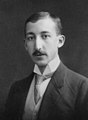 Hevesy György, chemist
 -
 Békésy György, biophysicist
 -
 Krausz Ferenc, physicist


.jpg)
Other notable alumni:
Sport[edit]
_utca,_BEAC_sportp%C3%A1lya,_h%C3%A1tt%C3%A9rben_a_L%C3%A1gym%C3%A1nyosi_doh%C3%A1nygy%C3%A1r_%C3%A9p%C3%BClete._Fortepan_92320.jpg)
The Eötvös Loránd University has its own sport club, Budapesti Egyetemi Atlétikai Club (English: Budapest University Athletic Club). The biggest achievement of the association football department of the club was qualifying for the 1924-25 Nemzeti Bajnokság I season. However, in the subsequent season (1925-26 Nemzeti Bajnokság I) the club were relegated to the Nemzeti Bajnokság II and has never been able to qualify to the top flight ever since.
https://www.beac.hu/
See also[edit]
References[edit]
- ^ elte.hu. "Brief History of ELTE". Archived from the original on 2016-05-07.
- ^ "Study in Hungary - Universities".
- ^ elte.hu. "A brief presentation of Eötvös Loránd University, page 12 Facts and Figuers - Students". Archived from the original on 2016-02-13.
- ^ Kaplan, Robert B.; Baldauf, Richard B. (2005-01-01). Language Planning and Policy in Europe. Multilingual Matters. ISBN 9781853598111.
- ^ "Brief History of ELTE". ELTE. Retrieved 2021-09-04.
- ^ "Hungarian parliament approves law creating new foundations". Financial Times. 2021-04-27. Archived from the original on 2022-12-11. Retrieved 2022-07-17.
- ^ "The Nobel Prize in Physics 2023". NobelPrize.org. Retrieved 2023-10-03.
- ^ "Academic System".
- ^ a b "Az Egyetem története". ELTE. Retrieved 2021-07-07.
- ^ "Közérdekű, nyilvános adatok". elte.hu. Retrieved 23 April 2021.
- ^ "Academic Ranking of World Universities 2023". shanghairanking.com. Retrieved 24 February 2023.
- ^ "QS World University Rankings: Eötvös Loránd University". Top Universities. 29 June 2023. Retrieved 29 June 2023.
- ^ "Eötvös Loránd University". Times Higher Education (THE). 28 September 2023. Retrieved 28 September 2023.
- ^ U.S. News. "Eötvös Loránd University". Retrieved 27 February 2024.
- ^ "Academic Ranking of World Universities - Eotvos Lorand University". ShanghaiRanking. Retrieved 2020-01-11.
- ^ "Az ELTE campusai" (in Hungarian). ELTE. Retrieved 2021-09-04.
- ^ "Savaria Egyetemi Központ (SEK)" (in Hungarian). ELTE. Retrieved 2021-09-04.
- ^ "Homepage". University Library and Archives. Retrieved 2022-08-30.
- ^ "University Library Service". University Library and Archives. Retrieved 2022-08-30.
- ^ "ELTE's leadership supports CEU". elte.hu. ELTE. 2017-04-03. Retrieved 15 April 2022.
- ^ "The Nobel Prize in Physics 2023". NobelPrize.org. Retrieved 2023-10-03.
External links[edit]

- Official website

- Information brochure (2012) (48 pages)
- Szögi, László. "The Illustrated History of the Eötvös Loránd University, Budapest (ELTE, 2010, 2015)" (PDF) (in Hungarian and English). Eötvös Kiadó. Retrieved 2019-10-13. (282 pages)


| Landmarks |
| ||||||||||||||||||||||||
|---|---|---|---|---|---|---|---|---|---|---|---|---|---|---|---|---|---|---|---|---|---|---|---|---|---|
| Districts |
| ||||||||||||||||||||||||
| Events and traditions | |||||||||||||||||||||||||
| Universities |
| ||||||||||||||||||||||||
| Economy | |||||||||||||||||||||||||
| Transport | |||||||||||||||||||||||||
Danube Rectors' Conference | ||
|---|---|---|
| Public |
|  |
| Private | ||
| International | |
|---|---|
| National | |
| Other | |