


Krasnodar
 | You can help expand this article with text translated from the corresponding article in Russian. (March 2024) Click [show] for important translation instructions.
|
Krasnodar
Краснодар | |
|---|---|
 .jpg)    .jpg) From the top to the left: Theatre's Square, Krasnodar-1 railway station, Obelisk, Medical Academy, Pokrovsky Pond (Karasun), Krasnodar Park | |
 Flag .png) Coat of arms | |
Location of Krasnodar  | |
.svg)  Krasnodar Location of Krasnodar .svg) Krasnodar Krasnodar (European Russia)  Krasnodar Krasnodar (Black Sea) | |
| Coordinates: 45°02′N 38°58′E / 45.033°N 38.967°E | |
| Country | Russia |
| Federal subject | Krasnodar Krai[2] |
| Founded | January 12, 1794[3] |
| City status since | 1867[4] |
| Government | |
| • Body | City Duma |
| • Mayor | Yevgeny Naumov[5] |
| Elevation | 25 m (82 ft) |
| Population | |
| • Total | 744,995 |
| • Estimate (2018)[7] | 899,541 (+20.7%) |
| • Rank | 16th in 2010 |
| • Subordinated to | City of Krasnodar[1] |
| • Capital of | Krasnodar Krai,[2] City of Krasnodar[1] |
| • Urban okrug | Krasnodar Urban Okrug[8] |
| • Capital of | Krasnodar Urban Okrug[8] |
| Time zone | UTC+3 (MSK  [9]) [9]) |
| Postal code(s)[10] | List
350000–350005, 350007, 350010–350012, 350014–350016, 350018–350020, 350033, 350035, 350038–350040, 350042, 350044, 350047, 350049, 350051, 350058, 350059, 350061–350067, 350072, 350075, 350078, 350080, 350086–350090, 350500, 350880, 350890, 350899–350901, 350910–350912, 350931, 350960, 350961, 350963–350965, 350991–350999 |
| Dialing code(s) | +7 861 |
| OKTMO ID | 03701000001 |
| City Day | Last non-working day of September[3] |
| Website | www |
Krasnodar[a] is the largest city and the administrative centre of Krasnodar Krai, Russia. The city stands on the Kuban River in southern Russia, with a population of 1,121,291 residents, and up to 1.226 million residents in the Urban Okrug.[13] In the past decade Krasnodar has experienced rapid population growth, rising to become the thirteenth-largest city in Russia, and the second-largest city in southern Russia, as well as the Southern Federal District.
The city originated in 1793 as a fortress built by the Cossacks, and became a trading center for southern Russia. The city sustained heavy damage in World War II but was rebuilt and renovated after the war. Krasnodar is a major economic hub in southern Russia; In 2012, Forbes named Krasnodar the best city for business in Russia. Krasnodar is home to numerous sights, including the Krasnodar Stadium. Its main airport is Krasnodar International Airport.
Name[edit]
Krasnodar was founded on January 12, 1794 (Gregorian calendar)[3] as Yekaterinodar (Екатеринода́р). The original name meant "Catherine's Gift", recognizing both Catherine the Great's grant of land in the Kuban region to the Black Sea Cossacks[14] (created from former Zaporozhian Cossacks) and Saint Catherine of Alexandria, who is considered to be the patron of the city. City status was granted in 1867.[4]
On December 7, 1920, as a result of the October Revolution, Yekaterinodar was renamed Krasnodar (Gift of the Reds).[15] The new name consists of Krasno- (Красно- – 'red', i.e. Communist, but also archaic/poetic form of 'beautiful'); and dar (дар – 'gift').[16]
History[edit]


The city originated in 1793 as a military camp, then as a fortress built by the Cossacks to defend imperial borders and to assert Russian dominion over Circassia, a claim which Ottoman Turkey contested. In the first half of the 19th century, Yekaterinodar grew into a busy center of the Kuban Cossacks, gaining official town status in 1867.[17] By 1888 about 45,000 people lived in the city, which had become a vital trade center for southern Russia. In 1897 an obelisk commemorating the two-hundred-year history of the Kuban Cossacks (seen as founded in 1696) was erected in Yekaterinodar. The city was the administrative center of the Yekaterinodarsky Otdel of the Kuban Oblast.
During the Russian Civil War (1917-1922) the city changed hands several times, coming successively under the control of the Red Army and of the Volunteer Army. Many Kuban Cossacks, as committed anti-Bolsheviks, supported the White Movement. Lavr Kornilov, a White general, captured the city on April 10, 1918, only to be killed a week later when a Bolshevik artillery shell blew up the farmhouse where he had set up his headquarters. During the Soviet famine of 1932–1933 Krasnodar lost over 14% of its population.[18]
During World War II units of the German Army occupied Krasnodar between August 9, 1942, and February 12, 1943 as part of Operation Edelweiss. The city sustained heavy damage in the fighting but was rebuilt and renovated after the war. German forces, including Gestapo and mobile SS execution squads, killed thousands of Jews, Communists, and suspected Communist partisans. Shooting, hanging, burning, and even gas vans were used.[19]
In the summer of 1943, the Soviets began trials, including of their own citizens, for collusion with the Nazis and for participation in war crimes. The first such trial took place at Krasnodar from July 14 to 17, 1943. The Krasnodar tribunal pronounced eight death sentences, which were summarily carried out in the city square in front of a crowd of about thirty thousand people.
On June 14, 1971, a bombing occurred on a bus in the city, when a homemade suitcase bomb placed near the gas tank by a mentally ill Peter Volynsky exploded. The bomb killed 10 persons and wounded 20–90 others.
Geography[edit]
Krasnodar is the largest city and capital of Krasnodar Krai by population and the second-largest by area. It is the 17th-largest city in Russia as of 2010[update] and the 13th-largest city in Russia as of 2021. It is located on the right bank of the Kuban River. It is 1300 km south of the Russian capital, Moscow. The Black Sea lies 120 km to the west.
Climate[edit]
Under the Köppen climate classification, Krasnodar has a humid subtropical climate (Cfa), bordering closely on a hot-summer humid continental climate, very similar to that of New York City.
Winters are cold and damp, with unstable snow cover. The average temperature in January, the area's coldest month, is 1 °C (34 °F). Weather conditions in winter vary greatly in the city; temperatures can exceed 20 °C (68 °F) for a few days, but temperatures below −20 °C (−4 °F) are not uncommon for Krasnodar as the city is not protected by mountains from cold waves. Summers are typically hot, with a July average of 24.1 °C (75.4 °F).
The city receives 735 millimeters (28.9 in) of precipitation annually, fairly spread throughout the year. Extreme storms are rare in the Krasnodar area. Extreme temperatures have ranged from −32.9 to 40.7 °C (−27.2 to 105.3 °F), recorded on January 11, 1940 and July 30, 2000, respectively.
| Climate data for Krasnodar (1991–2020, extremes 1881–present) | |||||||||||||
|---|---|---|---|---|---|---|---|---|---|---|---|---|---|
| Month | Jan | Feb | Mar | Apr | May | Jun | Jul | Aug | Sep | Oct | Nov | Dec | Year |
| Record high °C (°F) | 20.8 (69.4) |
23.1 (73.6) |
28.5 (83.3) |
34.7 (94.5) |
35.1 (95.2) |
39.3 (102.7) |
40.7 (105.3) |
40.0 (104.0) |
38.5 (101.3) |
33.9 (93.0) |
28.5 (83.3) |
23.0 (73.4) |
40.7 (105.3) |
| Mean daily maximum °C (°F) | 4.5 (40.1) |
6.7 (44.1) |
11.8 (53.2) |
18.6 (65.5) |
23.9 (75.0) |
28.2 (82.8) |
31.1 (88.0) |
31.4 (88.5) |
25.6 (78.1) |
19.0 (66.2) |
11.2 (52.2) |
6.4 (43.5) |
18.2 (64.8) |
| Daily mean °C (°F) | 0.8 (33.4) |
1.9 (35.4) |
6.5 (43.7) |
12.4 (54.3) |
17.9 (64.2) |
22.2 (72.0) |
24.9 (76.8) |
24.7 (76.5) |
19.2 (66.6) |
12.9 (55.2) |
6.3 (43.3) |
2.4 (36.3) |
12.7 (54.9) |
| Mean daily minimum °C (°F) | −1.9 (28.6) |
−1.5 (29.3) |
2.7 (36.9) |
7.4 (45.3) |
12.9 (55.2) |
17.0 (62.6) |
19.4 (66.9) |
18.9 (66.0) |
13.8 (56.8) |
8.4 (47.1) |
2.9 (37.2) |
−0.4 (31.3) |
8.3 (46.9) |
| Record low °C (°F) | −32.9 (−27.2) |
−29.8 (−21.6) |
−25.5 (−13.9) |
−5.6 (21.9) |
−1.2 (29.8) |
4.2 (39.6) |
9.5 (49.1) |
3.9 (39.0) |
−2.2 (28.0) |
−9.9 (14.2) |
−20.4 (−4.7) |
−27.6 (−17.7) |
−32.9 (−27.2) |
| Average precipitation mm (inches) | 65 (2.6) |
53 (2.1) |
65 (2.6) |
49 (1.9) |
65 (2.6) |
80 (3.1) |
66 (2.6) |
41 (1.6) |
51 (2.0) |
61 (2.4) |
66 (2.6) |
69 (2.7) |
731 (28.8) |
| Average extreme snow depth cm (inches) | 3 (1.2) |
4 (1.6) |
1 (0.4) |
0 (0) |
0 (0) |
0 (0) |
0 (0) |
0 (0) |
0 (0) |
0 (0) |
1 (0.4) |
2 (0.8) |
4 (1.6) |
| Average rainy days | 13 | 11 | 14 | 15 | 14 | 14 | 10 | 8 | 10 | 12 | 14 | 15 | 150 |
| Average snowy days | 11 | 10 | 6 | 0.3 | 0 | 0 | 0 | 0 | 0 | 0 | 3 | 9 | 39 |
| Average relative humidity (%) | 81 | 76 | 72 | 66 | 66 | 68 | 63 | 62 | 68 | 75 | 81 | 82 | 72 |
| Mean monthly sunshine hours | 71 | 84 | 136 | 181 | 247 | 277 | 303 | 286 | 238 | 173 | 88 | 55 | 2,139 |
| Source 1: Погода и Климат[20] | |||||||||||||
| Source 2: NOAA (sun, 1961–1990)[21] | |||||||||||||
Demographics[edit]
| Year | Pop. | ±% |
|---|---|---|
| 1897 | 65,606 | — |
| 1926 | 158,460 | +141.5% |
| 1939 | 203,806 | +28.6% |
| 1959 | 313,110 | +53.6% |
| 1970 | 464,147 | +48.2% |
| 1979 | 560,438 | +20.7% |
| 1989 | 620,516 | +10.7% |
| 2002 | 646,175 | +4.1% |
| 2010 | 744,995 | +15.3% |
| 2021 | 1,099,344 | +47.6% |
| Source: Census data | ||
Per the 1897 imperial census, Krasnodar—then known as Yekaterinodar—had a population of 65,606. Of them, 34,684 (52.9%) spoke "Great Russian" (Russian), 25,112 (38.3%) "Little Russian" (Ukrainian), and 1,834 (2.8%) Armenian.[22] In 1916, Yekaterinodar had a population of 103,624, composed of 88,508 Russians (85.4%, including Little Russians), 5,963 Europeans (5.8%), 5,900 Armenians (5.7%), and other nationalities.[23]
Per the 1926 Soviet census, Krasnodar's population consisted of 82,818 Russians (51.17%), 48,511 Ukrainians (29.97%), 12,463 Armenians (7.70%), 2,948 Belarusians (1.82%), 1,746 Jews (1.08%), 1,316 Poles (0.81%), 1,105 Germans (0.68%) and 1,007 Greeks (0.62%), while 9,929 people (6.14%) belonged to other various minorities. [24] The 1939 census saw a sharp decrease of people identified as Ukrainians. Of 203,806 people living in Krasnodar, 177,579 were listed as Russians and only 8,253 as Ukrainians. The amount of Armenians also decreased to 7,867.[25]
As of the 2021[update] census, the population of Krasnodar is 1,099,344 people,[11] up from 744,995 in the 2010 census.[26]
Economy[edit]
.jpg)
Krasnodar is the economic center of southern Russia. For several years, Forbes magazine named Krasnodar the best city for business in Russia.[27] The industrial sector of the city has more than 130 large and medium-sized enterprises.
The main industries of Krasnodar:
- Agriculture and food industry: 42.8%
- Energy sector: 13.4%
- Fuel industry: 10.5%
- Machine construction: 9.4%
- Forestry and chemical industries: about 4%
Krasnodar is a highly developed commercial area, and has the largest annual turnover in the Southern Federal District of Russia. Retail trade turnover in 2010 reached 290 billion rubles. Per capita, Krasnodar has the highest number of malls in Russia. Note that in the crisis year 2009 turnover of Krasnodar continued to grow, while most of the cities showed a negative trend in the sale of goods.
Krasnodar has the lowest unemployment rate among the cities of the Southern Federal District at 0.3% of the total working-age population. In addition, Krasnodar holds the first place in terms of highest average salary – 21,742 rubles per capita.[28]
Tourism comprises a large part of Krasnodar's economy. There are more than 80 hotels in Krasnodar. The Hilton Garden Inn, opened in 2013, is the first world-class hotel in the city.[29]
Administrative and municipal status[edit]
Krasnodar is the administrative center of the krai.[2] Within the framework of administrative divisions, it is, together with twenty-nine rural localities, incorporated as the City of Krasnodar—an administrative unit with the status equal to that of the districts.[1] As a municipal division, the City of Krasnodar is incorporated as Krasnodar Urban Okrug.[8]
Culture[edit]

The oldest part of the city is Krasnodar Historic Center, which consists of many historic buildings, several from the 19th century. Buildings have been preserved, restored or reconstructed, and the district is now a substantial tourist attraction.
There are several major theater venues in Krasnodar:
- The Gorky Krasnodar State Academic Drama Theater
- The Krasnodar Ballet Theater
- The Krasnodar State Academic Drama Theater
- The Krasnodar Regional Puppet Theater
- The Krasnodar Musical Theater
- The Children's Ballet Theater "Fugitives"
- The Krasnodar State Circus
- The Krasnodar Youth Theater
- The Ponomarenko Krasnodar Philharmonic
- The Kuban Cossack Choir
- The Creative Association "Premiere"
- The New Puppet Theater
Krasnodar has several major museums. The Kovalenko Krasnodar Regional Art Museum, the oldest public art museum in the North Caucasus, is one of the finest.
The largest public library of the city is the Pushkin Krasnodar Regional Universal Scientific Library, founded in 1900.
Main sights[edit]


Krasnodar is home to the steel lattice hyperboloid tower built by the Russian engineer and scientist Vladimir Grigorievich Shukhov in 1928; it is located near Krasnodar Circus.
Other attractions include St. Catherine's Cathedral, the State Arts Museum, a park and theater named after Maxim Gorky, the beautiful concert hall of the Krasnodar Philharmonic Society, which is considered to have some of the best acoustics in southern Russia, State Cossack Choir and the Krasnodar circus
The most interesting place in Krasnodar is Krasnaya Street (which translates as "Red, Beautiful Street"). There are situated many sights of Krasnodar. At the beginning of the street, one can see the Central Concert Hall; at the other end, one can see the Avrora cinema center. A "Triumphal Arch" is situated in the middle of Krasnaya Street.
Theater Square is home to the largest splash fountain in Europe.[30] This fountain was officially inaugurated on September 25, 2011 along with an official ceremony to celebrate the City Day in Krasnodar.
Also in the city is the famous Krasnodar Park (also called Galitsky Park) — a city park located in the northeast of the center of Krasnodar in the Shkolny microdistrict, between Vostochno-Kruglikovskaya and Hero Vladislav Posadsky streets, next to the FC Krasnodar stadium. The park was built at the expense of entrepreneur Sergey Galitsky and opened on September 28, 2017. The area is 22.7 hectares. This is twice as much as the Novorossiysk forest! More than 2.5 thousand trees are planted in the park: oak, hornbeam, alder, bonsai, poplar, pine, tulip tree, maple, thuja, decorative plum.
Sports[edit]
In amateur sport shinty in Russia has its centre in Krasnodar. Several professional sports clubs are active in the city:
| Club | Sport | Founded | Current League | League Level |
Stadium |
|---|---|---|---|---|---|
| Kuban Krasnodar (defunct) | Football | 1928 | — | ||
| FC Krasnodar | Football | 2008 | Premier League | 1st | Krasnodar Stadium |
| WFC Krasnodar | Football | 2020 | Women's Supreme Division | 1st | Krasnodar Academy Stadium |
| Kubanochka Krasnodar (defunct) | Football | 1988 | — | ||
| Urozhay Krasnodar | Football | 2018 | PFL | 3rd | Kuban Stadium |
| Lokomotiv Kuban | Basketball | 2009 | VTB United League | 1st | Basket Hall |
| Kuban Krasnodar | Rugby union | 1996 | Professional Rugby League | 1st | Trud Stadium |
| Kuban Krasnodar (defunct) | Ice hockey | 2012 | — | ||
| Dinamo Krasnodar | Volleyball | 1994 | Volleyball Super League | 3rd | Olimp Sports Palace |
| Dinamo Krasnodar | Volleyball | 1946 | Women's Volleyball Super League | 1st | Olimp Sports Palace |
| SKIF Krasnodar | Handball | 1963 | Handball Super League | 1st | Olimp Sports Palace |
| Kuban Krasnodar | Handball | 1965 | Women's Handball Super League | 1st | Olimp Sports Palace |
| Krasnodar Bisons | American Football | 2006 | League of American Football | 1st | UTB Kuban |
Transportation[edit]
As in many other major cities in Russia, the primary mode of local transportation in Krasnodar is the automobile, though efforts have been made to increase the availability of alternative modes of transportation, including the construction of light railways (projected), biking paths, and wide sidewalks. Public transportation within Krasnodar consists of city buses, trolleybuses, trams, and marshrutkas (routed taxis). Trolleybuses and trams, both powered by overhead electric wires, are the main form of public transportation in Krasnodar, which does not have a metro system.
The main airline was Kuban Airlines (at Krasnodar International Airport), but it closed down in 2012 and now the main ones are Aeroflot and Rossiya Airlines. The largest hotels in the city include the Intourist, Hotel Moskva, and Hotel Platan. Krasnodar uses a 220 V/50 Hz power supply with two round-pin outlets, like most European countries.
There are also two railway stations in Krasnodar: Krasnodar-1 and Krasnodar-2.
-
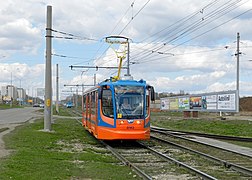 KTM-23 tram
 -
 Trolza 5250 Ecobus hybrid bus
 -
 ZiU-682 trolleybuses
 -
 Krasnodar-I railway station
 -
 Krasnodar International Airport (Pashkovsky) international passenger terminal


Education[edit]
In Krasnodar there are 15 gymnasiums (academic secondary schools) 5 lyceums (colleges of higher education), 110 schools of general education and 20 specialized schools, as well as 7 non-state lyceums and schools.[31]
The city has numerous institutions of higher education, including some state universities (Kuban State University, Kuban State Technological University, Kuban State Agrarian University, Kuban State Medical University, etc.). Other universities include: Marketing and Social Technology University of Krasnodar.
Coat of arms[edit]
The coat of arms of Yekaterinodar was introduced in 1841 by the Cossack yesaul Ivan Chernik. The royal letter "E" in the middle is for Ekaterina II (Russian for Catherine II). It also depicts the date the city was founded, the Imperial double headed eagle (symbolizing Tsar's patronage of the Black Sea Cossacks), a bulawa of a Cossack ataman, Yekaterinodar fortress, and flags with letters "E", "P", "A", and "N" standing for Catherine II, Paul I, Alexander I and Nicholas I. Yellow stars around the shield symbolized 59 Black Sea stanitsas around the city.
Notable people[edit]
- Nina Agadzhanova (1889–1974), film writer and director
- Viktoriya Baginskaya (1926–2012), Journalist, folklorist ( collector of songs and folklore of the Krymchaks ), one of the last speakers of the living Krymchak language.
- Alexandre Bondar (born 1972), writer and novelist
- Natalia Chernova (born 1976), gymnast
- Tatyana Chernova (born 1988), heptathlon athlete
- Violetta Egorova (born 1969), concert pianist
- Ilya Ezhov (born 1987), ice hockey goaltender, Gagarin Cup champion
- Pyotr Gavrilov (1900–1979), Soviet war hero, last defender of the Brest Fortress
- Alexander Karasyov (born 1971), writer
- Irina Karavayeva (born 1975), trampoline gymnast
- Eduard Koksharov (born 1975), handball player
- Viktor Likhonosov (1936–2021), writer
- Boris Loza (born 1960), information systems security professional
- Anna Netrebko (born 1971), opera singer
- Gennady Padalka (born 1958), cosmonaut
- Lazaros Papadopoulos, (born 1980), Greek basketball player
- Viktor Popkov (1946–2001), Old Believer & Humanitarian
- Andrei Shkuro (1887–1947), counter revolutionary
- Alexander Tamanian (1878–1936), neoclassical architect
- Sergei Tiviakov (born 1973), chess Grandmaster
- Sergei Vorzhev (1950–2023), artist
- Inna Zhukova (born 1986), rhythmic gymnast
- Yevgeniya Zhigulenko (1920-1994) navigator 46th Taman Guards Night Bomber Aviation Regiment, film-maker
International relations[edit]
Twin towns – sister cities[edit]
Krasnodar is twinned with:[32]


Partner cities[edit]
Krasnodar cooperates with:[32]


See also[edit]
Notes[edit]
- ^ /ˌkrɑːsnəˈdɑːr, -noʊ-/;[12] Russian: Краснода́р, IPA: [krəsnɐˈdar]; formerly Yekaterinodar (until 1920)
References[edit]
Notes[edit]
- ^ a b c d Reference Information #34.01-707/13-03
- ^ a b c Charter of Krasnodar Krai, Article 13
- ^ a b c Charter of Krasnodar, Article 1
- ^ a b Cities and Towns of Russia Encyclopedia, pp. 217–218
- ^ "Vice Governor of Kuban Naumov became mayor of Krasnodar". generico.ru. November 10, 2022.
- ^ Russian Federal State Statistics Service (2011). Всероссийская перепись населения 2010 года. Том 1 [2010 All-Russian Population Census, vol. 1]. Всероссийская перепись населения 2010 года [2010 All-Russia Population Census] (in Russian). Federal State Statistics Service.
- ^ "26. Численность постоянного населения Российской Федерации по муниципальным образованиям на 1 января 2018 года". Federal State Statistics Service. Retrieved January 23, 2019.
- ^ a b c Law #670-OZ
- ^ "Об исчислении времени". Официальный интернет-портал правовой информации (in Russian). June 3, 2011. Retrieved January 19, 2019.
- ^ Почта России. Информационно-вычислительный центр ОАСУ РПО. (Russian Post). Поиск объектов почтовой связи (Postal Objects Search) (in Russian)
- ^ a b
- Таблица 5. Численность населения России, федеральных округов, субъектов Российской Федерации, городских округов, муниципальных районов, муниципальных округов, городских и сельских поселений, городских населенных пунктов, сельских населенных пунктов с населением 3000 человек и более
- Стали известны окончательные итоги переписи населения в Краснодаре, но вопросы остались
- ^ Roach, Peter (2011). Cambridge English Pronouncing Dictionary (18th ed.). Cambridge: Cambridge University Press. ISBN 978-0-521-15253-2.
- ^ "Оценка численности постоянного населения Краснодарского края на 1 января 2023 года". Federal State Statistics Service. Retrieved April 12, 2023.
- ^ Azarenkova et al., pp. 9ff.
- ^ Azarenkova et al., p. 253.
- ^ "Renaming of the city of Yekaterinodar" (in Russian). Official site of the Education and Science Department of Krasnodar Krai. Archived from the original on April 4, 2013. Retrieved December 4, 2010.
- ^ "'Rachel's Challenge' promotes little acts of kindness among Calgary kids". britannica.com. January 14, 2009. Retrieved March 9, 2017.
- ^ Wolowyna, Oleh (October 2020). "A Demographic Framework for the 1932–1934 Famine in the Soviet Union". Journal of Genocide Research. 23 (4): 501–526. doi:10.1080/14623528.2020.1834741. S2CID 226316468.
- ^ Lichtblau (2014), p. 47-48
- ^ "Climate Krasnodar". Pogoda.ru.net. Retrieved November 8, 2021.
- ^ "KRASNODAR 1961–1990". NOAA. Retrieved October 29, 2021.
- ^ "Первая всеобщая перепись населения Российской Империи 1897 г.Распределение населения по родному языку и уездам Российской Империи кроме губерний Европейской России". demoscope.ru. Демоскоп Weekly. Archived from the original on September 24, 2020. Retrieved October 8, 2020.
- ^ Кавказский календарь на 1917 год [Caucasian calendar for 1917] (in Russian) (72nd ed.). Tiflis: Tipografiya kantselyarii Ye.I.V. na Kavkaze, kazenny dom. 1917. pp. 222–229. Archived from the original on November 4, 2021.
- ^ Поселенные итоги переписи 1926 года по Северо-Кавказскому краю (in Russian). Rostov-on-Don: Северо-Кавказкое краевое статистическое управление. 1929.
- ^ "Всесоюзная перепись населения 1939 года. Национальный состав населения районов, городов и крупных сел РСФСР". demoscope.ru. Демоскоп Weekly. Retrieved February 17, 2024.
- ^ "The Population of Krasnodar Reached 990 Thousand People". investment.krd.ru (in Russian). Retrieved November 30, 2018.
- ^ "Krasnodar again was named best city for business in Russia. RU". Vesti.kz. Retrieved December 17, 2012.
- ^ В рейтинге Минрегионразвития Краснодар лидирует по 16-ти из 26-ти позиций Archived May 4, 2013, at archive.today
- ^ Центральная Югополис, 30.04.2013
- ^ "The Splash Fountain in Krasnodar". Sergio-zevs.blogspot.com. September 25, 2011. Archived from the original on April 26, 2012. Retrieved December 17, 2012.
- ^ Рейтинг школ: кто первый? «Югополис», 05.01.2011
- ^ a b "Города-побратимы и города-партнёры". krd.ru (in Russian). Krasnodar. Archived from the original on February 3, 2020. Retrieved February 3, 2020.
Sources[edit]
- Городская Дума Краснодара. Решение №11 п. 6 от 21 апреля 2011 г. «О принятии Устава муниципального образования город Краснодар», в ред. Решения №78 п. 3 от 28 апреля 2015 г. «О внесении изменений в Устав муниципального образования город Краснодар». Вступил в силу со дня официального опубликования после государственной регистрации, за исключением пунктов 1–3, 5, 7, вступающих в силу со дня подписания. Опубликован: "Краснодарские известия", №89, 9 июня 2011 г. (City Duma of Krasnodar. Decision #11 p. 6 of April 21, 2011 On the Adoption of the Charter of the Municipal Formation of the City of Krasnodar, as amended by the Decision #78 p. 3 of April 28, 2015 On Amending the Charter of the Municipal Formation of the City of Krasnodar. Effective as of the day of the official publication after the state registration, with the exception of items 1–3, 5, 7, which take effect upon signing off.).
- «Устав Краснодарского края», в ред. Закона №2870-КЗ от 30 декабря 2013 г «О внесении изменений в Устав Краснодарского края». Опубликован: "Кубанские новости", 10 ноября 1993 г. ( Charter of Krasnodar Krai, as amended by the Law #2870-KZ of December 30, 2013 On Amending the Charter of Krasnodar Krai. ).
- Управление по взаимодействию с органами местного самоуправления Администрации Краснодарского края. Справочная информация №34.01-707/13-03 от 23 мая 2013 г. «Реестр административно-территориальных единиц Краснодарского края». (Department of Cooperation with the Organs of the Local Self-Government of the Administration of Krasnodar Krai. Reference Information #34.01-707/13-03 of May 23, 2013 Registry of the Administrative-Territorial Units of Krasnodar Krai. ).
- Законодательное Собрание Краснодарского края. Закон №670-КЗ от 10 марта 2004 г. «Об установлении границ муниципального образования город Краснодар и наделении его статусом городского округа», в ред. Закона №2435-КЗ от 3 февраля 2012 г «О внесении изменений в отдельные законодательные акты Краснодарского края об установлении границ муниципальных образований». Вступил в силу со дня официального опубликования. Опубликован: "Кубанские новости", №37–38, 13 марта 2004 г. (Legislative Assembly of Krasnodar Krai. Law #670-OZ of March 10, 2004 On Establishing the Borders of the Municipal Formation of the City of Krasnodar and on Granting It Urban Okrug Status, as amended by the Law #2435-KZ of February 3, 2012 On Amending Various Legislative Acts of Krasnodar Krai on Establishing the Borders of the Municipal Formations. Effective as of the day of the official publication.).
- Энциклопедия Города России (Cities and Towns of Russia, Encyclopedia). Moscow: Большая Российская Энциклопедия. 2003. ISBN 5-7107-7399-9.
- Азаренкова, А. С.; Бондарь, И. Ю.; Вертышева, Н. С. (1986). Основные административно-территориальные преобразования на Кубани (1793–1985 гг.) (in Russian). Краснодарское книжное издательство.
- Lichtblau, Eric. "The Nazis Next Door: How America Became A Safe Haven For Hitler's Men" (2014) pp: 47–48.
Bibliography[edit]
External links[edit]


- Official website of Krasnodar City Administration and City Duma
- Krasnodar news
- News and events in Krasnodar
- Old pictures of Yekaterinodar


| International | |
|---|---|
| National | |
| Geographic | |
| Other | |