


180 (number)
| ||||
|---|---|---|---|---|
| Cardinal | one hundred eighty | |||
| Ordinal | 180th (one hundred eightieth) | |||
| Factorization | 22 × 32 × 5 | |||
| Divisors | 1, 2, 3, 4, 5, 6, 9, 10, 12, 15, 18, 20, 30, 36, 45, 60, 90, 180 | |||
| Greek numeral | ΡΠ´ | |||
| Roman numeral | CLXXX | |||
| Binary | 101101002 | |||
| Ternary | 202003 | |||
| Senary | 5006 | |||
| Octal | 2648 | |||
| Duodecimal | 13012 | |||
| Hexadecimal | B416 | |||
180 (one hundred [and] eighty) is the natural number following 179 and preceding 181.
In mathematics[edit]
180 is an abundant number, with its proper divisors summing up to 366.[1][2] 180 is also a highly composite number, a positive integer with 18 divisors, more than any smaller positive integer.[3] One of the consequences of 180 having so many divisors is that it is a practical number, meaning that any positive number smaller than 180 that is not a divisor of 180 can be expressed as the sum of some of 180's divisors. 180 is a Harshad number and a refactorable number.[4]
180 is the sum of two square numbers: 122 + 62. It can be expressed as either the sum of six consecutive prime numbers: 19 + 23 + 29 + 31 + 37 + 41, or the sum of eight consecutive prime numbers: 11 + 13 + 17 + 19 + 23 + 29 + 31 + 37. 180 is an Ulam number, which can be expressed as a sum of earlier terms in the Ulam sequence only as 177 + 3.[5]
180 is a 61-gonal number,[2] while 61 is the 18th prime number.
Half a circle has 180 degrees,[6] and thus a U-turn is also referred to as a 180.
Summing Euler's totient function φ(x) over the first + 24 integers gives 180.
In binary it is a digitally balanced number, since its binary representation has the same number of zeros as ones (10110100).
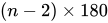
A triangle has three interior angles that collectively total 180 degrees. In general, the interior angles of an -sided polygon add to degrees.

In religion[edit]
The Book of Genesis says that Isaac died at the age of 180.[7]
In sports[edit]
- 180 is the highest score possible with three darts.
See also[edit]
- List of highways numbered 180
- United Nations Security Council Resolution 180
- United States Supreme Court cases, Volume 180
- Pennsylvania House of Representatives, District 180
References[edit]
- ^ "Positive Integers: 180".
- ^ a b "The Number 180". VirtueScience.com. Archived from the original on 2021-01-23. Retrieved 2009-05-29.
- ^ Sloane, N. J. A. (ed.). "Sequence A002182 (Highly composite numbers)". The On-Line Encyclopedia of Integer Sequences. OEIS Foundation. Retrieved 2016-05-30.
- ^ "Refactorable numbers". On-Line Encyclopedia of Integer Sequences. The OEIS Foundation. 2016-04-18. Retrieved 2016-04-18.
- ^ "Ulam numbers". On-Line Encyclopedia of Integer Sequences. The OEIS Foundation. 2016-04-18. Retrieved 2016-04-18.
- ^ Wells, D. (1987). The Penguin Dictionary of Curious and Interesting Numbers. London: Penguin Group. p. 142. ISBN 0-14-026149-4.
- ^ Genesis 35:28–29
External links[edit]

- "180". The Number Dictionary.
- G. L. Honaker, Jr. "Prime curiosities: 180". UTM.