


104 (number)
| ||||
|---|---|---|---|---|
| Cardinal | one hundred four | |||
| Ordinal | 104th (one hundred fourth) | |||
| Factorization | 23 × 13 | |||
| Divisors | 1, 2, 4, 8, 13, 26, 52, 104 | |||
| Greek numeral | ΡΔ´ | |||
| Roman numeral | CIV | |||
| Binary | 11010002 | |||
| Ternary | 102123 | |||
| Senary | 2526 | |||
| Octal | 1508 | |||
| Duodecimal | 8812 | |||
| Hexadecimal | 6816 | |||
104 (one hundred [and] four) is the natural number following 103 and preceding 105.
In mathematics[edit]
104 forms the fifth Ruth-Aaron pair with 105, since the distinct prime factors of 104 (2 and 13) and 105 (3, 5, and 7) both add up to 15.[1] Also, the sum of the divisors of 104 aside from unitary divisors, is 105. With eight total divisors where 8 is the fourth largest, 104 is the seventeenth refactorable number.[2] 104 is also the twenty-fifth primitive semiperfect number.[3]
The sum of all its divisors is σ(104) = 210, which is the sum of the first twenty nonzero integers,[4] as well as the product of the first four prime numbers (2 × 3 × 5 × 7).[5]
Its Euler totient, or the number of integers relatively prime with 104, is 48.[6] This value is also equal to the totient of its sum of divisors, φ(104) = φ(σ(104)).[7]
The smallest known 4-regular matchstick graph has 104 edges and 52 vertices, where four unit line segments intersect at every vertex.[8]
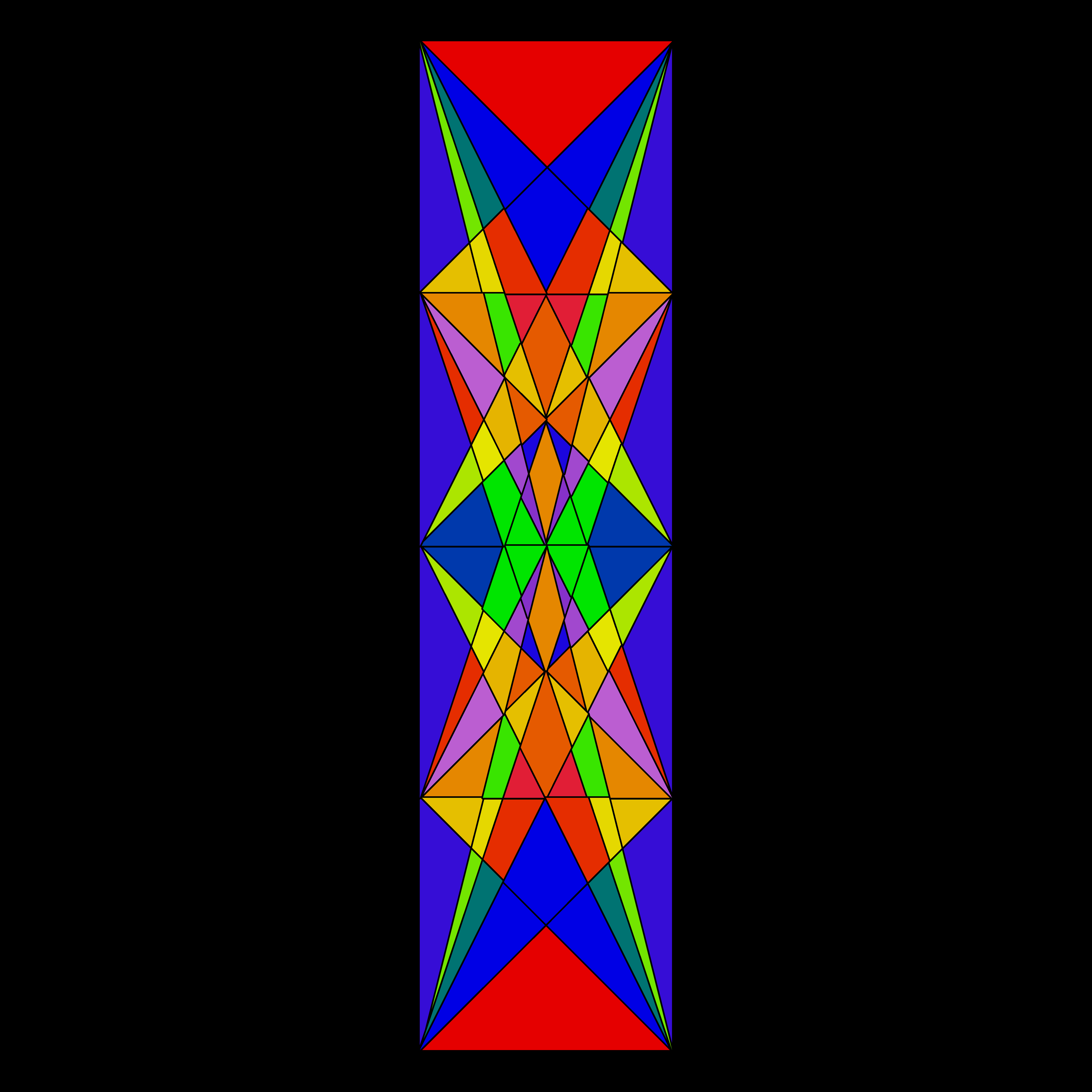
A row of four adjacent congruent rectangles can be divided into a maximum of 104 regions, when extending diagonals of all possible rectangles.[9]
Regarding the second largest sporadic group , its McKay–Thompson series representative of a principal modular function is , with constant term :[10]



The Tits group , which is the only finite simple group to classify as either a non-strict group of Lie type or sporadic group, holds a minimal faithful complex representation in 104 dimensions.[11] This is twice the dimensional representation of exceptional Lie algebra in 52 dimensions, whose associated lattice structure forms the ring of Hurwitz quaternions that is represented by the vertices of the 24-cell — with this regular 4-polytope one of 104 total four-dimensional uniform polychora, without taking into account the infinite families of uniform antiprismatic prisms and duoprisms.


In other fields[edit]
104 is also:
- The atomic number of rutherfordium.
- The number of Corinthian columns in the Temple of Olympian Zeus, the largest temple ever built in Greece.
- The number of Symphonies written by Joseph Haydn upon which numbers are agreed (though in fact, he wrote two more: see list of symphonies by Joseph Haydn).
See also[edit]
- List of highways numbered 104
- The years 104 BC and AD 104.
References[edit]
- ^ Sloane, N. J. A. (ed.). "Sequence A006145 (Ruth-Aaron numbers (1): sum of prime divisors of n is equal to the sum of prime divisors of n+1.)". The On-Line Encyclopedia of Integer Sequences. OEIS Foundation. Retrieved 2023-07-31.
- ^ Sloane, N. J. A. (ed.). "Sequence A033950 (Refactorable numbers: number of divisors of k divides k. Also known as tau numbers.)". The On-Line Encyclopedia of Integer Sequences. OEIS Foundation. Retrieved 2023-07-31.
- ^ Sloane, N. J. A. (ed.). "Sequence A006036 (Primitive pseudoperfect numbers.)". The On-Line Encyclopedia of Integer Sequences. OEIS Foundation. Retrieved 2016-05-27.
- ^ Sloane, N. J. A. (ed.). "Sequence A000217 (Triangular numbers)". The On-Line Encyclopedia of Integer Sequences. OEIS Foundation. Retrieved 2023-07-31.
- ^ Sloane, N. J. A. (ed.). "Sequence A002110 (Primorial numbers (first definition): product of first n primes. Sometimes written prime(n)#.)". The On-Line Encyclopedia of Integer Sequences. OEIS Foundation. Retrieved 2023-07-31.
- ^ Sloane, N. J. A. (ed.). "Sequence A000010 (Euler totient function phi(n): count numbers less than or equal to n and prime to n.)". The On-Line Encyclopedia of Integer Sequences. OEIS Foundation. Retrieved 2023-07-31.
- ^ Sloane, N. J. A. (ed.). "Sequence A006872 (Numbers k such that phi(k) is phi(sigma(k)))". The On-Line Encyclopedia of Integer Sequences. OEIS Foundation.
- ^ Winkler, Mike; Dinkelacker, Peter; Vogel, Stefan (2017). "New minimal (4; n)-regular matchstick graphs". Geombinatorics Quarterly. XXVII (1). Colorado Springs, CO: University of Colorado, Colorado Springs: 26–44. arXiv:1604.07134. S2CID 119161796. Zbl 1373.05125.
- ^ Sloane, N. J. A. (ed.). "Sequence A306302 (...Number of regions (or cells) formed by drawing the line segments connecting any two of the 2*(m+n) perimeter points of an m X n grid of squares.)". The On-Line Encyclopedia of Integer Sequences. OEIS Foundation. Retrieved 2022-05-09.
- ^ Sloane, N. J. A. (ed.). "Sequence A007267 (Expansion of 16 * (1 + k^2)^4 /(k * k'^2)^2 in powers of q where k is the Jacobian elliptic modulus, k' the complementary modulus and q is the nome.)". The On-Line Encyclopedia of Integer Sequences. OEIS Foundation. Retrieved 2023-07-31.
- ^ Lubeck, Frank (2001). "Smallest degrees of representations of exceptional groups of Lie type". Communications in Algebra. 29 (5). Philadelphia, PA: Taylor & Francis: 2151. doi:10.1081/AGB-100002175. MR 1837968. S2CID 122060727. Zbl 1004.20003.
- Wells, D. The Penguin Dictionary of Curious and Interesting Numbers London: Penguin Group. (1987): 133