


Automatic writing

Automatic writing, also called psychography, is a claimed psychic ability allowing a person to produce written words without consciously writing. Practitioners engage in automatic writing by holding a writing instrument and allowing alleged spirits to manipulate the practitioner's hand. The instrument may be a standard writing instrument, or it may be one specially designed for automatic writing, such as a planchette or a ouija board.
Religious and spiritual traditions have incorporated automatic writing, including Fuji in Chinese folk religion and the Enochian language associated with Enochian magic. In the modern era, it is associated with Spiritualism and the occult, with notable practitioners including W. B. Yeats and Arthur Conan Doyle. There is no evidence supporting the existence of automatic writing, and claims associated with it are unfalsifiable. Documented examples are considered to be the result of the ideomotor phenomenon.[1][2][3][4]
History
[edit]Early history
[edit]| Part of a series on |
| Spiritualism |
|---|
 Philosophy portal · Philosophy portal ·  Religion portal Religion portal |
| Part of a series on the |
| Paranormal |
|---|
Spirit writing, later called Fuji (扶乩/扶箕), has a long tradition in China, where messages from various deities and spirits were received by mediums since the Song dynasty. In the 19th century, messages received through spirit writing led to the foundation of several Chinese salvationist religions.[5] The spread of Chinese cultural techniques, such as printing and painting, introduced the influence of "spirit writing", practised by Japanese Zen Ōbaku monks, who were said to communicate with an ancient Taoist sage credited with creating the kung fu system.[6]
In the West, an early example of the practice is the 16th-century Enochian language, allegedly dictated to John Dee and Edward Kelley by Enochian angels and integral to the practice of Enochian magic.[7] The language is said to be extremely detailed and complex in its grammar and rules.[8] Dee also claimed that the Enochian instruction included information regarding the elixir of life in the ruins of Glastonbury Abbey.[8]
Approach
[edit]Parapsychologist William Fletcher Barrett wrote that "automatic messages may take place either by the writer passively holding a pencil on a sheet of paper, or by the planchette, or by an 'ouija board'."[9] In Spiritualism, spirits are claimed to take control of the hand of a medium to write messages, letters, and even entire books.[10] Automatic writing can happen in a trance or waking state.[11] Some psychical researchers such as Thomson Jay Hudson have claimed no spirits are involved in automatic writing and the subconscious mind is the explanation.[12]
Hoaxes
[edit]Paranormal investigator Harry Price exposed the supposed automatic writing in the Borley Rectory as the wall-scrawling of a housewife attempting to hide an extramarital affair.[4]
A prominent alleged example of automatic writing is the Brattleboro hoax. When Charles Dickens died in 1870, he left The Mystery of Edwin Drood unfinished. According to the itinerant printer T. P. James, this angered Dickens' spirit so much that he channelled the rest of the novel through James's hand. This is supposed to have begun on Christmas Eve 1872 and continued in tri-weekly sessions until completion.[13]
Practitioners
[edit]Automatic writing as a spiritual practice was reported by Hyppolyte Taine in the preface to the third edition of his De l'intelligence, published in 1878.[14] Besides "ethereal visions" or "magnetic auras", Fernando Pessoa claimed to have experienced automatic writing. He said he felt "owned by something else", sometimes feeling a sensation in the right arm he claimed was lifted into the air without his will.[15] Georgie Hyde-Lees, the wife of William Butler Yeats, also claimed she could write automatically.[16] Sri Aurobindo and his follower, The Mother (Mirra Alfassa), regularly practiced Automatic writing.
Shortly after his 1917 marriage to Georgie Hyde-Lees, the poet W. B. Yeats came to be heavily influenced by her delving into what they referred to as "the automatic script".[17]
In his 1918 book The New Revelation, Arthur Conan Doyle wrote that automatic writing occurs either by the writer's subconscious or by external spirits operating through the writer.[18] Doyle and his wife led an automatic writing séance with Harry Houdini wherein Lady Doyle wrote 15 pages of purported messages from Houdini's mother, although this information was immediately discounted as fraudulent by Houdini.[19]
The essay The Automatic Message (1933), first published in the magazine Minotaure, No. 3-4, (Paris), was one of André Breton's significant theoretical works about automatism. In 1919, Breton and Philippe Soupault had used what later became the Surrealist automatism method to compose Les Champs Magnétiques (The Magnetic Fields).[20] In 1997, "The Magnetic Fields" was also the title of a compilation of surrealist writing of André Breton, Paul Éluard, Philippe Soupault, and others. It included the authorized translation of Breton's The Automatic Message in English by the poet David Gascoyne, whose Man's Life is This Meat (1936) (a collection of his own surrealist writings and translations of the French surrealists) and Hölderlin's Madness (1938) established Gascoyne's reputation as one of a small group of English surrealists. Gascoyne's 1935 A Short Survey of Surrealism for the 1936 London International Surrealist Exhibition also expanded the movement to the English-speaking world. The Surrealist poet Robert Desnos claimed he was among the most gifted in automatic writing.[21] Surrealist automatists, most notably André Masson, adapted these methods to art-making in which the artist suppresses conscious control over the making process, allowing the unconscious mind to have great sway. Prior to the Surrealists, Dadaists, such as Hans Arp, made some use of this method through chance operations.[22]
The medium Pierre L. O. A. Keeler had an alleged spirit writing communication from Abraham Lincoln currently exhibited at the Lily Dale Museum.[23] Despite Lincoln being well-known for his skepticism and Keeler having been known to employ magician's tricks, this is used as one of the many examples of skeptics purportedly endorsing Spiritualism posthumously.[24] Skeptical investigator Joe Nickell who conducted a detailed examination of the "spirit" writing, concluded it had no resemblance to Lincoln's handwriting and described the message as "bogus".[25]
There was an apocalyptic cult led by a lapsed Scientologist named Dorothy Martin. She and her followers were waiting for an alien ship to take them to the nonexistent planet Clarion and save them from a worldwide flood that was to commence at midnight on December 20, 1954. When that did not occur, Martin allegedly got an automatic writing message from God calling the whole thing off.[26][27]
Since 1975
[edit]In 1975, Wendy Hart of Maidenhead claimed she wrote automatically about Nicholas Moore, a sea captain who died in 1642.[28] Also in 1975 the CIA attempted to employ remote viewing through the Stargate Project. In the spring of 1989, Angela Dellafiora, a member of Stargate Project's remote viewing unit, claimed to be guided by spirits moving her hand in writing responses about the location of a fugitive DEA agent named Charlie Jordan. In reviewing the matter, Joe Nickell states, "[T]he Charlie Jordan case, touted as one of the most successful examples... in the U.S. government's psychic-spying project is not convincing evidence of anything — save perhaps folly. ...[I]t also illustrates the limitations of anecdotal evidence: conflicting versions, selective reporting, and lack of documentation, together with additional manifestations of faulty memory, bias, and other human foibles."[29]
Conspiracy theorist David Icke said he first became aware of being "Son of the Godhead" via automatic writing.[30] Vassula Ryden claims to receive and transcribe messages from her guardian angel Daniel, Jesus, Yahweh.[31] She has provoked both skepticism and credulity from Catholic laity and clergy, as well as the skeptical community at large.[32] Alleged cases of automatic writing have included Joseph Smith,[33] Patience Worth,[4] Aleister Crowley,[34] Jane Roberts,[35] Helen Schucman[36] and author Neale Donald Walsch.[37][38] Crowley, for instance, compiled the Collected Works over time, which included The Book of the Law as well as transcripts of his visions of the first two Enochian Aethyrs (planes).[39]
Scientific analysis and skepticism
[edit]Scientists and skeptics consider automatic writing to be the result of the ideomotor effect.[1][2][3][4]
According to skeptical investigator Joe Nickell, "automatic writing is produced while one is in a dissociated state. It is a form of motor automatism, or unconscious muscular activity."[40] Neurologist Terence Hines has written "automatic writing is an example of a milder form of dissociative state".[41] In 1900, Swiss psychologist Theodore Flournoy studied the case of the French medium Helene Smith, particularly her handwriting during seances.[10] He concluded that the automatic writing phenomenon was an effect of autosuggestion produced by autohypnotization, leading to the emergence of a secondary self.[10]
Paranormal researcher Ben Radford writes in his 2017 book Investigating Ghosts that there is no real way to know if the writing is coming from "outside their bodies," you "must take their word for it. Because the source of the information is at issue and the medium cannot be validated, we must turn to the content of the material." Various psychic mediums have claimed to channel famous dead people, such as Susan Lander, who claimed that Betsy Ross contacted her to say, "I am gay and I fly the flag of pride and liberty for all of us." According to Radford, historians say that there is "no credible historical evidence that Ross ... either made or had a hand in designing the American flag." Without some kind of validation, "anyone can claim to communicate with the spirit of anyone." Radford argues that "Automatic writing should logically hinder, not help spirit communication," given spelling and grammar are more difficult than direct speech. [42]
Scientific studies
[edit]In an 1890 paper on hypnotism Morton Prince claims, "automatic writing is not a purely unconscious reflex act, but, the product of conscious individuality," and further claims that the hand that is writing is under the control of a separate hypnotic personality during trances.[43][44] Physician Charles Arthur Mercier in the British Medical Journal (1894) criticized the spiritualist interpretation of automatic writing, concluding, "there is no need nor room for the agency of spirits, and the invocation of such agency is the sign of a mind not merely unscientific, but uninformed."[45]
Psychology professor Théodore Flournoy investigated the claim by nineteenth-century medium Hélène Smith (Catherine Müller) she did automatic writing to convey messages from Mars in Martian language. Flournoy concluded her "Martian" language had a strong resemblance to Ms. Smith's native language of French and her automatic writing was "romances of the subliminal imagination, derived largely from forgotten sources (for example, books read as a child)." He invented the term cryptomnesia to describe this phenomenon.[46]
In 1927, psychiatrist Harold Dearden wrote that automatic writing is a psychological method of "tapping" the unconscious mind and there is nothing mysterious about it.[47]
In 1986, A. B. Joseph investigated two female patients who were found to exhibit ictal hypergraphia.[48]
Automatic writing behavior was discovered by Dilek Evyapan and Emre Kumral in three patients with right hemispheric damage.[49]
A 2012 study of ten psychographers using single photon emission computed tomography showed differences in brain activity and writing complexity during alleged trance states vs. normal state writing.[50]
Pop culture and media
[edit]Automatic writing is touted by medium Bonnie Page in a Sentinel and Enterprise article as a method of accessing claircognizance abilities.[51]
Automatic writing is featured prominently in a 1961 episode of Perry Mason, The Case of the Meddling Medium, and is also depicted in the 1980 film The Changeling and the 1999 film The Sixth Sense.
Portions of Van Morrison's album Astral Weeks supposedly are inspired by dreams, reveries, and automatic writing.[52]
Czech director Jan Švankmajer claims he concocted the screenplay for his hybrid film Insect (Hmyz) in a fit of automatic writing.[53]
William S. Burroughs has described his book Naked Lunch as "automatic writing gone horribly wrong" and believed he found his subconscious taken over by a hostile entity.[54][55]
In an interview in GQ, David Byrne indicated an interest in automatic writing due to the influence of Brian Eno.[56]
Gallery
[edit]-
 Automatic writing of Mina Crandon
 -
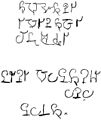 Automatic writing of Hélène Smith
 -
 Automatic writing of Mrs Thomas Everitt
 -
 Example of automatic writing cited by magician William Marriott
 -
 Automatic writing of Francis Ward Monck


See also
[edit]- Alien hand syndrome – Neuropsychiatric disorder
- Automatic drawing
- Artistic inspiration
- Asemic writing
- Automatic speech
- Memoirs of a Suicide
- Chico Xavier
- Joseph Sieber Benner
- Bicameral mentality – Hypothesis in psychology
- Divided consciousness
- Dowsing
- Dual consciousness
- Graphology
- Left brain interpreter
- List of topics characterized as pseudoscience
- Matthew Manning – British Author and Healer
- Oahspe: A New Bible – claimed to be written via automatic writing
- Spiritism
- Spiritism
- Spiritualist art
- Speaking in tongues
- Surrealist automatism
- Table-turning
- Xenoglossy
References
[edit]- ^ a b Burgess, C.A., Kirsch, I., Shane, H., Niederauer, K.L., Graham, S.M., & Bacon, A. (1998). Facilitated Communication as an Ideomotor Response. Psychological Science 9: 71-74.
- ^ a b Heap, Michael. (2002). Ideomotor Effect (the Ouija Board Effect). In Michael Shermer. The Skeptic Encyclopedia of Pseudoscience. ABC-CLIO. pp. 127–129. ISBN 1-57607-654-7
- ^ a b Erickson, Milton H; Hershman, Seymour: Secter, Irving I. (2014). The Practical Application of Medical and Dental Hypnosis. Routledge. pp. 68–69. ISBN 0-87630-570-2
- ^ a b c d Stollznow, Karen (2011). "Bad Language". No. 3. Skeptic Magazine.
- ^ Wang Chien-ch'uan, "Spirit Writing Groups in Modern China (1840–1937): Textual Production, Public Teachings, and Charity." In Modern Chinese Religion II 1850–2015, edited by Vincent Goossaert, Jan Kiely and John Lagerwey, Leiden: Brill, vol. 2, 651–684.
- ^ Haskel, Peter (2001). Letting Go: The Story of Zen Master Tōsui. University of Hawaii Press. pp. 37–38. ISBN 0-8248-2440-7.
- ^ Stollznow, Karen. (2014). Language Myths, Mysteries and Magic. Palgrave Macmillan. p. 114. ISBN 978-1-137-40484-8
- ^ a b Da'Neos, Frater (2003). Musings of a Thelemite. Wright City, MO: Alchemy Press. p. 152. ISBN 978-0977691104.
- ^ William Fletcher Barrett On the Threshold of the Unseen Cambridge University Press, 2011, p. 162
- ^ a b c Kontou, Tatiana (23 March 2016). The Ashgate Research Companion to Nineteenth-Century Spiritualism and the Occult. Routledge. ISBN 9781317042273.
- ^ "Dictionary Definition". Retrieved 13 May 2020.
- ^ Thomson Jay Hudson, The Law of Psychic Phenomena, Wildhern Press, 2009, p. 252
- ^ Heller, Paul. "DICKENS in the SPIRIT WORLD — the Brattleboro hoax". rutlandherald.com. The Rutland Herald. Retrieved 25 April 2018.
- ^ Taine, Hippolyte (1870). De l'intelligence. p. 252. Retrieved 23 April 2018.
- ^ Pessoa, Fernando (1999), Correspondência 1905–1922, Assírio & Alvim, pp. 214–219, ISBN 978-85-7164-916-3.
- ^ Marjorie Elizabeth Howes, John S. Kelly, The Cambridge Companion to W.B. Yeats, 2006, p. 11
- ^ Hedayati-Rad, Arjang. "W. B. Yeats, George Hyde-Lees, and the Automatic Script". CSUN.edu. Retrieved 24 April 2018.
- ^ Arthur Conan Doyle The New Revelation 2010 Reprint Edition, p. 47
- ^ Loxton, James; Loxton, Daniel. "Great American Skeptics" (PDF). Skeptic.com. Pat Linse. Retrieved 24 April 2018.
- ^ Chilvers, Ian and Glaves-Smith, John, A Dictionary of Modern and Contemporary Art, second edition (Oxford and New York: Oxford University Press, 2009), p. 45-46. ISBN 0199239665.
- ^ Thacker, Eugene (16 October 2013). "THE PERIOD OF THE SLEEPING FITS". Metamute.org. Retrieved 24 April 2018.
- ^ The Surrealists: Revolutionaries in art & writing 1919–1935, Jemma Montagu
- ^ Lily Dale Museum
- ^ Nickell, Joe (September 2004). "Abraham Lincoln: An Instance of Alleged 'Spirit Writing'". csicop.org. Skeptical Inquirer. Retrieved 25 April 2018.
- ^ Nickell, Joe. (2007). Adventures in Paranormal Investigation. University Press of Kentucky. pp. 42–47. ISBN 978-0-8131-2467-4.
- ^ Sharps, Matthew J.; Liao, Schuyler W.; Herrera, Megan R. (November 2014). "Remembrance of Apocalypse Past: The Psychology of True Believers When Nothing Happens". csicop.org. Skeptical Inquirer. Retrieved 25 April 2018.
- ^ Debies-Carl, Jeffrey S. (November 2017). "Pizzagate and Beyond: Using Social Research to Understand Conspiracy Legends". csicop.org. Skeptical Inquirer. Retrieved 25 April 2018.
- ^ Rabey, Arthur Ivan (1979). The book of St Columb & St Mawgan - the story of two ancient parishes. Buckingham - Barracuda Books. ISBN 978-0860230588. Retrieved 23 April 2018.
- ^ Nickell, Joe (March 2001). "Remotely Viewed? The Charlie Jordan Case". csicop.org. Skeptical Inquirer. Retrieved 25 April 2018.
- ^ Richardson, Andy (28 March 2018). "Controversial conspiracy theorist David Icke is doing a secret gig in Birmingham". birminghammail.co.uk. Retrieved 24 April 2018.
- ^ Curty, Christian. "A Letter of Our Lord to His Church". True Life in God. Retrieved 24 April 2018.
- ^ Nickell, Joe (March 2011). "Heaven's Stenographer: The 'Guided' Hand of Vassula Ryden". Committee for Skeptical Inquiry. Center for Inquiry. Retrieved 25 April 2018.
- ^ Dunn, Scott C. (2002). "Automaticity and the Dictation of the Book of Mormon". American Apocrypha: Essays on the Book of Mormon. Vogel, Dan, and Metcalfe, Brent Lee, Eds. Salt Lake City, Utah: Signature Books. ISBN 978-1560851516. OCLC 47870060.
- ^ Crowley, Aleister. "The Book of the Law". Archive.org. Retrieved 23 April 2018.
- ^ Seth (Spirit); Roberts, Jane; Butts, Robert F. (1994). Seth Speaks: The Eternal Validity of the Soul. New World Library. ISBN 9781878424075. Retrieved 23 April 2018.
- ^ A Course in Miracles. A Course in Miracles (1975). 1975. ISBN 9780670869756. Retrieved 23 April 2018.
- ^ Walsch, Neale D. (29 October 1996). Conversations with God: An Uncommon Dialogue Book 1. Tarcher Perigee. ISBN 9780399142789. Retrieved 23 April 2018.
- ^ Sue Lim Good Spirits, Bad Spirits: How to Distinguish Between Them 2002, p. 82
- ^ Churton, Tobias (2012). Aleister Crowley: The Biography – Spiritual Revolutionary, Romantic Explorer, Occult Master and Spy. London: Watkins Media Limited. p. 148. ISBN 9781780283845.
- ^ Nickell, Joe. (2007). "A Case of Automatic Writing From Robert G. Ingersoll's Spirit?". Csicop.org. Retrieved 2014-10-11.
- ^ Hines, Terence. (2003). Pseudoscience and the Paranormal. Prometheus Books. p. 48. ISBN 1-57392-979-4
- ^ Radford, Ben (2017). Investigating Ghosts: The Scientific Search for Spirits. Corrales, New Mexico: Rhombus Publishing Company. pp. 182–185. ISBN 9780936455167.
- ^ Prince, Morton (1975). Psychotherapy and Multiple Personality: Selected Essays, Volume 2. Harvard University Press. pp. 37–60. ISBN 978-0674722255. Retrieved 24 April 2018.
- ^ Prince, Morton (15 May 1890). "Some of the Revelations of Hypnotism – Post-Hypnotic Suggestion, Automatic Writing and Double Personality". Boston Medical and Surgical Journal. CXXII (20): 463–467. doi:10.1056/NEJM189005151222001.
- ^ Mercier, Charles Arthur (1894). "Automatic Writing". British Medical Journal. 1 (1726): 198–199. doi:10.1136/bmj.1.1726.198. PMC 2403845. PMID 20754638.
- ^ Randi, James. (1995). An Encyclopedia of Claims, Frauds, and Hoaxes of the Occult and Supernatural. St. Martin's Press. p. 22. ISBN 0-312-15119-5
- ^ Dearden, Harold. (April 9, 1927). How Spiritualists are Deluded. The Graphic pp. 50–51.
- ^ Joseph, A. B. (1986). "A hypergraphic syndrome of automatic writing, affective disorder, and temporal lobe epilepsy in two patients". The Journal of Clinical Psychiatry. 47 (5): 255–257. PMID 3084454. Retrieved 24 April 2018.
- ^ Evyapan, Dilek; Kumral, Emre, (2001). Visuospatial Stimulus-Bound Automatic Writing Behavior: A Right Hemispheric Stroke Syndrome. Neurology 56: 245–247.
- ^ Perez, Julio Fernando; Moreira-Almeida, Alexander; Caixeta, Leonardo; Leao, Frederico; Newberg, Andrew (16 November 2012). "Neuroimaging during Trance State: A Contribution to the Study of Dissociation". PLOS ONE. 7 (11): e49360. Bibcode:2012PLoSO...749360P. doi:10.1371/journal.pone.0049360. PMC 3500298. PMID 23166648.
- ^ Page, Bonnie (17 April 2018). "'Know' something without knowing why? You could be claircognizant". Sentinel & Enterprise. Retrieved 24 April 2018.
- ^ Michaud, Jon (7 March 2018). "The Miracle of Van Morrison's "Astral Weeks"". The New Yorker. Retrieved 24 April 2018.
- ^ Mintzer, Jordan (2 February 2018). "'Insect' ('Hmyz'): Film Review - Rotterdam 2018". hollywoodreporter.com. Retrieved 24 April 2018.
- ^ "William S. Burroughs & Surrealist Writing Methods". knowledgelost.org. Retrieved 25 April 2018.
- ^ Wills, David S. (21 September 2017). "What the Beats can teach us about writing". beatdom.com. Retrieved 25 April 2018.
- ^ Pappademas, Alex (16 April 2018). "This Must Be David Byrne". Gq. Retrieved 24 April 2018.
Further reading
[edit]- Carpenter, William Benjamin (12 March 1852). "On the Influence of Suggestion in Modifying and directing Muscular Movement, independently of Volition". Notices of the Meetings. Royal Institution of Great Britain. Retrieved 2 March 2011. (The document is in English but the linked website is in German.)
- Downey, June E.; Anderson, John E. (1915). "Automatic Writing". American Journal of Psychology. 26 (2): 161. doi:10.2307/1413248. JSTOR 1413248.
- Joseph, A. B. (1986). "A hypergraphic syndrome of automatic writing, affective disorder, and temporal lobe epilepsy in two patients". The Journal of Clinical Psychiatry. 47 (5): 255–257. ISSN 0160-6689. PMID 3084454.
- Walsh, E.; Mehta, M.A.; Oakley, D.A.; Guilmette, D.N.; Gabay, A.; Halligan, P.W.; Deeley, Q. (2014). "Using suggestion to model different types of automatic writing". Consciousness and Cognition. 26: 24–36. doi:10.1016/j.concog.2014.02.008. ISSN 1053-8100. PMID 24657632. S2CID 5200153.
- Zusne, Leonard; Jones, Warren H. (1989). Anomalistic psychology: a study of magical thinking (2nd ed.). Hillsdale, N.J.: L. Erlbaum Associates. ISBN 0-8058-0507-9. OCLC 19264110.
- Carroll, Robert Todd (2003). The skeptic's dictionary: a collection of strange beliefs, amusing deceptions, and dangerous delusions. Hoboken, NJ: Wiley. ISBN 0-471-48088-6. OCLC 55751218.
- Randi, James (1997). An encyclopedia of claims, frauds, and hoaxes of the occult and supernatural: James Randi's decidedly skeptical definitions of alternative realities (1st ed.). New York: St. Martin's Griffin. ISBN 0-312-15119-5. OCLC 35978760.
- Shermer, Michael (1 February 2011). "Houdini's Skeptical Advice: Just Because Something's Unexplained Doesn't Mean It's Supernatural". Scientific American. 304 (2): 89. doi:10.1038/scientificamerican0211-89. PMID 21319549. Retrieved 13 May 2020.
External links
[edit]- Chisholm, Hugh, ed. (1911). . Encyclopædia Britannica (11th ed.). Cambridge University Press.


| Founders |  | |
|---|---|---|
| Influences | ||
| Ministers | ||
| Notable groups | ||