


Batman (1966 film)
| Batman | |
|---|---|
 Theatrical release poster | |
| Directed by | Leslie H. Martinson |
| Written by | Lorenzo Semple Jr. |
| Based on | |
| Produced by | William Dozier |
| Starring | |
| Cinematography | Howard Schwartz |
| Edited by | Harry Gerstad |
| Music by | Nelson Riddle |
Production company | Greenlawn Productions |
| Distributed by | 20th Century-Fox |
Release date |
|
Running time | 104 minutes[1] |
| Country | United States |
| Language | English |
| Budget | $1.378 million[2][3] |
| Box office | $3.9 million (rentals)[4] |
Batman (also known as Batman: The Movie) is a 1966 American superhero film directed by Leslie H. Martinson. Based on the television series, and the first full-length theatrical adaptation of the DC Comics character of the same name, the film stars Adam West as Batman and Burt Ward as Robin. The film hit theaters two months after the last episode of the first season of the television series. The film includes most members of the original TV cast, with the exception of Julie Newmar as Catwoman, who, in the movie, was replaced by Lee Meriwether.
Plot[edit]
When Batman and Robin get a tip that Commodore Schmidlapp, owner of the Big Ben Distillery, is in danger aboard his yacht, they launch a rescue mission using the Batcopter. As Batman descends on the bat-ladder to land on the yacht, it suddenly vanishes beneath him. He rises out of the sea with a shark attacking his leg. After Batman dislodges it with bat-shark repellent, the shark explodes. Batman and Robin head back to Commissioner Gordon's office, where they deduce that the tip was a set-up by the United Underworld, a gathering of four of the most powerful villains in Gotham City: the Joker, the Penguin, the Riddler, and the Catwoman.
The four criminals equip themselves with a dehydrator that can turn humans into dust (an invention of Schmidlapp's, who is unaware that he has been kidnapped), escape in a war-surplus, pre-atomic submarine made to resemble a penguin, and recruit three pirate-themed henchmen (Bluebeard, Morgan and Quetch). Batman and Robin learn that the yacht was really a holographic projection and return via Batboat to a buoy concealing a projector, where they are trapped on the buoy by a magnet and targeted by torpedoes. They use a radio-detonator to destroy two of the missiles, and a porpoise sacrifices itself to intercept the last one. Catwoman, disguised as Soviet journalist "Kitayna Ireyna Tatanya Kerenska Alisoff" (acronymed as Kitka) of the Moscow Bugle, helps the group kidnap Bruce Wayne and pretends to be kidnapped with him, as part of a plot to lure Batman and finish him off with another of Penguin's explosive animals (of course unaware that Bruce Wayne is Batman's alter-ego).
After Bruce Wayne fights his way out of captivity, he again disguises himself as Batman, and the Dynamic Duo returns to the United Underworld's HQ, only to find a smoking bomb. Batman is met with frustration rushing all over the docks unable to locate a safe place to dispose of the bomb but finally does so in the nick of time. The Penguin disguises himself as the Commodore and schemes his way into the Batcave along with five dehydrated henchmen. This plan fails when the henchmen unexpectedly disappear into antimatter once struck: the Penguin mistakenly rehydrated them with toxic heavy water used to recharge the Batcave's atomic pile, leaving them highly unstable. Ultimately, Batman and Robin are unable to prevent the kidnapping of the dehydrated United World Organization's Security Council, consisting of ambassadors from Japan, the U.S, the U.S.S.R., Israel, France, Spain, West Germany, the United Kingdom, and Nigeria. Giving chase in the Batboat to retrieve them (and Miss Kitka, presumed by the duo as still captive), Robin uses a sonic charge weapon to disable The Penguin's submarine and force it to surface, where a fist fight ensues.
Although Batman and Robin come out on top, Batman is heartbroken to discover that his "true love" Miss Kitka is actually Catwoman when she loses her mask. Commodore Schmidlapp accidentally breaks the powdered Council members' vials and sneezes on them, scattering the dust. Batman sets to work, constructing an elaborate Super Molecular Dust Separator to filter the mingled dust. Robin asks him whether it might be in the world's best interests for them to alter the dust samples so that humans can no longer harm one another. In response, Batman says that they cannot do so, reminding Robin of the fate of the Penguin's henchmen and their tainted rehydration, and can only hope for people, in general, to learn to live together peacefully on their own.
With the world watching, the Security Council is re-hydrated. All members are restored alive and well, but continue to squabble amongst themselves, totally oblivious of their surroundings; however, each of them now speaks the language and displays the stereotypical mannerisms of a nation other than their own. Batman quietly expresses his sincere hope to Robin that this "strange mixing of minds" does more good than harm. The duo quietly leaves United World Headquarters by climbing out of the window and descending on their bat-ropes.
Cast[edit]
- Adam West as Bruce Wayne / Batman
- Burt Ward as Dick Grayson / Robin
- Lee Meriwether as The Catwoman, Kitka
- Cesar Romero as The Joker
- Burgess Meredith as The Penguin
- Frank Gorshin as The Riddler
- Alan Napier as Alfred
- Neil Hamilton as Commissioner Gordon
- Stafford Repp as Chief O'Hara
- Madge Blake as Aunt Harriet
- Reginald Denny as Commodore Schmidlapp
- Milton Frome as Vice Admiral Fangschleister
- Gil Perkins as Bluebeard
- Dick Crockett as Morgan
- George Sawaya as Quetch
- Teru Shimada as Japanese Delegate
- Maurice Dallimore as United Kingdom Delegate
- Gregory Gaye as Soviet Delegate
- Albert Carrier as French Delegate
- Van Williams (uncredited voice) as President Lyndon B. Johnson[5]
Production[edit]
Development[edit]
William Dozier wanted to make a big-screen film to generate interest in his proposed Batman television series by having the feature in theaters while the first season of the series was rolling before the cameras. The studio, 20th Century-Fox, refused because it would have to cover the entire cost of a movie, while it would only have to share the cost of a TV series (a much less risky proposition).[6]
The studio acquiesced after a 1965 screening of Columbia Pictures' 1943 The Batman serial in New York City renewed interest in the character and after the television series became phenomenally successful. The project was announced in a March 26, 1966, issue of Variety magazine.[7]
The film features many characters from the show. It was written by series writer Lorenzo Semple Jr. and directed by Leslie H. Martinson,[8] who had directed a pair of the television series season one episodes: "The Penguin Goes Straight" and "Not Yet, He Ain't". Semple Jr. completed the screenplay in 10 days. Principal photography began on April 28, 1966, and concluded within 28 days, with a further three days to complete second-unit photography.[7]
Casting[edit]


The film includes most members of the original TV cast: the actors for Batman, Robin, Alfred, Gordon, O'Hara, Aunt Harriet, the Joker, the Penguin, and the Riddler all reprised their roles. Though Julie Newmar had at this point played Catwoman in two episodes of season one in the TV series, she had other commitments at that time[9] and was replaced by Lee Meriwether in the film. According to the Biography special Catwoman: Her Many Lives aired on July 20, 2004, Newmar was unable to reprise her role because of a back injury. Catwoman was nonetheless played by Newmar once again in the following eleven episodes of season two of the series; Eartha Kitt would then play Catwoman in three episodes of season three.
Jack LaLanne has a cameo as a man on a rooftop with bikini-clad women.[10]
Tone and themes[edit]
Even though it is often described (like many contemporary shows) as a parody of a popular comic-book character, some commentators believe that its comedy is not so tightly confined. They felt the film's depiction of the Caped Crusader "captured the feel of the contemporary comics perfectly".[11] The film was made at a time when "the Batman of the Golden Age comics was already essentially neutered".[12]
Certain elements verge into direct parody of the history of Batman. The movie, like the TV series, is strongly influenced by the comparatively obscure 1940s serials of Batman, such as the escapes done almost out of luck.[12] The penchant for giving devices a "Bat-" prefix and the dramatic use of stylized title cards during fight scenes acknowledge some of the conventions that the character had accumulated in various media. However, the majority of Batman's campier moments can be read as a broader parody on contemporary mid-1960s culture in general.[13]
Furthermore, the movie represented Batman's first major foray into Cold War issues, paying heavy attention to Polaris Missiles, war surplus submarines and taking a poke at the Pentagon. The inclusion of a glory-hunting presidential character and the unfavorable portrayal of Security Council Members marked Batman's first attempts to poke fun at domestic and international politics.[14]
Vehicles[edit]
.jpg)
Besides the Batmobile, other vehicles used by The Dynamic Duo include:
Of the three new Batvehicles which first appeared in the Batman film, only the Batcycle properly crossed over into the TV series as the budgetary limits of the TV series precluded the full use of the others. While the Batcopter and Batboat from the movie appeared briefly in episodes (including a use of the Batboat in the conclusion of the first post-film two-parter: "Walk the Straight and Narrow"), they primarily did so in the form of stock-footage scenes from the film intercut into the series.
Music[edit]
Nelson Riddle's original score to Batman the Movie was released in 2010 by La-La Land Records and Fox Music. The album contains the entire score as heard in the film in chronological order as well as an unreleased cue. This limited edition includes a lavishly illustrated color booklet which features exclusive liner notes by Brian Baterwhite. This Limited Edition was of 2000 units.[15]
It was newly re-issued in 2016. While the program and master of this release is identical to the 2010 release, this reissue features all-new exclusive liner notes by John Takis and art design by Jim Titus. This new Limited Edition is of 2500 units.[16]
Release[edit]
Theatrical[edit]
Batman premiered at the Paramount Theatre in Austin, Texas, on July 30, 1966 (between the first and second seasons of the TV series); it was moderately successful at the box office. The Batboat featured in the film was created by Austin-based company Glastron, whose payment was in having the film premiere in their hometown. In conjunction with the premiere, Jean Boone of Austin CBS affiliate station KTBC interviewed the film's cast, including Lee Meriwether, Cesar Romero, and Adam West.[17]
Television[edit]
ABC, the network which previously aired the Batman television series, first broadcast the film on the July 4, 1971, edition of The ABC Sunday Night Movie; the film was quickly rebroadcast on ABC September 4 of that year.
Home media[edit]
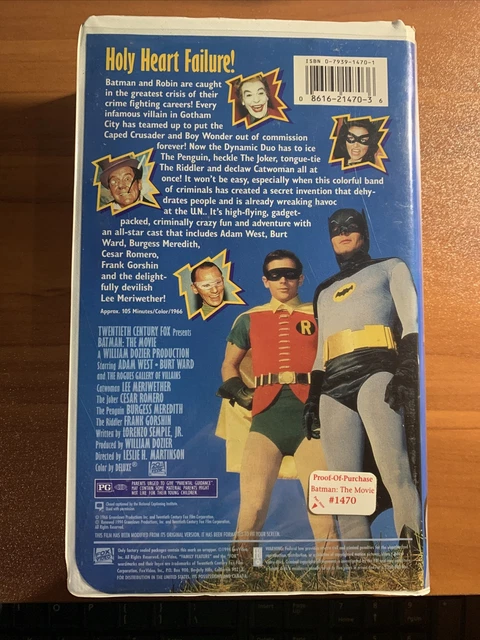
The film debuted on home video via formats VHS and Betamax release in 1985 by Playhouse Video,[18] then apparently re-released (after a Blockbuster Video executive asked why it wouldn't be repackaged on the heels of the successful Batman film of 1989)[19] in 1989 by CBS/Fox Video,[20] and in 1994 by Fox Video.[21]
The film was released on DVD in 2001, and re-released July 1, 2008, on DVD and on Blu-ray by 20th Century Fox Home Entertainment.[22]
Reception[edit]
Box office[edit]
According to Fox records, the film needed to earn $3.2 million in rentals to break even and made $3.9 million (equivalent to $36.6 million in 2023).[4]
Critical response[edit]
Batman holds an 81% rating on Rotten Tomatoes based on thirty-six reviews. The site's consensus states: "Batman: The Movie elevates camp to an art form -- and has a blast doing it, every gloriously tongue-in-cheek inch of the way." Metacritic, which uses a weighted average, assigned the film a score of 71 out of 100, based on 4 critics, indicating "generally favorable" reviews.[23]
Bill Gibron of Filmcritic.com gave the film 3 out of 5 stars: "Unlike other attempts at bringing these characters to life...the TV cast really captures the inherent insanity of the roles".[24] Variety stated in their review that "the intense innocent enthusiasm of Cesar Romero, Burgess Meredith and Frank Gorshin as the three criminals is balanced against the innocent calm of Adam West and Burt Ward, Batman and Robin respectively".[25]
Sequels[edit]
West and Ward reprised their roles in Batman animated movies for the show's 50th anniversary along with Julie Newmar returning.[26][27]
Batman: Return of the Caped Crusaders[28] was released on Digital HD and digital media on October 11, 2016, and on DVD and Blu-ray November 1.[29]
A sequel to Batman: Return of the Caped Crusaders called Batman vs. Two-Face was released on October 10, 2017. The film starred William Shatner voicing Two-Face as the main antagonist.[30][31] Adam West completed his voiceover work, but died of Leukemia in June 2017, before it was released.[32]
See also[edit]
References[edit]
- ^ "BATMAN (U)". British Board of Film Classification. August 16, 1966. Archived from the original on December 22, 2015. Retrieved December 20, 2015.
- ^ Solomon, Aubrey. Twentieth Century Fox: A Corporate and Financial History (The Scarecrow Filmmakers Series). Lanham, Maryland: Scarecrow Press, 1989. ISBN 978-0-8108-4244-1. p254
- ^ "Batman – The Movie (1966)". The Numbers. Archived from the original on October 27, 2017. Retrieved December 28, 2020.
- ^ a b Silverman, Stephen M (1988). The Fox that got away: the last days of the Zanuck dynasty at Twentieth Century-Fox. L. Stuart. p. 325. ISBN 9780818404856.
- ^ Van Hise, James, "The man who played The Green Hornet" [sic], The Green Hornet Book, Shuster and Shuster, Inc., 1988, p.16.
- ^ Garcia, Bob, "Batman: Making the Original Movie", Cinefantastique, Volume 24, #6/Vol. 25, #1 (double issue), February 1994, p. 55.
- ^ a b "Batman". catalog.afi.com. Retrieved June 9, 2021.
- ^ Geoff Boucher (May 17, 2010). "Camp it up: The writer of 'Batman' and 'Flash Gordon' answers five questions". Los Angeles Times. Archived from the original on October 15, 2012. Retrieved December 3, 2010.
- ^ Garcia, Bob, "Batman: Catwoman", Cinefantastique, Vol. 26, #6/Vol. 7, #1 (double issue), February 1994, p. 19 (interview with Julie Newmar).
- ^ "BATMAN (1966, U.S.)". Kiddiematinee.com. Archived from the original on December 20, 2010. Retrieved January 31, 2011.
- ^ Stomp Tokyo Video Reviews – Batman (1966) Archived January 18, 2018, at the Wayback Machine. Retrieved January 14, 2011.
- ^ a b "GrouchoReviews.com Review of 'Batman'". Archived from the original on May 12, 2013. Retrieved January 19, 2013.
- ^ "Museum of Broadcast Communication's entry on the parent TV show". Museum.TV. Archived from the original on June 20, 2002. Retrieved December 25, 2010.
- ^ Batman at 45: A Milestone Tribute to Pow, Bam and Zap!, Chris Gould, 2011
- ^ "Film music | movie music| film score | BATMAN the Movie 1966 - Nelson Riddle - Limited Edition". Archived from the original on April 24, 2018. Retrieved April 24, 2018.
- ^ "Film music | movie music| film score | BATMAN the Movie 1966 - Nelson Riddle - Limited Edition". Archived from the original on April 24, 2018. Retrieved April 24, 2018.
- ^ "Jean Boone – Interview with Cast of Batman, The Movie (1966)". Gordon Wilkison Collection. Texas Archive of the Moving Image. July 1966. Archived from the original on April 13, 2014. Retrieved July 28, 2011.
- ^ Walker, Morley (December 13, 1985). "Video Scene: Clint Can Do No Wrong". Newspapers.com. The Winnipeg Sun. p. F8. Retrieved December 2, 2023.
Its distributor, Playhouse Video, has put the big push on this tape. It'll retail for $29.95.
- ^ Donlon, Brian (June 24, 1989). "POW! 'Batman' reruns capturing the market". Newspapers.com. The Courier-News. Gannett News Service. p. B-3. Retrieved December 2, 2023.
"Why didn't CBS-Fox (distributors) put it back into release to coincide with the film?" asks Ron Castell, senior vice president of Blockbuster Video. A CBS-Fox spokesman said there are no plans to do so.
- ^ White, Scott (February 5, 1994). "Batman back on silver screen". Newspapers.com. North Bay Nugget. The Canadian Press. p. B-4. Retrieved December 2, 2023.
Released on video in 1989 by CBS-Fox Video.
- ^ "Vintage-1994-Batman-The-Movie-VHS-Clamshell-1966". PicClickImg. Retrieved December 2, 2023.
- ^ "Batman The Movie Blu-ray: Special Edition". Blu-ray.com. Archived from the original on April 11, 2012. Retrieved April 14, 2012.
- ^ "Batman". Metacritic. Fandom, Inc. Retrieved March 31, 2023.
- ^ "AMC Filmcritic – Batman (1966) Review". Filmcritic.com. Retrieved December 25, 2010.[permanent dead link]
- ^ "Variety Reviews – Batman – Film Reviews". Variety. December 31, 1965. Archived from the original on February 8, 2013. Retrieved December 25, 2010.
- ^ Lussier, Germain (March 30, 2015). "Animated Batman 1966 Movie Coming in 2016". /Film. Archived from the original on January 15, 2021. Retrieved January 13, 2021.
- ^ Greenfield, Dan (April 1, 2015). "Exclusive: Julie Newmar Will Be In Batman 66 Animated Movie, As of March 2016, no new updates". 13th Dimension. Archived from the original on April 3, 2016. Retrieved January 13, 2021.
- ^ "The Cast of Batman '66 Returns for a New Animated Movie". August 17, 2016. Archived from the original on January 21, 2021. Retrieved January 13, 2021.
- ^ Slead, Evan (August 17, 2016). "Adam West, Burt Ward, Julie Newmar return for animated Batman movie". Entertainment Weekly. Archived from the original on January 21, 2021. Retrieved January 13, 2021.
- ^ Seifert, Mark (October 6, 2016). "BATMANNNN! William Shatner Will Play Two-Face In Batman: Return of the Caped Crusaders Sequel". Bleeding Cool. Archived from the original on October 8, 2016. Retrieved October 6, 2016.
- ^ "DC on Instagram: "BATMAN: RETURN OF THE CAPED CRUSADERS is getting a sequel, featuring one villain who's a double dose of evil…and you'll never guess who's…"". Archived from the original on November 9, 2019. Retrieved January 13, 2021.
- ^ "'Batman' TV star Adam West dies at 88". ABC News. June 10, 2017. Archived from the original on June 11, 2017. Retrieved June 11, 2017.
External links[edit]

- Batman at IMDb
- Batman at Rotten Tomatoes
- Batman at the TCM Movie Database
- Batman The Movie at BYTB: Batman Yesterday, Today and Beyond (archived 2006)
- BATMAN (1966, U.S.) at kiddiematinee.com (archived 2010)
- Jean Boone – Interview with the cast of Batman: The Movie (1966) (archived 2008)

| Characters |
| ||||
|---|---|---|---|---|---|
| Vehicles and gadgetry | |||||
| In-story locations | |||||
| Episodes |
| ||||
| Other | |||||
| Spin-off productions | |||||
| |||||

| Incarnations | |
|---|---|
| Supporting characters | |
| Antagonists | |
| Publications | |
| In other media | |
| Authority control databases: National |
|---|
- 1966 films
- Batman (TV series)
- 1960s action comedy films
- 1960s American films
- 1960s buddy comedy films
- 1960s superhero films
- 1960s English-language films
- 1960s fantasy action films
- 1960s fantasy comedy films
- 20th Century Fox films
- American action comedy films
- American buddy comedy films
- American fantasy action films
- American fantasy comedy films
- American superhero comedy films
- Batman films
- Cold War submarine films
- Films based on adaptations
- Films based on television series
- Films directed by Leslie H. Martinson
- Films produced by William Dozier
- Films scored by Nelson Riddle
- Films shot in California
- Films with screenplays by Lorenzo Semple Jr.
- Sequel films to television series
- Live-action films based on DC Comics