


Cinema of Israel
| Cinema of Israel | |
|---|---|
 | |
| No. of screens | 286 (2011)[1] |
| • Per capita | 4.4 per 100,000 (2011)[1] |
| Main distributors | United King Globus Group Forum Cinemas[2] |
| Number of admissions (2011)[4] | |
| Total | 12,462,537 |
| • Per capita | 1.5 (2012)[3] |
| Gross box office (2012)[3] | |
| Total | €94.6 million (₪454.8 million) |
Cinema of Israel (Hebrew: קולנוע ישראלי, romanized: Kolnoa Yisraeli) refers to film production in Israel since its founding in 1948. Most Israeli films are produced in Hebrew, but there are productions in other languages such as Arabic and English. Israel has been nominated for more Academy Awards for Best Foreign Language Film than any other country in the Middle East.
History[edit]
Pre-state films[edit]

Movies were made in Mandatory Palestine from the beginning of the silent film era although the development of the local film industry accelerated after the establishment of the state. Early films were mainly documentary or news roundups, shown in Israeli cinemas before the movie started.[5] The earliest film shot entirely in Mandatory Palestine was Murray Rosenberg's 1911 documentary, The First Film of Palestine.[6]
In 1933, a children's book by Zvi Lieberman Oded ha-noded (Oded the Wanderer) was made into a silent film, the country's first full-length feature film for children, produced on a shoestring budget with private financing.[7] In 1938, another book by Lieberman, Me’al ha-khoravot (Over the Ruins) was turned into a 70-minute film with a soundtrack and dialogue. Lieberman wrote the screenplay himself. Produced by Nathan Axelrod and directed by Alfred Wolf, it told the story of children in a Second Temple Jewish village in the Galilee where all the adults were killed by the Romans. The children rebuild the village. Production costs came to 1,000 Palestine pounds. It failed at the box office but is considered a landmark in the history of Israeli cinema.[8]
One of the pioneers of cinema in Israel was Baruch Agadati.[9][10] Agadati purchased cinematographer Yaakov Ben Dov's film archives in 1934 when Ben Dov retired from filmmaking and together with his brother Yitzhak established the AGA Newsreel.[10][11] He directed the early Zionist film entitled This is the Land (1935).[12]
State of Israel[edit]
In 1948, Yosef Navon, a soundman, and Abigail Diamond, American producer of the first Hebrew-language film at age 15, Baruch Agadati, found an investor, businessman Mordechai Navon , who invested his own money in film and lab equipment. Agadati used his connections among Haganah comrades to acquire land for a studio. In 1949 the Geva Films studio was established on the site of an abandoned woodshed in Givatayim.[5]
In 1954, the Knesset passed the Law for the Encouragement of Israeli Films (החוק לעידוד הסרט הישראלי), the following year Hill 24 Doesn't Answer was released as the first Israeli feature film. Leading filmmakers in the 1960s were Menahem Golan, Ephraim Kishon, and Uri Zohar.
The first Bourekas film was Sallah Shabati, produced by Ephraim Kishon in 1964. In 1965, Uri Zohar produced the film Hole in the Moon, influenced by French New Wave films.
In the first decade of the 21st century, several Israeli films won awards in film festivals around the world. Prominent films of this period include Late Marriage (Dover Koshashvili), Broken Wings, Walk on Water and Yossi & Jagger (Eytan Fox), Nina's Tragedies, Campfire and Beaufort (Joseph Cedar), Or (My Treasure) (Keren Yedaya), Turn Left at the End of the World (Avi Nesher), The Band's Visit (Eran Kolirin) Waltz with Bashir (Ari Folman), and Ajami. In 2011, Strangers No More won the Oscar for Best Short Documentary.[13] In 2013 two documentaries were nominated the Oscar for the Best Feature Documentary: The Gatekeepers (Dror Moreh) and Five Broken Cameras, a Palestinian-Israeli-French co-production (Emad Burnat and Guy Davidi). In 2019, Synonyms (Nadav Lapid) won the Golden Bear award at the 69th Berlin International Film Festival. In 2021, Ahed's Knee, directed too by Lapid, was selected to compete for the Palme d'Or at the 2021 Cannes Film Festival and shared the Jury Prize.
Author Julie Gray notes, "Israeli film is certainly not new in Israel, but it is fast gaining attention in the U.S., which is a double-edged sword. American distributors feel that the small American audience interested in Israeli film, are squarely focused on the turbulent and troubled conflict that besets us daily."[14]
In 2014 Israeli-made films sold 1.6 million tickets in Israel, the best in Israel's film history.[15]
Genres[edit]
Documentary and propaganda films[edit]
Zionist documentary and/or propaganda films were shot both before and after 1948, often with the purpose of not just informing Jews living elsewhere, but also for attracting donations from them and for persuading them to immigrate. Among the pioneers who were active both as photographers and cinematographers are Ya'acov Ben-Dov (1882–1968) and Lazar Dünner (most often spelled Dunner; 1912-1994). Dünner first worked as a cinematographer, gradually moving into other film-making tasks. In 1937 he shot the 15-minute film "A Day in Degania", in full colour, giving us a document about the first kibbutz some 27 years after it being established, and with the Nazi threat still "just" as a background threat, not fully mentioned by name.[16] After the years of war, in 1949, Dünner would start churning out short documentaries of this type, narrated in English for the benefit of the mainly US public.[17][18]
Bourekas films[edit]
Bourekas films (סרטי בורקס) were a film genre popular in the 1960s and 1970s. Central themes include ethnic tensions between the Ashkenazim and the Mizrahim or Sephardim and the conflict between rich and poor.[19] The term was supposedly coined by the Israeli film director Boaz Davidson, the creator of several such films,[20] as a play-on-words, after "spaghetti Western:" just as the Western subgenre was named after a notable dish of its country of filming, so the Israeli genre was named after the notable Israeli dish, Bourekas, although some[who?]say the term originated from a scene in The Policeman where the title character is shown giving one of his coworkers a bourekas.[citation needed] Bourekas films are further characterized by accent imitations (particularly of Moroccan Jews, Polish Jews, Romanian Jews and Persian Jews); a combination of melodrama, comedy and slapstick; and alternate identities.[citation needed] Bourekas films were successes at the box office but were often panned by the critics. They included comedy films such as Charlie Ve'hetzi and Hagiga B'Snuker and sentimental melodramas such as Nurit. Prominent filmmakers in this genre during this period include Boaz Davidson, Ze'ev Revach, Yehuda Barkan and George Ovadiah.[citation needed]
New sensitivity films[edit]
The "New sensitivity films" (סרטי הרגישות החדשה) is a movement which started during the 1960s and lasted until the end of the 1970s. The movement sought to create a cinema in modernist cinema with artistic and esthetic values, in the style of the new wave films of the French cinema.[citation needed] The "New sensitivity" movement produced social artistic films such as But Where Is Daniel Wax? by Avraham Heffner. The Policeman Azoulay (Ephraim Kishon), I Love You Rosa and The House on Chelouche Street by Moshé Mizrahi were candidates for an Oscar Award in the foreign film category.[citation needed] One of the most important creators in this genre is Uri Zohar, who directed Hor B'Levana (Hole In The Moon) and Three Days and a Child.
Movie theaters[edit]
In the early 1900s, silent movies were screened in sheds, cafes and other temporary structures.[21] In 1905, Cafe Lorenz opened on Jaffa Road in the new Jewish neighborhood of Neve Tzedek. From 1909, the Lorenz family began screening movies at the cafe. In 1925, the Kessem Cinema was housed there for a short time.[22] Silent films were screened there, accompanied by commentary and piano playing by a member of the Templer community.[23]
In 1953, Cinema Keren, the Negev's first movie theater, opened in Beersheba. It was built by the Histadrut and had seating for 1,200 people.[24]
In 1966, 2.6 million Israelis went to the cinema over 50 million times. In 1968, when television broadcasting began, theaters began to close down, first in the periphery, then in major cities. Three hundred thirty standalone theaters were torn down or redesigned as multiplex theaters.[21]
Eden Cinema, Tel Aviv[edit]
The Eden Cinema (Kolnoa Eden) was built in 1914. The building, which still stands at the beginning of Lilienblum Street in Neve Tzedek, had two 800-seat halls: a roofed one for winter and an outdoor hall for screenings in the pre-air-conditioning summer heat. Owners Mordechai Abarbanel and Moshe Visser were granted a 13-year exclusive municipal license. When Eden’s monopoly expired in 1927, other cinemas sprang up around Tel Aviv.[25]
During World War I, the theater was shut down by order of the Ottoman government on the pretext that its generator could be used to send messages to enemy submarines offshore. It reopened to the public during the British Mandate and became a hub of cultural and social activity. It closed down in 1974.[21]
Mograbi Cinema, Tel Aviv[edit]
The Mograbi Cinema (Kolnoa Mograbi) opened in 1930. The cinema was established by Yaakov Mograbi, an affluent Jewish merchant who immigrated from Damascus, at the request of Meir Dizengoff, then mayor of Tel Aviv. The building housed two large halls: on the upper floor a cinema with a sliding roof that could be opened on the hot summer days, and a performance hall that was the venue of the first Hebrew theaters, among them Hamatateh, HaOhel, Habima, and the Cameri.[26] It was designed by architect Joseph Berlin in an art deco style that was popular in cinemas worldwide. People gathered in front of the theater to dance in the streets when the UN General Assembly voted in favor of the Partition Plan in November 1947. After a fire in the summer of 1986 due to an electric short circuit, the building was demolished.[21] In 2011, plans were submitted to rebuild a replica of the original cinema with a luxury high-rise above it.
Allenby Cinema, Tel Aviv[edit]
The Allenby Cinema was designed by Shlomo Gepstein, an Odessa-born architect who immigrated to Palestine in the 1920s. It was a large, imposing building in the International Style. In the 1900s, it housed Allenby 58, a famous nightclub.[27]
Armon Cinema, Haifa[edit]
In 1931, Moshe Greidinger opened a cinema in Haifa. In 1935 he built a second movie theater, Armon, a large art-deco building with 1,800 seats that became the heart of Haifa's entertainment district. It was also used as a performance venue by the Israel Philharmonic Orchestra and the Israeli Opera.[28]
Alhambra Cinema, Jaffa[edit]
The art deco Alhambra cinema, with seating for 1,100, opened in Jaffa in 1937. It was designed by a Lebanese architect, Elias al-Mor, and became a popular venue for concerts of Arab music. Farid al-Atrash and Umm Kulthum appeared there. In 2012, the historic building reopened as a Scientology center after two years of renovation.[29]
Smadar Theater, Jerusalem[edit]
The Smadar theater was built in Jerusalem's German Colony in 1928. It was German-owned and mainly served the British Army. In 1935, it opened for commercial screenings as the "Orient Cinema." It was turned over to Jewish management to keep it from being boycotted as a German business, infuriating the head of the Nazi Party branch in Jerusalem. After 1948, it was bought by four demobilized soldiers, one of them Arye Chechik, who bought out his partners in 1950.[30] According to a journalist who lived next door, Chechik sold the tickets, ran to collect them at the door and worked as the projectionist. His wife ran the concession stand.[31]
-
 Beit Shemesh movie theater, early 1950s
 -
 Eden Cinema, Tel Aviv
 -
 Mograbi Theater, Tel Aviv
 -
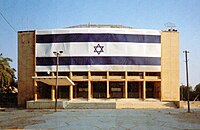 Keren Cinema, first movie theater in the Negev
 -
 Rimon movie theater, Tel Aviv, 1939


Cinema festivals[edit]

The main international film festivals in Israel are the Jerusalem Film Festival and the Haifa Film Festival.
Cinema awards[edit]
Film schools[edit]
See also[edit]


- Culture of Israel
- Israeli films of the 1950s
- Jewish culture § Cinema
- List of Israeli films
- List of Israeli submissions for the Academy Award for Best Foreign Language Film
- Media of Israel
- Edison Theater (Jerusalem)
References[edit]
- ^ a b "Table 8: Cinema Infrastructure - Capacity". UNESCO Institute for Statistics. Archived from the original on 5 November 2013. Retrieved 5 November 2013.
- ^ "Table 6: Share of Top 3 distributors (Excel)". UNESCO Institute for Statistics. Archived from the original on 24 December 2018. Retrieved 5 November 2013.
- ^ a b "Annual Report 2012/2013" (PDF). Union Internationale des Cinémas. Archived from the original (PDF) on 10 November 2013. Retrieved 10 November 2013.
- ^ "Table 11: Exhibition - Admissions & Gross Box Office (GBO)". UNESCO Institute for Statistics. Archived from the original on 3 November 2013. Retrieved 5 November 2013.
- ^ a b Editing out a frame of history, Haaretz
- ^ "Matis Collection". Hebrew University of Jerusalem. Retrieved 20 October 2023.
- ^ Companion Encyclopedia of Middle Eastern and North African Film, ed. Oliver Leaman
- ^ Eshed, Eli, “Back to the Days of the Bible in Israeli Film and Television” (Hebrew)
- ^ Amos Oz, Barbara Harshav (2000). The silence of heaven: Agnon's fear of God. Princeton University Press. ISBN 0691036926. Retrieved 5 August 2011.
- ^ a b Oliver Leaman (2001). Companion Encyclopedia of Middle Eastern and North African Film. Taylor & Francis. ISBN 9780203426494. Retrieved 5 August 2011.
- ^ Stiftung Deutsche Kinemathek (1997). Filmexil. Hentrich. Retrieved 5 August 2011.
- ^ Gary Hoppenstand (2007). The Greenwood encyclopedia of world popular culture, Volume 4. Greenwood Press. ISBN 9780313332746. Retrieved 5 August 2011.
- ^ Film about Tel Aviv school wins Academy Award Archived August 9, 2011, at the Wayback Machine
- ^ Gray, Julie (3 July 2014). "Stories Without Borders: Emergent Israeli Films". Script Magazine. Retrieved 1 August 2014.
- ^ "A glowing 2014 for the Israeli film industry". Cineuropa. Retrieved 20 January 2015.
- ^ A Day in Degania, The Spielberg Jewish Film Archive. Accessed 30 April 2020.
- ^ Gertz, Nurith; Hermoni, Gal (2013). "9". In Yosef, Raz; Hagin, Boaz (eds.). History of violence: from the trauma of expulsion to the Holocaust in Israeli cinema. Bloomsbury Publishing USA. ISBN 9781441199263. Retrieved 30 April 2020.
{{cite book}}:|work=ignored (help) - ^ Freeman, Samuel D., ed. (1964–1966) [1959]. "Israel: Films". The Jewish Audio-Visual Review (9th, 10th, 14th-16th annual ed.). New York, NY: National Council of Jewish Audio-Visual Materials sponsored by the American Association for Jewish Education. Retrieved 30 April 2020.
- ^ Shohat, Ella (2010). Israeli Cinema: East/West and The Politics of Representation. London: I.B.Tauris & Co Ltd. p. 113. ISBN 9781845113131.
- ^ Shaul, Shiran (Fall–Winter 1978). Interview tih Boaz Davidson. Kolnoa. pp. 15–16.
- ^ a b c d Shalit, David (3 January 2011). "Cinemas in Eretz Yisrael". Boeliem.com. Archived from the original on 18 May 2018. Retrieved 2 August 2011.
- ^ Paraszczuk, Joanna (5 June 2010). "Reviving Tel Aviv's Valhalla". The Jerusalem Post. Retrieved 2 August 2011.
- ^ The Nine Lives of the Lorenz Cafe
- ^ Be'er-Sheva Tours and Trails, Adi Wolfson and Zeev Zivan, 2017, p.20
- ^ Israeli cinemas of yesteryear get repurposed or closed
- ^ Allenby and Mograbi
- ^ The Party Is Over, Haaretz
- ^ Roe, Ken. "Armon Cinema Ha'Nevi'im Street, Haifa". Cinema Treasures. Retrieved 14 April 2012.
- ^ Rosenblum, Keshet (30 August 2012). "Alhambra Cinema in Jaffa reopens as Scientology center". Haaretz. Retrieved 3 September 2012.
- ^ German Colony Cinema Once Again Under Threat of Closure
- ^ Rotem, Tamar (9 April 2008). "80-year-old Smadar Cinema projects special image of Jerusalem". Haaretz. Retrieved 23 September 2012.
- ^ "Ma'aleh School of Television, Film and the Arts". Maale.co.il. 26 February 1997. Retrieved 2 April 2013.
Further reading[edit]
- Israel Studies 4.1, Spring 1999 - Special Section: Films in Israeli Society (pp. 96–187).
- Amy Kronish, World cinema: Israel, Trowbridge, Wiltshire: Flicks Books [etc.], 1996.
- Amy Kronish and Costel Safirman, Israeli film: a reference guide, Westport, Conn. [etc.]: Praeger, 2003.
- Gilad Padva. Discursive Identities in the (R) Evolution of the New Israeli Queer Cinema. In Talmon, Miri and Peleg, Yaron (Eds.), Israeli Cinema: Identities in Motion (pp. 313–325). Austin, TX: Texas University Press, 2011.
- Ella Shohat, Israeli cinema: East West and the politics of representation, Austin: Univ. of Texas Pr., 1989.
- Gideon Kouts, The Representation of the Foreigner in Israeli Films (1966–1976), REEH The European Journal of Hebrew Studies, Paris: 1999 (Vol. 2), pp. 80– 108.
- Dan Chyutin and Yael Mazor, Israeli Cinema Studies: Mapping Out a Field, Shofar: An Interdisciplinary Journal of Jewish Studies 38.1 (Spring 2020).
- Ido Rosen. "National Fears in Israeli Horror Films." Jewish Film & New Media 8.1 (2020): 77-103.
External links[edit]

- Israel Film Festival
- Israeli cinematographers win prestigious awards at the 60th Cannes Film Festival. 28 May 2007
- Israeli Film, Home of the Early Israeli & Hebrew Film
- Oded Hanoded First Israeli Drama film
- Israeli Film Fund
- Israel Film Center Database of Israeli films, news about Israeli cinema, calendar of screenings in the USA
| ||

| Africa |
| ||||||||||||
|---|---|---|---|---|---|---|---|---|---|---|---|---|---|
| Asia |
| ||||||||||||
| Europe |
| ||||||||||||
| Americas |
| ||||||||||||
| Oceania | |||||||||||||
| Intercontinental & transnational | |||||||||||||


