


Ford Excursion
| Ford Excursion | |
|---|---|
 2001 Ford Excursion Limited | |
| Overview | |
| Manufacturer | Ford Motor Company |
| Model code | UW137[1] |
| Production | 1999 – September 30, 2005 |
| Model years | 2000–2005 2000–2006 (Mexico) |
| Assembly | Louisville, Kentucky (Kentucky Truck Assembly) |
| Body and chassis | |
| Class | Full-size SUV |
| Body style | 4-door SUV[2] |
| Layout | Front engine, rear-wheel drive / four-wheel drive |
| Related | Ford Super Duty |
| Powertrain | |
| Engine | 5.4 L Triton V8 6.8 L Triton V10 7.3 L Power Stroke V8 turbodiesel 6.0 L Power Stroke V8 turbodiesel |
| Transmission | Ford 4R100 4-speed automatic Ford 5R110W 5-speed automatic |
| Dimensions | |
| Wheelbase | 137.1 in (3,482 mm) |
| Length | 226.7 in (5,758 mm) |
| Width | 2000–01: 80.0 in (2,032 mm) 2002–05: 79.9 in (2,029 mm) |
| Height | 4WD: 77.2 in (1,961 mm) 2WD: 74.8 in (1,900 mm) |
| Curb weight | 7,688 lb (3,487 kg) (Turbodiesel) 7,230 lb (3,280 kg) (Gasoline) |
| Chronology | |
| Successor | Ford Expedition EL/MAX (indirect) |
The Ford Excursion is a heavy-duty (Class 2) SUV that was sold by Ford Motor Company from 2000 to 2005. At the time of its introduction, the Excursion was the longest and heaviest SUV ever to enter mass production. The third Ford SUV derived from the F-Series pickup trucks (after the Ford Bronco and the Ford Expedition), the model line used a heavier-duty chassis and frame than the Expedition; both vehicles competed against the Chevrolet Suburban.
Developed as a competitor for the 2500-series (3⁄4-ton) Chevrolet Suburban/GMC Yukon XL,[3][4] the Ford Excursion was derived from the 3⁄4-ton F-250 Super Duty pickup truck (sharing its chassis with the regular cab, long-bed chassis). The model line was produced for a single generation; a shortened 2006 model year was offered exclusively for Mexico. Sold nearly exclusively in the North American market, limited numbers of the model line were produced for export. As of current production, the Excursion remains the largest mass-produced SUV (matched in length by the 2023 introduction of the lighter Jeep Grand Wagoneer L); currently, only the GMC Hummer EV SUV is heavier.
Throughout its production run, the Excursion was assembled at its Kentucky Truck Plant (Louisville, Kentucky) alongside the Ford Super Duty line; the final example was produced on September 30, 2005. For 2007, Ford introduced the extended-length Ford Expedition EL/MAX (today, Expedition MAX), competing more closely against the 1500-series Suburban in capability.
Origin and concept[edit]
For the 1973 model year, General Motors redesigned its Suburban utility wagon (sold by both Chevrolet and GMC) as part of its Rounded-Line C/K trucks. As a central part of the redesign, a fourth passenger door was added, allowing the model line to compete directly against the similar-size International Harvester Travelall wagon for the first time. Following the 1975 discontinuation of the Travelall, the Suburban became the only wagon-style full-size SUV (a distinction it would hold until the 1997 introduction of the Expedition), competing primarily against the smaller Jeep Wagoneer.
For 1978, the second-generation Ford Bronco was released, becoming a full-size SUV. To better compete against the Chevrolet K5 Blazer/GMC Jimmy and Dodge Ramcharger, the Bronco adopted design commonality with the contemporary Ford F-100 pickup truck while retaining its previous body style: a three-door half-cab wagon with a lift-off hardtop (a configuration also used by the Blazer/Jimmy). In contrast to the Rounded-Line pickup trucks serving as the basis for both the K5 Blazer and the Suburban (which shared much of its bodywork with crew-cab pickup trucks), Ford did not develop a five-door station wagon body from its trucks.
During the 1980s and early 1990s, Ford marketed four-door versions of the Bronco on a special-order basis. License-built by second-party manufacturers, the designs mated the rear body of the Bronco to crew-cab F-Series bodywork.[5][6] Examples used the 1-ton F-350 chassis (a first since the IHC Travelall) as a basis, in contrast to the Suburban, offered with ½-ton or ¾-ton payload[5][6]
For 1991, Ford released its first five-door wagon-style SUV, as the Ford Explorer replaced the Ford Bronco II. Though not the first vehicle in the segment to offer the configuration, the Explorer would go on to become one of the most popular SUVs during the 1990s. As the decade progressed, three-door SUVs (both compact and full-size) saw an extensive decline in demand, leading Ford to discontinue the Bronco after 1996.
For 1997, Ford released the Ford Expedition as its all-new SUV derived from the Ford F-150 (itself redesigned the same year). Nearly matching the International Travelall in size, the Expedition adopted a five-door wagon configuration, sized between the Chevrolet Tahoe (replacing the K5 Blazer) and the Suburban (offering the three-row interior seating of the latter).
For 1999, Ford expanded the F-Series model range, with the Super Duty series including the F-250 and F-350 (and all larger Ford trucks). Intended for work usage and towing, Super Duty F-Series trucks received a heavier-duty chassis and suspension along with a distinct body design. Coinciding with the development of the Super Duty series, Ford commenced development of a heavy-duty SUV derived from the 3⁄4-ton F-250 Super Duty, intended to compete against the higher-payload 2500-series Suburban (itself based on a 3⁄4-ton pickup truck chassis).
Design overview[edit]
The Ford Excursion was introduced for the 2000 model year on September 30, 1999.[7] In contrast to the Expedition (which replaced the Bronco), the Excursion had no direct predecessor in the Ford truck line. In terms of dimensions, the model line is outranked in length (both body and wheelbase) and height by the Ford E-350 12/15-passenger van.
Chassis[edit]
The Ford Excursion shares a large number of body and chassis assemblies with its F-250 pickup truck counterpart. To allow for a common front and rear track width, the front suspension and most of the rear suspension were common components (the Excursion was fitted with its own leaf springs and front spring hanger bracket). The Excursion was fitted with a distinct frame (differing from the front sway bar mounts rearward), leaving the model taller and wider than its pickup truck counterpart.
The rear axle for all Excursions was a Sterling 10.5 axle. The four-wheel-drive models were equipped with a NV273 transfer case and Dana 50 front axle. Rear axle ratios of 3.73:1 and 4.30:1 were offered.
During the development of the chassis, Ford learned that its initial design caused smaller vehicles (such as a Ford Taurus) to become severely overridden in a head-on collision. In the test, the tire of the Excursion drove up to the windshield of the Taurus (reducing the chance of survival for its driver).[8] As a response, Ford modified the chassis to include an under-bumper "blocker beam"; the device was initially tested by the French transportation ministry in 1971.[8] For the rear of the chassis, Ford chose to include a trailer hitch as standard equipment in production to reduce underriding in rear-end collisions by smaller vehicles.
Powertrain[edit]
During its entire production, the Excursion was offered with both gasoline and diesel engines. The standard gasoline engine was a 5.4 L Triton V8; a 6.8 L Triton V10 was offered as an option. At its launch, the optional diesel engine was the Navistar-produced 7.3 L Power Stroke V8; during 2003 production, a Navistar-produced 6.0 L diesel V8 was introduced, again using the Power Stroke name.
All four engines were paired with an automatic transmission. The 4-speed 4R100 automatic was fitted to the 5.4 L, 6.8 L, and 7.3 L engines, with a 5-speed 5R110W automatic fitted to the 6.0 L engine.
| Engine | Configuration | Fuel | Production | Power output | Torque output | Transmission |
|---|---|---|---|---|---|---|
| Ford Triton V8 | 5.4 L (330 cu in) SOHC 2V V8 | Gasoline | 2000–2005 | 255 hp (190 kW; 259 PS) | 350 lb⋅ft (475 N⋅m) | 4-speed automatic
Ford 4R100 |
| Ford Triton V10 | 6.8 L (413 cu in) SOHC 2V V10 | 310 hp (231 kW; 314 PS) | 425 lb⋅ft (576 N⋅m) | |||
| Ford/Navistar Power Stroke V8 | 7.3 L (444 cu in) OHV V8 turbo | Diesel | 2000–2003.5 | 250 hp (186 kW; 253 PS) | 525 lb⋅ft (712 N⋅m) | |
| Ford/Navistar Power Stroke V8 | 6.0 L (365 cu in) OHV 4V V8 turbo | 2003.5–2005 | 325 hp (242 kW; 330 PS) | 560 lb⋅ft (759 N⋅m) | 5-speed automatic
Ford 5R110W TorqShift[9] |
Though using the 3⁄4-ton chassis of the F-250, the two-wheel-drive Excursion was rated with a GVWR of 8,600 lb (3,900 kg) when equipped with gasoline engines and 8,900 lb (4,000 kg) with equipped with diesel engines (four-wheel-drive models have a 300 lb (140 kg) higher GVWR with either engine). As its GVWR was above 8,500 lb (3,900 kg), the Excursion was exempt from EPA fuel economy ratings; reviewers cited fuel economy in the range of 12-15 Lmpg with the V10 gasoline engine.[4] While its GVWR exempted it from emissions standards applied to light-duty vehicles, Ford designed the powertrains of the Excursion to meet low-emissions vehicle (LEV) status.[7]
Body design[edit]
While the smaller Ford Expedition shared design elements with the popular Ford F-150, the Excursion adopted a high degree of commonality from its F-250 counterpart. With the exception of its egg-crate grille (styled similarly to the Expedition and the third-generation Explorer), the Excursion shares its front bodywork forward of the B-pillars with its pickup truck counterpart. From the B-pillar rearward, the Excursion is designed with model-distinct bodywork. Along with rear passenger doors specific to the model line (including forward-tilted C-pillars, instead of the rectangular design from the pickup truck), the rear wagon body is styled similar to the 1980-1996 Bronco (with flush-mounted glass). In place of a conventional liftgate, Ford designed the rear cargo door with a three-way layout (similar to the 1992–2005 Chevrolet Astro), pairing a framed upper window (with rear wiper) with two lower "Dutch doors"; the Excursion sourced its taillamps directly from the E-Series van. For 2005, the egg-crate grille was retired, with the Excursion taking on the same grille used by Super Duty pickup trucks.
Sharing its dashboard entirely from the F-250 (though adding an "Excursion" nameplate badge), the interior was offered in either 8 or 9-passenger seating (with either a front bench seat or front bucket seats). As with the Bronco, Ford mounted the spare tire vertically in the cargo area (behind the third-row seat). For 2002, the instrument panel underwent minor revisions (receiving a digital odometer and a transmission temperature gauge); seating materials underwent revisions.
Coinciding with its design commonality with the Ford Super Duty crew cab, the Excursion was a mass-produced SUV with four full-length passenger doors. Along with the Chevrolet Suburban (and its GMC/Cadillac counterparts) and the International Travelall, the only mass-produced model lines produced with the design feature are the Ford Expedition Max/Lincoln Navigator L and the Jeep (Grand) Wagoneer L.[10]
-
 2002–2004 Ford Excursion Limited (Germany)
 -
 2001 Ford Excursion Limited, rear view
 -
 2001 Ford Excursion XLT
 -
 2002 Ford Excursion Limited
 -
 2005 Ford Excursion XLT
 -
 Ford Excursion XLS (FDNY Battalion Chief vehicle)
.jpg)


Trim[edit]
The Excursion adopted the trim nomenclature adopted across Ford light trucks in North America. The base trim was XL (marketed nearly exclusively for fleet sales), XLT (standard trim in retail markets), and Limited (highest trim line). Following its use across many Ford light trucks, an Eddie Bauer trim package was introduced for the Excursion for 2003 (differing from the Limited primarily in appearance).
XLT: Included three rows of seating, leather-wrapped steering wheel with speed control, a security system, keyless entry, 16 in (41 cm) chrome steel rims or optional alloy rims, trailer towing package, an AM/FM radio with cassette and single-disc CD player with six premium speakers, and air conditioning.
Limited: Included same features as XLT, but adds a power driver's seat, rear audio controls, illuminated running boards, 16 in (41 cm) alloy rims, front-speed sensitive windshield wipers, five power points, ten cupholders, leather seats (with heated first row), and an optional rear entertainment system with DVD player.
Reception[edit]
Being launched on September 30, 1999, the 2000 Ford Excursion was described by Popular Science as the "biggest sport utility on the planet."[11][12] This would be the most successful model year for the Excursion, with nearly 69,000 examples sold. After largely meeting sales projections at its launch,[11] demand for the model line was affected by the energy crisis of the 2000s. While able to produce 70,000 examples yearly,[11] sales from 2001 onward struggled to reach half of that capacity, becoming the lowest-selling SUV sold by Ford or Lincoln-Mercury.
The large size of the Excursion led to it being dubbed the Ford Valdez by the Sierra Club in 1999 (in reference to the Exxon Valdez supertanker).[13] In 2007, Time selected it as one of the "Fifty Worst Cars of All Time."[14]
Variants[edit]
F-250 Tropivan[edit]
From 1998 to 2012, a second-party SUV conversion of the Ford F-250 was sold in Brazil.[15] Similar in design and layout to the Excursion, the F-250 Tropivan differed primarily by its assembly as a second-party conversion (similar to the Centurion Classic). In contrast to the Excursion, two different wheelbases of the Tropivan were produced.
As with all Super Duty trucks in Brazil, the Tropivan had a different engine selection throughout its production run, including a 4.2L Essex gasoline V6 and two types of diesels: a 3.9L Cummins B-series and the 4.2L MWM Sprint 6.07TCA straight-6.
Aftermarket[edit]
During and since its production, the Excursion has become a basis for several types of aftermarket vehicles. As a result of its body commonality with the Super Duty model range, the bodywork of the Excursion led to aftermarket conversions of Ford medium-duty truck chassis (Ford F-650 and F-750) to SUVs; to accommodate the longer wheelbase, the body typically is fitted with an extra set of doors.[citation needed]
At the other end of the size scale, the Hennessey VelociRaptor SUV was created by mating the rear bodywork of the Excursion with the bodywork of the first-generation Ford Raptor (a practice similar to the creation of the 1990s Centurion Classic C350).
As the Excursion shares a large degree of design commonality with the 1999-2016 Ford F-250, the SUV has been customized by replacing the 2000-2005 front bodywork with the bodywork of 2008–2016 Super Duty pickup trucks.[citation needed]
The Excursion also has served as a basis for stretch limousines. Though Ford imposed a strict 120-inch length limit on body extensions (on full-frame cars such as the Lincoln Town Car), many examples of the Excursion have been extended longer on an unofficial basis, coinciding with its heavier-duty chassis.
-
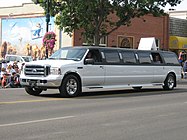 Ford Excursion stretch limousine
 -
 Ford Excursion armored car in use by the Taiwanese military police
 -
 6-door Ford F-650 Super Duty SUV in Australia (Ford Excursion bodywork)
.jpg)


Yearly U.S. sales[edit]
| Calendar Year | Total American sales |
|---|---|
| 1999[16] | 18,315 |
| 2000 | 50,786 |
| 2001[17] | 34,710 |
| 2002[18] | 29,042 |
| 2003 | 26,259 |
| 2004[19] | 20,010 |
| 2005 | 16,283 |
References[edit]
- ^ "Automotive Projects". zaytran.com. 2007. Retrieved June 23, 2022.
- ^ Consumer Guide Automobile Book, 2001. Publications International. 2001. p. 100. ISBN 978-0-7853-4639-5. Retrieved July 27, 2015.
- ^ McCosh, Dan, ed. (November 1999). "Big, bigger, biggest". Popular Science. Vol. 255, no. 5. p. 48. Retrieved June 23, 2022 – via Google Books.
- ^ a b Weitzman, Larry (2000). "The Ford Excursion, It doesn't get any Bigger". theautochannel.com. Retrieved September 17, 2012.
- ^ a b Snitkoff, Edward (January 18, 2017). "Curbside Classic: Ford Classic 350 – Centurion Vehicles Creates A Frankenstein Suburban Fighter". Retrieved July 7, 2019.
- ^ a b "This is the 4-Door Ford Bronco You Didn't Know Existed". February 28, 2016. Archived from the original on February 28, 2016. Retrieved July 7, 2019.
- ^ a b "Ford Excursion makes a grand debut". klik.com.my. Reuters. August 9, 1999. Retrieved June 23, 2022.
- ^ a b Bradsher, Keith (2004). High and mighty: the dangerous rise of the SUV. PublicAffairs. p. 199. ISBN 978-1-58648-203-9. Retrieved June 12, 2012.
- ^ 2000, 2001, 2002, 2003, 2004, 2005 Ford Truck/SUV source books
- ^ Stafford, Eric (April 13, 2022). "2023 Jeep Wagoneer L and Grand Wagoneer L Are Stretched and Turbocharged". Car and Driver. Retrieved June 23, 2022.
- ^ a b c "Ford Excursion makes a grand debut". klik.com.my. Reuters. August 9, 1999. Retrieved June 23, 2022.
- ^ McCosh, Dan, ed. (November 1999). "Big, bigger, biggest". Popular Science. Vol. 255, no. 5. p. 48. Retrieved June 23, 2022 – via Google Books.
- ^ "Ford's new gas-guzzling SUV wins the 'Exxon Valdez' award from the Sierra Club". San Diego Earth Times. Retrieved March 7, 2020.
- ^ "The 50 Worst Cars of All Time". Time. September 7, 2007. Retrieved March 7, 2020.
- ^ "Avaliação NA – F-250 Tropivan". Notícias Automotivas (in Brazilian Portuguese). December 13, 2010. Retrieved November 11, 2017.
- ^ "Ford Motor Company Sets New Full Year U.S. Sales Record". theautochannel.com. Retrieved April 28, 2009.
- ^ "Ford Motor Company's December U.S. Sales Climb 8.2 Percent" (PDF) (Press release). Ford Motor Company. Archived from the original (PDF) on April 30, 2011. Retrieved June 16, 2012.
- ^ "Ford's F-Series Truck Caps 22nd Year in a Row as America's Best-Selling Vehicle With a December Sales Record". theautochannel.com. November 17, 2004. Retrieved April 28, 2009.
- ^ "Ford Achieves First Car Sales Increase Since 1999". theautochannel.com. November 17, 2004. Retrieved April 28, 2009.
External links[edit]
 Media related to Ford Excursion at Wikimedia Commons
| Current models |
|  | |||||||||||||||||||||
|---|---|---|---|---|---|---|---|---|---|---|---|---|---|---|---|---|---|---|---|---|---|---|---|
| Former models (by date of introduction) |
| ||||||||||||||||||||||
| Military | |||||||||||||||||||||||
| Related topics | |||||||||||||||||||||||


_front_view_01.png)


| Authority control databases: National |
|---|
