


Armed Forces of Croatia
| Armed Forces of Croatia | |
|---|---|
| Oružane snage Republike Hrvatske | |
 Croatian Armed Forces emblem | |
| Founded | 1991 |
| Service branches |  Croatian Army Croatian Army Croatian Navy Croatian Navy Croatian Air Force Croatian Air ForceCroatian Special Operations Forces Command |
| Website | www |
| Leadership | |
| Commander-in-Chief |  Zoran Milanović Zoran Milanović |
| Ministry of Defence |  Ivan Anušić Ivan Anušić |
| Chief of the General Staff |  Major general Tihomir Kundid Major general Tihomir Kundid |
| Personnel | |
| Military age | 18 years of age |
| Conscription | No |
| Available for military service | 2,033,589 males, age 15–49 (2015 est.[citation needed]), 2,045,898 females, age 15–49 (2015 est.[citation needed]) |
| Fit for military service | 1,610,442 males, age 15–49 (2015 est.[citation needed]), 1,323,985 females, age 15–49 (2015 est.[citation needed]) |
| Reaching military age annually | 20,000[1] males (2015 est.[citation needed]), 20,000[1] females (2015 est.[citation needed]) |
| Active personnel | 14,325[2] |
| Reserve personnel | 20,105[3] |
| Deployed personnel |  Lithuania – 200[4] Lithuania – 200[4]  Poland – 80[5] Poland – 80[5]  Kosovo – 150[6] Kosovo – 150[6]  India / India /  Pakistan – 9[7] Pakistan – 9[7]  Western Sahara – 7[8] Western Sahara – 7[8] Cyprus – 2 Cyprus – 2  Liberia – 2 Liberia – 2  Somalia – 1 Somalia – 1 |
| Expenditures | |
| Budget | c. 7.568 billion HRK[9] (c. 1.0 billion Euro) |
| Percent of GDP | 1.46% (2022)[10] |
| Industry | |
| Domestic suppliers | Đuro Đaković (armored vehicles)
Brodosplit (naval vessels) HS Produkt (small arms) |
| Foreign suppliers |  France France Germany Germany Israel Israel Italy Italy United States United States |
| Related articles | |
| History | Military history of Croatia Ban Josip Jelačić Nikola Šubić Zrinski Croatian War of Independence Croatian National Guard War in Bosnia and Herzegovina |
| Ranks | Croatian military ranks |
The Armed Forces of the Republic of Croatia (Croatian: Oružane snage Republike Hrvatske – OSRH) are the military forces of Croatia.
The President is the Armed Forces Commander-in-Chief, and exercises administrative powers in times of war by giving orders to the chief of staff, while administration and defence policy execution in peacetime is carried out by the Government through the Ministry of Defence. This unified institution consists of land, sea, and air branches referred to as:
- Croatian Army (Hrvatska kopnena vojska - HKoV)
- Croatian Navy (Hrvatska ratna mornarica - HRM)
- Croatian Air Force (Hrvatsko ratno zrakoplovstvo - HRZ)
The Croatian Armed Forces are charged with protecting the Republic as well as supporting international peacekeeping efforts, when mandated by NATO,[11] the United Nations or the European Union.
The Army has 650 AFVs, around 150 pieces of artillery, 100 MLRSs, around 75 tanks, and 25 SPGs. The Air Force has 12 MiG-21 jet fighters, 10 combat-transport Mi-171 and 16 OH-58 attack helicopters. The Navy has 30 ships, out of which five 60-80 metre fast attack craft are used in offensive capabilities. In April of 2024 Croatia acquired first 6 out of 12 used French Rafale F-3R.
Strength[edit]
In 2020, Armed Forces had 15,605 members, of which 14,325 were active military personnel and 1,280 civil servants. Of the 14,506 active military personnel, 3,033 were officers, 5,549 non-commissioned officers, 5,214 soldiers, 529 military specialists, 307 civil servants and 973 other employees.[2]
Total available male manpower aged 16–49 numbers 1,035,712, of which 771,323 are technically fit for military service. Male citizens are now no longer subject to compulsory military service since January 1, 2008. However, the last generation of 2007 servicemen was also absolved of compulsory service by an act from then Minister of Defence Berislav Rončević.[12]
Budget[edit]
The trajectory of Croatian military budget and spending was constantly below 2% of GDP, a major difference from the 1990s when defence expenditure represented a major stake in Croatian budgetary expenditure due to then ongoing Croatian War of Independence. For example, 1995 Croatian defence budget stood at 12.4 billion Croatian Kuna or around 10% of GDP, which was also represented at the time highest defence expenditure rate. In late 2019, Croatian Government issued revised defence expenditure strategy which will see country increase its defence expenditure to gradually meet 2% NATO target, with 2019 and 2020 defence budgets seeing immediate revisions and increases to meet new spending plan. Defence expenditure in 2025 therefore based on current projections could reach €1.75 billion or around 2% of GDP which would meet NATO recommendation. However, if defence pensions are included in Croatia's defence expenditure, then Croatia already meets 2% target recommended by the NATO. Some €1140 million was paid in defence pensions to some 97000 individuals in Croatia.[13][14]
Defence expenditures in recent years (source Croatian MOD);
| Year | Amount (in HRK) | % of GDP | Change in % |
| 2000 | 4.768 bln[15] | 3.13 | 
|
| 2010 | 4.811 bln | 1.45 |  0.07 0.07
|
| 2011 | 5.119 bln[16] | 1.47 |  0.02 0.02
|
| 2015 | 4.75 bln[17] | 1.21 | 0.04[17]
|
| 2016 | 4.7 bln[17] | 1.21 | 0.04
|
| 2017 | 4.39 bln[18] | 1.21 | 0.04[18]
|
| 2018 | 4.816 bln[19] | 1.25 | 0.04
|
| 2019 | 5.375 bln[19] | 1.31 | 0.03
|
| 2020 | 7.19 bln[19] | 1.71 | 0.40[20]
|
| 2021 | 7.273 bln[19] | 1.65 | 0.06[21][9]
|
| 2022 | 7.568 bln[19] | 1.46 | 0.21[9]"Raste vojni proračun: Zbog NATO-a ćemo na obranu trošiti gotovo 10 milijardi kuna!". Vijesti.hr. 2 December 2019.[21]
|
- Croatia adopted € and therefore, Kuna is no longer national currency in circulation or used in statistics. As of January 1, 2023 exchange rate for €1 = 7.53 Kuna.
| Year | Amount (in Euro) | % of GDP | Change in % |
| 2023 | *1.16 bln[19] | 1.54 | 0.09 [9]
|
| 2024 | *1.25 bln[19] | 1.56 | 0.01
|
| 2025 | *1.42 bln[19] | 1.65 | 0.09[22][21]
|
- (*) - projected expenditure
- (**) - proposed expenditure
Although the budget has been decreased in percentage of BDP from year to year, overall budget increased and the Croatian Armed Forces were able to maintain military readiness and to participate in major NATO exercises in Croatia and overseas. Downsizing of the armed forces has allowed for more funds to be allocated to modernization over the past few years with an average of 1.6 billion HRK spent on modernization, infrastructure and construction of new facilities.[23][24]
A $3 billion modernization plan was proposed by the then Prime Minister Ivica Račan of the SDP led government in 2003., with planned modernization starting in 2006. and ending in 2015.. However it has been delayed due to the subsequent economic recession that has cost the Croatian MOD several billion HRK since 2006.. A new plan under former Prime Minister Zoran Milanović should define exactly how and what the Croatian armed forces should look like by 2023.. A defense white paper was published in 2015 with emphasis placed on modernization of the Army.
Dr. Franjo Tuđman Military Academy[edit]

The Dr. Franjo Tuđman Military Academy, named after Franjo Tuđman, acts as a school of higher learning responsible for training and educating future generations of military personnel. The academy consists of several schools including "Ban Josip Jelačić", "Blago Zadro", "Katarina Zrinska", the Officers Academy, and a school for non commissioned officers. The academy has 300 full-time staff and is the only military academy in Croatia. Each year also 100–120 foreign nationals attend the academy.


Commander[edit]
The Commander-in-Chief of all Croatian armed forces in peace and war is the President of the Republic. The Commander-in-Chief prescribes the organisation of the Croatian Armed Forces at the proposal of the Chief of General Staff, with consent of the Minister of Defence.
The Armed Forces consist of peacetime and wartime components. The peacetime component is composed of the active military officers, civil servants and employees in the Croatian Armed Forces, cadets, and conscripts serving a 6-month national service and reservists when on military exercise. The wartime component of the Armed Forces includes all other reservists.
The General Staff is part of the Ministry of Defence in charge of commanding, training and use of the Armed Forces. It also has a number of units under its direct command, including the Special Operations Battalion, Honour Guard Battalion and several others.
In peace, the Commander-in-Chief exercises his command through the Minister of Defence. In war and in cases where the Minister of Defence is not fulfilling his orders, the Commander-in-Chief exercises his command directly through the General Staff Commander.
The Croatian Parliament exercises democratic control over the Armed Forces by adopting defence strategy, defence budget, and defence laws.
Special Forces Command[edit]
Special Forces Command (Zapovjedništvo specijalnih snaga, ZSS) was established in February 2015, succeeding the Special Operations Battalion (Croatia), in accordance with the Long-term Development Plan of the Croatian Armed Forces in the period 2015–2024. The command staff is composed of the members who served in the special units, guards brigades and reconnaissance units of the Croatian Armed Forces. The main mission of the Special Forces Command is to ensure combat readiness of the special forces in the protection of the territorial integrity, sovereignty and independence of the Republic of Croatia, as well as for the participation in NATO-led operations.[25][26] Colonel Perica Turalija is the current commanding officer of the command.
The Croatian General Staff exercises direct command over the battalion which thus elevates the unit to strategic level deployment for quicker reaction and overall better and faster response to tactical and strategic situations. Also, this means that members of all three branches of the Croatian armed forces can apply for selection.
Other special operations units are the Military Intelligence Battalion (Vojno-obavještajna bojna, VOB) and Special Military Police Company (Satnija specijalne vojne policije, SS VP).
The duties of an Honor Guard are performed by the Honor Guard Battalion (Počasno zaštitna bojna), located at Zagreb in the Tuškanac military base.[27]
Projects[edit]
A long term modernization plan for 2015–2024 has been published outlining overall goals and is available for download (102 pages) at the Ministry of Defense of Croatia website. According to earlier reports from the government, the Croatian Armed Forces are set to receive vitally needed new equipment.
Army[edit]
- Modernisation of M-84A and M-84A4 Snajper MBTs and upgrade to M-84D standard.[28] The programme is at a standstill and is unlikely to receive further funding due to high costs involved of nearly 20 million kuna per tank, but overhaul of existing fleet might be completed by the end of 2017 at cost of 120 million kuna (24 vehicles already overhauled at cost of 60 million kuna).
- The Croatian Army is looking at replacing 128 M80A IFV in its inventory, Croatian Army requires 108 vehicles, 88 infantry combat vehicles, 4 driver training vehicles, 8 armoured ambulance vehicles and 8 command vehicles. It was announced that M2 Bradley in M2A2 ODS variant was chosen, 60 + 24 vehicles for spare parts will be delivered in 2020 as a donation from United States and modernised in Croatia by BAE Systems. In 2022 Croatia bought 89 M2 Bradley vehicles.[29]
- Talks are being held with US and German governments on possible purchase of M270 Multiple Launch Rocket System,[30] Croatian requirements call for initially 8 systems to form a two battery teams at independent Artillery regiment, with potential for further 16 systems to equip 2 active brigades for total of 24 systems + simulators and training aids. Number of systems Croatian Army might purchase will solely depend on price of the entire purchase and delivery dates, Croatian Defence budget has set aside some 200 million kuna or $32 million for this programme, although it is likely said systems might be donated by the US for symbolic price in turn Croatian MOD paying only VAT.
- The initial order of 8 Elbit UT30Mk2 CRO unmanned turrets for Patria AMV, armed with 30mm gun and Spike launchers in 2019,[31] value of the contract: $14.9 million.
- Scores of smaller programmes, communication equipment, night vision capability, electronic sensors, NBC equipment, battlefield management systems and modernisation of artillery systems with new sights and electronic fire control systems are planned.
- Procurement of advanced short to medium range NATO SAM system. As of now no real funding has been mentioned other than the statement that this project is a priority and current requirements call for one battery. Estimated value – $50–70 million for new system. Alternately a second-hand system might be obtained as a donation by the United States, in which case only the VAT cost will be incurred.
- Procurement of short range SAM systems – no indication of what system or specifications other than a requirement for a range of up to 10 km. Intent is for up to 3 batteries with one battery being ready by 2015/6. Total funding for this programme has not been made public yet, but similar western systems tend to be in range of $17–20 million per battery.
Air Force[edit]
- Croatia has a requirement for a small number of fighter aircraft (6-12) to replace the MiG-21. A plan to acquire ex-Israeli F-16C/Ds was cancelled in January 2019 after the United States refused to allow Israel to sell the aircraft.[32] The Croatian interdepartmental commission for the procurement of multi-purpose combat aircraft has sent requests for proposals (RFP) for two new fighter types (F-16 Block 70/72 and JAS-39C/D) and five second hand fighters types (F-16AM/BM, F-16C/D, F-16 Barak, Eurofighter Typhoon and Dassault Rafale). Croatia's government said it expects to receive the new offers by May and make the decision by August 2020. In 2021 Croatia bought 12 used Dassault Rafale from France.[33]
- Purchase of up to 10–12 transport helicopters (after 2020) – replacing older Mi-8. With the Government indicating that purchase of 10 new helicopters might be the only option after 2020. Most likely candidate is the UH-60M since the United States donated two new helicopters[34] and Croatia decided to purchase additional two.[35] Programme cost: 2.5 billion kuna.
[edit]
Navy plans are still being worked on but present plans call for a moderate expansion of the naval force.
- 5 new patrol boats, locally built, 42 metres in length. Cost of programme 750 million kuna, or 375 million for first 5 ships, first to enter service in 2018.[36]
- 2 new corvettes – 80–125 metres in length. Cost of programme 3.0 billion kuna. Programme is at standstill due to lack of funds, feasible only after 2020.
- Overhaul of existing 2 Kralj class fast attack crafts, including new engines. Cost of programme – 40 million kuna.
- Overhaul of sea radar Falcon 2 Enhanced Peregrine – programme is being financed by US government at estimated cost of $8 million.
- Possible purchase of 2nd minesweeper before 2020; although there are only indications that this might happen if funds can be allocated. Programme cost – 80 million kuna.
Arms exports[edit]
As a small country, Croatia has a relatively well developed arms industry that is highly competitive internationally with significant annual arms exports. In 2012, Croatia managed to export nearly €120 million.[37] However it has been reported in The New York Times that Croatia has been arming Syrian rebels with Croatian manufactured arms used during the Homeland War, arms Croatia no longer uses due to their obsolescence. Nevertheless, these arms played a crucial role in some significant rebel gains during 2012.[38][39] As a result of these arms sales into this volatile region the Croatian government ordered the immediate withdrawal of the Croatian UN Golan Heights contingent to avoid their being targeted in retaliation.
In 2013 Croatia exported €143 million worth of arms,[40][41] however it is not clear if this also includes $36.5 million worth of arms Croatia exported to Jordan for Syrian rebels. Croatia was the top supplier of arms to Syrian rebels in 2013, but much of it through illicit channels without Croatian government approval or knowledge. Most of these arms were exported via Jordan.[42]
In 2014 Croatian arms exports reached 1.5 bn HRK (Croatian kuna) or €200 million or $257 million, the majority of exports being to NATO allies and Australia. In late 2014 the Croatian Defence Minister announced a major export deal to Iraq including the State of Kurdistan. This agreement includes the sale of 20,000 VHS Rifles, 150,000 complete sets of uniforms, helmets and associated equipment valued at €100 million.[43] Croatian arms exports are growing steadily at 10–15% year-on-year and were expected to reach 1.75 billion HRK in 2015 or around €230 million, although much of the equipment exported is non-lethal. Croatian firms are well positioned on some major arms tenders in the Middle East, supplying complex military hardware such as the Patria AMV incorporating a newly developed 30mm overhead weapon station (valued at €1.25 million each) and said vehicles valued at €1.75 million. Kuwait, the UAE, and Saudi Arabia have been mentioned as potential customers, although no concrete contracts have been signed so far. Croatian firms are participating in Kuwaiti and UAE tenders for next-generation APC programmes, each valued at billions of euros.
Croatian arms exports have grown steadily for the better part of this decade and have reached €325 million per year, placing Croatia in the top 10 arms exporters within NATO, behind the US, Germany, UK, France, Netherlands, Spain, Italy, Poland and Norway. The vast majority of these exports are to NATO partners such as the US, Norway, Australia, Canada, France. Croatia granted €5.75 billion in export licenses in 2016 and 2017; however, only a fraction of this sum has materialised in actual arms exports.[44]
International cooperation[edit]
On 1 April 2009, Croatia joined NATO and on 1 July 2013, it became the 28th member of the European Union. The Croatian Armed Forces participate in many of the (military) aspects of both organisations as well as actively participating in many United Nations peacekeeping operations worldwide.
| Current Mission | Organization | Location | Number of personnel |
|---|---|---|---|
| European Union Naval Force Mediterranean – Operation Irini | European Union | Mediterranean Sea | 1 |
| European Union Naval Force Somalia – Operation Atalanta | European Union | Somalia | 1 |
| European Union Rule of Law Mission in Kosovo – EULEX | European Union | Kosovo | N/A |
| Kosovo Force – KFOR | NATO | Kosovo | 142 |
| NATO Enhanced Forward Presence – Battle Group Poland | NATO | Poland | 80 |
| NATO Enhanced Forward Presence – Battle Group Lithuania | NATO | Lithuania | 188 |
| NATO mission in Iraq | NATO | Iraq | 1-10 |
| Operation Inherent Resolve | U.S Armed Forces | Kuwait | 1 |
| Operation Sea Guardian | NATO | Mediterranean Sea | 32 |
| United Nations Military Observer Group in India and Pakistan – UNMOGIP | United Nations | India and Pakistan | 9 |
| United Nations Mission for the Referendum in Western Sahara – MINURSO | United Nations | Western Sahara | 6 |
| Former Mission | Organization | Location |
|---|---|---|
| European Union mission in Chad – EUFOR Tchad/RCA | European Union | Chad |
| European Union Naval Force Mediterranean – Operation Sophia | European Union | Mediterranean Sea |
| International Security Assistance Force – ISAF | NATO | Afghanistan |
| Operation Active Endeavour | NATO | Mediterranean Sea |
| Operation Triton | European Union | Mediterranean Sea |
| Resolute Support Mission – RS | NATO | Afghanistan |
| United Nations Disengagement Observer Force – UNDOF | United Nations | Golan Heights - Syria and Israel |
| United Nations Mission in Ethiopia and Eritrea – UNMEE | United Nations | Ethiopia and Eritrea |
| United Nations Mission in Liberia – UNMIL | United Nations | Liberia |
| United Nations Mission in Sierra Leone – UNAMSIL | United Nations | Sierra Leone |
| United Nations Mission of Support in East Timor – UNMISET | United Nations | East Timor |
| United Nations Observer Mission in Georgia – UNOMIG | United Nations | Georgia |
| United Nations Operation in Côte d'Ivoire – UNOCI | United Nations | Ivory Coast |
| United Nations Peacekeeping Force in Cyprus – UNFICYP | United Nations | Cyprus |
| United Nations Stabilization Mission in Haiti – MINUSTAH | United Nations | Haiti |
Gallery[edit]
-
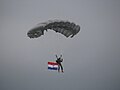 Parachute jump on the day of the Armed Forces
 -
 Croatian Army soldier with a U.S. Army soldier
 -
 Special operation forces conduct close quarter battle training
 -
 Patria AMV infantry fighting vehicle
 -
 PzH 2000 self-propelled howitzer
 -
 MOL coastal anti-ship missile launcher
 -
 Kralj class missile boat
 -
 Mirna class patrol vessel
 -
 Silba class landing ship-minelayer
 -
 Mi-171Sh combat-transport helicopters
 -
 OH-58D observation helicopter
 -
 Bell 206 training helicopter
 -
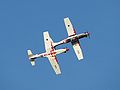 Wings of Storm aerobatic team PC-9M aircraft
 -
 CL-415 firefighter


.jpg)


See also[edit]

- Croatian military ranks
- Croatian War of Independence
- List of Croatian soldiers
- Military history of Croatia
- Military Security and Intelligence Agency
- Croatian Ministry of Defence
- Orders, decorations, and medals of Croatia
Citations[edit]
 | This article needs additional citations for verification. (October 2012) |
- ^ a b "OZBILJNO, HRVATSKA RAPIDNO PROPADA: / Lani je otišlo 47.000 ljudi, a broj rođenih drastično je pao - evo gdje je najkritičnije". Archived from the original on 21 May 2021. Retrieved 18 December 2020.
- ^ a b "OSRH - Glavna".
- ^ IISS 2020, p. 93.
- ^ "Povratak OS RH u Litvu". obris.org. Retrieved 30 December 2020.
- ^ "6. HRVCON ispraćen u NATO-ovu aktivnost u Poljskoj". hrvatski-vojnik.hr. 15 June 2020. Retrieved 30 December 2020.
- ^ "Zbogom Afganistanu, pozdrav Kosovu! Hrvatska vojska ojačat će svoje snage u susjedstvu". vecernji.hr. Retrieved 30 December 2020.
- ^ "U Kašmiru se nalazi devet hrvatskih vojnika. Pitali smo MORH jesu li na sigurnom". index.hr. Retrieved 30 December 2020.
- ^ "Pogledajte u kojim kriznim žarištima hrvatski vojnici održavaju mir". tportal.hr. Retrieved 30 December 2020.
- ^ a b c d "Proračun Ministarstva obrane najveći je do sada, iznosit će 7,568 milijardi kuna". 12 May 2022.
- ^ "Main macroeconomic indicators".
- ^ "NATO Topics: NATO's relations with Croatia". www.nato.int.
- ^ Martina Čizmić (19 October 2007). "Nema više obveznog vojnog roka" [Compulsory military service abolished] (in Croatian). Nacional (weekly). Archived from the original on 17 July 2012. Retrieved 1 July 2012.
- ^ "Pročešljali smo novi državni proračun: Vojska, policija, političari, umirovljenici i učitelji trljaju ruke, medicinari najveći gubitnici".
- ^ "Koliko iznose mirovine hrvatskih branitelja?". 18 November 2022.
- ^ Alvir, Marija (March 2005). "Proračun MORH-a neće više padati". Hrvatski vojnik (in Croatian). Croatian Ministry of Defence. Archived from the original on 8 February 2012. Retrieved 9 September 2011.
- ^ "Ograničeni vojni proračun za 2011. iznosi pet milijardi kuna". Archived from the original on 16 December 2010. Retrieved 30 November 2010.
- ^ a b c "NACRT PRORAČUNA - kupuje se Air Tractor za obuku i jedan ophodni brod do 2015". Archived from the original on 2 December 2013. Retrieved 24 December 2014.
- ^ a b "Nestali u tišini: Hrvatska vojska s 43.000 spala na 17.000 zaposlenih - Večernji.hr". Vecernji.hr. Retrieved 16 December 2016.
- ^ a b c d e f g h "Krstičević: U 4. godini mandata nabavljat ću oružane sustave!". vecernji.hr. Retrieved 2 November 2019.
- ^ "Jutarnji list - VIDEO: HRVATSKA VOJSKA TESTIRALA NOVO MOĆNO NAORUŽANJE Stižu Patrije s izraelskim topom, 8 sofisticiranih stanica instalirat će u DOK-ING-u i Đakoviću". www.jutarnji.hr. 30 November 2019.
- ^ a b c "Zaključak Vlade RH o postupnom povećanju izdvajanja za obranu". MORH. 21 June 2018.
- ^ "Raste vojni proračun: Zbog NATO-a ćemo na obranu trošiti gotovo 10 milijardi kuna!". Vijesti.hr. 2 December 2019.
- ^ "PREDSTAVLJEN PLAN JAVNE NABAVE MORH-a ZA IDUĆU GODINU". Hrvatski vojnik. No. 434. Archived from the original on 27 November 2013. Retrieved 27 November 2013.
- ^ "HRT: MORH predstavio ostvarenje plana nabave za 2013. i plan za 2014". Hrvatska radiotelevizija. 6 November 2013. Retrieved 24 December 2014.
- ^ "Minister Buljević visits Croatian Army and Special Operations Command - Ministry of Defence of the Republic of Croatia". Morh.hr. 9 December 2016. Archived from the original on 9 October 2016. Retrieved 16 December 2016.
- ^ "Special Forces Command marks 1st Anniversary - Ministry of Defence of the Republic of Croatia". Morh.hr. 28 September 2015. Archived from the original on 9 October 2016. Retrieved 16 December 2016.
- ^ "Request Rejected" (PDF). Morh.hr. Archived from the original (PDF) on 6 March 2009. Retrieved 25 May 2016.
- ^ "Croatia plans to upgrade its M-84 Main Battle Tanks' fleet | February 2018 Global Defense Security army news industry | Defense Security global news industry army 2018 | Archive News year". www.armyrecognition.com. Retrieved 23 December 2018.
- ^ "Jutarnji list - FOTO, VIDEO: USKORO STIŽU OKLOPNA VOZILA KOJA ĆE POVEĆATI VATRENU MOĆ HV-a Krstičević otkrio: Amerikanci nam šalju 84 Bradleyja". www.jutarnji.hr. 27 November 2019.
- ^ "Croatia has asked United States to donate 16 M270 Multiple launch Rocket Systems from US surplus 11201162 | January 2016 Global Defense Security news industry | Defense Security global news industry army 2016 | Archive News year". www.armyrecognition.com. Retrieved 23 December 2018.
- ^ Adamowski, Jaroslaw (25 August 2017). "Rafael to benefit from Elbit win in Croatia weapons tender". Defense News. Retrieved 23 December 2018.
- ^ "Israel-Croatia F-16 deal officially pronounced dead". N1. 10 January 2019.
- ^ "Vlada Republike Hrvatske - Zahtjev za ponudu VBA upućen je prema sedam država". vlada.gov.hr. Retrieved 24 January 2020.
- ^ "Janes | Latest defence and security news". Janes.com.
- ^ "Croatia cleared to buy Black Hawks | Jane's 360". www.janes.com. Retrieved 24 January 2020.
- ^ "Croatia takes delivery of first locally-built inshore patrol vessel 'Omiš'". Naval Today. 7 December 2018. Retrieved 23 December 2018.
- ^ "Hrvatska među 25 najvećih izvoznika vojne opreme na svijetu: lanjski izvoz 880 milijuna kuna / Novi list". Novilist.hr. 8 March 2013. Retrieved 25 May 2016.
- ^ C. J. CHIVERS;ERIC SCHMITT (25 February 2013). "In Shift, Saudis Are Said to Arm Rebels in Syria". The New York Times. Retrieved 24 December 2014.
{{cite news}}: CS1 maint: multiple names: authors list (link) - ^ By C. J. CHIVERS and ERIC SCHMITTFEB. 25, 2013 (25 February 2013). "In Shift, Saudis Are Said to Arm Rebels in Syria - The New York Times". The New York Times. Retrieved 16 December 2016.
{{cite web}}: CS1 maint: numeric names: authors list (link) - ^ program, IRIB-Bosanski radio. "Hrvatski izvoz oružja blizu 143 miliona eura". bosnianold.ws.irib.ir.
- ^ "Croatian military output approaches USD1 billion". Retrieved 24 December 2014.
- ^ "Hrvatska trgovala preko Jordana: Siriji prodano oružje vrijedno 200 milijuna kuna". Novi list online portal. 28 January 2014. Retrieved 24 December 2014.
- ^ "Kotromanović: Lani izvezeno 25 posto više vojne opreme i oružja > Slobodna Dalmacija". Slobodnadalmacija.hr. 30 January 2015. Retrieved 25 May 2016.
- ^ "Izvezli oružja za 200 mil. eura, SAD ostaje najveći kupac". www.vecernji.hr.
References[edit]
- IISS (2020). The Military Balance 2020. Routledge. ISBN 978-0367466398.
External links[edit]

- Croatian Armed Forces Official website
- Croatian Forces International Volunteers Association official website
- Croatian Military Academy official website
- [1] - Defense planning and procurement.
- [2] - long term planning and long term defense strategy
- Photos BSD
- CROMIL - Croatian military's official English-language magazine

| Leadership | |||||||||
|---|---|---|---|---|---|---|---|---|---|
| Organization |
| ||||||||
| Military history | |||||||||
| Uniforms and Insignia | |||||||||


| International | |
|---|---|
| National | |
