


Solar power in Spain
 | This article needs to be updated. (April 2017) |

Spain is one of the first countries to deploy large-scale solar photovoltaics, and is the world leader in concentrated solar power (CSP) production.
In 2022, the cumulative total solar power installed was 19.5 GW, of which 17.2 GW were solar PV installations and 2.3 GW were concentrated solar power.[1][2] In 2016, nearly 8 TWh of electrical power was produced from photovoltaics, and 5 TWh from CSP plants.[3]
In 2022, solar power accounted for 11.5% of total electricity generation in Spain, up from 2.4% in 2010 and less than 0.1% in 2000.[4][5] Industry organization Solar Power Europe projects Spain will more than double its solar PV capacity between 2022 and 2026.[6][7]
Spain is one of the European countries with the most hours of sunshine.
The country initially had a leading role in the development of solar power. Generous prices for grid connected solar power were offered to encourage the industry. The boom in solar power installations were faster than anticipated and prices for grid connected solar power were not cut to reflect this, leading to a fast but unsustainable boom in installations. Spain would find itself second only to Germany in the world for solar power installed capacity. In the wake of the 2008 financial crisis, the Spanish government drastically cut its subsidies for solar power and capped future increases in capacity at 500 MW per year, with effects upon the industry worldwide.[8] Between 2012 and 2016, new installations stagnated in Spain while growth accelerated in other leading countries leaving Spain to lose much of its world leading status to countries such as Germany, China and Japan. The controversial "sun tax" and intimidating regulation surrounding solar self consumption introduced in 2015 were only begun to be repealed in late 2018 by the new government.
As a legacy from Spain's earlier development of solar power, the country remains a world leader in concentrated solar power, accounting for almost a third of solar power installed capacity in the country, a much higher ratio than that for other countries as of 2017. Many large concentrated solar power stations remain active in Spain and may have provided some of the impetus for large CSP developments in neighbouring Morocco. In 2017 Spain held large auctions for renewable energy capacity to be constructed by 2020: PV and wind projects each won 4 GW.
The 2020s are seeing a large increase in solar installations in Spain; following three years of strong growth, the country's updated 2023 National Energy and Climate Plan anticipates solar PV capacity reaching 76 GW by 2030.[9][10]
Installed capacity[edit]
Installed capacity grew rapidly until 2013. Between 2013 and 2018 growth was negligible in Spain, and the country fell behind many other European countries in the development of capacity, though it retained its leading position in the deployment of solar thermal power. Growth resumed again after 2018.
| 2006 | 2007 | 2008 | 2009 | 2010 | 2011 | 2012 | 2013 | 2014 | 2015 | 2016 | 2017 | 2018 | 2019 | 2020 | 2021 | 2022 | |
|---|---|---|---|---|---|---|---|---|---|---|---|---|---|---|---|---|---|
| Solar PV* | 125 | 637 | 3,355 | 3,399 | 3,840 | 4,261 | 4,561 | 4,639 | 4,646 | 4,656 | 4,669 | 4,688 | 4,707 | 8,711 | 11,669 | 15,286 | 18,164 |
| Solar thermal | 11 | 11 | 61 | 232 | 532 | 999 | 1,950 | 2,304 | 2,304 | 2,304 | 2.304 | 2,304 | 2,304 | 2,304 | |||
| Total | 136 | 648 | 3,416 | 3,631 | 4,372 | 5,260 | 6,511 | 6,943 | 6,950 | 6,960 | 6.973 | 6,992 | 7,011 | 11,015 | |||
| *Solar PV figures include only grid-connected capacity. | |||||||||||||||||
Timeline of developments[edit]

2004[edit]
Through a ministerial ruling in March 2004, the Spanish government removed economic barriers to the connection of renewable energy technologies to the electricity grid. The Royal Decree 436/2004 equalised conditions for large-scale solar thermal and photovoltaic plants and guaranteed feed-in tariffs.[13]
2008[edit]
Spain added a record 2.6 GW of solar photovoltaic power in 2008,[14] a figure almost five times that of the next record year, increasing capacity to 3.5 GW.[15] Spain surpassed both Japan and the United States in 2008 as the number two market as measured by cumulative installed PV capacity behind the world leader at the time Germany, accounting for 24% of global PV capacity.[16] PV capacity added during 2008 would still account for more than half of total capacity as of 2016. In 2008 the Spanish government committed to achieving a target of 12% of primary energy from renewable energy by 2010 and by 2020 expected the installed solar generating capacity of 10 GW.[17]
2010–2011[edit]
Since 2010, Spain has been the world's leader in concentrated solar power (CSP). Spain is leapfrogged by Italy during 2011 following a later solar boom there to lose its position as the world's second largest installer of solar PV.
2012[edit]
By the end of 2012, 4.5 GW of solar photovoltaics had been installed, and in that year 8.2 TWh of electricity was produced.[18] New installations of solar photovoltaics have slowed down significantly to around 300 MW during 2012. By the end of 2012 Spain had also installed over 2,000 MW of CSP.
2014–2016[edit]

Almost no new solar capacity is added during this period following the removal of government feed-in tariffs. Having promoted the solar industry with large government subsidies during earlier periods, the system now operates under a 180-degree turn with a punitive 'sun tax' applied to new PV systems which would otherwise flourish. Spain has been cited as a model in how not to develop renewables.[19] The hoped for growth in self consumption solar generation during 2016 fails to materialise due to delays to reforms following the extended time taken to form a government, albeit with just one party opposed to reforms in this area.[4]
2017[edit]
In May 2017, Spain held an auction for new renewable capacity to be online by 2020. Solar projects won only 1 MW of the 3000 MW awarded. After complaints by the solar industry which felt the auction terms favoured wind power, another auction occurred in July. In this auction, solar projects received 3,909 MW and wind received 1,128 MW.[20][21] Financing, land acquisition and solar panel price fluctuations could reduce the actual amount of solar power installed.
2018[edit]
A new sector of the market begins to make headway in the Spanish market following the easing of regulations on self consumption generation. 261.7 MW of new solar power was installed, of which just 26 MW were connected to the grid and the remainder, 235.7 MW being self-generating installations.[22] It is expected that this could increase to 300 to 400 MW per year following further easing of regulations in May 2018.[22] Renewable energy auctions held in the previous year have yet to show much impact on grid connected capacity but expected to make a considerable change during 2019. According to industry sources the 3.9 GW tendered through government auctions has been dwarfed by huge merchant and power purchase agreements bringing the combined total under consideration to 29 GW.[23] The re-emerging boom in Spanish solar PV is not being driven by subsidies or government tenders but as a result of solar being a highly cost effective proposition for electricity needs.
2023[edit]
Spain is poised to become a major contributor to Europe's renewable energy landscape, supported by its robust solar potential and favorable market conditions. In 2023, Spain is on track to increase its solar capacity by 4 GW. The country also has ambitions to install an additional 19 GW of new capacity between 2022 and 2025, which would make it home to the largest solar pipeline in Europe. However, Spain grapples with lengthy permitting processes, which can take up to five years, posing a significant hurdle to project development. To address this challenge, the government introduced new regulations in March 2023, streamlining permitting for projects below 150 MW capacity and with low or medium environmental impact. These measures aim to reduce permitting times to approximately two years.[24]
Solar thermal power plants[edit]

| Name of Plant | Net Power MW(e) |
GW·h /year |
Capacity factor |
Completed |
|---|---|---|---|---|
| PS10 | 10 | 23.4 | 0.24 | 2007 |
| Andasol 1 | 50 | 165 | 0.41 | 2008 |
| PS20 | 20 | 48 | 0.27 | 2009 |
| Eureka | 2 | 2009, June[25] | ||
| Andasol 2 | 50 | 2009 | ||
| Puerto Errado 1 | 1.5 | 2009 | ||
| Puertollano | 50 | 2009 | ||
| La Risca | 50 | 2009 | ||
| Extresol 1 | 50 | 2010 | ||
| Extresol 2 | 50 | 2010 | ||
| La Florida | 50 | 2010, July | ||
| Majadas | 50 | 2010, August | ||
| Solnova 1 | 50 | 2010 | ||
| Solnova 3 | 50 | 2010 | ||
| Alvarado I | 50 | 2010 | ||
| Solnova 4 | 50 | 2010 | ||
| La Dehesa | 50 | 2010, November | ||
| Palma del Rio 2 | 50 | 2011 | ||
| Manchasol 1 | 50 | 2011 | ||
| Manchasol 2 | 50 | 2011 | ||
| Gemasolar | 20 | 2011 | ||
| Palma del Rio 1 | 50 | 2011 | ||
| Lebrija 1 | 50 | 2011 | ||
| Andasol 3 | 50 | 2011 | ||
| Helioenergy 1 | 50 | 2011 | ||
| Astexol 3 | 50 | 2011 | ||
| Arcosol 50 | 50 | 2011 | ||
| Termosol 50 | 50 | 2011 | ||
| Helioenergy 2 | 50 | 2012 | ||
| Valle 1 | 50 | 170 | 2012 | |
| Valle 2 | 50 | 170 | 2012 | |
| Puerto Errado 2 | 30 | 2012 | ||
| Aste 1A | 50 | 2012 | ||
| Aste 1B | 50 | 2012 | ||
| Moron | 50 | 2012 | ||
| Helios 1 | 50 | 2012, May | ||
| Solaben 3 | 50 | 2012, June | ||
| Guzman | 50 | 2012, July | ||
| La Africana | 50 | 2012, July | ||
| Olivenza 1 | 50 | 2012, July | ||
| Helios 2 | 50 | 2012, August | ||
| Extresol 3 | 50 | 2012, August | ||
| Orellana | 50 | 2012, August | ||
| Solaben 2 | 50 | 2012, October | ||
| Solarcor 1 | 50 | 2012 | ||
| Solarcor 2 | 50 | 2012 | ||
| Termosolar Borges | 25 | 2012, December |


In March 2007, Europe's first commercial concentrating solar power tower plant was opened near the sunny Andalusian city of Seville. The 11 MW plant, known as the PS10 solar power tower, produces electricity with 624 large heliostats. Each of these mirrors has a surface measuring 120 square meters (1,290 square feet) that concentrates the Sun's rays to the top of a 115-meter (377 feet) high tower where a solar receiver and a steam turbine are located. The turbine drives a generator, producing electricity.[26]
The Andasol 1 solar power station is Europe's first parabolic trough commercial power plant (50 MWe), located near Guadix in the province of Granada, also in Andalusia (the plant is named after the region). The Andasol 1 power plant went online in November 2008, and has a thermal storage system which absorbs part of the heat produced in the solar field during the day. This heat is then stored in a molten salt mixture and used to generate electricity during the night, or when the sky is overcast.[27]
A 15 MWe solar-only power tower plant, the Solar Tres project, is in the hands of the Spanish company SENER, employing molten salt technologies for receiving and energy storage. Its 16-hour molten salt storage system will be able to deliver power around the clock. The Solar Tres project has received a €5 million grant from the EC's Fifth Framework Programme.[13]
Solar thermal power plants designed for solar-only generation are well matched to summer noon peak loads in prosperous areas with significant cooling demands, such as Spain. Using thermal energy storage systems, solar thermal operating periods can even be extended to meet base-load needs.[13]
Abengoa Solar began commercial operation of a 20-megawatt solar power tower plant near Seville in late April 2009. Called the PS20, the plant uses a field of 1,255 flat mirrors, or heliostats, to concentrate sunlight on a receiver mounted on a central tower. Water pumped up the tower and through the receiver boils into steam, which is then directed through a turbine to produce electricity. The new facility is located adjacent to one with half its capacity, called PS10, which was the world's first commercial solar power tower plant. According to Abengoa Solar, the new facility is exceeding its predicted power output.[28]
Photovoltaics[edit]
Solar PV market segmentation[edit]
| Installed PV capacity in Spain by class size in 2017[29] | |
|---|---|
| <10 kW | 2% |
| 10-100 kW | 27% |
| 100-500 kW | 43% |
| >500 kW | 28% |
Utility scale solar PV dominated the cumulative installed capacity in 2018 accounting for over 75% of the total in Spain although some sources would not define smaller sized installations as utility scale. Only 2% of Spain's installations in 2017 were in the size typical for residential rooftop solar. This is typically the situation in European countries which had a short-term generous feed in their tariff system with little attention to policy consistency and scale of installations. As of 2018, 19% of Europe's cumulative PV capacity was installed on residential rooftops, and about 30% on commercial roofs, while the industrial segment accounted for 17%, and the utility market for 34%.[30]
The government projects an increase in solar PV capacity by approximately 30 GW, rising from 9 GW in 2020 to 21.7 GW by 2025, and reaching 39.2 GW by 2030.[31]
Residential solar PV capacity[edit]
According to a report on behalf of the European Commission Spain had just 49 MW of residential solar PV capacity with just 12,000 residential solar PV prosumers in the country representing only 0.1% of households as of 2015.[32] The average size of residential solar PV installations in Spain moving forwards to 2030 is 3.94 kW.[32] The technical potential for residential solar PV in Spain is estimated at 13,620 MW.[32] The United Kingdom, a relative latecomer to Solar PV development, had 2,499 MW of residential solar PV installed as of 2015.[32]
-
 PV solar parking lot in Madrid
 -

-
 An isolated mountain hut with stand-alone PV system in Catalonia
 -
-
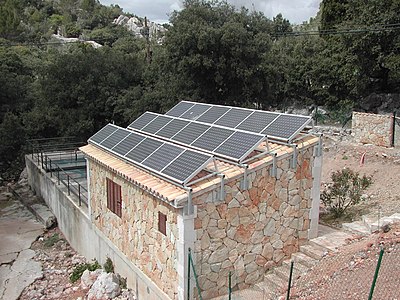
 solar PV system at a port warehouse in Galicia


Large PV roofs[edit]
| Location | Organisation (linked) |
Online | Capacity (MW) |
|---|---|---|---|
| Figueruelas | GM facility | 2008 | 11.8 |
| Martorell | Seat al Sol, SEAT facility | 2010–2013 | 11.0 |
| Castala | Actiu Technology Park | 2008 | 5.2 |
At the time of opening, the General Motors facility at Figueruelas was the world's largest photovoltaic (PV) roof, consisting of 85,000 lightweight panels, thereby reducing annual carbon dioxide emissions by 6,700 tonnes per year.[34] GM planned to install solar panels at eleven other plants across Europe.
Utility-scale systems[edit]
Photovoltaics (PV) convert sunlight into electricity and many solar photovoltaic power stations have been built in Spain.[35] As of November 2010, the largest PV power plants in Spain include the Olmedilla Photovoltaic Park (60 MW), Puertollano Photovoltaic Park (47.6 MW), Planta Solar La Magascona & La Magasquila (34.5 MW), Arnedo Solar Plant (34 MW), and Planta Solar Dulcinea (31.8 MW).[35]
BP Solar begun constructing a new solar photovoltaic cell manufacturing plant at its European headquarters in Tres Cantos, Madrid.[38] For phase one of the Madrid expansion, BP Solar aimed to expand its annual cell capacity from 55 MW to around 300 MW. Construction of this facility was underway, with the first manufacturing line expected to be fully operational in 2009.[38] The new cell lines would use innovative screen-printing technology. By fully automating wafer handling, the manufacturing lines would be able to handle the very thinnest of wafers available and ensure the highest quality.[38] Thin wafers are of particular importance since there has been a silicon shortage in recent years. However, after the new national law limiting installed power by year, in April 2009 BP Solar closed its factories.[39]
Since the beginning of 2007, Aleo Solar AG has also been manufacturing high-quality solar modules for the Spanish market at its own factory in Santa Maria de Palautordera near Barcelona. In 2014 SITECNO S.A. took over this facility[38]
Regional PV distribution[edit]

| <1 watt 1—10 watts 10—50 watts 50—100 watts 100—200 watts | 200—350 watts 350—500 watts 500—750 watts >750 watts |
| Autonomous Communities | 2010 | 2011 | 2022 | Watts per capita (2022) |
|---|---|---|---|---|
| Andalusia | 765 | 822 | 4,163 | 488 |
| Aragon | 142 | 146 | 1,851 | 1,408 |
| Asturias | 1 | 1 | 1 | |
| Balearic Islands | 60 | 66 | 225 | 183 |
| Basque Country | 20 | 23 | 51 | 23 |
| Canary Islands | 133 | 138 | 212 | 94 |
| Cantabria | 2 | 2 | 4 | 6 |
| Castile-La Mancha | 897 | 923 | 4,048 | 1,974 |
| Castile and León | 410 | 467 | 1,438 | 605 |
| Catalonia | 202 | 234 | 295 | 38 |
| Ceuta and Melilla | 0.1 | 0.1 | ||
| Community of Madrid | 38 | 48 | 63 | 9 |
| Extremadura | 492 | 558 | 5,347 | 5,076 |
| Galicia | 10 | 12 | 18 | 6 |
| La Rioja | 83 | 89 | 99 | 313 |
| Navarre | 142 | 155 | 166 | 251 |
| Region of Murcia | 357 | 404 | 1,384 | 908 |
| Valencian Community | 277 | 313 | 419 | 82 |
| Source:[41][42][43] | ||||
Policies, laws and incentives[edit]

New technical building code[edit]
In 2006, Spain implemented a regulatory instrument of national jurisdiction promulgated by the Royal Decree 314/2006 referred to as the technical building code (TBC or CTE in Spanish) to regulate the basic quality requirements of buildings and their respective installations concerning thermal and photovoltaic solar energy. It applies to new constructions as well as any modifications made on any existing building with the final goal to guarantee and promote the use of renewable sources of energy.[44]
Concerning thermosolar energy, Spain was the first country in Europe to enforce the integration of solar thermal systems in new constructed or refurnished buildings to cover from 30 to 70% of the Domestic Hot Water (DHW) demand. Article 15.4 of the TBC states that "buildings with foreseen demand for hot water or the conditioning of a covered swimming pool, part of the thermal energy needs shall be covered by incorporating systems for the collection, storage and use of low temperature solar energy [...]".[45]
In relation to Photovoltaic power, Article 15.5 requires the incorporation of "systems for the collection and transformation of solar energy into electric power by photovoltaic processes for proprietary use or supply to the network".[46] This policy triggered the production of this type of renewable energy positioning Spain on top of the largest producers of photovoltaic electricity in the world by 2009.[47]
Subsidy reductions[edit]
In the wake of the 2008 financial crisis, the Spanish government drastically cut its subsidies for solar power and capped future increases in capacity at 500 MW per year, with effects upon the industry worldwide. "The solar industry in 2009 has been undermined by [a] collapse in demand due to the decision by Spain", according to Henning Wicht, a solar-power analyst.[8] In 2010, the Spanish government went further, retroactively cutting subsidies for existing solar projects, aiming to save several billion euro it owed.[14][48] According to the Photovoltaic Industry Association, several hundred photovoltaic plant operators may face bankruptcy.[49] Phil Dominy of Ernst & Young, comparing the feed-in tariff reductions in Germany and Italy, said; "Spain stands out as an example of how not to do it".[50] As a result, a Spanish association of solar power producers has announced its intention to go to court over the government's plans to cap solar subsidies. In 2014 alternative energy group NextEra filed a complaint against Spain at the International Centre for Settlement of Investment Disputes.[51]
Research and development[edit]
The Plataforma Solar de Almería (PSA), part of the Center for Energy, Environment and Technological Research (CIEMAT), is a center for research, development, and testing of concentrating solar power technologies.[52] ISFOC[53] in Puertollano is a development institute for concentrator photovoltaics (CPV) which evaluates CPV technologies at the pilot production scale to optimise operation and determine cost. Technical University of Madrid has a photovoltaic research group.[54]
Solar Concentra is the Spanish technology platform for concentrated solar power (CSP).[55] It was created in 2010, and it combines the efforts of the different agents of the CSP sector in Spain.
See also[edit]
- Growth of photovoltaics
- List of renewable energy topics by country
- Net metering
- Renewable energy in Spain
- Solar energy in the European Union
References[edit]
- ^ "Photovoltaic Barometer 2023". EurObserv’ER. 5 May 2023. p. 2/7. Retrieved 9 July 2023.
- ^ a b "Red Eléctrica de España | Series estadísticas nacionales". www.ree.es (in Spanish). Retrieved 4 July 2017.
- ^ "Red Electrica de Espana, Statistical data of electrical system April 2017, Balance of electrical energy". Spain: REE. 2017. p. 2.
- ^ a b "IEA-pvps, Annual Report 2016". IEA-PVPS. 2016.
- ^ "Share of electricity production from solar - Spain". Our World in Data. 2023. Retrieved 20 June 2023.
- ^ "Spain second country in Europe with the most solar energy". InSpain.news. 19 December 2022. Retrieved 20 June 2023.
- ^ Anu Bhambhani (19 December 2022). "European Union To Exit 2022 With Over 41 GW Solar Installed". TaiyangNews. Retrieved 20 June 2023.
- ^ a b Gonzalez, Angel; Keith Johnson (8 September 2009). "Spain's Solar-Power Collapse Dims Subsidy Model". The Wall Street Journal. Retrieved 6 March 2011.
- ^ Jonathan Touriño Jacobo (28 June 2023). "Spain updates NECP, targets 76GW of solar PV by 2030". PV Tech. Retrieved 9 July 2023.
- ^ Gareth Chetwynd (29 June 2023). "Spain eyes massive solar and wind boosts under new energy plan". Recharge News. Retrieved 9 July 2023.
- ^ "Wind energy and solar power capacity in Spain". Reve. 5 February 2021. Retrieved 27 March 2021.
- ^ Edwin Cartlidge (18 November 2011). "Saving for a rainy day". Science (Vol 334). pp. 922–924.
{{cite web}}: Missing or empty|url=(help) - ^ a b c "Spain pioneers grid-connected solar-tower thermal power" (PDF).
- ^ a b Couture, Toby D. (23 February 2011). "Spain's Renewable Energy Odyssey". Greentech Media. Retrieved 6 March 2011.
- ^ Sills, Ben (18 October 2010). "Spain's Solar Deals on Edge of Bankruptcy as Subsidies Founder". Bloomberg Markets Magazine. Bloomberg.com. Retrieved 6 March 2011.
- ^ "2008 Solar Technologies Market Report, U.S. Department of Energy" (PDF).
- ^ "Spain expects 3,000 MW in solar plants by 2010". Environmental News Network. 25 September 2008. Retrieved 6 March 2011.
- ^ "Photovoltaic Barometer" (PDF).
- ^ "Spain Is a Case Study in How Not to Foster Renewables". Retrieved 4 July 2017.
- ^ Hill, Joshua S (28 July 2017). "Spain Awards 4 Gigawatts Solar & 1 Gigawatt Wind In Renewables Auction". CleanTechnica.
- ^ European Energy Auctions Yield Ever-Lower Wind Energy Prices In Germany & Spain, CleanTechnica, Joshua S Hill, 22 May 2017
- ^ a b Planelles, Manuel (6 February 2019). "Self-generated energy soars in Spain as solar panels plunge in price". El País. ISSN 1134-6582. Retrieved 5 July 2019.
- ^ "Economics not tenders driving Spain's solar resurgence". PV Tech. 23 April 2018. Retrieved 11 July 2019.
- ^ "Spain's bulging solar pipeline heaps pressure on permitting". Reuters. 8 December 2022.
- ^ "Abengoa Solar Business Group" (PDF).
- ^ "Sunny Spain to Host Europe's First Large Solar Thermal Plant". Environment News Service. 30 June 2006. Retrieved 6 March 2011.
- ^ "Andasol 1 Goes Into Operation".
- ^ "eere.energy.gov". Archived from the original on 3 March 2016. Retrieved 21 May 2009.
- ^ "EXISTING AND FUTURE PV PROSUMER CONCEPTS" (PDF). pvp4grid.eu. 2012. p. 18.
- ^ "SolarPower Europe's Global Market Outlook 2019 – 2023" (PDF). 2019. p. 82. Archived from the original (PDF) on 15 February 2020. Retrieved 10 July 2019.
- ^ "Spain 2021 - Energy Policy Review" (PDF). International Energy Agency. 2021.
- ^ a b c d "Study on 'Residential Prosumers in the European Energy Union' , pg. 196" (PDF).
- ^ "Large Photovoltaic Roofs". pvresources.com. Retrieved 15 July 2019.
- ^ Keeley, Graham (8 July 2008). "GM installs world's biggest rooftop solar panels". The Guardian. ISSN 0261-3077. Retrieved 24 July 2019.
- ^ a b c d e PV Resources.com (2009). World's largest photovoltaic power plants
- ^ "Europe's largest solar PV plant, a 500MW facility in Spain, begins production". RenewEconomy. Australia. 14 April 2020.
- ^ Citysolar (2007). Solar park of the superlative
- ^ a b c d "BP Solar to Expand Its Solar Cell Plants in Spain and India". Archived from the original on 18 April 2016. Retrieved 1 September 2015.
- ^ "BP Solar closes its Spanish factories".
- ^ "Global Market Outlook for Photovoltaics 2014–2018" (PDF). epia.org. EPIA – European Photovoltaic Industry Association. p. 24. Archived from the original (PDF) on 25 June 2014. Retrieved 12 June 2014.
- ^ Global Market Outlook 2016 Archived 20 March 2013 at the Wayback Machine pg. 71
- ^ Lucía Fernández (14 June 2023). "Solar photovoltaic capacity in Spain in 2022, by autonomous community". Statista. Retrieved 9 July 2023.
- ^ "Population of Spain in 2022, by autonomous community". Statista. 21 July 2023. Retrieved 23 July 2023.
- ^ "CTE". Código Técnico de la Edificación.
- ^ "The Spanish Technical Building Code, Article 15.4" (PDF).
- ^ "The Spanish Technical Building Code, Article 15.5" (PDF).
- ^ A. Prieto, Pedro (2013). Spain's Photovoltaic Revolution: The Energy Return on Investment. SpringerBriefs in Energy. Springer. p. 20. doi:10.1007/978-1-4419-9437-0. ISBN 978-1-4419-9436-3.
- ^ Johnson, Steve (9 January 2011). "Investors may walk after Spain's solar cut". Financial Times. Retrieved 1 March 2011.
- ^ Sills, Ben (1 August 2010). "Spain Proceeds With Plans to Cut Solar Subsidies After Talks Break Down". Bloomberg.com. Retrieved 7 March 2011.
- ^ Wilson, Peter (5 March 2011). "Sun setting on European solar subsidies". The Australian. Retrieved 6 March 2011.
- ^ "U.S.'s NextEra files complaint over Spain's new renewable energy rules". Reuters. 26 May 2014.
- ^ "General Description of the PSA". Archived from the original on 15 May 2007. Retrieved 14 January 2023.
- ^ isfoc.es
- ^ ies.upm.es – Instituto Energía Solar
- ^ solarconcentra.org
External links[edit]
- Spain pioneers grid-connected solar-tower thermal power
- Photovoltaic solar power grows fast in Spain
- GM installs world's biggest rooftop solar panels
- Is the Sun Setting on Solar Power in Spain?


| Africa | |||||
|---|---|---|---|---|---|
| Asia | |||||
| Europe |
| ||||
| North America | |||||
| Oceania | |||||
| South America | |||||

