


Toei Asakusa Line
 | This article needs additional citations for verification. (March 2010) |
| Toei Asakusa Line | |
|---|---|
 | |
 A Toei Asakusa Line 5500 series train | |
| Overview | |
| Other name(s) | A |
| Native name | 浅草線 |
| Owner |  Toei Subway Toei Subway |
| Line number | 1 |
| Locale | Tokyo |
| Termini | |
| Stations | 20 |
| Color on map | |
| Service | |
| Type | Heavy rail |
| System | Tokyo subway |
| Operator(s) | Toei Subway |
| Depot(s) | Magome |
| Daily ridership | 718,855 (FY2016)[1] |
| History | |
| Opened | 4 December 1960 |
| Technical | |
| Line length | 18.3 km (11.4 mi) |
| Track gauge | 1,435 mm (4 ft 8+1⁄2 in) standard gauge |
| Minimum radius | 161 m (528 ft) |
| Electrification | 1,500 V DC (overhead catenary) |
| Operating speed | 70 km/h (43 mph) |
| Signalling | Automatic closed block |
| Train protection system | C-ATS |
| Maximum incline | 3.5% |


The Toei Asakusa Line (都営地下鉄浅草線, Toei Chikatetsu Asakusa-sen) is a subway line in Tokyo, Japan, operated by the municipal subway operator Toei Subway. The line runs between Nishi-magome in Ōta and Oshiage in Sumida. The line is named after the Asakusa district, a cultural center of Tokyo, under which it passes.
The Asakusa Line was the first subway line in Japan to offer through services with a private railway. Today, it has more through services to other lines than any other subway line in Tokyo. Keikyu operates through trains on the Keikyu Main Line to Misakiguchi and the Keikyu Airport Line to Haneda Airport Domestic Terminal. The Keisei Electric Railway operates through trains on the Keisei Oshiage Line to Inba-Nihon-Idai and the Keisei Main Line to Narita Airport Terminal 1, and the Shibayama Railway runs trains via the Keisei Main Line and the Shibayama Railway Line to Shibayama-Chiyoda. Via its through services with Keisei and Keikyu, the Asakusa line is the only train line that offers a direct connection between Tokyo's two main airports.
The Asakusa Line is often split into two routes: Oshiage–Sengakuji and Sengakuji–Nishi-magome; only some trains make all station stops on the line, as many trains travel on the Keikyu Main Line south of Sengakuji.
On maps and signboards, the line is shown in the color rose. Stations carry the letter "A" followed by a two-digit number inside a more reddish vermilion circle.
Services[edit]
- Local (普通 futsū) trains operate between Nishi-Magome and Sengakuji approximately every ten minutes and are timed to connect to Keikyu through service trains at Sengakuji.
- Rapid service (快速 kaisoku) trains operate between Nishi-Magome and Keisei Sakura Station approximately every twenty minutes. They make all station stops on the Asakusa Line.
- Limited Express (快特 kaitoku) trains operate approximately every twenty minutes. They generally use Keikyu rolling stock and have a southern terminus at Misakiguchi Station or Keikyu Kurihama Station. They operate as Limited Express trains only on the Keikyu line, and provide local service on the Asakusa Line and Keisei Oshiage Line. Their northern terminus is generally either Aoto Station or Keisei Takasago Station, but select trains operate to Narita International Airport.
- Limited Express (快特 kaitoku) trains operate approximately every twenty minutes and make all stops (local service) on the Asakusa Line, providing Limited Express service on the Keikyu line between Sengakuji and Haneda Airport Domestic Terminal. Their northern terminus is usually either Inzai-Makinohara Station or Inba-Nihon-Idai Station on the Hokuso Railway.
- Airport Limited Express (エアポート快特 eapōto kaitoku) trains operate approximately every twenty minutes, and skip certain stations while operating on the Asakusa Line. Their northern terminus alternates between "Access Express" (アクセス特急 akusesu tokkyū) service to Narita International Airport and Limited Express service to either Aoto or Takasago. The total travel time from Haneda Airport to Narita Airport on this train is approximately one hour and 46 minutes.
Station list[edit]
- All stations are located in Tokyo.
- The Airport Limited Express/Access Express stops at stations marked "●", skips those marked "|". All other services stop at every station.
| No. | Station | Japanese | Distance (km) | Airport Ltd. Exp./Access Exp. | Transfers | Location | |
|---|---|---|---|---|---|---|---|
| Between stations |
From Nishi-magome | ||||||
| A01 | Nishi-magome | 西馬込 | – | 0.0 | Keikyu Main Line Through to Keikyu Airport Line |
Ōta | |
| A02 | Magome | 馬込 | 1.2 | 1.2 | |||
| A03 | Nakanobu | 中延 | 0.9 | 2.1 | OM Ōimachi Line (OM04) | Shinagawa | |
| A04 | Togoshi | 戸越 | 1.1 | 3.2 | IK Ikegami Line (Togoshi-ginza Station: IK03) | ||
| A05 | Gotanda | 五反田 | 1.6 | 4.8 |
| ||
| A06 | Takanawadai | 高輪台 | 0.7 | 5.5 | Minato | ||
| Keikyu through services: | To/from Haneda Airport Terminal 1·2 via the KK Keikyū Main Line and KK Keikyū Airport Line From Zushi·Hayama via the KK Keikyū Zushi Line (northbound only) From Uraga via the KK Keikyū Main Line (northbound only; southbound trains for KK Keikyū Kurihama Line via Horinouchi) To/from Misakiguchi via the KK Keikyū Main Line and KK Keikyū Kurihama Line | ||||||
| A07 | Sengakuji | 泉岳寺[* 1] | 1.4 | 6.9 | ● |
|
Minato |
| A08 | Mita | 三田 | 1.1 | 8.0 | ● |
| |
| A09 | Daimon | 大門 | 1.5 | 9.5 | ● |
| |
| A10 | Shimbashi | 新橋 | 1.0 | 10.5 | ● |
| |
| A11 | Higashi-ginza | 東銀座 | 0.9 | 11.4 | | | H Hibiya Line (H-10) Underground passage to Ginza, Hibiya and Yūrakuchō stations |
Chūō |
| A12 | Takaracho | 宝町 | 0.8 | 12.2 | | | ||
| A13 | Nihombashi | 日本橋 | 0.8 | 13.0 | ● |
| |
| A14 | Ningyocho | 人形町 | 0.8 | 13.8 | | |
| |
| A15 | Higashi-nihombashi | 東日本橋 | 0.7 | 14.5 | ● |
| |
| A16 | Asakusabashi | 浅草橋 | 0.7 | 15.2 | | | JB Chūō-Sōbu Line (JB20) | Taitō |
| A17 | Kuramae | 蔵前 | 0.7 | 15.9 | | | E Ōedo Line (E-11) | |
| A18 | Asakusa | 浅草 | 0.9 | 16.8 | ● |
| |
| A19 | Honjo-azumabashi | 本所吾妻橋 | 0.7 | 17.5 | | | Sumida | |
| A20 | Oshiage (SKYTREE) |
押上 (スカイツリー前)[* 2] |
0.8 | 18.3 | ● |
| |
| Through Services via the KS Keisei Oshiage Line | To/from Narita Airport Terminal 1 via the KS Keisei Main Line To/from Narita Airport Terminal 1 via the KS Keisei Main Line and KS Narita Sky Access Line To/from Imba-Nihon-Idai via the KS Keisei Main Line and HS Hokusō Line To/from Shibayama-Chiyoda via the KS Keisei Main Line, KS Keisei Higashi-Narita Line, and SR Shibayama Railway | ||||||

Rolling stock[edit]
A variety of rolling stock is in use due to the large number of through service operators on the line, all of which use standard gauge tracks and 1,500 V DC electrification via overhead lines. Currently, six operators run trains onto the Asakusa Line, the most of any Tokyo subway line, and the line is unique as the only subway line in Tokyo with through services onto standard gauge railways (all other through services are with narrow gauge lines).
Toei[edit]
-
 A Toei 5500 series EMU

Keisei Electric Railway[edit]
-
 A Keisei 3000 series EMU
 -
 A Keisei 3050 series EMU
 -
 A Keisei 3100 series EMU
 -
 A Keisei 3400 series EMU
 -
 A Keisei 3600 series EMU
 -
 A Keisei 3700 series EMU


- Keisei 3000 series
- Keisei 3050 series
- Keisei 3100 series
- Keisei 3400 series
- Keisei 3600 series
- Keisei 3700 series
Keikyu[edit]
-
 A Keikyu 600 series EMU
 -
 A Keikyu N1000 series EMU
 -
 A Keikyu 1500 series EMU


Hokuso Railway[edit]
-
 A Hokuso 7300 series EMU
 -
 A Hokuso 7500 series EMU


Chiba New Town Railway[edit]
-
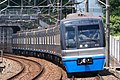 A Chiba New Town Railway 9100 series
 -
 A Chiba New Town Railway 9200 series EMU
 -
 A Chiba New Town Railway 9800 series


- Chiba New Town Railway 9100 series
- Chiba New Town Railway 9200 series
- Chiba New Town Railway 9800 series
Shibayama Railway[edit]
-
 A Shibayama 3600 series EMU

Former rolling stock[edit]
- Toei 5000 series
- Toei 5200 series
- Toei 5300 series[2]
- Keikyu 1000 series
- Keisei 3000 series (original type)
- Keisei 3050 series (original type)
- Keisei 3100 series (original type)
- Keisei 3150 series
- Keisei 3200 series
- Keisei 3300 series
- Keisei 3500 series
- Hokuso 7000 series
- Hokuso 7050 series
- Hokuso 7150 series
- Hokuso 7250 series
- Hokuso 7260 series
- Chiba New Town Railway 9000 series
History[edit]
The Toei Asakusa Line was the first subway line constructed by the Tokyo Metropolitan Government. The line number is Line 1, because it was technically the first subway line in Tokyo to be planned in the 1920s as an underground route connecting the Keikyu and Keisei Electric Railway via Shinagawa, eventually allowing for through trains between these two railways. In its original plan form, the line would have actually bypassed Asakusa Station entirely. However, the plan was changed to take advantage of the existing Tobu Isesaki Line (section now named as the Tobu Skytree Line) and Tokyo Metro Ginza Line connections at Asakusa.
Construction of this line began on 27 August 1956 after years of delays, and the initial 3.2 km (2.0 mi) segment between Oshiage and Asakusabashi opened on 4 December 1960. The line then opened in stages from north to south:
- May 1962: Asakusabashi to Higashi-Nihombashi
- September 1962: Higashi-Nihombashi to Ningyōchō
- February 1963: Ningyōchō to Higashi-Ginza
- December 1963: Higashi-Ginza to Shimbashi
- October 1964: Shimbashi to Daimon
- June 1968: Daimon to Sengakuji (Through service with Keikyū begins)
- 15 November 1968: Sengakuji to Nishi-Magome
The line was named Asakusa Line on 1 July 1978.[3]
From 1998 to 2002, the Asakusa Line was used as part of a rail connection between Tokyo's two major airports, Haneda and Narita. While a few trains still run between the airports, the service has greatly diminished in frequency since 2002.[citation needed]
In 2005, a research group of government, metropolitan and railway company officials proposed that the Asakusa Line be connected to Tokyo Station via a spur to the north of Takarachō Station. This would provide Tokyo Station's first direct connection to the Toei subway network. It would also make it possible to reach Haneda Airport in 25 minutes (versus 35 minutes today) and Narita Airport in 40 minutes (versus 57 minutes today).[4] This plan has yet to be finalized or formally adopted. Authorities are re-considering a similar plan as part of the infrastructure improvements for the 2020 Summer Olympics; the proposed line would cut travel time to Haneda from 30 minutes to 18 minutes, and to Narita from 55 minutes to 36 minutes, at a total cost of around 400 billion yen.[5]
References[edit]

- ^ 東京都交通局ホーム – 経営情報 – 交通局の概要 – 都営地下鉄 [Tokyo Metropolitan Bureau of Transportation Home – Management Information – Overview of the Department of Transportation – Toei Subway] (in Japanese). 東京都交通局 [Tokyo Metropolitan Bureau of Transportation]. April 1, 2015. Retrieved 2016-01-17.
- ^ 東京都交通局,ピックアップ情報,「ありがとう5300形 都営まるごときっぷ」を限定発売 [Tokyo Metropolitan Bureau of Transportation announces "Thank you 5300 series"]. Tokyo Metropolitan Bureau of Transportation (in Japanese). 7 March 2023. Retrieved 8 March 2023.
- ^ "都営交通のあらまし2020" [Toei Transportation Summary 2020] (PDF). Toei Transportation Online (in Japanese). Archived (PDF) from the original on 9 November 2020. Retrieved 29 May 2022.
- ^ 都営浅草線東京駅接着等の事業化推進に関する検討 調査結果のとりまとめ Archived 2007-08-24 at the Wayback Machine, May 2003.
- ^ "羽田・成田発着を拡大、五輪へインフラ整備急ぐ" [Race to increase slots at Haneda & Narita and build infrastructure for Olympics]. Nihon Keizai Shimbun. Nikkei Inc. 10 September 2013. Retrieved 10 September 2013.
External links[edit]

| Shinkansen lines | |
|---|---|
 JR East lines JR East linespassing through Central Tokyo |
|
 Tokyo Metro lines Tokyo Metro lines |
|
| Toei Subway lines | |
 Yokohama Municipal Subway Yokohama Municipal Subway | |
| JR East lines in satellite cities or suburbs | |
 Keikyu Keikyu | |
 Keio Keio | |
 Keisei Keisei | |
 Odakyu Odakyu | |
 Seibu Seibu | |
 Sotetsu Sotetsu | |
 Tobu Tobu | |
 Tōkyū Railways Tōkyū Railways |
|
| Other commuter rail lines | |
| Trams | |
| Monorails | |
| People movers | |
| Hinterland | |
| Funiculars and aerial lifts | |
 Bus services and hubs Bus services and hubs | |
| Public ferries | |
| Major terminals | |
| Miscellaneous |
|


_symbol.svg)
_symbol.svg)
_symbol.svg)
_symbol.svg)
_symbol.svg)


