


Tōhoku Shinkansen
| Tōhoku Shinkansen | |||
|---|---|---|---|
 | |||
 E5 Series Shinkansen set U2 coupled to an E6 Series Shinkansen set on a Hayabusa service towards Tokyo, August 2023 | |||
| Overview | |||
| Native name | 東北新幹線 | ||
| Status | Operational | ||
| Owner | |||
| Locale | Tokyo; Saitama, Tochigi, Fukushima, Miyagi, Iwate and Aomori Prefectures | ||
| Termini | |||
| Stations | 23 | ||
| Color on map | Green (#41934c) | ||
| Service | |||
| Type | High-speed rail (Shinkansen) | ||
| System | Shinkansen | ||
| Services | |||
| Operator(s) |  JR East JR East | ||
| Depot(s) | Tokyo, Oyama, Nasushiobara, Sendai, Morioka, Shin-Aomori | ||
| Rolling stock | |||
| History | |||
| Opened | 23 June 1982 (Ōmiya - Morioka) 4 December 2010 (Full line) | ||
| Technical | |||
| Line length | 674.9 km (419.4 mi) | ||
| Number of tracks | Double-track | ||
| Track gauge | 1,435 mm (4 ft 8+1⁄2 in) standard gauge | ||
| Minimum radius | 4,000 m (2.5 mi; 13,000 ft) | ||
| Electrification | 25 kV 50 Hz AC overhead catenary | ||
| Operating speed | 320 km/h (200 mph) Around 2027: 360 km/h (225 mph) | ||
| Signalling | Cab signalling | ||
| Train protection system | DS-ATC | ||
| |||


The Tōhoku Shinkansen (東北新幹線) is a Japanese high-speed Shinkansen rail line, connecting Tokyo with Aomori in Aomori Prefecture in a route length of 674.9 km (419.4 mi), making it Japan's longest Shinkansen line. It runs through the more sparsely populated Tōhoku region of Japan's main island, Honshu, and was extended as the Hokkaido Shinkansen through the Seikan Tunnel to Shin-Hakodate-Hokuto (this section opened March 2016) and is expected to be extended to Sapporo by 2030. It has two Mini-shinkansen branch lines, the Yamagata Shinkansen and Akita Shinkansen. The line is operated by East Japan Railway Company (JR East).
Services[edit]
There are four services in operation:
- Hayabusa, Tokyo – Shin-Aomori/Shin-Hakodate-Hokuto limited-stop, starting 5 March 2011
- Hayate, Morioka/Shin-Aomori - Shin-Hakodate-Hokuto limited-stop, starting 26 March 2016 (the name has been in use since 1 December 2002)
- Yamabiko, Tokyo – Sendai limited-stop, and all-stations to Morioka, starting June 1982
- Nasuno, Tokyo – Oyama/Nasushiobara/Kōriyama all-stations, starting 1995
One service has been discontinued:
- Aoba, Tokyo – Sendai all-stations, June 1982 – October 1997 (consolidated with Nasuno)
Through trains on the Akita Shinkansen and Yamagata Shinkansen lines also run on Tōhoku Shinkansen tracks from Morioka and Fukushima respectively.
As of March 2021, the maximum line speed is 110 km/h (68 mph) between Tokyo and Ueno, 130 km/h (81 mph) between Ueno and Ōmiya, 275 km/h (171 mph) between Ōmiya and Utsunomiya, 320 km/h (199 mph) between Utsunomiya and Morioka, and 260 km/h (162 mph) between Morioka and Shin-Aomori.[1][2][3]
On 30 October 2012, JR East announced that it is pursuing research and development to increase speeds to 360 km/h (224 mph) on the Tohoku Shinkansen.[4] Work seems to be ongoing to upgrade the section between Morioka and Shin-Aomori to 320 km/h (199 mph), primarily in the form of improved sound barriers. This should make operating at 360 km/h (224 mph) possible, if the improved noise dampening techniques being tested using the ALFA-X test train are successful.[5] Upgrade works on this section started in October 2020, and are expected to take seven years to complete.[6]
List of stations[edit]
Legend:
| ● | All trains stop |
|---|---|
| ▲ | Some trains stop |
| | | All trains pass |


Rolling stock[edit]
As of March 2024, the following types are used on Tohoku Shinkansen services.
- E2 series: Yamabiko / Nasuno services
- E3 series: Tsubasa / Yamabiko / Nasuno services
- E5 series: Hayabusa / Hayate / Yamabiko / Nasuno services
- E6 series: Komachi / Hayabusa / Yamabiko / Nasuno services
- E8 series: Tsubasa / Yamabiko / Nasuno services[7]
- H5 series: Hayabusa / Hayate / Yamabiko / Nasuno services
-
 E2 series
 -
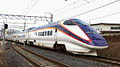 E3 series
 -
 E5 series
 -
 E6 series
 -
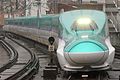 H5 series


Former rolling stock[edit]

- 200 series: Yamabiko / Nasuno / Aoba services (1982 – November 2011)[8]
- 400 series: Tsubasa / Nasuno services (July 1992 – April 2010)
- E1 series: Max Yamabiko / Max Aoba services (July 1994 – December 1999)
- E4 series: Max Yamabiko / Max Nasuno services (1999 – September 2012)
-
 200 series
 -
 A 400 series train on a Tsubasa service at Yonezawa Station in March 2005
 -
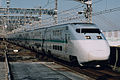 E1 series
 -
 E4 series
.jpg)


Non-revenue-earning types[edit]
-
 E926 East i train at Omiya Station, May 2001

Timeline[edit]
History[edit]
- 28 November 1971: Construction starts on the line.
- 23 June 1982: The Ōmiya–Morioka section opens.[9]
- 14 March 1985: The Ueno–Ōmiya section opens.
- 20 June 1991: The Tokyo–Ueno section opens.
- October 1998: 1 billionth passenger carried on Tōhoku, Joetsu and Nagano Shinkansen lines.
- 1 December 2002: The Morioka–Hachinohe section opens.
- 13 April 2010: Test running starts on the extension from Hachinohe to Shin-Aomori.[10]
- 4 December 2010: The extension from Hachinohe to Shin-Aomori opens.[11]
- 5 March 2011: New Hayabusa services operating at 300 km/h (190 mph) commence operation between Tokyo and Shin-Aomori using new E5 series trainsets.[12]
- 23 June 2012: The line's 30th anniversary was celebrated, with approximately 1.93 billion passengers having been transported on the line.[13]
From Shin-Aomori, the line continues to Shin-Hakodate in Hokkaido (148.9 km or 92.5 mi, since March 26, 2016 under the name Hokkaido Shinkansen), passing through the world's longest undersea railway tunnel, the Seikan Tunnel. A further 211.3 km (131.3 mi) to Sapporo is due to open by 2030.
The mountainous terrain that the line passes through has necessitated heavy reliance on tunnels. The Iwate-Ichinohe Tunnel on the Morioka–Hachinohe stretch, completed in 2000, was briefly the world's longest land rail tunnel at 25.8 km (16.0 mi), but in 2005 it was superseded by the Hakkōda Tunnel on the extension to Aomori, at 26.5 km (16.5 mi). In 2007 the Lötschberg Base Tunnel (34.57 km or 21.48 mi), and in 2010 the Gotthard Base Tunnel (57 km or 35 mi, bored through and due in service by 2016) in Switzerland superseded both.
2011 Tohoku earthquake and tsunami[edit]
On the afternoon of 11 March 2011, services on the Tohoku Shinkansen were suspended as a result of the Tōhoku earthquake and tsunami. JR East estimated that around 1,100 repairs would be required for the line between Omiya and Iwate-Numakunai, ranging from collapsed station roofs to bent power pylons.[14]
Limited service on the line was restored in segments: Tokyo to Nasushiobara was re-opened on 15 March, and Morioka to Shin-Aomori was re-opened on 22 March.[15] The line between Morioka and Ichinoseki re-opened on 7 April, Nasushiobara and Fukushima on 12 April, and the rest of the line on or around 30 April, although not at full speed or a full schedule.[16][17][18] The trains returned to full-speed operations on 23 September 2011.[19]
2021 Tohoku earthquake[edit]
A magnitude 7.1 earthquake struck the Tohoku area approximately 46 km (29 mi) east of Namie on the evening of 13 February 2021.[20] Following the quake, infrastructure damage was discovered between Shin-Shirakawa and Furukawa stations.[21]
East Japan Railway closed the Tohoku Shinkansen between Nasushiobara and Morioka.[21] The section between Ichinoseki and Morioka re-opened on 16 February,[22] Sendai and Ichinoseki on 22 February, and the remaining section between Nasushiobara and Sendai on 24 February.[23] Trains operated at 80% the usual timetable with top speeds reduced until 26 March, when repairs were completed and the normal timetable was restored.[24]
Special event train services[edit]
25th anniversary[edit]

On 23 June 2007, 10-car set K47 was used for a special Yamabiko 931 service from Omiya to Morioka to mark the 25th anniversary of the opening of the Tohoku Shinkansen.[25]
30th anniversary[edit]
On 23 June 2012, 10-car set K47 was used for a special Yamabiko 235 service from Omiya to Morioka to mark the 30th anniversary of the opening of the Tohoku Shinkansen.[26]
References[edit]
- JR Timetable, December 2008
- ^ "300km/hのトップランナー" [300 km/h Top Runners]. Japan Railfan Magazine. Vol. 52, no. 612. Japan: Kōyūsha Co., Ltd. April 2012. p. 14.
- ^ JR East press release: "東北新幹線八戸~新青森間の開業時期について" (10 November 2008). Retrieved on 11 November 2008. (in Japanese)
- ^ 2020-10-12T11:12:00. "JR East to speed up Tohoku Shinkansen". Railway Gazette International. Retrieved 21 August 2021.
{{cite web}}: CS1 maint: numeric names: authors list (link) - ^ グループ経営構想V [Group Business Vision V] (PDF) (in Japanese). Japan: East Japan Railway Company. 30 October 2012. p. 5. Archived from the original (PDF) on 2 December 2012. Retrieved 17 November 2012.
- ^ "東北新幹線、盛岡~新青森間を時速320キロへ 高速化への挑戦(小林拓矢) - Yahoo!ニュース". Yahoo!ニュース 個人 (in Japanese). Retrieved 14 February 2019.
- ^ "新幹線の速度向上に向けた取り組みについて" (PDF) (Press release). 東日本旅客鉄道. 6 October 2020. Archived from the original (PDF) on 6 October 2020. Retrieved 6 October 2020.
- ^ "JR東日本,E8系"つばさ"の運転を3月16日から開始" [E8 Series Shinkansen to Enter Service 16 March 2024]. Japan Railfan Magazine Online (in Japanese). 15 December 2023. Archived from the original on 15 December 2023. Retrieved 16 March 2024.
- ^ 東北新幹線:はやてにもE5系 200系は姿消す [E5 for Tohoku Shinkansen "Hayate" also - 200 series to disappear]. Mainichi.jp (in Japanese). Japan: The Mainichi Newspapers. 12 September 2011. Archived from the original on 10 July 2012. Retrieved 12 September 2011.
- ^ Taniguchi, Mamoru (1993). "The Japanese Shinkansen". Built environment. 19 (3/4): 216 – via JSTOR.
- ^ 4月から八戸・新青森間で試験走行開始 (in Japanese). 3 February 2010. Archived from the original on 20 November 2017. Retrieved 3 February 2010.
- ^ 東北新幹線 新青森開業等について [Opening of Tōhoku Shinkansen to Shin-Aomori] (PDF) (in Japanese). JR East. 11 May 2010. Retrieved 11 May 2010.
- ^ 新しい東北新幹線の列車愛称等の決定について [Name selected for new Tohoku Shinkansen services] (PDF) (in Japanese). JR East. 11 May 2010. Retrieved 11 May 2010.
- ^ [1] Archived July 7, 2012, at the Wayback Machine
- ^ [2][dead link]
- ^ [3] Archived March 25, 2011, at the Wayback Machine
- ^ "東日本大震災:東北新幹線、7日に盛岡-一ノ関間運転再開". Mainichi Shimbun. 4 April 2011. Archived from the original on 16 April 2011. Retrieved 4 April 2011.
- ^ Kyodo News, "Tohoku Shinkansen to resume services on more sections", 12 April 2011.
- ^ NHK, "Tohoku Shinkansen to fully resume April 30", 18 April 2011.
- ^ Kyodo News, "Tohoku Shinkansen Line back to normal", Japan Times, 24 September 2011, p. 2.
- ^ Ogura, Junko (13 February 2021). "Japan rocked by 'aftershock' from devastating 9.0-magnitude quake that hit in 2011". cnn. Retrieved 13 February 2021.
- ^ a b "Japan braces for aftershocks as M7.3 quake injures over 150". Kyodo News. 14 February 2021. Retrieved 14 February 2021.
- ^ "Japan scrambles to cover railway artery severed by powerful quake". Kyodo News. Retrieved 15 February 2021.
- ^ "福島県沖地震に伴う東北新幹線の運転再開見込みについて" [About the prospect of resuming operation on the Tōhoku Shinkansen due to the Fukushima Prefecture Offshore Earthquake] (PDF) (Press release) (in Japanese). East Japan Railway Company. 19 February 2021. Retrieved 19 February 2021.
- ^ "東北新幹線が通常ダイヤ復帰 所要時間や本数、元通りに". news.yahoo.co.jp (in Japanese). Kyodo News. 26 March 2021. Archived from the original on 19 June 2021. Retrieved 26 March 2021.
- ^ "JR東日本 "東北新幹線大宮開業25周年記念号" 運転" [JR East runs Tohoku Shinkansen 25th anniversary special train]. Tetsudō Daiya Jōhō Magazine. Vol. 36, no. 280. Japan: Kōtsū Shimbun. August 2012. p. 75.
- ^ "JR東日本 東北新幹線が開業30周年を迎える" [JR East Celebrates 30th Anniversary of Tohoku Shinkansen Opening]. Tetsudō Daiya Jōhō Magazine. Vol. 41, no. 340. Japan: Kōtsū Shimbun. August 2012. p. 74.
External links[edit]

- JR East website (in English)
- Japan blasts longest land tunnel
| Lines |
|     | ||||||||||||||||||
|---|---|---|---|---|---|---|---|---|---|---|---|---|---|---|---|---|---|---|---|---|
| Service names |
| |||||||||||||||||||
| Train types |
| |||||||||||||||||||
| Operators |
| |||||||||||||||||||
| Builders and owners |
| |||||||||||||||||||
| People | ||||||||||||||||||||


.svg)
.svg)
.svg)
.svg)


.svg)


.svg)

| Shinkansen | .svg) | |
|---|---|---|
| Main | ||
| Local |
| |
| Others | ||
| Past | ||
| Africa |
| ||||||||||||||||||||||||||||
|---|---|---|---|---|---|---|---|---|---|---|---|---|---|---|---|---|---|---|---|---|---|---|---|---|---|---|---|---|---|
| Asia |
| ||||||||||||||||||||||||||||
| Europe |
| ||||||||||||||||||||||||||||
| North America |
| ||||||||||||||||||||||||||||
| Oceania | None | ||||||||||||||||||||||||||||
| South America | None
| ||||||||||||||||||||||||||||
* An asterisk indicates overlap with conventional services. | |||||||||||||||||||||||||||||


| International | |
|---|---|
| National | |
