


Myoga
| Myōga | |
|---|---|
(Zingiber_mioga)-%E8%8A%B1_(5852495693).jpg)
| |
Scientific classification 
| |
| Kingdom: | Plantae |
| Clade: | Tracheophytes |
| Clade: | Angiosperms |
| Clade: | Monocots |
| Clade: | Commelinids |
| Order: | Zingiberales |
| Family: | Zingiberaceae |
| Genus: | Zingiber |
| Species: | Z. mioga
|
| Binomial name | |
| Zingiber mioga | |
| Synonyms[1] | |
| |
_Roscoe,_1804.jpg)
Myoga, myoga ginger or Japanese ginger (myōga (茗荷)) is the species Zingiber mioga in the family Zingiberaceae. It is a deciduous herbaceous perennial native to Japan, China, and the southern part of Korea.[1][2][3] Only its edible flower buds and flavorful shoots are used in cooking.[4] The flower buds are finely shredded and used in Japanese cuisine as a garnish for miso soup, sunomono, and dishes such as roasted eggplant. In Korean cuisine, the flower buds are skewered alternately with pieces of meat and then are pan-fried.[citation needed]
Cultivation[edit]
A traditional crop in Japan, myoga ginger has been introduced to cultivation in Australia and New Zealand for export to the Japanese market.[3]
As a woodland plant, myoga has specific shade requirements for its growth. It is frost-tolerant to −16 °C (3 °F), and possibly colder.[3]
Three variegated cultivars are known: 'Dancing Crane', 'Silver Arrow' and 'White Feather'. They are less cold-hardy than unvariegated plants.[3]
Medicinal properties[edit]
Myoga has shown promise for potentially anticarcinogenic properties.[5]
Gallery[edit]
-
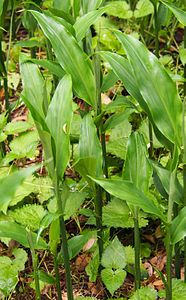 Plants
 -
 Fruits with red interiors and black seeds with a whitish aril
 -
 Buds prepared for sale


References[edit]
- ^ a b Kew World Checklist of Selected Plant Families
- ^ Flora of China v 24 p 332, 蘘荷 rang he, Zingiber mioga (Thunberg) Roscoe, Trans. Linn. Soc. London, Bot. 8: 348. 1807.
- ^ a b c d Cole TCH, Nürnberger S "Zingiber mioga and its Cultivars," The Plantsman. Royal Horticultural Society. December 2014, 4: 226-229.
- ^ Matsuhisa, Nobu and Mark Edwards. (2007). Nobu West, p. 252.
- ^ Ha Won Kim et al. "Suppressive Effects of Mioga Ginger and Ginger Constituents on Reactive Oxygen and Nitrogen Species Generation, and the Expression of Inducible Pro-Inflammatory Genes in Macrophages," Antioxidants & Redox Signaling. November/December 2005, 7(11-12): 1621-1629; retrieved 2013-8-4.
External links[edit]
 Data related to Zingiber mioga at Wikispecies
 Media related to Zingiber mioga at Wikimedia Commons


| Main dishes |
|
|---|---|
| Side dishes | |
| Beverages | |
| Snacks / desserts | |
| Ingredients / condiments | |
| Utensils | |
| Lists | |
| Fruits | |
| Related | |

| Alimentary Varieties |
| ||||||||||||
|---|---|---|---|---|---|---|---|---|---|---|---|---|---|
| Medicinal Varieties |
| ||||||||||||
| Foods |
| ||||||||||||
| Bioactive constituents Health |
| ||||||||||||
| Consumed parts |
| ||||||||||||
| Preparation | |||||||||||||
| Unrelated species |
| ||||||||||||
| Related species | |||||||||||||


