


Chinese Lunar Exploration Program
| 中国探月工程 Zhōngguó Tànyuè Gōngchéng | |
 Program insignia: a lunar crescent with two footprints at its center. The symbol resembles 月, the Chinese character for "Moon". | |
| Program overview | |
|---|---|
| Country | China |
| Organization | China National Space Administration (CNSA) |
| Purpose | Robotic Moon missions Human spaceflight (beginning 2030) |
| Status | Ongoing |
| Program history | |
| Duration | 23 January 2004–present |
| First flight | Chang'e 1, 24 October 2007, 10:05:04.602 UTC |
| Last flight | Chang'e 6, 3 May 2024, 09:27:29.132 UTC |
| Successes | 9 |
| Failures | 0 |
| Launch site(s) | |
| Vehicle information | |
| Uncrewed vehicle(s) | lunar orbiters, landers, rovers and sample return spacecraft |
| Launch vehicle(s) | |
The Chinese Lunar Exploration Program (CLEP; Chinese: 中国探月工程; pinyin: Zhōngguó Tànyuè Gōngchéng), also known as the Chang'e Project (Chinese: 嫦娥工程; pinyin: Cháng'é Gōngchéng) after the Chinese Moon goddess Chang'e, is an ongoing series of robotic Moon missions by the China National Space Administration (CNSA).
Engineering Program
[edit]The program encompasses lunar orbiters, landers, rovers and sample return spacecraft, launched using the Long March series of rockets. A human lunar landing component may have been added to the program, after China publicly announced crewed lunar landing plans by the year 2030 during a conference in July 2023.[1]
The program's launches and flights are monitored by a telemetry, tracking, and command (TT&C) system, which uses 50-meter (160-foot) radio antennas in Beijing and 40-meter (130-foot) antennas in Kunming, Shanghai, and Ürümqi to form a 3,000-kilometer (1,900-mile) VLBI antenna.[2][3] A proprietary ground application system is responsible for downlink data reception.
In 2019, China National Space Administration head Zhang Kejian announced that China is planning to build a scientific research station on the Moon's south pole "within the next 10 years".[4]
Program structure
[edit] | This section needs additional citations for verification. (May 2024) |
Ouyang Ziyuan, a geologist and chemical cosmologist, is the program's chief scientist. Ye Peijian serves as the program's chief commander and chief designer.[5][better source needed] Sun Jiadong, an aerospace engineer, is the program's general designer and Sun Zezhou is deputy general designer. The leading program manager is Luan Enjie.[citation needed]
The Chinese Lunar Exploration Program is divided into four main operational phases, with each mission serving as a technology demonstrator in preparation for future missions. International cooperation in the form of various payloads and a robotic station is invited by China.[6]
Phase I (robotic): Orbital missions
[edit]The first phase entailed the launch of two lunar orbiters, and is now effectively complete.
- Chang'e 1 was launched aboard a Long March 3A rocket from Xichang Satellite Launch Center on 24 October 2007,[7] having been delayed from the initial planned date of 17–19 April 2007.[8] It scanned the entire Moon in unprecedented detail, generating a high definition 3D map that would provide a reference for future soft landings. The probe also mapped the abundance and distribution of various chemical elements on the lunar surface as part of an evaluation of potentially useful resources.
- Chang'e 2, launched on 1 October 2010 aboard a Long March 3C rocket, reached the Moon in under 5 days, compared to 12 days for Chang'e 1, and mapped the Moon in even greater detail. It then left lunar orbit and headed for the Earth–Sun L2 Lagrangian point in order to test the TT&C network. Having done that it completed a flyby of asteroid 4179 Toutatis on 13 December 2012, before heading into deep space to further test the TT&C network.
Phase II (robotic): Soft landers/rovers
[edit].png)

The second phase is ongoing[when?], and incorporates spacecraft capable of soft-landing on the Moon and deploying lunar rovers.
- Chang'e 3, launched on 2 December 2013 aboard a Long March 3B rocket, landed on the Moon on 14 December 2013. It carried with it a 140 kilograms (310 pounds) lunar rover named Yutu, which was designed to explore an area of 3 square kilometers (1.2 square miles) during a 3-month mission. It was also supposed to conduct ultra-violet observations of galaxies, active galactic nuclei, variable stars, binaries, novae, quasars, and blazars, as well as the structure and dynamics of the Earth's plasmasphere.
- Chang'e 4 was launched on 7 December 2018. Originally scheduled for 2015, it was a back-up for Chang'e 3. However, as a result of the success of that mission, the configuration of Chang'e 4 was adjusted for the next mission.[9] It landed on 3 January 2019 on the South Pole-Aitken Basin, on the far side of the Moon, and deployed the Yutu-2 rover.[10]
Phase III (robotic): Sample-return
[edit]The third phase included a lunar sample-return mission.
- Chang'e 5-T1 was launched on 23 October 2014. It was designed to test the lunar return spacecraft.
- Chang'e 5 was launched on 23 November 2020, landed near Mons Rümker on the Moon on 1 December 2020, and returned to Earth with 1,731 grams (61.1 oz) of lunar samples back to Earth.[11][12]
Phase IV (robotic): Lunar robotic research station
[edit]Phase IV is the development of an autonomous lunar research station near the Moon's south pole.[6][13][14] The Phase IV program entered active development in 2023 following the successful completion of the previous three phases.[15]
- Chang'e 6, launched on 3 May 2024,[16][17][18] investigated the topography, composition and subsurface structure of the South Pole–Aitken basin on the far side of the Moon. The mission returned samples to Earth from Apollo Basin on the far side of the Moon.[19][20] It also carried a Chinese rover called Jinchan to conduct infrared spectroscopy of lunar surface and imaged Chang'e 6 lander on lunar surface.[21]
- Chang'e 7, expected to launch in 2026, is a mission that will explore the south pole for resources. The mission will include an orbiter, a lander, and a mini-flying probe.[22]
- Chang'e 8, expected to launch in 2028, will verify in-situ resource development and utilization technologies.[22] It may include a lander, a rover, and a flying detector,[13] as well as a 3D-printing experiment using in situ resource utilization (ISRU) to test-build a structure,[6] It will also transport a small sealed ecosystem experiment.[13] It will test technology necessary to the construction of a lunar science base.[23]
Crewed mission phase
[edit]In 2019, China was reviewing preliminary studies for a crewed lunar landing mission in the 2030s,[24][25] and possibly building an outpost near the lunar south pole with international cooperation.[6][24]
On 12 July 2023, at the 9th China (International) Commercial Aerospace Forum in Wuhan, Hubei province, Zhang Hailian, a deputy chief designer with the China Manned Space Agency (CMSA), publicly introduced a preliminary plan to land two astronauts on the Moon by the year 2030[1] using the Mengzhou crewed spacecraft and the Lanyue crewed lunar lander.[26][27]
On 28 September 2024, in Chongqing, the China Manned Space Agency (CMSA) unveiled the extravehicular lunar spacesuit and also solicited suggestions for a name for the suit.[28]
2035 and thereafter: International Moon base and application
[edit]In 2021, China and Russia announced they will be building a Moon base together, also formally invited more countries and international organizations to join their International Lunar Research Station (ILRS) project being developed by the two nations,[29] as an alternative to the American Artemis Program.[30] China announced on April 24 the International Lunar Research Station Cooperation Organization (ILRSCO) with members including: China, Russia, South Africa, Belarus, Azerbaijan, Venezuela, Pakistan and Egypt.[31]
List of missions
[edit]Conducted missions
[edit]Planned hard landing Planned soft landing
| Mission |
Launch Date |
Launch Vehicle |
Orbital Insertion Date | Landing Date | Return Date | Notes |
Status | ||
|---|---|---|---|---|---|---|---|---|---|
| Main Mission |
Extended Mission | ||||||||
| Phase 1 | |||||||||
| Chang'e 1 | 24 Oct 2007 | Long March 3A | 7 Nov 2007 | 1 Mar 2009 | - | Lunar orbiter; first Chinese lunar mission. | Success | - | |
| Chang'e 2 | 1 Oct 2010 | Long March 3C | 6 Oct 2010 | - | - | Lunar orbiter; following lunar orbit mission flew extended mission to 4179 Toutatis. | Success | Success | |
| Phase 2 | |||||||||
| Chang'e 3 | 1 Dec 2013 | Long March 3B | 6 Dec 2013 | 14 Dec 2013 | - | Lunar lander and rover; first Chinese lunar landing, landed in Mare Imbrium with Yutu 1. | Success | Ongoing | |
| Queqiao 1 | 20 May 2018 | Long March 4C | 14 Jun 2018 | - | - | Relay satellite located at the Earth-Moon L2 point in order to allow communications with Chang'e 4. | Success | Ongoing | |
| Chang'e 4 | 7 Dec 2018 | Long March 3B | 12 Dec 2018 | 3 Jan 2019 | - | Lunar lander and rover; first soft landing on the Far side of the Moon, landed in Von Karman crater with Yutu-2. | Success | Ongoing | |
| Phase 3 | |||||||||
| Chang'e 5-T1 | 23 Oct 2014 | Long March 3C | 10 Jan 2015 | - | 31 Oct 2014 | Experimental test flight testing technologies ahead of first Lunar sample return; tested return capsule and lunar orbit autonomous rendezvous techniques and other maneuvers. | Success | Success | |
| Chang'e 5 | 23 Nov 2020 | Long March 5 | 28 Nov 2020 | 1 Dec 2020 | 16 Dec 2020 | Lunar orbiter, lander, and sample return; which landed near Mons Rümker and returned 1731g of lunar soil to Earth. The service module made a visit to Lagrange point L1 and also performed a lunar flyby in extended mission.[32] | Success | Ongoing | |
| Phase 4 | |||||||||
| Queqiao 2 | 20 Mar 2024 | Long March 8 | 24 Mar 2024 | - | - | Lunar Relay satellite to support communications for the upcoming lunar missions, including Chang'e 6, 7 and 8.[16] | Success | Ongoing | |
| Chang'e 6 | 3 May 2024 | Long March 5 | 8 May 2024 | 1 Jun 2024[33] | 25 Jun 2024 | Lunar orbiter, lander, rover, and sample return; landed at the South Pole–Aitken basin on the far side of the Moon.[17] | Success | Ongoing | |
Upcoming missions
[edit]| Mission | Launch Date | Launch Vehicle | Mission Type | Notes |
|---|---|---|---|---|
| Phase 4 | ||||
| Chang'e 7 | 2026 | Long March 5 | Lunar surface survey | Lunar orbiter, lander, rover, and mini-flying probe; expected to perform in-depth exploration of the lunar south pole to look for resources.[22] |
| Chang'e 8 | 2028 | Long March 5 | Lunar surface survey | Full mission details are currently unknown; will test ISRU and 3D-printing technologies, ahead of future crewed exploration of the Moon.[22] |
| 1st crewed lunar mission | 2029-2030 | Long March 10 | Human landing on lunar surface | 2 launches using the Long March 10 to place two astronauts on the lunar surface via the Mengzhou crewed lunar spacecraft and the Lanyue crewed lunar lander.[1] |
Key technologies
[edit] | This section needs additional citations for verification. (January 2024) |
Long-range TT&C
[edit]The biggest challenge in Phase I of the program was the operation of the TT&C system, because its transmission capability needed sufficient range to communicate with the probes in lunar orbit.[34] China's standard satellite telemetry had a range of 80,000 kilometers (50,000 miles), but the distance between the Moon and the Earth can exceed 400,000 kilometers (250,000 miles) when the Moon is at apogee. In addition, the Chang'e probes had to carry out many attitude maneuvers during their flights to the Moon and during operations in lunar orbit. The distance across China from east to west is 5,000 kilometers (3,100 miles),[35] forming another challenge to TT&C continuity. At present, the combination of the TT&C system and the Chinese astronomical observation network has met the needs of the Chang'e program,[36] but only by a small margin.
Environmental adaptability
[edit]The complexity of the space environment encountered during the Chang'e missions imposed strict requirements for environmental adaptability and reliability of the probes and their instruments. The high-radiation environment in Earth-Moon space required hardened electronics to prevent electromagnetic damage to spacecraft instruments. The extreme temperature range, from 130 degrees Celsius (266 degrees Fahrenheit) on the side of the spacecraft facing the Sun to −170 degrees Celsius (−274 degrees Fahrenheit) on the side facing away from the Sun, imposed strict requirements for temperature control in the design of the detectors.
Orbit design and flight sequence control
[edit]Given the conditions of the three-body system of the Earth, Moon and a space probe, the orbit design of lunar orbiters is more complicated than that of Earth-orbiting satellites, which only deal with a two-body system. The Chang'e 1 and Chang'e 2 probes were first sent into highly elliptical Earth orbits. After separating from their launch vehicles, they entered an Earth-Moon transfer orbit through three accelerations in the phase-modulated orbit. These accelerations were conducted 16, 24, and 48 hours into the missions, during which several orbit adjustments and attitude maneuvers were carried out so as to ensure the probes' capture by lunar gravity. After operating in the Earth-Moon orbit for 4–5 days, each probe entered a lunar acquisition orbit. After entering their target orbits, conducting three braking maneuvers and experiencing three different orbit phases, Chang'e 1 and Chang'e 2 carried out their missions.
Attitude control
[edit]Lunar orbiters have to remain properly oriented with respect to the Earth, Moon and Sun. All onboard detectors must be kept facing the lunar surface in order to complete their scientific missions, communication antennas have to face the Earth in order to receive commands and transfer scientific data, and solar panels must be oriented toward the Sun in order to acquire power. During lunar orbit, the Earth, the Moon and the Sun also move, so attitude control is a complex three-vector control process. The Chang'e satellites need to adjust their attitude very carefully to maintain an optimal angle towards all three bodies.
Hazard avoidance
[edit]During the second phase of the program, in which the spacecraft were required to soft-land on the lunar surface, it was necessary to devise a system of automatic hazard avoidance in order that the landers would not attempt to touch down on unsuitable terrain. Chang'e 3 utilized a computer vision system in which the data from a down-facing camera, as well as 2 ranging devices, were processed using specialized software. The software controlled the final stages of descent, adjusting the attitude of the spacecraft and the throttle of its main engine. The spacecraft hovered first at 100 meters (330 feet), then at 30 meters (98 feet), as it searched for a suitable spot to set down. The Yutu rover is also equipped with front-facing stereo cameras and hazard avoidance technology.
International cooperation
[edit]Chang’e 1: The first Chinese lunar orbiter, launched in 2007. It carried a European Space Agency (ESA) instrument called D-CIXS, which measured the elemental composition of the lunar surface. It also received tracking and data relay support from ESA’s ground stations in Australia and Spain.
Chang’e 2: The second Chinese lunar orbiter, launched in 2010. It carried a laser altimeter provided by the German Aerospace Center (DLR), which mapped the lunar topography with high precision. It also used ESA’s deep space network for communication and navigation during its extended mission to the asteroid 4179 Toutatis.
Chang’e 3: The first Chinese lunar lander and rover, launched in 2013. It carried a lunar ultraviolet telescope (LUT) developed by the National Astronomical Observatories of China (NAOC) and the International Lunar Observatory Association (ILOA), which performed the first astronomical observations from the lunar surface. It also received data relay support from NASA’s Lunar Reconnaissance Orbiter (LRO) for the landing of the Chang’e 3 probe.
Chang’e-4: The first mission to land and explore the far side of the Moon, with four international scientific payloads from the Netherlands, Germany, Sweden, and Saudi Arabia. It also received support from NASA’s LRO team, Russia’s radioisotope heat source, China’s deep space station in Argentina, and the European Space Agency’s tracking station.
Chang’e-5: The first mission to return lunar samples since 1976, with international cooperation in telemetry, tracking, and command from the European Space Agency, Argentina, Namibia, Pakistan, and other countries and organizations. It also carried a French magnetic field detector. Scientists from various countries, including Australia, Russia, France, the United States, the United Kingdom, and Sweden, have participated in scientific research involving Chinese lunar samples.
Cooperation with Russia
[edit]In November 2017, China and Russia signed an agreement on cooperative lunar and deep space exploration.[37] The agreement includes six sectors, covering lunar and deep space, joint spacecraft development, space electronics, Earth remote sensing data, and space debris monitoring.[37][38][39] Russia may also look to develop closer ties with China in human spaceflight,[37] and even shift its human spaceflight cooperation from the US to China and build a crewed lunar lander.[40]
Gallery
[edit]-
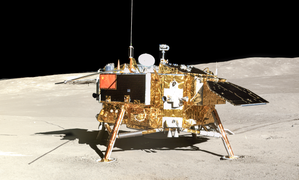 Chang'e 4 lander on the Moon
 -
 Yutu-2 rover on lunar surface
 -
 Lunar soil sample collected by China's Chang'e 5 mission, displayed at Airshow China 2021


See also
[edit]


- Exploration of the Moon
- List of missions to the Moon
- Chinese space program
- Planetary Exploration of China
- Tianwen-1 - 2020 Mars mission
References
[edit]- ^ a b c Andrew Jones (17 July 2023). "China sets out preliminary crewed lunar landing plan". spacenews.com. Retrieved 24 July 2023.
- ^ ""嫦娥奔月"地面主干工程基本完成 云南天文台巨型射电追踪望远镜年底投入使用". Archived from the original on 27 October 2007.
- ^ "巨型望远镜送"嫦娥"飞月-望远镜,嫦娥-北方网-科技无限". Archived from the original on 24 October 2017. Retrieved 9 March 2007.
- ^ "China to build moon station in 'about 10 years'". phys.org.
- ^ "嫦娥工程总指挥兼总设计师叶培建" [Chang'e Project Commander and Chief Designer Ye Peijian]. Sohu. 22 October 2007. Retrieved 7 June 2017.
- ^ a b c d Chang'e 4 press conference. CNSA, broadcast on 14 January 2019.
- ^ ""嫦娥一号"发射时间确定 但未到公布时机". Xinhua News Agency. 7 July 2007. Archived from the original on 7 February 2012. Retrieved 12 July 2007.
- ^ "阅读文章". Archived from the original on 5 March 2016.
- ^ Austin Ramzy (16 December 2013). "China Celebrates Lunar Probe and Announces Return Plans". The New York Times. Retrieved 16 December 2013.
- ^ Rivers, Matt; Regan, Helen; Jiang, Steven (3 January 2019). "China lunar rover successfully touches down on far side of the moon, state media announces". CNN. Retrieved 3 January 2019.
- ^ "China recovers Chang'e-5 moon samples after complex 23-day mission". SpaceNews. 16 December 2020. Retrieved 16 December 2020.
- ^ CNSA. "China's Chang'e-5 retrieves 1,731 kilograms of moon samples". Archived from the original on 4 January 2021.
- ^ a b c China's Planning for Deep Space Exploration and Lunar Exploration before 2030. (PDF) XU Lin, ZOU Yongliao, JIA Yingzhuo. Space Sci., 2018, 38(5): 591-592. doi:10.11728/cjss2018.05.591
- ^ A Tentative Plan of China to Establish a Lunar Research Station in the Next Ten Years. Zou, Yongliao; Xu, Lin; Jia, Yingzhuo. 42nd COSPAR Scientific Assembly. Held 14–22 July 2018, in Pasadena, California, USA, Abstract id. B3.1-34-18.
- ^ "China to advance lunar exploration program". Xinhua. 6 February 2023. Retrieved 7 February 2023.
- ^ a b China N' Asia Spaceflight [@CNSpaceflight] (24 November 2022). "Update:
2024 Queqiao-2 data relay
2025 Chang'e-6 lunar sample return from far side
2026 Chang'e-7 lunar landing in south pole
2028 Chang'e-8 basic model of lunar research station" (Tweet) – via Twitter. - ^ a b Jones, Andrew (8 July 2021). "China's Chang'e 6 mission will collect lunar samples from the far side of the moon by 2024". Space.com. Retrieved 9 July 2021.
- ^ "大陸「嫦娥六號」明年5月發射 擬帶回月球背面岩石採樣" (in Traditional Chinese). 聯合報. 25 April 2023. Retrieved 25 April 2023.
- ^ "Lunar plans for phase IV". Archived from the original on 15 April 2019. Retrieved 13 January 2019.
- ^ Lunar program next plan
- ^ Jones, Andrew (6 May 2024). "China's Chang'e-6 is carrying a surprise rover to the moon". SpaceNews. Archived from the original on 8 May 2024. Retrieved 8 May 2024.
- ^ a b c d Jones, Andrew (28 November 2022). "China outlines pathway for lunar and deep space exploration". SpaceNews. Retrieved 29 November 2022.
- ^ Future Chinese Lunar Missions. David R. Williams, NASA. Accessed on 7 November 2019.
- ^ a b China lays out its ambitions to colonize the moon and build a "lunar palace". Echo Huang, Quartz. 26 April 2018.
- ^ China prepares first manned mission to the Moon. Ben Blanchard, Independent. 7 June 2017.
- ^ Jones, Andrew (29 May 2023). "China sets sights on crewed lunar landing before 2030". SpaceNews. Retrieved 28 October 2023.
- ^ Zhao, Lei (24 February 2024). "Chinese lunar lander and new crew spaceship names revealed". China Daily. Retrieved 4 March 2024.
- ^ "China unveils lunar spacesuit for crewed moon mission". Spacenews. Retrieved 10 October 2024.
- ^ "China, Russia open moon base project to international partners, early details emerge". 26 April 2021.
- ^ "Lunar Research Station: Russia, China Almost Ready To Ink Pact On 'Moon Base' That Will Rival Artemis Accords - Rogozin". Latest Asian, Middle-East, EurAsian, Indian News. 1 June 2022.
- ^ @CNSpaceflight (24 April 2023). "CNSA announces to establish International Lunar Research Station Cooperation Organization and founding member states to sign agreement by June" (Tweet) – via Twitter.
- ^ "China's Chang'e-5 orbiter is heading back to the moon". SpaceNews. 6 September 2021. Retrieved 8 September 2021.
- ^ Jones, Andrew (1 June 2024). "Chang'e-6 lands on far side of the moon to collect unique lunar samples". SpaceNews. Retrieved 1 June 2024.
- ^ Shen, Rongjun; Qian, Weiping (29 September 2012). Proceedings of the 26th Conference of Spacecraft TT&C Technology in China. Springer. ISBN 9783642336621.
- ^ "China's Location, Size, Land Boundaries, Length of Coastline, and Maritime Claims".
- ^ "China Builds Advanced Spacecraft Tracking and Command Network". www.spacedaily.com.
- ^ a b c China, Russia agree cooperation on lunar and deep space exploration, other sectors. Archived 27 August 2019 at the Wayback Machine GB Times. 2 November 2017.
- ^ Russia, China to add lunar projects to joint space cooperation program. TASS, Russia. 11 July 2018.
- ^ China, Russia agree cooperation on lunar and deep space. Janet R. Aguilar, Tunisie Soir. 3 March 2018.
- ^ Russia's Space Agency Might Break Up With the U.S. To Get With China. Anatoly Zak, Popular Mechanics. 7 March 2018.
External links
[edit]
- CLEP official website
- Data Release and Information Service System of China's Lunar Exploration Program Archived 10 June 2021 at the Wayback Machine
- "China's Lunar Exploration Program - English". The People's Daily online. Archived from the original on 24 February 2021. Retrieved 21 January 2021.
- Encyclopedia Astronautica
- The Scientific Objectives of Chinese Lunar Exploration Project by Ouyang Ziyuan
- 我国发射首颗探月卫星专题
- 嫦娥探月专题 Archived 26 January 2021 at the Wayback Machine
- Sūn Huīxiān (孙辉先); Dài Shùwǔ (代树武); Yáng Jiànfēng (杨建峰); Wú Jì (吴季); Jiāng Jǐngshān (姜景山) (2005). "Scientific objectives and payloads of Chang'E-1 lunar satellite" (PDF). Journal of Earth System Science. 114 (6): 789–794. Bibcode:2005JESS..114..789H. doi:10.1007/BF02715964. S2CID 128428662.
| Missions | |
|---|---|
| Launch vehicles | |
| Facilities | |
| People | |


| American projects |
|  |
|---|---|---|
| Soviet and Russian projects |
| |
| Chinese and Russian project |
| |
| Other projects |
| |
| Proposed sites | ||
| Related | ||


| Africa |
| ||||||||||||
|---|---|---|---|---|---|---|---|---|---|---|---|---|---|
| Americas |
| ||||||||||||
| Asia |
| ||||||||||||
| Europe |
| ||||||||||||
| Oceania | |||||||||||||
| World | |||||||||||||
| Former | |||||||||||||
| |||||||||||||


