


List of volcanoes in Indonesia


The geography of Indonesia is dominated by volcanoes that are formed due to subduction zones between the Eurasian Plate and the Indo-Australian Plate. Some of the volcanoes are notable for their eruptions, for instance, Krakatoa for its global effects in 1883,[1] the Lake Toba Caldera for its supervolcanic eruption estimated to have occurred 74,000 years before present which was responsible for six years of volcanic winter,[2] and Mount Tambora for the most violent eruption in recorded history in 1815.[3]
Volcanoes in Indonesia are part of the alpida belt and Pacific Ring of Fire. The 150 entries in the list below are grouped into six geographical regions, four of which belong to the volcanoes of the Sunda Arc trench system. The remaining two groups are volcanoes of Halmahera, including its surrounding volcanic islands, and volcanoes of Sulawesi and the Sangihe Islands. The latter group is in one volcanic arc together with the Philippine volcanoes.
The most active volcano is Mount Merapi on Java. Since AD 1000, Kelut has erupted more than 30 times, of which the largest eruption was at scale 5 on the Volcanic Explosivity Index (VEI),[4] while Mount Merapi has erupted more than 80 times.[5] The International Association of Volcanology and Chemistry of the Earth's Interior has named Mount Merapi as a Decade Volcano since 1995 because of its high volcanic activity.
As of 2012, Indonesia has 127 active volcanoes and about 5 million people live within the danger zones. It has been conjectured that the earthquake and tsunami event of 26 December 2004 could trigger eruptions, with Mount Sinabung (dormant since the 1600s) erupting in 2010 as a possible example.[6]
The word for Mount in Indonesian and many regional languages of the country is Gunung. Thus, Mount Merapi may be referred to as Gunung Merapi.
Scope
[edit]
There is no single standard definition of a volcano. It can be defined as individual vents, volcanic edifices, or volcanic fields. The interior of ancient volcanoes may have been eroded, creating a new subsurface magma chamber as a separate volcano. Many contemporary active volcanoes rise as young parasitic cones from flank vents or at a central crater. Some volcanic cones are grouped into one volcano name, for instance, the Tengger caldera complex, whereas, individual vents are named by local people. The status of a volcano, either active or dormant, cannot be defined precisely. An indication of a volcano is determined by either its historical records, radiocarbon dating, or geothermal activities.
The primary source of the list below is taken from the Volcanoes of the World book, compiled by two volcanologists Tom Simkin and Lee Siebert,[a] in which active volcanoes in the past 10,000 years (Holocene) are listed.[7] Particularly for Indonesia, Simkin and Siebert used a catalogue of active volcanoes from the International Association of Volcanology and Chemistry of the Earth's Interior publication series.[b] The Simkin and Siebert list is the most complete list of volcanoes in Indonesia, but the accuracy of the record varies from one region to another in terms of contemporary activities and fatalities in recent eruptions. Complementary sources for the latest volcanic data are taken from the Volcanological Survey of Indonesia, a governmental institution which is responsible for volcanic activities and geological hazard mitigation in Indonesia,[8] and some academic resources.
Geographical groups
[edit]Sumatra
[edit]
The geography of Sumatra is dominated by a mountain range called Bukit Barisan (lit: "a row of hills"). The mountain range spans nearly 1,700 km (1,100 mi) from the north to the south of the island, and it was formed by movement of the Australian tectonic plate.[9] The plate moves with a convergence rate of 5.5 cm/year which has created major earthquakes on the western side of Sumatra including the 2004 Sumatra–Andaman earthquake.[10][11] The tectonic movement has been responsible not only for earthquakes, but also for the formation of magma chambers beneath the island.[9]
Only one of the 35 active volcanoes, Weh, is separated from the Sumatran mainland. The separation was caused by a large eruption that filled the lowland between Weh and the rest of the mainland with sea water in the Pleistocene epoch. The largest volcano of Sumatra is the supervolcano Toba within the 100 km (62 mi) × 30 km (19 mi) Lake Toba, which was created after a caldera collapse (est. in 74,000 Before Present).[2] The eruption is estimated to have been at level eight on the VEI scale, the highest level for a volcanic eruption. The highest peak of the mountain range is Mount Kerinci with an elevation of 3,800 m (12,467 ft).


Sunda Strait and Java
[edit]The Sunda Strait separates the islands of Sumatra and Java with the volcanic island Krakatoa lying between them. Krakatau erupted violently in 1883, destroying two-thirds of the island and leaving a large caldera under the sea. This cataclysmic explosion was heard as far away as the island of Rodrigues near Mauritius (approx. 4,800 kilometres (3,000 mi) away).[1] A new parasitic cone, called Anak Krakatau (or the child of Krakatau), rose from the sea at the centre of the caldera in 1930.[14] The other Krakatau islets from the 1883 eruptions are known as Sertung, Panjang and Rakata.
Java is a relatively small island compared to Sumatra, but it has a higher concentration of active volcanoes. There are 45 active volcanoes on the island excluding 20 small craters and cones in the Dieng volcanic complex and the young cones in the Tengger caldera complex. Some volcanoes are grouped together in the list below because of their close location. Mount Merapi, Semeru and Kelud are the most active volcanoes in Java. Mount Semeru has been continuously erupting since 1967.[15] Mount Merapi has been named as one of the Decade Volcanoes since 1995.[16] Ijen has a unique colourful caldera lake which is an extremely acidic natural reservoir (pH<0.3).[17] There are sulfur mining activities at Ijen, where miners collect highly concentrated sulfur rocks by hand.
| Name | Shape | Elevation | Last eruption (VEI) | Coordinates |
|---|---|---|---|---|
| Krakatau | caldera | 813 metres (2,667 ft) | 2022 (ongoing) | 6°06′07″S 105°25′23″E / 6.102°S 105.423°E |
| Pulosari | stratovolcano | 1,346 metres (4,416 ft) | unknown | 6°20′31″S 105°58′30″E / 6.342°S 105.975°E |
| Gunung Karang | stratovolcano | 1,778 metres (5,833 ft) | unknown | 6°16′12″S 106°02′31″E / 6.27°S 106.042°E |
| Salak | stratovolcano | 2,211 metres (7,254 ft) | 31 January 1938 (2) | 6°43′S 106°44′E / 6.72°S 106.73°E |
| Kiaraberes-Gagak | stratovolcano | 1,511 metres (4,957 ft) | 6 April 1939 (1) | 6°44′S 106°39′E / 6.73°S 106.65°E |
| Perbakti | stratovolcano | 1,699 metres (5,574 ft) | unknown | 6°45′S 106°41′E / 6.75°S 106.68°E |
| Kendeng | stratovolcano | 1,732 metres (5,682 ft) | Pleistocene | 6°46′05″S 106°31′34″E / 6.768°S 106.526°E |
| Gede | stratovolcano | 2,958 metres (9,705 ft) | 13 March 1957 (2) | 6°47′S 106°59′E / 6.78°S 106.98°E |
| Patuha | stratovolcano | 2,434 metres (7,986 ft) | unknown | 7°09′36″S 107°24′00″E / 7.160°S 107.40°E |
| Wayang-Windu | lava dome | 2,182 metres (7,159 ft) | unknown | 7°12′29″S 107°37′48″E / 7.208°S 107.63°E |
| Malabar | stratovolcano | 2,343 metres (7,687 ft) | unknown | 7°08′S 107°39′E / 7.13°S 107.65°E |
| Tangkuban Perahu | stratovolcano | 2,084 metres (6,837 ft) | 26 June 2019 (1) | 6°46′S 107°36′E / 6.77°S 107.60°E |
| Papandayan | stratovolcano | 2,665 metres (8,743 ft) | 11 November 2002 (2) | 7°19′S 107°44′E / 7.32°S 107.73°E |
| Kendang | stratovolcano | 2,608 metres (8,556 ft) | unknown | 7°14′S 107°43′E / 7.23°S 107.72°E |
| Kamojang | stratovolcano | 1,730 metres (5,680 ft) | Pleistocene | 7°07′30″S 107°48′00″E / 7.125°S 107.80°E |
| Guntur | complex volcano | 2,249 metres (7,379 ft) | 16 October 1847 (2) | 7°08′35″S 107°50′24″E / 7.143°S 107.840°E |
| Tampomas | stratovolcano | 1,684 metres (5,525 ft) | unknown | 6°46′S 107°57′E / 6.77°S 107.95°E |
| Galunggung | stratovolcano | 2,168 metres (7,113 ft) | 9 January 1984 (1) | 7°15′00″S 108°03′29″E / 7.25°S 108.058°E |
| Talagabodas | stratovolcano | 2,201 metres (7,221 ft) | unknown | 7°12′29″S 108°04′12″E / 7.208°S 108.07°E |
| Karaha | fumarole | 1,155 metres (3,789 ft) | unknown | 7°07′S 108°05′E / 7.12°S 108.08°E |
| Cereme | stratovolcano | 3,078 metres (10,098 ft) | 1951 | 6°53′31″S 108°24′00″E / 6.892°S 108.40°E |
| Slamet | stratovolcano | 3,432 metres (11,260 ft) | 2014 | 7°14′31″S 109°12′29″E / 7.242°S 109.208°E |
| Dieng | complex volcano | 2,565 metres (8,415 ft) | 29 April 2021 (?) | 7°12′S 109°55′E / 7.20°S 109.92°E |
| Sundoro | stratovolcano | 3,136 metres (10,289 ft) | 29 October 1971 (2) | 7°18′00″S 109°59′31″E / 7.30°S 109.992°E |
| Sumbing | stratovolcano | 3,371 metres (11,060 ft) | 1730 (?) | 7°23′02″S 110°04′12″E / 7.384°S 110.070°E |
| Ungaran | stratovolcano | 2,050 metres (6,730 ft) | unknown | 7°11′S 110°20′E / 7.18°S 110.33°E |
| Telomoyo | stratovolcano | 1,894 metres (6,214 ft) | unknown | 7°22′S 110°24′E / 7.37°S 110.40°E |
| Merbabu | stratovolcano | 3,145 metres (10,318 ft) | 1797 (2) | 7°27′S 110°26′E / 7.45°S 110.43°E |
| Merapi | stratovolcano | 2,968 metres (9,738 ft) | 2019 (ongoing) | 7°32′31″S 110°26′31″E / 7.542°S 110.442°E |
| Muria | stratovolcano | 1,625 metres (5,331 ft) | 160 BC ± 30 years | 6°37′S 110°53′E / 6.62°S 110.88°E |
| Lawu | stratovolcano | 3,265 metres (10,712 ft) | 28 November 1885 (1) | 7°37′30″S 111°11′31″E / 7.625°S 111.192°E |
| Wilis | stratovolcano | 2,563 metres (8,409 ft) | unknown | 7°48′29″S 111°45′29″E / 7.808°S 111.758°E |
| Kelud | stratovolcano | 1,731 metres (5,679 ft) | 13 February 2014 (4) | 7°55′48″S 112°18′29″E / 7.93°S 112.308°E |
| Kawi–Butak | stratovolcano | 2,651 metres (8,698 ft) | unknown | 7°55′S 112°27′E / 7.92°S 112.45°E |
| Arjuno–Welirang | stratovolcano | 3,339 metres (10,955 ft) | 15 August 1952 (0) | 7°43′30″S 112°34′48″E / 7.725°S 112.58°E |
| Penanggungan | stratovolcano | 1,653 metres (5,423 ft) | unknown | 7°37′S 112°38′E / 7.62°S 112.63°E |
| Malang Plain | maar | 680 metres (2,230 ft) | unknown | 8°01′S 112°41′E / 8.02°S 112.68°E |
| Semeru | stratovolcano | 3,676 metres (12,060 ft) | 2024 (ongoing) | 8°06′29″S 112°55′12″E / 8.108°S 112.92°E |
| Bromo | stratovolcano | 2,329 metres (7,641 ft) | 2023 | 7°56′31″S 112°57′00″E / 7.942°S 112.95°E |
| Lamongan | stratovolcano | 1,651 metres (5,417 ft) | 5 February 1898 (2) | 7°58′44″S 113°20′31″E / 7.979°S 113.342°E |
| Lurus | complex volcano | 539 metres (1,768 ft) | unknown | 7°44′S 113°35′E / 7.73°S 113.58°E |
| Iyang-Argapura | complex volcano | 3,088 metres (10,131 ft) | unknown | 7°58′S 113°34′E / 7.97°S 113.57°E |
| Raung | stratovolcano | 3,332 metres (10,932 ft) | 2022 (?) | 8°07′30″S 114°02′31″E / 8.125°S 114.042°E |
| Ijen | stratovolcano | 2,799 metres (9,183 ft) | 28 June 1999 (1) | 8°03′29″S 114°14′31″E / 8.058°S 114.242°E |
| Baluran | stratovolcano | 1,247 metres (4,091 ft) | unknown | 7°51′S 114°22′E / 7.85°S 114.37°E |
Note: Height of Krakatau is of Rakata, not of the active Anak Krakatau
-
 Tangkuban Perahu, taken from above
 -
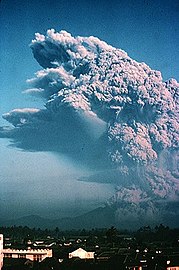 A plinian eruption of Galunggung in 1982
 -
 Mount Merapi, one of the most famous volcanoes in Indonesia
 -
 The turquoise coloured sulfuric acid lake on Ijen caldera
 -
 The 1883 eruption of Krakatoa produced the loudest sound.


Lesser Sunda Islands
[edit]The Lesser Sunda Islands is a small archipelago which, from west to east, consists of Bali, Lombok, Sumbawa, Flores, Sumba and the Timor islands; all are located at the edge of the Australian continental shelf. Volcanoes in the area are formed because of oceanic crusts and the movement of the shelf itself.[18] Some volcanoes completely form an island, for instance, the Sangeang Api island. Mount Tambora, on Sumbawa island, erupted on 5 April 1815, with a scale 7 on the VEI and is considered the most violent eruption in recorded history.[3]
| Name | Island | Shape | Elevation | Last eruption (VEI) | Coordinates |
|---|---|---|---|---|---|
| Merbuk | Bali | unknown | 1,386 metres (4,547 ft) | unknown | 8°13′S 114°39′E / 8.22°S 114.65°E |
| Bratan | Bali | caldera | 2,276 metres (7,467 ft) | unknown | 8°17′S 115°08′E / 8.28°S 115.13°E |
| Batur | Bali | caldera | 1,717 metres (5,633 ft) | 2000 (1) | 8°14′31″S 115°22′30″E / 8.242°S 115.375°E |
| Agung | Bali | stratovolcano | 3,031 metres (9,944 ft) | 2019 | 8°20′31″S 115°30′29″E / 8.342°S 115.508°E |
| Samalas | Lombok | stratovolcano | 2,867 metres (9,406 ft) | 1257 (7) | 8°25′S 116°24′E / 8.41°S 116.40°E |
| Rinjani | Lombok | stratovolcano | 3,726 metres (12,224 ft) | 2016 (2) | 8°25′S 116°28′E / 8.42°S 116.47°E |
| Tambora | Sumbawa | stratovolcano | 2,722 metres (8,930 ft) | 1967 ± 20 years (0) | 8°15′S 118°00′E / 8.25°S 118.00°E |
| Sangeang Api | Sangeang | complex volcano | 1,949 metres (6,394 ft) | 2019 (ongoing) | 8°12′S 119°04′E / 8.20°S 119.07°E |
| Wai Sano | Flores | caldera | 903 metres (2,963 ft) | unknown | 8°43′S 120°01′E / 8.72°S 120.02°E |
| Poco Leok | Flores | unknown | 1,675 metres (5,495 ft) | unknown | 8°41′S 120°29′E / 8.68°S 120.48°E |
| Ranakah | Flores | lava dome | 2,100 metres (6,900 ft) | March 1991 (1) | 8°37′S 120°31′E / 8.62°S 120.52°E |
| Inierie | Flores | stratovolcano | 2,245 metres (7,365 ft) | 8050 BC | 8°52′30″S 120°57′00″E / 8.875°S 120.95°E |
| Inielika | Flores | complex volcano | 1,559 metres (5,115 ft) | 11 January 2001 (2) | 8°44′S 120°59′E / 8.73°S 120.98°E |
| Ebulobo | Flores | stratovolcano | 2,124 metres (6,969 ft) | 27 February 1969 (2) | 8°49′S 121°11′E / 8.82°S 121.18°E |
| Iya | Flores | stratovolcano | 637 metres (2,090 ft) | 27 January 1969 (3) | 8°53′49″S 121°38′42″E / 8.897°S 121.645°E |
| Sukaria | Flores | caldera | 1,500 metres (4,900 ft) | unknown | 8°47′31″S 121°46′12″E / 8.792°S 121.77°E |
| Ndete Napu | Flores | fumarole | 750 metres (2,460 ft) | unknown | 8°43′S 121°47′E / 8.72°S 121.78°E |
| Kelimutu | Flores | complex volcano | 1,639 metres (5,377 ft) | 3 June 1968 (1) | 8°46′S 121°49′E / 8.77°S 121.82°E |
| Paluweh | Palu'e | stratovolcano | 875 metres (2,871 ft) | 3 February 1985 (1) | 8°19′12″S 121°42′29″E / 8.32°S 121.708°E |
| Egon | Flores | stratovolcano | 1,703 metres (5,587 ft) | 2008 | 8°40′S 122°27′E / 8.67°S 122.45°E |
| Ilimuda | Flores | stratovolcano | 1,100 metres (3,600 ft) | unknown | 8°28′41″S 122°40′16″E / 8.478°S 122.671°E |
| Lewotobi | Flores | stratovolcano | 1,703 metres (5,587 ft) | 2024 | 8°32′31″S 122°46′30″E / 8.542°S 122.775°E |
| Leroboleng | Flores | complex volcano | 1,117 metres (3,665 ft) | 26 June 2003 (3) | 8°21′29″S 122°50′31″E / 8.358°S 122.842°E |
| Riang Kotang | Flores | fumarole | 200 metres (660 ft) | unknown | 8°18′00″S 122°53′31″E / 8.30°S 122.892°E |
| Iliboleng | Adonara Island | stratovolcano | 1,659 metres (5,443 ft) | June 1993 (1) | 8°20′31″S 123°15′29″E / 8.342°S 123.258°E |
| Lewotolo | Lembata | stratovolcano | 1,423 metres (4,669 ft) | 2020 (ongoing) | 8°16′19″S 123°30′18″E / 8.272°S 123.505°E |
| Ililabalekan | Lembata | stratovolcano | 1,018 metres (3,340 ft) | unknown | 8°33′S 123°23′E / 8.55°S 123.38°E |
| Iliwerung | Lembata | complex volcano | 1,018 metres (3,340 ft) | 29 November 2021 | 8°32′S 123°34′E / 8.53°S 123.57°E |
| Batu Tara | Komba island | stratovolcano | 748 metres (2,454 ft) | 2007–2015 (2) | 7°47′31″S 123°34′44″E / 7.792°S 123.579°E |
| Sirung | Pantar Island | complex volcano | 862 metres (2,828 ft) | 2021 | 8°30′29″S 124°07′48″E / 8.508°S 124.13°E |
| Yersey | – | submarine | −3,800 metres (−12,500 ft) | unknown | 7°32′S 123°57′E / 7.53°S 123.95°E |
-
 Mount Agung on Bali
 -
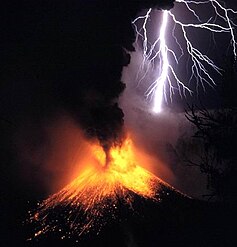 Eruption of Rinjani in 1984
 -
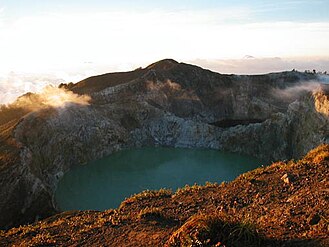 One of three different coloured lakes of Kelimutu


Banda Sea
[edit]The Banda Sea in the south of the Molucca archipelago includes a small group of islands. Three major tectonic plates beneath the sea, the Eurasian Plate, Pacific Plate and Indo-Australian Plate, have been converging since the Mesozoic epoch.[19] Volcanoes in the Banda Sea are mainly islands, but some are submarine volcanoes.
| Name | Shape | Elevation | Last eruption (VEI) | Coordinates |
|---|---|---|---|---|
| Emperor of China | submarine | −2,850 metres (−9,350 ft) | unknown | 6°37′S 124°13′E / 6.62°S 124.22°E |
| Nieuwerkerk | submarine | −2,285 metres (−7,497 ft) | unknown | 6°36′00″S 124°40′30″E / 6.60°S 124.675°E |
| Gunungapi Wetar | stratovolcano | 282 metres (925 ft) | 1699 (3) | 6°38′31″S 126°39′00″E / 6.642°S 126.65°E |
| Wurlali | stratovolcano | 868 metres (2,848 ft) | 3 June 1892 (2) | 7°07′30″S 128°40′30″E / 7.125°S 128.675°E |
| Teon | stratovolcano | 655 metres (2,149 ft) | 3 June 1904 (2) | 6°55′12″S 129°07′30″E / 6.92°S 129.125°E |
| Nila | stratovolcano | 781 metres (2,562 ft) | 7 May 1968 (1) | 6°44′S 129°30′E / 6.73°S 129.50°E |
| Serua | stratovolcano | 641 metres (2,103 ft) | 18 September 1921 (2) | 6°18′S 130°00′E / 6.30°S 130.00°E |
| Manuk | stratovolcano | 282 metres (925 ft) | unknown | 5°31′48″S 130°17′31″E / 5.53°S 130.292°E |
| Banda Api | caldera | 640 metres (2,100 ft) | 9 May 1988 (3) | 4°31′30″S 129°52′16″E / 4.525°S 129.871°E |
Sulawesi and Sangihe Islands
[edit]Four peninsulas dominate the shape of Sulawesi island (formerly known as Celebes). The central part is a high mountainous area, but mostly non-volcanic. Active volcanoes are found in the northern peninsula and continuously stretch to the north to Sangihe Islands. The Sangihe Islands mark the border with the Philippines.
| Name | Shape | Elevation | Last eruption (VEI) | Coordinates |
|---|---|---|---|---|
| Colo | stratovolcano | 507 metres (1,663 ft) | 18 July 1983 (4) | 0°10′12″S 121°36′29″E / 0.17°S 121.608°E |
| Ambang | complex volcano | 1,795 metres (5,889 ft) | 1845 ± 5 years | 0°45′N 124°25′E / 0.75°N 124.42°E |
| Soputan | stratovolcano | 1,784 metres (5,853 ft) | December 2018 | 1°06′29″N 124°43′48″E / 1.108°N 124.73°E |
| Sempu | caldera | 1,549 metres (5,082 ft) | unknown | 1°07′48″N 124°45′29″E / 1.13°N 124.758°E |
| Tondano | caldera | 1,202 metres (3,944 ft) | unknown | 1°14′N 124°50′E / 1.23°N 124.83°E |
| Lokon–Empung | stratovolcano | 1,580 metres (5,180 ft) | 2015 | 1°21′29″N 124°47′31″E / 1.358°N 124.792°E |
| Mahawu | stratovolcano | 1,324 metres (4,344 ft) | 16 November 1977 (0) | 1°21′29″N 124°51′29″E / 1.358°N 124.858°E |
| Klabat | stratovolcano | 1,995 metres (6,545 ft) | unknown | 1°28′N 125°02′E / 1.47°N 125.03°E |
| Tongkoko | stratovolcano | 1,149 metres (3,770 ft) | 1880 (1) | 1°31′N 125°12′E / 1.52°N 125.20°E |
| Ruang | stratovolcano | 725 metres (2,379 ft) | April 2024 (ongoing) | 2°18′N 125°22′E / 2.30°N 125.37°E |
| Karangetang | stratovolcano | 1,784 metres (5,853 ft) | 2019 (ongoing) | 2°47′N 125°24′E / 2.78°N 125.40°E |
| Banua Wuhu | submarine | −5 metres (−16 ft) | 18 July 1919 (3) | 3°08′17″N 125°29′28″E / 3.138°N 125.491°E |
| Awu | stratovolcano | 1,320 metres (4,330 ft) | 2 June 2004 (2) | 3°40′N 125°30′E / 3.67°N 125.50°E |
| Submarine 1922 | submarine | −5,000 metres (−16,000 ft) | unknown | 3°58′N 125°10′E / 3.97°N 125.17°E |

Halmahera
[edit]Halmahera island in the north of Molucca archipelago has been formed by the movement of three tectonic plates resulting in two intersecting mountain ranges, which form four rocky peninsulas separated by three deep bays. A volcanic arc stretches from north to south in the west side of Halmahera, some of which are volcanic islands, for instance, Gamalama and Tidore. Gamalama's island name is Ternate and it has been the centre for spice trading since the Portuguese Empire opened a fort in 1512. Due to its location as the centre for spice trading during the Age of Discovery, historical records of volcanic eruptions in Halmahera have been available as far back as the early 16th century.
| Name | Shape | Elevation | Last eruption (VEI) | Coordinates |
|---|---|---|---|---|
| Tarakan | pyroclastic cone | 318 metres (1,043 ft) | unknown | 1°50′N 127°50′E / 1.83°N 127.83°E |
| Dukono | complex volcano | 1,335 metres (4,380 ft) | 1933–2021 (ongoing) | 1°41′N 127°53′E / 1.68°N 127.88°E |
| Tobaru | unknown | 1,035 metres (3,396 ft) | unknown | 1°38′N 127°40′E / 1.63°N 127.67°E |
| Ibu | stratovolcano | 1,325 metres (4,347 ft) | 2024 | 1°29′17″N 127°37′48″E / 1.488°N 127.63°E |
| Gamkonora | stratovolcano | 1,635 metres (5,364 ft) | 9 July 2007 (?) | 1°23′N 127°32′E / 1.38°N 127.53°E |
| Todoko-Ranu | caldera | 979 metres (3,212 ft) | unknown | 1°15′N 127°28′E / 1.25°N 127.47°E |
| Jailolo | stratovolcano | 1,130 metres (3,710 ft) | unknown | 1°05′N 127°25′E / 1.08°N 127.42°E |
| Hiri | stratovolcano | 630 metres (2,070 ft) | unknown | 0°54′N 127°19′E / 0.90°N 127.32°E |
| Gamalama | stratovolcano | 1,715 metres (5,627 ft) | 2018 | 0°48′N 127°20′E / 0.80°N 127.33°E |
| Tidore | stratovolcano | 1,730 metres (5,680 ft) | unknown | 0°39′29″N 127°24′00″E / 0.658°N 127.40°E |
| Mare | stratovolcano | 308 metres (1,010 ft) | unknown | 0°34′N 127°24′E / 0.57°N 127.40°E |
| Moti | stratovolcano | 950 metres (3,120 ft) | unknown | 0°27′N 127°24′E / 0.45°N 127.40°E |
| Makian | stratovolcano | 1,357 metres (4,452 ft) | 29 July 1988 (3) | 0°19′N 127°24′E / 0.32°N 127.40°E |
| Tigalalu | stratovolcano | 422 metres (1,385 ft) | unknown | 0°04′N 127°25′E / 0.07°N 127.42°E |
| Amasing | stratovolcano | 1,030 metres (3,380 ft) | unknown | 0°32′S 127°29′E / 0.53°S 127.48°E |
| Bibinoi | stratovolcano | 900 metres (3,000 ft) | unknown | 0°46′S 127°43′E / 0.77°S 127.72°E |

Major eruptions
[edit]Below is a list of selected major eruptions of volcanoes in Indonesia, sorted chronologically by the starting date of the eruption. Only eruptions with scale 3 or above on VEI are given with known sources and fatalities, except if smaller scale eruptions resulted in some fatalities.
| Eruption date | Volcano | Cessation date | VEI | Characteristics | Tsunami | Tephra volume | Fatality | Sources |
|---|---|---|---|---|---|---|---|---|
| 3 December 2023 | Marapi | 8 December 2023 | 3 | cv,se,pf,fa,lm,cc | no | N/A | 24 | |
| 4 December 2021 | Semeru | 5 December 2021 | 4 | cv,se,pf,fa,lm,cc | no | N/A | 69 | |
| 21 December 2018 | Anak Krakatoa | 10 January 2019 | 3 | cv,se,pf,fa,lm,cc | 1–2 m | N/A | 437 | [20][21] |
| 13 February 2014 | Kelut | 15 February 2014 | 4 | cv,cl,pf,ph,ld,lm | no | 0.16 km3 | 4 | [22] |
| 3 November 2010 | Merapi | 8 November 2010 | 4 | cv,pf,ld,lm | no | N/A | 353 | [5] |
| 10 February 1990 | Kelut | March 1990 | 4 | cv,cl,pf,ph,ld,lm | no | 0.13 km3 | 35 | [23] |
| 18 July 1983 | Colo | December 1983 | 4 | cv,pf,ph | no | N/A | 0 | [23] |
| 5 April 1982 | Galunggung | 8 January 1983 | 4 | cv,pf,lf,lm | no | 0.37 km3 + | 68 | [24][25] |
| 6 October 1972 | Merapi | March 1985 | 2 | cv,pf,lf,ld,lm | no | 0.021 km3 | 29 | [5] |
| 26 April 1966 | Kelut | 27 April 1966 | 4 | cv,cl,pf,lm | no | 0.089 km3 | 212 | [23] |
| 17 March 1963 | Agung | 27 January 1964 | 5 | cv,pf,lf,lm | no | 1 km3 | 1,148 | [26] |
| 31 August 1951 | Kelut | 31 August 1951 | 4 | cv,cl,pf,lm | no | 0.2 km3 | 7 | [23] |
| 25 November 1930 | Merapi | September 1931 | 3 | cv,rf,pf,lf,ld,lm | no | 0.0017 km3 | 1,369 | [5] |
| 19 May 1919 | Kelut | 20 May 1919 | 4 | cv,cl,pf,lm | no | 0.19 km3 | 5,110 | [23] |
| 7 June 1892 | Awu | 12 June 1892 | 3 | cv,pf,lm | yes | N/A | 1,532 | [27] |
| 26 August 1883 | Krakatoa | February 1884 | 6 | cv,se,pf,fa,lm,cc | 15–42 m | 5–8.5 km3 | 36,600 | [1][26][28] |
| 15 April 1872 | Merapi | 21 April 1872 | 4 | cv,pf | no | 0.33 km3 | 200 | [5] |
| 2 March 1856 | Awu | 17 March 1856 | 3 | cv,pf,lm | yes | 0.51±0.50 km3 | 2,806 | [27] |
| 8 October 1822 | Galunggung | December 1822 | 5 | cv,pf,ld,lm | no | 1 km3 + | 4,011 | [23] |
| 10 April 1815 | Mount Tambora | 15 July 1815 | 7 | cv,pf,cc | 1–2 m | 160 km3 | 71,000+ | [3][29] |
| 6 August 1812 | Awu | 8 August 1812 | 4 | cv,pf,lm | no | 0.55±0.50 km3 | 963 | [27] |
| 12 August 1772 | Papandayan | 12 August 1772 | 3 | cv,ph | no | N/A | 2,957 | [30] |
| 4 August 1672 | Merapi | unknown | 3 | cv,pf,lm | no | N/A | 3,000 | [5] |
| 1586 | Kelut | unknown | 5 | cf,cl,lm | no | 1 km3 + | 10,000 | [23] |
| September 1257 | Samalas | unknown | 7 | [31] | ||||
| ≈ 74,000 BP | Toba | unknown | 8 | pf,lf,cc | likely | 2,800 km3 | Possible near extinction of all the human population | [2] |
See also
[edit]
- List of earthquakes in Indonesia
- Lists of volcanoes
- List of disasters in Indonesia
- Volcanism of Indonesia
- Volcanism of Java
- List of Ultras of the Malay Archipelago
References
[edit]Notes
[edit]- ^ a b c Winchester, Simon (2003). Krakatoa: The Day the World Exploded: August 27, 1883. HarperCollins. ISBN 978-0-06-621285-2.
- ^ a b c Oppenheimer, C. (2002). "Limited global change due to the largest known Quaternary eruption, Toba ≈74 kyr BP?". Quaternary Science Reviews. 21 (14–15): 1593–1609. Bibcode:2002QSRv...21.1593O. doi:10.1016/S0277-3791(01)00154-8.
- ^ a b c Stothers, Richard B. (1984). "The Great Tambora Eruption in 1815 and Its Aftermath". Science. 224 (4654): 1191–1198. Bibcode:1984Sci...224.1191S. doi:10.1126/science.224.4654.1191. PMID 17819476. S2CID 23649251.
- ^ "Kelut Eruptive History". Global Volcanism Program. Smithsonian Institution. Retrieved 19 December 2006.
- ^ a b c d e f "Merapi Eruptive History". Global Volcanism Program. Smithsonian Institution. Retrieved 19 December 2006.
- ^ "Indonesia Miliki 127 Gunung Api Aktif". 2 May 2012.
- ^ "Volcano Data Criteria". Global Volcanism Program. Smithsonian Institution. Retrieved 14 June 2015.
- ^ "Centre of Volcanology & Geological Hazard Mitigation". Volcanological Survey of Indonesia. Archived from the original on 16 December 2006. Retrieved 31 December 2006.
- ^ a b Simoes, M.; Avouac, J.P.; Cattin, R.; Henry, P. (2004). "The Sumatra subduction zone: A case for a locked fault zone extending into the mantle" (PDF). Journal of Geophysical Research. 109 (B10): B10402. Bibcode:2004JGRB..10910402S. doi:10.1029/2003JB002958. Archived (PDF) from the original on 9 September 2006.
- ^ Subarya, C.; Chlieh, M.; Prawirodirdjo, L.; Avouac, J.P.; Bock, Y.; Sieh, K.; Meltzner, A.; Natawidjaja, D.H.; McCaffrey, R. (2006). "Plate-boundary deformation associated with the great Sumatra-Andaman earthquake" (PDF). Nature. 440 (7080): 46–51. Bibcode:2006Natur.440...46S. doi:10.1038/nature04522. hdl:10356/94250. PMID 16511486. S2CID 4429816. Archived (PDF) from the original on 9 September 2006.
- ^ Lay, T.; Kanamori, H.; Ammon, C.; Nettles, M.; Ward, S.; Aster, R.; Beck, S.; Bilek, S.; Brudzinski, M.; Butler, R.; DeShon, H.; Ekstrom, G. (2005). "The Great Sumatra-Andaman Earthquake of 26 December 2004" (PDF). Science. 308 (5725): 1127–1133. Bibcode:2005Sci...308.1127L. doi:10.1126/science.1112250. PMID 15905392. S2CID 43739943. Archived (PDF) from the original on 11 September 2006.
- ^ "Smithsonian / USGS Weekly Volcanic Activity Report". Smithsonian Institution. 15 August 2020. Retrieved 15 August 2020.
- ^ "Masurai". Global Volcanism Program. Smithsonian Institution.
- ^ Whittaker, R. J.; Bush, M. B. (1993). "Anak Krakatau and old Krakatau: a reply". GeoJournal. 29 (4): 417–420. doi:10.1007/BF00807545. S2CID 155054596.
- ^ "Semeru Weekly Reports". Global Volcanism Program. Smithsonian Institution. Retrieved 7 December 2006.
- ^ International Association of Volcanology and Chemistry of the Earth's Interior (1995). "Decade Volcano Update". Bulletin of Volcanology. 57 (1): 82–83. Bibcode:1995BVol...57...76.. doi:10.1007/BF00298711. S2CID 195243529.
- ^ Ansje Löhr; Thom Bogaard; Alex Heikens; Martin Hendriks; Sri Sumarti; Manfred van Bergen; Kees C.A.M. van Gestel; Nico van Straalen; Pieter Vroonand & Budi Widianarko (2005). "Natural Pollution Caused by the Extremely Acid Crater Lake Kawah Ijen, East Java, Indonesia". Environmental Science and Pollution Research. 12 (2): 89–95. Bibcode:2005ESPR...12...89L. doi:10.1065/espr2004.09.118. PMID 15859115. S2CID 128470417.
- ^ H. A. Brouwer (July 1939). "Exploration in the Lesser Sunda Islands". The Geographical Journal. 94 (1): 1–10. Bibcode:1939GeogJ..94....1B. doi:10.2307/1788584. JSTOR 1788584.
- ^ Christian Honthaasa; Jean-Pierre Réhaulta; René C. Maurya; Hervé Bellona; Christophe Hémonda; Jacques-André Maloda; Jean-Jacques Cornéeb; Michel Villeneuveb; Joseph Cottena; Safri Burhanuddinc; Hervé Guilloud; Nicolas Arnaud (1998). "A Neogene back-arc origin for the Banda Sea basins: geochemical and geochronological constraints from the Banda ridges (East Indonesia)". Tectonophysics. 298 (4): 297–317. Bibcode:1998Tectp.298..297H. doi:10.1016/S0040-1951(98)00190-5.
- ^ Albert (4 January 2019). "The rise and fall of Anak Krakatau". VolcanoCafe. Retrieved 13 June 2019.
- ^ "Krakatau". Global Volcanism Program. Retrieved 13 June 2019.
- ^ "Kelut Eruptive History". Global Volcanism Program. Retrieved 13 June 2019.
- ^ a b c d e f g "Large Holocene Eruptions". Global Volcanism Program. Smithsonian Institution. Archived from the original on 30 December 2006. Retrieved 18 December 2006.
- ^ Katili, J.A. & Sudradjat, A. (1984). "Galunggung: the 1982-1983 eruption". Volcanology Survei Indonesia: 102.
- ^ "Galunggung, Java, Indonesia". Volcano World. Department of Geosciences at Oregon State University. Archived from the original on 16 June 2008. Retrieved 30 December 2006.
- ^ a b Michael R. Rampino & Stephen Self (1982). "Historic eruptions of Tambora (1815), Krakatau (1883), and Agung (1963), their stratospheric aerosols, and climatic impact". Quaternary Research. 18 (2): 127–143. Bibcode:1982QuRes..18..127R. doi:10.1016/0033-5894(82)90065-5. S2CID 140594715.
- ^ a b c "Awu's Eruptive History". Global Volcanism Program. Smithsonian Institution. Retrieved 31 December 2006.
- ^ B.H. Choi; E. Pelinovsky; K.O. Kim; J.S. Lee (2003). "Simulation of the trans-oceanic tsunami propagation due to the 1883 Krakatau volcanic eruption". Natural Hazards and Earth System Sciences. 3 (5): 321–332. Bibcode:2003NHESS...3..321C. doi:10.5194/nhess-3-321-2003.
- ^ Oppenheimer, Clive (2003). "Climatic, environmental and human consequences of the largest known historic eruption: Tambora volcano (Indonesia) 1815". Progress in Physical Geography. 27 (2): 230–259. Bibcode:2003PrPG...27..230O. doi:10.1191/0309133303pp379ra. S2CID 131663534.
- ^ "The Deadliest Eruptions". Volcano World. Department of Geosciences at Oregon State University. Archived from the original on 25 January 2009. Retrieved 15 March 2009.
- ^ Vidal, Céline M.; Komorowski, Jean-Christophe; Métrich, Nicole; Pratomo, Indyo; Kartadinata, Nugraha; Prambada, Oktory; Michel, Agnès; Carazzo, Guillaume; Lavigne, Franck; Rodysill, Jessica; Fontijn, Karen; Surono (8 August 2015). "Dynamics of the major plinian eruption of Samalas in 1257 A.D. (Lombok, Indonesia)". Bulletin of Volcanology. 77 (9): 73. Bibcode:2015BVol...77...73V. doi:10.1007/s00445-015-0960-9. S2CID 127929333.
Sources
[edit]- ^ Tom Simkin & Lee Siebert (1994). Volcanoes of the World: A Regional Directory, Gazetteer, and Chronology of Volcanism During the Last 10,000 Years (2nd ed.). Geoscience Press. ISBN 978-0-945005-12-4.
- ^ M. Neumann van Padang (1951). "Indonesia". Catalog of Active Volcanoes of the World and Solfatara Fields (1 ed.). Rome: IAVCEI. pp. 1–271.
External links
[edit]