


Oatcake
.jpg) Oatcakes | |
| Type | Cracker or biscuit |
|---|---|
| Place of origin | United Kingdom |
| Main ingredients | Oats, salt, water (Scottish variety)[1] |

An oatcake is a type of flatbread similar to a cracker or biscuit,[1][2][3] or in some versions takes the form of a pancake. They are prepared with oatmeal as the primary ingredient, and sometimes include plain or wholemeal flour as well.[4] Oatcakes are cooked on a griddle (girdle in Scots)[5][6] or baked in an oven.
History
[edit],_plate_IX,_opposite_21_-_BL.jpg)
Oatcakes have been documented as existing in Scotland since at least the time of the Roman conquest of Britain in AD 43, and likely before then.[7][unreliable source?] Oatcakes have also been described as being the "mainstay of Scottish breads for centuries".[7][unreliable source?] Jean Le Bel, around AD 1357–1360 describes the Beguine nuns making "little pancakes rather like communion wafers". This is thought to be an early description of a Scottish oatcake.[8]
Regional variations
[edit]Oatcake variations exist based upon the different preparations in various countries and regions.
Great Britain
[edit]Seen as a typically Scottish food item, oatcakes have also long been made elsewhere in Britain.[9] Oatcakes may replace toast at breakfast in Scotland.[10]
Queen Elizabeth II typically had Scottish oatcakes for breakfast[11] and Walkers Oatcakes carry a Royal Warrant.[12] British Prime Minister David Cameron named Scottish oatcakes as his favourite cake.[13]
England
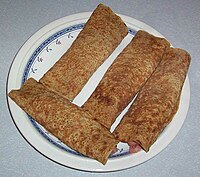
[edit]The Universal British Directory of Trade, Commerce and Manufacture of the 1790s notes the bread of High Furness being thin oatcakes, whilst in Lancashire a leavened oatcake known as riddle bread was made.[14] The Staffordshire oatcake is quite different from those from Scotland, being more of a pancake in form, containing a significant proportion of wheat flour along with oatmeal.[3][4] In Yorkshire, oatcakes are cooked from the bottom only, and the tops are bubbly in appearance.[1]
The Duke of Wellington's Regiment was nicknamed the Havercakes due to their recruiting sergeants bearing oat cakes on the end of their swords.[15][16]
-
-
 Oatcakes in the Beamish Museum, near Durham, England


Scotland
[edit]In Scotland, oatcakes are made on a girdle (or griddle, in other forms of English) or by baking rounds of oatmeal on a tray. If the rounds are large, they are sliced into farls before baking. Oats are one of the few grains that grow well in the north of Scotland and were, until the 20th century, the staple grain eaten in that area.
Scottish soldiers in the 14th century carried a metal plate and a sack of oatmeal. According to contemporary accounts, a soldier would heat the plate over fire, moisten a bit of oatmeal and make a cake to "comfort his stomach. Hence it is no marvel that the Scots should be able to make longer marches than other men."[17][18]
Samuel Johnson referred, disparagingly, to this staple diet in his dictionary definition for oats:
- A grain, which in England is generally given to horses, but in Scotland supports the people.
Lord Elibank was said by Sir Walter Scott to have retorted
- Yes, and where else will you see such horses and such men?[19]
The texture may vary from rough to fine depending on how the oats are ground. Oatcakes may be slightly chewy or hard, depending on the water content and for how long they are cooked. Oatcakes were traditionally eaten with every meal as a major source of carbohydrate in the diet. From the 19th century onward, they were commonly served to accompany soups, meat, and fish dishes. Today, they are sometimes eaten as an alternative to bread or toast at breakfast.[20][21]
Nowadays, many brands of oatcakes are commercially available, such as Nairn's, Stockan's, Paterson's, and Walkers.[22] Apart from those larger commercial manufacturers of oatcakes, there are many local bakers providing variations on the basic recipe.
-
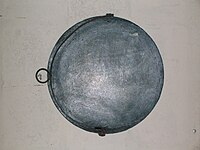 A girdle from Dalgarven Mill in North Ayrshire, used for baking oatcakes and other foods such as bannocks
 -
 Oatcakes being cooked outdoors
 -
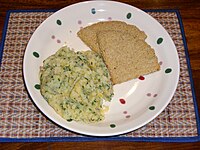 Oatcakes (top) with clapshot


Wales
[edit]In Wales, oatcakes tend to resemble savoury pancakes.[1] They were sometimes crumbled up and used as one of the ingredients of brewis, a staple breakfast.[citation needed]
Ireland
[edit]
Oatcakes similar to the Scottish variety are produced in Ireland,[23] in shared tradition with the Scots.[24] Ditty's is a Northern Irish brand of oatcake.[25][26]
Canada
[edit]Scottish immigrants to the New World brought the recipe for this sustaining food to Canada. One such journey was HMS Elizabeth, which brought immigrants to Prince Edward Island in 1775. Caught in a storm just off the coast of the island, the settlers and crew all survived and made it to the island in life boats, where they waited for three days for the storm to die down. When they returned to their ship to retrieve their possessions and provisions, they discovered that several barrels of oats were among the few foodstuffs that remained. The oats were full of sand and salt water, but that didn't stop them from breaking out the frying pans and cooking oatcakes as their first meal in days. One settler wrote in his journal, "This I thought was the Sweetest morsel I ever Ate in my life though the Outside was burnt black and the middle was not half done".[27]
Oatcakes in Canada gradually[when?] moved from being a mainstay of the diet to being a part of afternoon tea. Sweet and savoury versions were developed, to be served with jam or cheese respectively.
See also
[edit]
References
[edit]- ^ a b c d Martin, James. "Oatcakes recipes". BBC Food. Retrieved 1 May 2014.
- ^ Pippa Cuthbert; Lindsay Cameron Wilson (2007). Cookies!. New Holland Publishers. p. 68. ISBN 9781845376819.[permanent dead link]
- ^ a b Cauvain & Young (26 August 2009). More Baking Problems Solved. Elsevier. p. 190. ISBN 9781845697204.
- ^ a b Scott, Chloe (22 October 2013). "How to make the ultimate Staffordshire oatcake". Metro. Retrieved 25 April 2014.
- ^ Chambers English Dictionary. W. & R. Chambers and Cambridge University Press. 1987. pp. 599, 624. ISBN 1-85296-000-0.
- ^ Mairi Robinson, ed. (1987). The Concise Scots Dictionary. Aberdeen University Press. p. 233. ISBN 0-08-028492-2.
- ^ a b Albert, Susan Wittig (2010). The Tale of Oat Cake Crag. Penguin. p. 194. ISBN 978-1101459904.
- ^ Le Bel, Jehan (1290–1360). The True Chronicles of Jean Le Bel. Scotland: Boydell & Brewer Ltd, 2011. p. 40. ISBN 9781843836940.
- ^ Hope, Annette (2010). A Caledonian Feast. Canongate Books. p. 110. ISBN 978-1847674425.[permanent dead link]
- ^ Fuller, Barbara (2005). Great Britain. Marshall Cavendish. pp. 125. ISBN 0761418458.
- ^ "Right royal requirements". BBC. 10 October 2000.
- ^ "Scottish oatcake". Walkers Shortbread Ltd. Archived from the original on 22 July 2012. Retrieved 28 October 2010.
- ^ "Let them eat oatcake". The Scotsman. Edinburgh. 17 October 2009.
- ^ Peter Barfoot; John Wilkes (of Milland House, Sussex.) (1790). The Universal British Directory of Trade, Commerce and Manufacture, Volume 4. p. 648.
- ^ Harland, John; Wilkinson, Thomas Turner (16 August 1867). "Lancashire Folk-lore: Illustrative of the Superstitious Beliefs and Practices, Local Customs and Usages of the People of the County Palatine". F. Warne – via Google Books.
- ^ "The United Service Magazine". H. Colburn. 16 August 1869 – via Google Books.
- ^ McNeill, Marian (1929). "Bannocks, Scones, and Tea-bread". The Scots Kitchen (1993 ed.). Blackie & Son Ltd/Mercat Press Ltd. p. 175. ISBN 1-84183-070-4.
- ^ "Feasting with Shadows". Outremer.co.uk. Retrieved 6 February 2013.
- ^ The Life of Samuel Johnson, LL.D.: Including a Journal of His Tour to the Hebrides. Volume 3 by James Boswell. Edited by John Wilson Croker. Publisher: Derby & Jackson, New York, 1858. Page 11.
- ^ Elizabeth Foyster; Christopher A. Whatley (2009). A History of Everyday Life in Scotland, 1600 to 1800. Edinburgh University Press. p. 139.
- ^ Alan Davidson & Tom Jaine (2006). The Oxford companion to food. Oxford University Press. p. 185.
- ^ History of Oatcake Making in Rutherglen Archived 11 September 2021 at the Wayback Machine, Rutherglen Heritage Society
- ^ "Bon Appetit Wednesday! Celebrate St. Patrick's Day With Ancient Irish Oatcakes". 12 March 2014.
- ^ "Captain Cuellar's Adventures in Connacht and Ulster". celt.ucc.ie. Retrieved 24 October 2019.
- ^ "Products". Ditty's Home Bakery. Archived from the original on 5 September 2014. Retrieved 1 May 2014.
- ^ "About us". Ditty's Home Bakery. Archived from the original on 5 September 2014. Retrieved 1 May 2014.
- ^ Roy, Suman and Brooke Ali (2010). From Pemmican to Poutine: A Journey Through Canada's Culinary History. Toronto: The Key Publishing House, Inc. p. 16. ISBN 978-1-926780-00-9.
Further reading
[edit]- Sinclair, Molly. Scottish Heritage Cookbook. Heritage Cookbooks. Mission San Jose, California: 1990.
External links
[edit]


- Oatcakes recipes from BBC Food
| Avena species and cultivars | |
|---|---|
| Basic preparations | |
| Culinary usage |
|
| Brands | |
| Related | |


