


Roti canai

 Roti telur, a type of roti canai with egg filling, served on a banana leaf | |
| Alternative names |
|
|---|---|
| Type | Flatbread |
| Course | Main course, usually for breakfast |
| Region or state | Southeast Asia |
| Associated cuisine | Brunei, Indonesia, Malaysia, Singapore, and Thailand[1][2][3][4][5][6][7] |
| Created by | South Indian diaspora in Southeast Asia |
| Serving temperature | Hot |
| Main ingredients | Flour |
| Variations | Roti tissue, murtabak |

Roti canai, or roti prata, also known as roti chanai and roti cane, is an Indian flatbread dish found in several countries in Southeast Asia, especially Brunei, Indonesia, Malaysia, Singapore, and Thailand.[8] It is usually served with dal or other types of curry but can also be cooked in a range of sweet or savoury variations made with different ingredients, such as meat, eggs, or cheese.
In Southeast Asia, roti canai can often be found in cities that have populations of Indian descent, such as in West Sumatra, North Sumatra, and Aceh in Indonesia, as well as in Malaysia and Singapore.[9] Since being introduced around the 19th century, roti canai has become a popular breakfast and snack dish and is one of the most common examples of South Indian cuisine in the region.[1][10] It is said that the dish was brought by Indians during the era of British Malaya, the Dutch East Indies, and the Straits Settlements. It is also colloquially known as "mamak"[citation needed], served in street mamak stalls located in both rural and urban areas.[11][12][13]
It has also been theorized that the dish had been introduced much earlier, in the 17th century, in Aceh and North Sumatra, by Indian traders under the name roti cane.[14][15][9][16][17] In Indonesia, the dish is particularly found in Sumatra, where the Indian Indonesian community is more prominent compared to the rest of the country.[17]
Etymology
Roti means bread in Sanskrit and most other Indian languages.[18] There are different suggestions for the origin of canai: it has been claimed that the word refers to channa, a North Indian dish made with boiled chickpeas in a spicy gravy, with which this type of bread was traditionally served.[19] Meanwhile, the Oxford English Dictionary states that it may be from the Malay word canai, meaning "to roll (dough) thinly".[8]
In Singapore, the dish is known as roti prata, similar to the Indian paratha, or parotta.[20] The Hindi word paratha means "flat".[20][21]
Description
 | This article has multiple issues. Please help improve it or discuss these issues on the talk page. (Learn how and when to remove these template messages)
|

Roti canai is a flatbread made from dough that is composed of fat (usually ghee), flour, and water; some recipes also include sweetened condensed milk. The dough is repeatedly kneaded, flattened, oiled, and folded before proofing, creating layers. The dough ball is then flattened, spread out until paper-thin (usually by "tossing" it on a flat surface), and gathered into a long rope-like mass. This "rope" is then wound into a knot or spiral and flattened, so that it consists of thin flakes of dough when cooked.
When making varieties with fillings, however, the fillings (eggs, chopped onions, etc.) are spread or sprinkled on the thin sheet of dough, which is then folded with the fillings inside.

Regional variations
| This section possibly contains original research. (April 2018) |
Plain roti is often referred to as roti kosong ("empty bread" in the Malay language).[22]
Traditionally, roti canai is served with dal (lentil) curry. It may also be served with the following curries:
- Kari ayam – chicken curry
- Kari daging – beef curry
- Kari kambing – mutton curry
- Kari ikan – fish curry (mostly served with ikan pari)
- Kari campur – mixed curry
- Kari kacang kuda – chickpea curry
Indonesia

Roti cane came to Indonesia via Muslim Indian migration to Aceh Sultanate, in the northern parts of Sumatra, around the 17th century,[14][15][9][16] and later to the rest of the Dutch East Indies, in the early 19th century;[17] it has since been adopted into the Malay, Acehnese, and Minangkabau cuisine of Sumatra. Consequently, there are Malay, Acehnese, and Minangkabau restaurants serving the dish with mutton curry that are operated by ethnic groups other than Indians.[17] Two types of popular roti cane dishes include sweet roti cane, served with various toppings such as cheese, chocolate sprinkles, and chocolate syrup; and savoury roti cane, served with curry sauce.[23] Today in Indonesia, roti canai is often associated with Acehnese cuisine, despite its Indian origin.[24]

In Ampel, an Arab quarter in Surabaya, the dish is known as roti maryam,[25] while the Javanese call it roti konde, after its shape resembling a hairbun (Javanese: konde). Despite having different names, each variant is derivative of the Indian paratha and is similar in preparation.[6] Indian-influenced roti is typically served with kari kambing (mutton curry).[17]
Brunei and Malaysia
| This article has multiple issues. Please help improve it or discuss these issues on the talk page. (Learn how and when to remove these template messages)
|


Different varieties of roti canai served in Brunei and Malaysia are listed below:
- Murtabak, a very thick roti filled with a mixture of egg, meat, onions, and spices. In Brunei, Malaysia, and Singapore, it is usually prepared on a griddle like roti canai, but in Indonesia, it is often deep-fried in a wok and very oily. In Thailand, it is called "mataba". In Malaysia, Singapore, and Thailand, murtabak is made using the same dough used for roti canai, and on the same equipment, in the same shops. Most murtabak in Malaysia tend to have less minced meat and more egg than Singaporean murtabak or Johorean murtabak. Murtabak cheese is a variation, with added mozzarella cheese.
- Roti telur, with an egg (telur) stuffing
- Roti jantan, roti telur with two-egg stuffing
- Roti bawang, with onion (bawang) stuffing
- Roti telur bawang, with eggs and onions
- Roti boom (or bom; 'bomb bread'), a smaller but thicker roti, with the dough wound in a spiral; served with sugar and margarine, or with curry.
- Roti planta, stuffed with margarine (often Planta Margarine) and sugar
- Roti sardin, stuffed with canned sardine, with or without egg, and sometimes mixed with ketchup or sambal, similar to murtabak
- Roti pisang, stuffed with sliced bananas
- Roti sayur, stuffed with shredded or sliced vegetables
- Roti salad, raw shredded vegetables rolled up with a piece of roti
- Roti tissue/roti tisu, a tissue-paper-thin and flaky roti, usually with sprinkled sugar and condensed milk. Also called roomali roti, from roomal (Hindi, meaning 'handkerchief').
- Roti kaya, with kaya spread
- Roti maggi, stuffed with prepared instant noodles, usually Maggi brand
- Roti cheese, stuffed with cheese
- Roti milo, stuffed with Milo powder
- Roti cobra, served with curry chicken and a piece of fried egg on top
- Roti banjir ("flooded roti"), usually chopped into pieces, with curry poured over the top
- Roti tsunami, roti banjir with added sambal and soft-boiled eggs
- Roti Doll ("Doll's roti"), roti banjir with added sambal and a fried egg on top. Most commonly found in northern Malaysia, especially in the town of Alor Setar; named after a customer.
- Roti Sarang Burung ("bird's nest roti"), roti cooked in a doughnut shape with a fried egg in the hole, similar to egg in the basket and khachapuri.
Singapore

Roti prata in Singapore is a fried flatbread that is cooked over a flat grilling pan. It is usually served with sugar or a vegetable- or meat-based curry and is also commonly cooked with cheese, onions, bananas, red beans, chocolate, mushrooms, or eggs.[26]
Roti prata is prepared by flipping the dough into a large thin layer before folding the outside edges inwards. The dough is cooked on a flat, round iron pan measuring about three feet in diameter. The cooking process lasts two to five minutes.[26]
- Roti tampal or roti plaster (in Singapore): the roti is plastered on one side with egg, with the yolk left runny or totally cooked.
Thailand
 |

In Thailand, roti (with variations on spelling such as ro tee) is commonly available from street carts, usually halal, sold by Thai Muslims. Roti thitchu (Thai for "tissue") is Thai roti canai that is fluffed up by clapping it between two hands inside a dry cloth after frying, served with a Thai Muslim-style beef curry.
In other parts of Thailand, roti is also commonly eaten with mango, banana, sugar, condensed milk, jam, peanut butter, or Nutella, although egg roti is also available.
Gallery
-
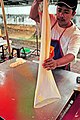 The mixture is kneaded, flattened, and then oiled, before being folded repeatedly.
 -
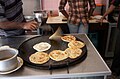 Roti canai is cooked on a tava with a lot of oil.
 -
 Another picture of roti canai preparation
 -
 A sweet Thai roti kluai khai: similar to roti canai, it is folded around a filling of sliced bananas and eggs.
 -
 Roti canai with curry chicken in New Zealand
 -
 Roti prata being prepared
 -
 "Coin prata" is a smaller, crispier version of Singaporean roti prata, found at Kampong Glam.
 -


See also
.svg)


References
- ^ a b "Roti Prata". Singapore Tourism Board.
- ^ Yi Jun Loh (22 May 2019). "The Indian Roti That Became Malaysia's National Bread". Taste. New York: Penguin Random House LLC.
- ^ Yip, Lynnett (29 February 2020). "What is roti canai, and why can't people in Southeast Asia get enough of it?". South China Morning Post. Hong Kong.
- ^ "Roti Canai (Mamak Copycat)". NyonyaCooking. 23 July 2016.
- ^ Krich, John (31 July 2009). "Roti Canai Kuala Lumpur takes a flatbread to new heights". The Wall Street Journal. New York: Dow Jones & Company.
- ^ a b "Roti Maryam/Konde/Cane/Canai". Indonesia Eats. 27 February 2008.
- ^ "Mencoba Roti Canai Asli Aceh di Tepi Jalan Pasar Minggu". Liputan6. 18 December 2016.
- ^ a b "roti canai, n." Oxford English Dictionary. Retrieved 20 January 2020.
- ^ a b c Novita, Cicik (25 February 2022). "Resep Roti Canai dan Cara Membuatnya yang Dapat Dicoba di Rumah". tirto.id (in Indonesian). Retrieved 6 March 2024.
- ^ Krich, John (31 July 2009). "Roti Canai". Wall Street Journal. New York: Dow Jones & Company. ISSN 0099-9660. Retrieved 16 April 2018.
- ^ "Singapore hawker dishes: Roti prata". travelfish.org. TravelFish. Retrieved 13 January 2022.
- ^ "Malaysia's 5 mamak stall favoritesaccess-date=16 April 2018".
- ^ Staff writers. "The 10 types of roti you'll find at the mamak". Time Out Kuala Lumpur. Kuala Lumpur: Time Out International Limited. Retrieved 16 April 2018.
- ^ a b "Mengenal Asal Usul Roti Canai Yang Populer Di Wilayah Asia Tenggara". Timurasa.com (in Indonesian). 21 November 2020. Retrieved 21 March 2024.
- ^ a b Rinaldi, M Yon (17 November 2020). "Martabak Faliel Hadirkan Menu Khas Melayu Berkultur India, Ada Roti Cane Berbagai Topping". Tribun Jambi (in Indonesian). Retrieved 21 March 2024.
- ^ a b Adriansyah, Taufiq Dali (30 July 2023). "Resep Membuat Roti Canai, Makanan Khas Aceh yang Paling Cocok Temani Sarapan Pagi". Harian Haluan (in Indonesian). Retrieved 6 March 2023.
- ^ a b c d e Ni Luh Made Pertiwi F (2 April 2013). "Roti Cane dan Kari Kambing, Pasangan Sejati Nan Lezat" (in Indonesian). Kompas.com. Retrieved 23 July 2014.
- ^ "Roti canai, a popular snack | The Star Online". The Star. Malaysia. Archived from the original on 17 April 2018. Retrieved 16 April 2018.
- ^ Wijnen, Ben van. "Roti Canai (Malay Recipe)". malaysiasite.nl. Retrieved 16 April 2018.
- ^ a b Koh, Aun. "Roti Prata – Words Without Borders". Words Without Borders. Retrieved 16 April 2018.
- ^ "Roti Prata". Singapore Tourism Board. Retrieved 16 April 2018.
- ^ Krich, John (31 July 2009). "Roti Canai". The Wall Street Journal.
- ^ Rahma, Imelda (13 June 2022). "Mengenal Asal Usul Pembuatan Roti Canai Beserta Resepnya". fimela.com (in Indonesian). Retrieved 1 March 2024.
- ^ "Roti Canai, Kue Paling Dicari Penyuka Kuliner Aceh". Merah Putih (in Indonesian). 18 June 2018. Retrieved 6 March 2024.
- ^ "Ramadan di Kampung Ampel, Roti Maryam Paling Diburu". Detiknews (in Indonesian). 18 July 2014. Retrieved 21 March 2024.
- ^ a b "Inilah Cara Membuat Roti Prata Singapore Yang Mudah". Toko Mesin Maksindo (in Indonesian). 14 October 2017. Retrieved 7 April 2022.
External links

- Roti prata video recipe
- Roti Prata, Singapore Infopedia, National Library Board, Singapore (archived)


Indonesian breads | |
|---|---|

| Common dishes |
| ||||||||||||
|---|---|---|---|---|---|---|---|---|---|---|---|---|---|
| Snacks |
| ||||||||||||
| Desserts | |||||||||||||
| Drinks |
| ||||||||||||
| Condiments | |||||||||||||

| Articles | |||||||
|---|---|---|---|---|---|---|---|
| Dishes |
| ||||||
| Snacks and desserts | |||||||
| Drinks | |||||||

| Individual dishes | |
|---|---|
| Shared dishes | |
| Isan dishes | |
| Northern Thai dishes | |
| Southern Thai dishes | |
| Snacks |
|
| Desserts |
|
| Miscellaneous |
|
| Beverages | |
| See also | |


| Foods |
|  |
|---|---|---|
| By location | ||
| Mobile catering | ||
| Lists | ||
- Acehnese cuisine
- Culture of Indian diaspora
- Desi cuisine
- Flatbreads
- Indian diaspora in Singapore
- Indonesian breads
- Indonesian pancakes
- Javanese cuisine
- Malay cuisine
- Malaysian breads
- National dishes
- Padang cuisine
- Pancakes
- Roti
- Singaporean cuisine
- Thai cuisine
- Bruneian cuisine
- Unleavened breads
- Indian breads
- Indonesian Indian cuisine
- Indian-Malaysian culture
- Indian diaspora in Thailand