


Crêpe
 A stack of crêpes | |
| Alternative names | Crepe |
|---|---|
| Type | Crepes |
| Place of origin | France[1][2] |
| Region or state | Brittany |
| Serving temperature | Warm, hot, or cold |
| Main ingredients | Wheat flour or buckwheat flour, milk, eggs |


A crêpe or crepe (/kreɪp/ ⓘ[3] or /krɛp/, French: [kʁɛp] ⓘ, Quebec French: [kʁaɪ̯p] ⓘ) is a dish made from unleavened batter or dough that is cooked on a frying pan or a griddle. Crêpes are usually one of two varieties: sweet crêpes (crêpes sucrées) or savoury galettes (crêpes salées). They are often served with a wide variety of fillings such as cheese, fruit, vegetables, meats, and a variety of spreads.[4] Crêpes can also be flambéed, such as in crêpes Suzette.
Etymology[edit]
The French term "crêpe" derives from crispa, the feminine version of the Latin word crispus, which means "curled, wrinkled, having curly hair."[5]
Traditions[edit]
In France crêpes are traditionally served on the Christian holiday Candlemas (La Chandeleur), on February 2.[6] In 472, Pope Gelasius I offered sacramental bread to French pilgrims that were visiting Rome for the Chandeleur.[7] With time the sacramental bread was replaced by crêpes in France, and the day also became known as "Le Jour des Crêpes" ("The Day of the Crêpes"). The day is also celebrated by many as the day that marks the transition from winter to spring (similar to the North American tradition of Groundhog Day), with the golden color and circular shape of crêpes representing the sun and the circle of life.[8]
There are a few superstitions around the preparation of crêpes for Le Jour des Crêpes.
One example involves holding a gold coin (such as a Louis d'or) or ring in the left hand while successfully flipping a crêpe in a pan with the right hand. It's said to bring a person wealth in the upcoming year (other variations describe a year of good weather).[9]
Another version of the tradition involves cooking a crêpe with a gold coin on top. Some hide the first crêpe in a drawer instead of eating it for good luck in the coming year. Eating and sharing crêpes with others on Candlemas is another tradition based on popes giving food to the poor every year on February 2.[8]
A traditional French proverb describes the tradition of eating crêpes on Candlemas: “manger des crêpes à la chandeleur apporte un an de bonheur” (eating crêpes on Candlemas brings a year of happiness).[10]
Types[edit]
Sweet crêpes are generally made with wheat flour (farine de blé). When sweet, they can be eaten as part of breakfast or as a dessert. Common fillings include hazelnut cocoa spread, preserves, sugar (granulated or powdered), maple syrup, golden syrup, lemon juice, whipped cream, fruit spreads, custard, and sliced soft fruits or confiture.
Savory crêpes can be made with non-wheat flours such as buckwheat. A normal savory crêpe recipe includes using wheat flour but omitting the sugar.[11] Batter made from buckwheat flour is gluten-free, which makes it possible for people who have a wheat allergy or gluten intolerance to eat this type of crêpe.[12] Common savory fillings for crêpes are cheese, ham, and eggs, ratatouille, mushrooms, artichoke (in certain regions), and various meat products.
Crêpes can also be made into crepe cakes by stacking plain crepes on top of each other, adding a layer of filling between the layers. Fruits, chocolate, cookies, marshmallow, etc., can be added. Most crêpe cakes are sweet and considered dessert. It can also replace the traditional birthday cake. Crêpe cakes are usually 15–30 layers, and the crêpes used are very thin and soft.[13]
Batters can also consist of other ingredients such as butter, milk, water, eggs, flour, salt, and sugar.[14] Fillings are commonly added to the center of the crêpe and served with the edges partially folded over the center. An Indian variety of the crêpe uses a multi-grain flour called "bhajanee," eggs, curd, and an assortment of spices as its ingredients. It is a modern variation of an Indian dish called Thalipeeth.
A cake made with layers of crêpes with a filling in between is called “gâteau de crêpes” or “ミルクレープ(mille-crêpes)” (a Japanese-made French word combining crêpes and mille-feuille).[15] This French pâtisserie,[16][17] was popularized by Emy Wada, a pâtissier who studied in France[18] and operated Paper Moon Cake Boutiques in Japan, in the 1980s. In 2001, she expanded to New York City, where she supplied crêpe cakes to popular chains Dean & DeLuca and Takashimaya through the company Lady M.[19]
Recipe[edit]
The standard recipe for French crêpe calls for flour, eggs, milk, salt, and butter. Sugar is optional. In the industrial production of crêpes, the dry ingredients are combined with eggs to form a dough. The rest of the wet ingredients are then added to thin the batter to a loose enough consistency to spread easily. The batter is added, one ladle at a time, to a hot, greased pan, cooked until golden, then flipped. Crêpe batter is characterized by its liquidity, making it easy to spread in a thin layer. Crêpes are also characterized by their quick cooking time, usually 20–30 seconds per side.[20]
In older versions of crêpe recipes, beer or wine was used instead of milk. Buckwheat flour is often used as well, specifically in making a Breton Galette.[10]
Crêperies[edit]
A crêperie (French: [kʁɛpʁi]) may be a takeaway restaurant or stall, serving crêpes as a form of fast food or street food, or it may be a more formal sit-down restaurant or café. Crêperies can be found throughout France, especially in Brittany and in many other countries. Many also serve apple cider, a popular drink to accompany crêpes.


_crepe_stall.jpg)
Special crêpes[edit]

Mille crêpes are a French cake made of many crêpe layers. The word mille means "a thousand," implying the many layers of crêpe.[21] Another standard French and Belgian crêpe is the crêpe Suzette, a crêpe with lightly grated orange peel and liqueur (usually Grand Marnier), which is lit during presentation.[22]

The 49er flapjack is a sourdough crêpe which is popular in the United States,[23] getting its name from the popularity of this style of pancake during the California Gold Rush. Because it is similar to a Swedish pancake, the 49er is sometimes served with lingonberry sauce, although most often, it is rolled up with butter and powdered sugar or served open-faced and topped with maple syrup.
Crêpe dentelle is a crispy biscuit made with a very thin layer of crêpe folded in a cigar shape and then baked. It is usually enjoyed with a hot drink during the goûter, in France.[24]
Crêpes in European culture[edit]
In Norwegia, crêpes are called pannekake, and in most German regions Crêpes (referring to a wide and flat crêpe, as opposed to the smaller and thicker native Pfannkuchen pancakes). In Swedish, a crêpe is called pannkaka in southern regions while being called plättar in the north. In Danish it is called pandekager ("pancakes"). In Icelandic it is called pönnukaka. In Finnish a crêpe is called either ohukainen or lettu or räiskäle. In Greek it is called krepa (Κρέπα). In Dutch it is a pannenkoek or flensje. In Afrikaans crêpes are called pannekoek, and are usually served with cinnamon and sugar. In the Spanish regions of Galicia and Asturias, they are traditionally served at carnivals. In Galicia, they're called filloas and may also be made with pork blood instead of milk. In Asturias, they are called fayueles or frixuelos, and in Turkey, akıtma.
In areas of central Europe, formerly belonging to the Austro-Hungarian empire, there is a thin pancake comparable to a crêpe that in Austro-Bavarian is called Palatschinken; in Hungarian: palacsinta; and in Bulgarian, Macedonian, Czech, Croatian, Serbian and Slovene: palačinka; in Slovak: palacinka. In the Balkan countries, palačinka or pallaçinka may be eaten with fruit jam, quark cheese, sugar, honey, or the hazelnut-chocolate cream Nutella, while there is also a breaded variant which is mostly filled with meat. Restaurants specializing in palačinci are called "Palačinkara" in the region. In Ashkenazi Jewish cuisine, there is a similar dish known as the blintz. The Oxford English Dictionary derives the German and Slavic words from the Hungarians palacsinta, which it derives from the Romanian plăcintă, which comes in turn from classical Latin placenta ("small flat cake"), even though the Romanian plăcintă is more similar to a pie, and the crêpes are called clătită.
During the East Slavic celebration of Maslenitsa (Cheesefare Week), one of the most popular foods are blini, or crêpes. Since they are made from butter, eggs, and milk, crêpes can be consumed during the celebration by the Orthodox church. White flour can be replaced with buckwheat flour, milk can be switched for kefir, and oils can be added or substituted. Blini are served with butter and topped with caviar, cheese, meat, potatoes, mushrooms, honey, berry jam, or often a dollop of sour cream. The dish is supposed to represent the sun since the holiday is about the beginning of spring.[25]
-
 A sweet crêpe filled with oats and berries and topped with whipped cream
 -
 Frixuelos. This is a kind of crêpe made in Asturias, Spain.
 -
 Making Finnish crêpes called ohukainen
 -
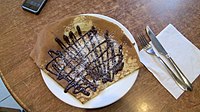 Chocolate-Coconut Crêpe served in crêperie near the Pantheon in Paris, France


.jpg)

Crêpes outside of Europe[edit]
Crêpes have also long been popular in Japan and Malaysia, with sweet and savory varieties being sold at many small stands, usually called crêperies. In Argentina, Uruguay, and Chile, they are called panqueques and are often eaten with dulce de leche. Various other French foods such as crêpes, soufflés, and quiche have slowly made their way into American cooking establishments.[26] Typically, these franchises stick to the traditional French method of making crêpes, but they have also put their own spin on the crêpe with new types, such as the hamburger and pizza crêpe. In Canada, particularly in French-speaking regions, crêpes and galettes have long been traditional food items.

The Japanese crêpes developed into something different from the French crêpes due to their various fillings and toppings, and the style later spread outside of Japan. It is often called 'Harajuku Crêpes'. In Japan, French crêpes were introduced in the 1970s, and they were only spread with jam and were not very popular. In 1977, Mizuki Ono opened a crêpe shop in Harajuku and, taking inspiration from ice cream monaka, began to sell crêpes with ice cream, whipped cream, and sliced fruit, which became very popular. They were rarely made at home and spread as sweets purchased from street stalls and eaten on the street.[27][28][29]
In Mexico, crêpes are known as crepas and were introduced during the 19th century by the French[30][31] and are typically served either as a sweet dessert when filled with cajeta (similar to dulce de leche), or as a savoury dish when filled with Huitlacoche (corn smut), which is considered a delicacy.
Similar dishes in other cuisines[edit]
 | This section possibly contains original research. (June 2023) |
In South India, a similar dish made of fermented rice batter is called a dosa, which often has savory fillings. In Western India, a dish made of gram flour is called "Pudlaa" or "Poodla," with the batter consisting of vegetables and spices. Another variety is called "patibola" and is sweet in taste due to milk, jaggery, or sugar. The injera of Ethiopian/Eritrean/Somali/Yemeni cuisine is often described as a thick crêpe. In Somalia, malawah is very similar to a crêpe. It is mostly eaten at breakfast.
In the Philippines, a native crêpe recipe is the daral which is made from ground glutinous rice and coconut milk batter (galapong). It is rolled into a cylinder and filled with sweetened coconut meat strips (hinti).[32]
In Indonesia, Kue leker is a type of Indonesian crêpe. Also, ledre, a rolled banana crêpe from Bojonegoro.[33]
In China, Jianbing is a traditional Chinese street food similar to crêpes. It is generally eaten for breakfast and hailed as "one of China's most popular street breakfasts." It consists of wheat and grain-based crepe, an egg, deep-fried crackers (known as Bao Cui/薄脆 in Chinese), 2–3 savory/spicy sauces, and chopped scallions & coriander.
See also[edit]
- List of pancakes
- Bánh xèo
- Blini
- Maslenitsa – a related Eastern Slavic festival
- Blintz
- Blodplättar – a form of savory crepe made with blood
- Brik
- Crêpe bretonne
- Crepe maker – crepe cooking device
- Dosa
- Galette – another kind of Breton pancake, also from Brittany, France
- Injera
- Jianbing – a traditional Chinese street food similar to a crepe
- Kue leker – a traditional Indonesian crepe
- Krampouz – crepe maker manufacturer, also from Brittany, France
- Memiljeon
- Palatschinken
- Pek Nga – Malaysian crepe-like snack
- Popiah – Chinese roll wrapped in a thin crepe made by "wiping" dough on a hot plate
- Roti prata
- Sope
- Swedish pancake
- Tava
References[edit]
- ^ Vachon, Pamela (2 January 2021). "The history of crêpes: A personal and historical exploration of the famous French pancake's origin". Salon.com. Retrieved 10 September 2023.
- ^ Mikus, Matt (31 July 2015). "Crepe history connected to France". Petoskey News-Review. Retrieved 10 September 2023.
- ^ Longman Pronunciation Dictionary. 3rd Ed. 2008.
Merriam-Webster Dictionary - ^ "48 Delicious Crepe Fillings That Will Rule Your Sunday Brunch!". DIYs.com. 14 September 2016. Retrieved 12 November 2021.
- ^ "crepe | Search Online Etymology Dictionary". www.etymonline.com. Retrieved 12 November 2021.
- ^ Roy, Christian (2005). Traditional Festivals: A Multicultural Encyclopedia. ABC-CLIO. ISBN 978-1-57607-089-5.
- ^ "The History of Crêpes | Institute of Culinary Education". ice.edu. Retrieved 11 October 2022.
- ^ a b "Why the French Eat Crêpes on February 2". Condé Nast Traveler. 1 February 2017. Retrieved 11 October 2022.
- ^ Salzberg, Alysa (31 January 2022). "All about La Chandeleur, a day of superstition and crepes". French Together. Retrieved 11 October 2022.
- ^ a b Albala, Ken (2008). Pancake: A Global History (1st ed.). London: Reaktion Books Ltd. pp. 24–93. ISBN 9781861893925.
- ^ Alfaro, Danilo. "Sweet or Savory Basic Crepe Recipe". The Spruce Eats. Dotdash. Retrieved 3 April 2020.
- ^ Mariotti, Manuela; Pagani, M. Ambrogina; Lucisano, Mara (1 January 2013). "The role of buckwheat and HPMC on the breadmaking properties of some commercial gluten-free bread mixtures". Food Hydrocolloids. 30 (1): 393–400. doi:10.1016/j.foodhyd.2012.07.005. ISSN 0268-005X.
- ^ "Tiramisu Crepe Cake Recipe". Sally's Baking Addiction. 19 October 2020. Retrieved 12 November 2021.
- ^ "Wrap it up in a crêpe; Thin pancakes work in savory or sweet dishes." Times-Colonist (Victoria, British Columbia). (24 April 2013 Wednesday) LexisNexis Academic.
- ^ "Invented Overseas, Reinterpreted in Japan: Unique Japanese Sweets with International Roots | LIVE JAPAN travel guide". LIVE JAPAN. Retrieved 26 February 2021.
- ^ Babinski, Henri (1923). Gastronomie pratique : études culinaires ; suivies du Traitement de l'obésité des gourmands [The Encyclopedia of Practical Gastronomy] (in French) (3rd ed.). Retrieved 12 October 2021.
- ^ Child, Julia (1976). Mastering the Art of French Cooking (3rd ed.). ISBN 9785879620764. Retrieved 12 October 2021.
- ^ "The history of crêpes: A personal and historical exploration of the famous French pancake's origin". Salon. 2 January 2021. Retrieved 12 October 2021.
- ^ "Gâteau de Crêpes (Crepe Cake)". The Little Epicurean. 15 September 2011. Retrieved 26 February 2021.
- ^ Guibert-Martin, Jury, V., Bouchet, B., Roellens, G., Lioret, P., & Le-Bail, A. (2017). Impact of the baking protocol on the structure of French crêpes. Journal of Food Engineering, 196, 183–192. https://doi.org/10.1016/j.jfoodeng.2016.07.002
- ^ Hesser, Amanda (15 May 2005). "The Way We Eat: Building a Modern, Multistoried Dessert". The New York Times.
- ^ Courtine, Robert J. (1984), Larousse gastronomique (French edition), Paris: Librairie Larousse.
- ^ "Why They Sell Like Hot Cakes". Los Angeles Times. 16 March 1995. Retrieved 19 October 2018.
- ^ "lace crepes". Archived from the original on 21 December 2012. Retrieved 4 December 2012.
- ^ Nesterova, Maria (24 February 2014). "Maslenitsa, another Russian festival you've probably never heard of". Eurokulture.missouri.edu. Archived from the original on 29 September 2018. Retrieved 19 October 2018.
- ^ Benenson, R. (1984). Dining in America. Editorial research reports 1984 (Vol. I). Washington, DC: CQ Press.
- ^ 本場フランスに逆輸入もされた“ハラジュクスタイル” カフェクレープ開発秘話 (in Japanese). Asahi Shimbun. 6 March 2016. Archived from the original on 1 July 2017.
- ^ 今や「竹下通り」の定番アイテム?原宿とクレープの甘い関係 (in Japanese). Shibuya Keizai Shimbun. 23 May 2003. Archived from the original on 19 January 2021.
- ^ "Japanese Crêpes: a Harajuku take on a French staple". Japan time. 6 October 2021. Archived from the original on 5 November 2021.
- ^ Fernández-del-Villar, Miguel Angel and Ruiz-Naufal, Víctor M., Mesa Mexicana (1993), Fundación Cultural Bancomer, ISBN 9789686084948
- ^ Hursh, Karen (1 February 2005). "The French Influence On Mexican Cooking". Mexconnect.com. Retrieved 19 October 2018.
- ^ Polistico, Edgie (28 December 2012). "daral". Philippine Food Illustrated. Retrieved 15 January 2020.
- ^ "Ledre". bojonegorokab.go.id (in Indonesian and English). Retrieved 21 April 2022.
Sources[edit]
- 19. Life A La Henri – Being The Memories of Henri Charpentier, by Henri Charpentier and Boyden Sparkes, The Modern Library, New York, 2001 Paperback Edition. Originally published in 1934 by Simon & Schuster, Inc.
External links[edit]
 Media related to Crêpe at Wikimedia Commons
 The dictionary definition of crêpe at Wiktionary
 Crêpe at the Wikibooks Cookbook subproject
- How to make a crepe


| Authority control databases: National |
|---|

