


Stroke order
 | This article includes a list of general references, but it lacks sufficient corresponding inline citations. (February 2023) |


| Stroke order | |||||||||||||
|---|---|---|---|---|---|---|---|---|---|---|---|---|---|
| Chinese name | |||||||||||||
| Traditional Chinese | 筆順 | ||||||||||||
| Simplified Chinese | 笔顺 | ||||||||||||
| |||||||||||||
| Vietnamese name | |||||||||||||
| Vietnamese alphabet | bút thuận | ||||||||||||
| Hán-Nôm | 筆順 | ||||||||||||
| Korean name | |||||||||||||
| Hangul | 필순 | ||||||||||||
| Hanja | 筆順 | ||||||||||||
| |||||||||||||
| Alternative Korean name | |||||||||||||
| Hangul | 획순 | ||||||||||||
| Hanja | 劃順 | ||||||||||||
| |||||||||||||
| Japanese name | |||||||||||||
| Kanji | 筆順 | ||||||||||||
| |||||||||||||
| Alternative Japanese name | |||||||||||||
| Kanji | 書き順 | ||||||||||||
| |||||||||||||
Stroke order is the order in which the strokes of a Chinese character are written. A stroke is a movement of a writing instrument on a writing surface.
Basic principles[edit]
Chinese characters are logograms constructed with strokes. Over the millennia a set of generally agreed rules have been developed by custom. Minor variations exist between countries, but the basic principles remain the same, namely that writing characters should be economical, with the fewest hand movements to write the most strokes possible. This promotes writing speed, accuracy, and readability. This idea is particularly important since as learners progress, characters often get more complex. Since stroke order also aids learning and memorization, students are often taught about it from a very early age in schools and encouraged to follow them.
The Eight Principles of Yong uses the single character 永 ('eternity') to teach eight of the most basic strokes in regular script.
Stroke order per style[edit]
| Oracle | Bronze | Seal | Clerical | Regular | ||
|---|---|---|---|---|---|---|
| Large | Small | Traditional | Simplified | |||
 |
 |
 |
 |
 |
 |

|
Ancient China[edit]
In ancient China, the Oracle bone script carved on ox scapula and tortoise plastrons showed no indication of stroke order. The characters show huge variations from piece to piece, sometimes even within one piece. During the divination ceremony, after the cracks were made, the characters were written with a brush on the shell or bone (to be carved in a workshop later). Although the brush-written stroke order is not discernible after carving, there exists some evidence that it was not entirely idiosyncratic: a few of the characters, often marginal administrative notations recording the provenance of the shells or bones, were not later re-carved, and the stroke order of these characters tends to resemble traditional and modern stroke order.[1] For those characters (the vast majority) which were later engraved into the hard surface using a knife, perhaps by a separate individual, there is evidence (from incompletely engraved pieces) that in at least some cases all the strokes running one way were carved, then the piece was turned, and strokes running another way were then carved.[1]
Imperial China[edit]
In early Imperial China, the common script was the small seal script. About 220 BC, the emperor Qin Shi Huang, the first to conquer all of China, imposed Li Si's character consolidation, a set of 3300 standardized small seal characters.[2] Its graphs on old steles—some dating from 200 BC—reveal indications of the stroke order of the time. However, stroke order could still not yet be ascertained from the steles, and no paper from that time is extant.
The true starting point of stroke order is the clerical script which is more regularized, and in some ways similar to modern text. By looking at the clerical style steles' graphs and the placement of each stroke, one can see hierarchical priority between the strokes, which indicates the stroke order used by the calligrapher or stele sculptors.[citation needed]
Regular script is the most recent major script stytleallowing one to more easily guess the stroke order used to write on the steles. The stroke order 1000 years ago was similar to that toward the end of Imperial China.[citation needed] For example, the stroke order of 广 is clear in the Kangxi Dictionary of 1716; but in a modern book, the official stroke order (the same) will not appear clearly. The Kangxi and current shapes have tiny differences, while current stroke order is still the same, according to the old style.[3] However, the stroke orders implied by the Kangxi dictionary are not necessarily similar to nowadays' norm.
Cursive styles and hand-written styles[edit]
Cursive and semi-cursive script show stroke order more clearly than Regular Script, as each move made by the writing tool is visible.
Stroke order per polity[edit]
The modern governments of mainland China, Hong Kong,[4] Taiwan,[5] and Japan[6] have standardized official stroke orders to be taught in schools. These stroke order standards are prescribed in conjunction to each government's standard character sets. The various official stroke orders agree on the vast majority of characters, but each has its differences. No governmental standard matches traditional stroke orders completely. The differences between the governmental standards and traditional stroke orders arise from accommodation for schoolchildren who may be overwhelmed if the rules about stroke orders are too detailed, or if there are too many exceptions.[citation needed] The differences listed below are not exhaustive.
- Traditional stroke order: Widely used in Imperial China, currently used in the Chinese cultural sphere secondary to each region's governmental standards. Practiced mainly by informed scholars of calligraphy. Also called "calligraphic" stroke order. These stroke orders are established by study of handwritten documents from pre-Republic China, especially those of notable calligraphers. These stroke orders are most conservative regarding etymology, character construction, character evolution, and tradition. Many characters have more than one stroke correct form. Stroke orders may vary depending on the script style. Unlike the other standards, this is not a governmental standard.
- Japanese stroke order: Prescribed mostly in modern Japan. The standard character set of the MEXT is the Jōyō kanji, which contains many characters reformed in 1946. The MEXT lets editors freely prescribe a character's stroke order, which all should "follow commonsensical orders which are widely accepted in the society"[This quote needs a citation]. This standard diverges from the traditional stroke order in that the two sides of the grass radical (艹) are joined, and written with three strokes. Also, this standard is influenced by semi-cursive script, leading to some vertical strokes to precede intersecting horizontal strokes if the vertical stroke does not pass through the lowest horizontal stroke, as in 隹 and 生. 必 is written with the top dot first, while the traditional stroke order writes the 丿 first.
- Taiwan stroke order (Li & al. 1995): Prescribed mostly in modern Taiwan. The standard character set of the ROC Ministry of Education is the Standard Form of National Characters. This standard diverges from the traditional stroke order in that the upper-right dot of the 戈 component is written second to last. The vertical stroke in 忄 is written second. 成 starts with the horizontal. Also, the 𠂇 component, as seen in 左 and 右, is written with the horizontal stroke first in all instances, while the traditional stroke order differentiates the stroke order of 𠂇 according to etymology and character structure.
- Mainland China stroke order: Prescribed mostly in modern Mainland China. In 1956, the government of the PRC introduced many newly created characters and substitutions, called Simplified Chinese characters, which form part of the PRC Ministry of Education's standard character set, the Xiàndài Hànyǔ Chángyòng Zìbiǎo. This in turn reformed the stroke order of many characters. Besides these characters, this standard diverges from the traditional stroke order in characters with the 艹 radical, merging both sides like the Japanese standard. Also, the horizontal stroke of the 𠂇 component is written first in all instances. 乃 ends with 丿. 成 starts with the horizontal. In 1997, the PRC Ministry of Education published the official stroke order standard for commonly used characters.
- Hong Kong stroke order: Prescribed mostly in modern Hong Kong. The standard character set of the Hong Kong Education Bureau is the List of Forms of Frequently Used Characters. In this standard, 艹 is written vertical–horizontal–vertical–horizontal, instead of the traditional vertical–horizontal–horizontal–vertical. 成 starts with the horizontal.
| Different stroke orders of the character 必. | |||
 Traditional |
 ROC & Hong Kong |
 Japan |
 PRC |
Alternative stroke orders[edit]
Besides general errors and regional differences in stroke order, it is common in the PRC to apply alternative stroke orders which resemble PRC stroke orders to Traditional Chinese characters, although the PRC generally uses Simplified characters.[citation needed] In the below example, the traditional character 門 (simplified: 门) is shown with both the traditional stroke order (left, starting with the left vertical stroke), as in imperial China, Taiwan, Japan, and Hong Kong, and with the Simplified stroke order (right, with the left vertical stroke fourth).
-
 Traditional 門, traditional stroke order.
 -
![Traditional 門, PRC stroke order.[7]](//upload.wikimedia.org/wikipedia/commons/thumb/5/52/%E9%96%80-aorder.gif/120px-%E9%96%80-aorder.gif) Traditional 門, PRC stroke order.[7]
Traditional 門, PRC stroke order.[7] -
 Simplified 门, traditional stroke order, comes from Cursive script.
 -
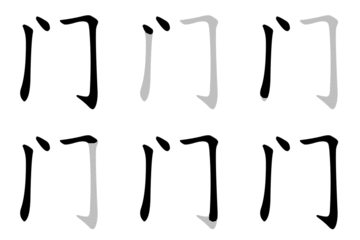 Simplified 门, PRC stroke order.

![Traditional 門, PRC stroke order.[7]](/wiki/File:%E9%96%80-aorder.gif)


General guidelines[edit]
 | This section contains instructions, advice, or how-to content. (February 2023) |
 |
Note: There are exceptions within and among different standards. The following are only guidelines.
1. Write from top to bottom, and left to right. 
As a general rule, strokes are written from top to bottom and left to right. For example, among the first characters usually learned is the number one, which is written with a single horizontal line: 一. This character has one stroke which is written from left to right.
The character for "two" has two strokes: 二. In this case, both are written from left to right, but the top stroke is written first. The character for "three" has three strokes: 三. Each stroke is written from left to right, starting with the uppermost stroke.

 , Mandarin Chinese: rén, Cantonese Chinese: yàhn, Korean: in, Japanese: hito, nin; jin). The character has two strokes, the first shown here in dark, and the second in red. The black area represents the starting position of the writing instrument.
This rule also applies to the order of components. For example, 校 can be divided into two. The entire left side (木) is written before the right side (交). There are some exceptions to this rule, mainly occurring when the right side of a character has a lower enclosure (see below).
When there are upper and lower components, the upper components are written first, then the lower components, as in 品 and 星.
2. Horizontal before vertical 
When horizontal and vertical strokes cross, horizontal strokes are usually written before vertical strokes: the character for "ten", 十, has two strokes. The horizontal stroke, 一, is written first, followed by the vertical stroke, to obtain 十.
Similarly, when a horizontal stroke is crossed by a right-to-left diagonal (丿), the horizontal stroke is written first, e.g., the first stroke of 大 is 一, followed by 丿.
In the Japanese standard, a vertical stroke may precede many intersecting horizontal strokes if the vertical stroke does not pass through the lowest horizontal stroke.
3. Character-spanning strokes last 
Vertical strokes that pass through many other strokes are written after the strokes through which they pass, as in 聿 and 弗.
Horizontal strokes that pass through many other strokes are written last, as in 毋 and 舟.
4. Diagonals right-to-left before diagonals left-to-right 
Right-to-left diagonals (丿) are written before left-to-right diagonals (乀), as in 文.
This is for symmetric diagonals; for asymmetric diagonals, as in 戈, the left-to-right may precede the right-to-left, based on other rules.
5. Center before outside in vertically symmetrical characters 
In vertically symmetrical characters, the center components are written before components on the left or right. Components on the left are written before components on the right, as in 兜 and 承.
6. Enclosures before contents 

Outside enclosing components are written before inside components; bottom strokes in the enclosure are written last if present, as in 日 and 口. (A common mnemonic is "Put people inside first, then close the door.") Enclosures may also have no bottom stroke, as in 同 and 月.
7. Left vertical before enclosing 
Left vertical strokes are written before enclosing strokes. In the following two examples, the leftmost vertical stroke (|) is written first, followed by the uppermost and rightmost lines (┐) (which are written as one stroke): 日 and 口.
8. Bottom enclosures last 
Bottom enclosing components are usually written last: 道, 建, 凶.
9. Dots and minor strokes last 
Minor strokes are usually written last, as the small "dot" in the following: 玉, 求, 朮.
10. Vertical before diagonal lower-left-to-right 软,特
A vertical is written before a crossing diagonal lower-left-to-right stroke (㇀, ti), such as: 软, 特, 打.
Representations[edit]
There are various ways to describe the stroke order of a character. Children learn the stroke order in courses, as part of writing learning. Various graphical representations are possible, most notably successive images of the character with one more stroke added (or changing color) each time, numbering strokes, color-coding, fanning,[8] and more recently animations. Stroke order is often described in person by writing characters on paper or in the air.
See also[edit]

- Stroke number
- Chinese character
- Chinese characters description languages
- Chinese character strokes
- CJK strokes
- Horizontal and vertical writing in East Asian scripts
- Radical (Chinese character)
- Stroke orders of the commonly used standard Chinese characters
Notes[edit]
- ^ a b Keightley 1978
- ^ Fazzioli 1987, p. 13"And so the first Chinese dictionary was born, the Sān Chāng, containing 3,300 characters"
- ^ Kangxi 1716, p. 41 See by example the radicals 卩, 厂 or 广. The 2007 common shape for those characters do not allow clearly to "guess" the stroke order, but old versions, visible on the Kangxi Zidian p.41 clearly allow us to guess the stroke order.
- ^ "香港小學學習字詞表". www.edbchinese.hk. Retrieved April 19, 2018.
- ^ "常用國字標準字體筆順學習網". stroke-order.learningweb.moe.edu.tw. Retrieved April 19, 2018.
- ^ kakijun. "漢字の正しい書き順(筆順)". 漢字の正しい書き順(筆順). Retrieved April 19, 2018.
- ^ "Stroking Characters - Wenlin Guide". guide.wenlininstitute.org. Retrieved March 8, 2022.
- ^ "Stroke Fanning". Lri.fr. Archived from the original on January 18, 2017. Retrieved January 16, 2017.
References[edit]
- Traditional stroke order
- 田蘊章 (2004), 歐楷解析, 天津: 天津人民美術出版社, ISBN 7-5305-2587-5
- 田其湜 (2004), 六体书法大字典, 湖南人民出版社, ISBN 7-5438-3668-8
- ROC stroke order
- Li, Xian (李鍌); et al. (教育部國語推行委員會) (1995), 常用國字標準字體筆順手冊 [Manual of standard shapes and stroke orders of commonly used characters], Taiwan Ministry of Education, ISBN 957-00-7082-X (Authoritative)
- PRC stroke order
- PRC, National Language Commission (2021). 通用规范汉字笔顺规范 (Stroke Orders of the Commonly-used Standard Chinese Characters) (in Chinese). Beijing: the Commercial Press. ISBN 978-7-100-19347-4.
- 国家语言文字工作委员会标准化工作委员会 (1997), 现代汉语通用字笔顺规范 [Modern Chinese commonly used characters standard stroke orders], Beijing: 语文出版社 (Language and Literature Press), p. 453, ISBN 7-80126-201-8, retrieved May 18, 2022 (Authoritative)
- Japanese
- Hitsujun shidō no tebiki 筆順指導の手びき, 1958 (Authoritative from 1958 to 1977).
- Hadamitzky, Wolfgang & Mark Spahn. A Handbook of the Japanese Writing System. Charles E. Tuttle Co. ISBN 0-8048-2077-5.
- Henshall, Kenneth G. A Guide to Remembering Japanese Characters. Charles E. Tuttle Co. ISBN 0-8048-2038-4.
- O'Neill, P.G. Essential Kanji: 2,000 Basic Japanese Characters Systematically Arranged for Learning and Reference. Weatherhill. ISBN 0-8348-0222-8.
- Pye, Michael (May 7, 1984), The Study of Kanji: A Handbook of Japanese Characters, Hokuseido Press, ISBN 0-89346-232-2
- Includes a translation of the Japanese Ministry of Education rules on Kanji stroke order.
- Hong Kong
- 香港小學學習字詞表 [Hong Kong Chinese Lexical Lists for Primary Learning], Chinese Language Education Section, Curriculum Development Institute, Education Bureau, The Government of the Hong Kong Special Administrative Region. Online version available at http://www.edbchinese.hk/lexlist_ch/. (Print version is official curriculum supporting material.)
- Archaic characters
- Keightley, David N. (1978), Sources of Shang History: The Oracle-Bone Inscriptions of Bronze Age China, Berkeley: University of California Press, ISBN 0-520-02969-0
- Other issues
- Fazzioli, Edoardo (1987), Chinese calligraphy : from pictograph to ideogram : the history of 214 essential Chinese/Japanese characters, calligraphy by Rebecca Hon Ko, New York: Abbeville Press, ISBN 0-89659-774-1
- Kangxi (1716), Kangxi Zidian 康熙字典
External links[edit]
- PRC
- Animated stroke order, from the California State University, Long Beach
- LearnchineseOK.com Web resources, instructions and animations for Chinese character stroke order
- Animated stroke order for Chinese characters Stroke Order tool with option to see many characters' stroke order at once.
- ROC
- Learning Program for Stroke Order of Frequently Used Chinese Characters (常用國字標準字體筆順學習網) with animated stroke order, by the Ministry of Education, R.O.C. (Taiwan).
- Hong Kong
- 中英對照香港學校中文學習基礎字詞 - Lexical Items with English Explanations for Fundamental Chinese Learning in Hong Kong Schools, by the Hong Kong Education Bureau
- 香港標準字形及筆順 - stroke orders following the Hong Kong Education Bureau's List of Commonly Used Characters
- Japanese
- Kanji Stroke Order, from the Engineering Department of New Mexico Tech, Socorro.
- Kanji alive, a free web application for learning Japanese kanji with stroke order animations.
- SODER Project, 1,513 Japanese kanji stroke order diagrams and animations, freely downloadable under license.
- Kakijun Kanji stroke order animations.(in Japanese)
- Kanji stroke order font, Japanese kanji stroke order diagrams presented as a TrueType font.
- Kanji Kakijun navi Japanese kanji stroke order.
- Korean
- 한자사전(漢字辭典) with stroke order diagrams (in Korean)

| Major groups | |||||||||
|---|---|---|---|---|---|---|---|---|---|
| Standard forms | |||||||||
| Phonology | |||||||||
| Grammar | |||||||||
| Idioms | |||||||||
| Input | |||||||||
| History | |||||||||
| Literary forms |
| ||||||||
| Scripts |
| ||||||||
