


Yuzhno-Sakhalinsk
Yuzhno-Sakhalinsk
Южно-Сахалинск | |
|---|---|
 Top: Cathedral of the Nativity of Christ, Gorny Vozduh Resort Cablecar, Center: Sakhalin Regional Museum, Bottom: Yuzhino-Sakhalinsk Gagarin Park, Anton Chekhov Museum and monument (all of item from left to right) | |
.svg) Flag  Coat of arms | |
Location of Yuzhno-Sakhalinsk  | |
  Yuzhno-Sakhalinsk Location of Yuzhno-Sakhalinsk  Yuzhno-Sakhalinsk Yuzhno-Sakhalinsk (Sakhalin Oblast) | |
| Coordinates: 46°58′N 142°44′E / 46.967°N 142.733°E | |
| Country | Russia |
| Federal subject | Sakhalin Oblast[1] |
| Founded | 1882 |
| City status since | 1905[2] |
| Government | |
| • Head | Sergey Nadsadin[3] |
| Area | |
| • Total | 164.7 km2 (63.6 sq mi) |
| Elevation | 50 m (160 ft) |
| Population | |
| • Total | 181,728 |
| • Estimate (2018)[5] | 198,973 (+9.5%) |
| • Rank | 99th in 2010 |
| • Density | 1,100/km2 (2,900/sq mi) |
| • Subordinated to | city of oblast significance of Yuzhno-Sakhalinsk[1] |
| • Capital of | Sakhalin Oblast,[1] city of oblast significance of Yuzhno-Sakhalinsk[1] |
| • Urban okrug | Yuzhno-Sakhalinsk Urban Okrug[6] |
| • Capital of | Yuzhno-Sakhalinsk Urban Okrug[6] |
| Time zone | UTC+11 (MSK+8  [7]) [7]) |
| Postal code(s)[8] | 693000 |
| Dialing code(s) | +7 4242; +7 424[9] |
| OKTMO ID | 64701000001 |
| Website | www |
Yuzhno-Sakhalinsk (Russian: Ю́жно-Сахали́нск, IPA: [ˈjuʐnə səxɐˈlʲinsk] ⓘ, lit. 'South Sakhalin city') is a city and the administrative center of Sakhalin Oblast, Russia. It is located on Sakhalin Island in the Russian Far East, north of Japan.[10] Gas and oil extraction as well as processing are amongst the main industries on the island. It was called Vladimirovka (Влади́мировка) from 1882 to 1905, then Toyohara (Japanese: 豊原市, Hepburn: Toyohara-shi) during its period of Imperial Japanese control from 1905 to 1946. As of the 2010 Census, its population was 181,728.[4]
History[edit]
Yuzhno-Sakhalinsk began as a small Russian settlement called Vladimirovka, founded by convicts in 1882.[2] The Treaty of Portsmouth in 1905, which brought an end to the Russo-Japanese War of 1904–1905, awarded the southern half of the Sakhalin Island to Japan. Vladimirovka was renamed Toyohara (meaning "bountiful plain"), and was the prefect capital of the Japanese Karafuto Prefecture.[11]
During the Soviet–Japanese War within World War II, the city was captured by Soviet troops. Ownership of the city was transferred to the Soviet Union and it was renamed Yuzhno-Sakhalinsk. Town status was granted to it in 1946.[2]
-
 Early days of Vladimirovka
 -
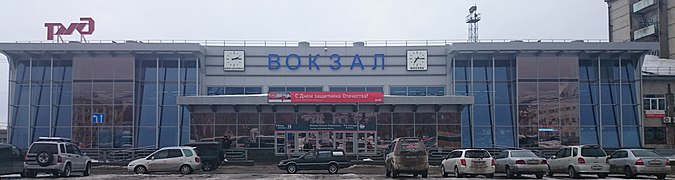
 This Japanese D51 steam locomotive stands outside the Yuzhno-Sakhalinsk Railway Station
 -
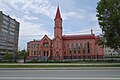 Catholic church in Yuzhno-Sakhalinsk


.JPG)
Administrative and municipal status[edit]
.svg)
Yuzhno-Sakhalinsk is the administrative center of the oblast.[1] Within the framework of administrative divisions, it is, together with ten rural localities, incorporated as the city of oblast significance of Yuzhno-Sakhalinsk—an administrative unit with the status equal to that of the districts.[1] As a municipal division, the city of oblast significance of Yuzhno-Sakhalinsk is incorporated as Yuzhno-Sakhalinsk Urban Okrug.
Economy and infrastructure[edit]
Due to significant investment from oil companies like ExxonMobil and Shell, Yuzhno-Sakhalinsk has experienced substantial economic growth. Although this growth has primarily occurred in the northern part of the island, both companies maintain headquarters and residential complexes in the city of Yuzhno-Sakhalinsk itself. The demand for natural resources by the Japanese, Chinese, and South Koreans has ensured continued prosperity in the foreseeable future for the entire island.
There has been significant criticism, including from Presidential Envoy Kamil Iskhakov, that Sakhalin is not caring for its citizens. Despite sizable gas deposits and incoming investments from gas companies, the regional administration does not yet have plans for the installation of gas services on the island. However, several improvements in the city have been made in the past 10 years, and it continues to grow in various aspects every year. [citation needed]
One of the very few remaining Japanese buildings in Yuzhno-Sakhalinsk now functions as the local museum. The building was designed in the Emperor's Crown Style by Japanese architect Yoshio Kaizuka, and completed in 1937.[12]
-
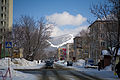 Central part of Yuzhno-Sakhalinsk
 -
 Yuzhno-Sakhalinsk museum during Japanese rule
 -
 Yuzhno-Sakhalinsk museum in 2012


Transportation[edit]
The city hosts the head office of Aurora Airline, subsidiary of Aeroflot. it is served by the Yuzhno-Sakhalinsk Airport. The city is also the hub for the island's narrow gauge railway network that underwent conversion to Russian broad gauge in August 2019.[13] In addition to railways, the town is also a hub for roadways, such as the A-391 (which travels south to Korsakov) and the A-392 (which travels west to Kholmsk).
Due to restrictions, foreigners wishing to leave Yuzhno-Sakhalinsk in order to travel to any other part of the Sakhalin Oblast and its internal and territorial waters are required to seek permission from the Federal Security Service (FSB) and the Border Guard. Scuba diving and recreating on the seacoast is permitted only in places defined by the Border Guard.[14]
-
-

-
 Airbus A319 of Aurora Airline
 -
 Toyohara Avenue


.JPG)
Education[edit]
Institutes of elementary and middle education include Sakhalin International School.
Institutes of higher education in the city include Sakhalin State University and Yuzhno-Sakhalinsk Institute of Economics, Law and Informatics. There are also some branches of other universities:
- Yuzhno-Sakhalinsk institute (branch) of Russian State trade-economics university
- Branch of Far East State university of railways
- Branch of Modern Academy of the humanities
- Branch of The Pacific State economics university
- Branch of Russian economics academy named after G.V. Plekhanov
- Branch of Far East law institute
Sport[edit]
There exist numerous sport venues and clubs in Sakhalin. FC Sakhalin Yuzhno-Sakhalinsk, PSK Sakhalin, Vostok-65, Sakhalin Sharks, Sakhalin for football,[15] hockey, basketball,[16] youth hockey and volleyball[17] respectively. Mount Bolshevik provides the Gorny Vozdukh ("Mountain Air") ski resort which is qualified for international competitions.[18]
-
 PSK Sakhalin players in Crystal Ice Palace
 -
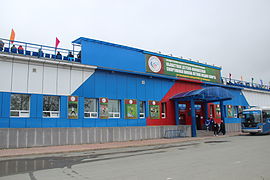 Spartak Stadium of FC Sakhalin Yuzhno-Sakhalinsk
 -
 Gorny Vozdukh ski resort
 -
 Ski lifts of Gorny Vozdukh ski resort
 -
 Arena City Ice Palace


Mass media[edit]
Television[edit]
- 3 - 1TV Russia
- 5 - Rossiya-24 (Russia-24)
- 10- Rossiya-1 (Russia-1)
- 12 - ASTV (Alternative Sakhalin Television)
- 21 - The first multiplex digital TV DVB T2
- 23 - Che
- 27 - Domashny / OTV (Sakhalin Regional Television)
- 30 - NTV Russia
- 33 - STS
- 35 - Ren-TV / Echo of Sakhalin
- 43 - Match TV Russia (ex. Russia-2)
- 46 - Petersburg–Channel 5
- 49 - Rossiya-K (Russia-K)
- 51 - The second multiplex of digital TV DVB T2
Radio[edit]
- 87,9 Autoradio (plan)
- 88,3 Retro FM
- 88,9 Radio Record
- 89,9 Russian Radio
- 101,7 Radio Chanson
- 102,5 Europa Plus
- 102,9 Humor FM
- 103,5 Mayak
- 104,4 Love Radio
- 105,1 Radio Dacha (plan)
- 105,5 Radio ASTV
- 106,0 Radio Rossii
- 106,5 Dorognoe Radio
- 107,2 Vesti FM
Demographics[edit]
| Year | Pop. | ±% |
|---|---|---|
| 1959 | 85,510 | — |
| 1970 | 105,840 | +23.8% |
| 1979 | 139,861 | +32.1% |
| 1989 | 159,299 | +13.9% |
| 2002 | 175,085 | +9.9% |
| 2010 | 181,728 | +3.8% |
| 2021 | 181,587 | −0.1% |
| Source: Census data | ||
Population[edit]
Most residents are ethnic Russians, but there also exists a sizable population of Korean Russians. Of the 43,000 Sakhalin Koreans, half are estimated to live in Yuzhno-Sakhalinsk, comprising roughly 12% of the city's population. Also smaller numbers of indigenous minorities, such as Ainu, Nivkhs and Oroks can be found.
Religion[edit]
The majority of the population are Russian Orthodox.
Geography[edit]
The city is located on the Susuya River. It is the largest city on the island, and the only one with more than 100,000 inhabitants. The straight-line distance to Moscow is 6,660 kilometers (4,140 mi).
Climate[edit]
The climate is humid continental (Köppen Dfb) with mild summers and cold winters. Maritime influences can be seen in that precipitation is much higher than in interior Russia and that summers are distinctly cooler than in Khabarovsk or Irkutsk, while winters are much milder. Summers are frequently foggy, reducing the amount of sunshine. Considering its southerly maritime position winters are very cold, albeit warmer than expected for surrounding inland areas affected by the Siberian High. Snowfall is more frequent than in those areas, due to said maritime influence bringing moisture to the coastline. Yuzhno-Sakhalinsk is relatively sunny compared to Hokkaido locations, but gloomy by the lower latitudes of the Russian Far East's standards.
| Climate data for Yuzhno-Sakhalinsk (1991–2020, extremes 1942–present) | |||||||||||||
|---|---|---|---|---|---|---|---|---|---|---|---|---|---|
| Month | Jan | Feb | Mar | Apr | May | Jun | Jul | Aug | Sep | Oct | Nov | Dec | Year |
| Record high °C (°F) | 4.3 (39.7) |
7.1 (44.8) |
13.0 (55.4) |
22.9 (73.2) |
29.6 (85.3) |
30.8 (87.4) |
34.4 (93.9) |
34.7 (94.5) |
29.0 (84.2) |
23.5 (74.3) |
18.1 (64.6) |
9.0 (48.2) |
34.7 (94.5) |
| Mean maximum °C (°F) | 0.8 (33.4) |
2.8 (37.0) |
6.8 (44.2) |
16.0 (60.8) |
23.7 (74.7) |
26.3 (79.3) |
28.0 (82.4) |
28.9 (84.0) |
25.9 (78.6) |
19.7 (67.5) |
12.4 (54.3) |
3.9 (39.0) |
29.8 (85.6) |
| Mean daily maximum °C (°F) | −6.0 (21.2) |
−4.8 (23.4) |
0.2 (32.4) |
6.9 (44.4) |
13.8 (56.8) |
17.7 (63.9) |
21.0 (69.8) |
22.3 (72.1) |
19.4 (66.9) |
12.5 (54.5) |
3.5 (38.3) |
−3.5 (25.7) |
8.6 (47.5) |
| Daily mean °C (°F) | −11.5 (11.3) |
−11.2 (11.8) |
−5.2 (22.6) |
1.7 (35.1) |
7.5 (45.5) |
11.9 (53.4) |
15.9 (60.6) |
17.3 (63.1) |
13.5 (56.3) |
6.7 (44.1) |
−1.2 (29.8) |
−8.5 (16.7) |
3.1 (37.6) |
| Mean daily minimum °C (°F) | −16.6 (2.1) |
−17.2 (1.0) |
−10.4 (13.3) |
−2.6 (27.3) |
2.7 (36.9) |
7.7 (45.9) |
12.3 (54.1) |
13.5 (56.3) |
8.7 (47.7) |
1.8 (35.2) |
−5.2 (22.6) |
−13.2 (8.2) |
−1.5 (29.3) |
| Mean minimum °C (°F) | −27.3 (−17.1) |
−27.3 (−17.1) |
−22.2 (−8.0) |
−10.4 (13.3) |
−2.6 (27.3) |
1.7 (35.1) |
6.6 (43.9) |
6.8 (44.2) |
0.6 (33.1) |
−5.3 (22.5) |
−14.8 (5.4) |
−22.5 (−8.5) |
−28.5 (−19.3) |
| Record low °C (°F) | −36.2 (−33.2) |
−34.8 (−30.6) |
−30.5 (−22.9) |
−19.5 (−3.1) |
−6.2 (20.8) |
−2.1 (28.2) |
1.3 (34.3) |
3.6 (38.5) |
−4.2 (24.4) |
−11.8 (10.8) |
−25.7 (−14.3) |
−33.5 (−28.3) |
−36.2 (−33.2) |
| Average precipitation mm (inches) | 56 (2.2) |
38 (1.5) |
52 (2.0) |
57 (2.2) |
66 (2.6) |
64 (2.5) |
92 (3.6) |
107 (4.2) |
102 (4.0) |
102 (4.0) |
75 (3.0) |
71 (2.8) |
882 (34.7) |
| Average rainy days | 0.3 | 0.4 | 2 | 10 | 17 | 17 | 20 | 19 | 19 | 19 | 9 | 2 | 135 |
| Average snowy days | 25 | 24 | 24 | 13 | 3 | 0.1 | 0 | 0 | 0 | 4 | 20 | 27 | 140 |
| Average relative humidity (%) | 81 | 79 | 76 | 75 | 76 | 83 | 85 | 86 | 83 | 79 | 80 | 82 | 80 |
| Average dew point °C (°F) | −15 (5) |
−14 (7) |
−9 (16) |
−2 (28) |
3 (37) |
9 (48) |
13 (55) |
15 (59) |
10 (50) |
3 (37) |
−4 (25) |
−11 (12) |
0 (32) |
| Mean monthly sunshine hours | 133.3 | 155.9 | 190.6 | 197.1 | 208.0 | 186.5 | 164.0 | 165.1 | 188.8 | 167.4 | 116.3 | 112.4 | 1,985.4 |
| Source 1: Pogoda.ru.net[19] | |||||||||||||
| Source 2: NOAA,[20] Time and Date (dewpoints 1985–2015)[21] Infoclimat [22] | |||||||||||||
Twin towns and sister cities[edit]
Yuzhno-Sakhalinsk is twinned with:


Notable people[edit]
- Natalya Pechonkina (maiden name Burda, later Chistyakova); born July 15, 1946, Yuzhno-Sakhalinsk) is a Soviet athlete. She competed for the USSR in the 1968 Summer Olympics held in Mexico City in the 400 metres where she won the bronze medal.
- Alexander Godunov; born November 28, 1949, died May 18, 1995, was a Russian-American ballet dancer and film actor.
References[edit]
Notes[edit]
- ^ a b c d e f g Law #25-ZO
- ^ a b c Южно-сахалинск - Исторический словарь - Словари и Энциклопедии
- ^ Сергей Надсадин вступил в должность мэра Южно-Сахалинска. astv.ru (in Russian).
- ^ a b Russian Federal State Statistics Service (2011). Всероссийская перепись населения 2010 года. Том 1 [2010 All-Russian Population Census, vol. 1]. Всероссийская перепись населения 2010 года [2010 All-Russia Population Census] (in Russian). Federal State Statistics Service.
- ^ "26. Численность постоянного населения Российской Федерации по муниципальным образованиям на 1 января 2018 года". Federal State Statistics Service. Retrieved January 23, 2019.
- ^ a b Law #524
- ^ "Об исчислении времени". Официальный интернет-портал правовой информации (in Russian). June 3, 2011. Retrieved January 19, 2019.
- ^ Почта России. Информационно-вычислительный центр ОАСУ РПО. (Russian Post). Поиск объектов почтовой связи (Postal Objects Search) (in Russian)
- ^ Телефонные коды Сахалина - Dialing codes of Sakhalin (in Russian)
- ^ "Where is Yuzhno-Sakhalinsk, Russia?". WorldAtlas. Retrieved September 25, 2018.
- ^ Amano, Naoki. "Sakhalin/Karafuto". Oxford University Press. Retrieved May 11, 2024.
- ^ "Sakhalin Regional Museum".
- ^ "Российская колея по всему Сахалину: движение открыто".
- ^ Freedom of movement for foreigners on Sakhalin restricted
- ^ "О клубе".
- ^ "Суперлига. Сергей Гришаев назначен новым главным тренером "Сахалина"". January 27, 2017.
- ^ "Глава Сахалинской области просит допустить ВК "Сахалин" к участию в Суперлиге / Россия - Женская лига / VolleyballNews.ru: Все новости волейбола".
- ^ "Gorny Vozdukh (Mountain Air)".
- ^ "Weather and Climate-The Climate of Yuzhno-Sakhalinsk" (in Russian). Weather and Climate (Погода и климат). Retrieved November 3, 2021.
- ^ "Juzno–Sahalinsk (Yuzhno-Sakhalinsk) Climate Normals 1991–2020". National Oceanic and Atmospheric Administration. Retrieved November 3, 2021.
- ^ "Climate & Weather Averages in Yuzhno Sakhalinsk, Russia". Time and Date. Retrieved January 10, 2022.
- ^ "Climatologie de l'année à Yuzhno-Sakhalinsk" (in French). Infoclimat. Retrieved October 3, 2023.
- ^ Владивосток новости - РИА Дейта.RU. deita.ru (in Russian).
Sources[edit]
- Сахалинская областная Дума. Закон №25-ЗО от 23 марта 2011 г. «Об административно-территориальном устройстве Сахалинской области», в ред. Закона №62-ЗО от 27 июня 2013 г. «О внесении изменения в статью 10 Закона Сахалинской области "Об административно-территориальном устройстве Сахалинской области"». Вступил в силу 9 апреля 2011 г.. Опубликован: "Губернские ведомости", №55(3742), 29 марта 2011 г. (Sakhalin Oblast Duma. Law #25-ZO of March 23, 2011 On the Administrative-Territorial Structure of Sakhalin Oblast, as amended by the Law #62-ZO of June 27, 2013 On Amending Article 10 of the Law of Sakhalin Oblast "On the Administrative-Territorial Structure of Sakhalin Oblast". Effective as of April 9, 2011.).
- Сахалинская областная Дума. Закон №524 от 21 июля 2004 г. «О границах и статусе муниципальных образований в Сахалинской области», в ред. Закона №45-ЗО от 27 мая 2013 г. «О внесении изменения в Закон Сахалинской области "О границах и статусе муниципальных образований в Сахалинской области"». Вступил в силу 1 января 2005 г. Опубликован: "Губернские ведомости", №175–176(2111–2112), 31 июля 2004 г. (Sakhalin Oblast Duma. Law #524 of July 21, 2004 On the Borders and Status of the Municipal Formations in Sakhalin Oblast, as amended by the Law #45-ZO of May 27, 2013 On Amending the Law of Sakhalin Oblast "On the Borders and Status of the Municipal Formations in Sakhalin Oblast". Effective as of January 1, 2005.).
External links[edit]

- Official website of Yuzhno-Sakhalinsk
- Yuzhno-Sakhalinsk: City's History in Architecture
- Yuzhno-Sakhalinsk Blizzard Photos[permanent dead link]
| International | |
|---|---|
| National | |
| Geographic | |